TheEduAssist Logo

TheEduAssist Editorial Team

Editorial Team

TheEduAssist Editorial Team manages content selection, research, and review to ensure practical and accurate guidance on learning strategy, instructional design, course development, LMS implementation, and enterprise learning. We combine subject-matter expertise with rigorous editorial standards to provide reliable insights for learning professionals.

Expertise

Learning Strategy Instructional Design Learning Technology

Articles by TheEduAssist Editorial Team

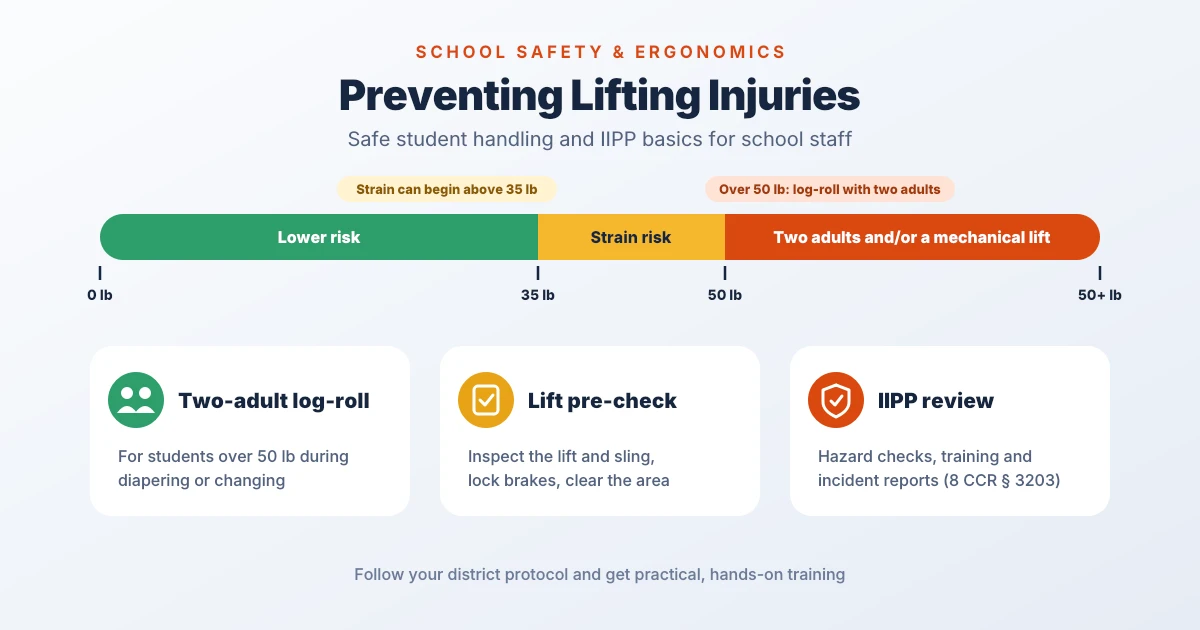
“Lifting risk gauge from 0 to over 50 pounds, marking strain risk above 35 pounds and two-adult or mechanical lift assistance above 50 pounds, with cards for the two-adult log-roll, lift pre-checks, and an Injury and Illness Prevention Program review.”

Ergonomics and Safety on the School Floor: Preventing 50+ lb Lifting Injuries and Cal/OSHA Violations

This article explores ergonomic risks faced by school staff and special education professionals when lifting, transferring, and repositioning students. It explains the importance of the two-adult log-roll method, mechanical Hoyer lift inspections, and safe student-handling procedures. It also discusses how schools can reduce workplace injuries, strengthen their Injury and Illness Prevention Programs (IIPPs), and monitor compliance with Cal/OSHA requirements through staff training, equipment inspections, and incident reporting.

• 4 min read
Read Article
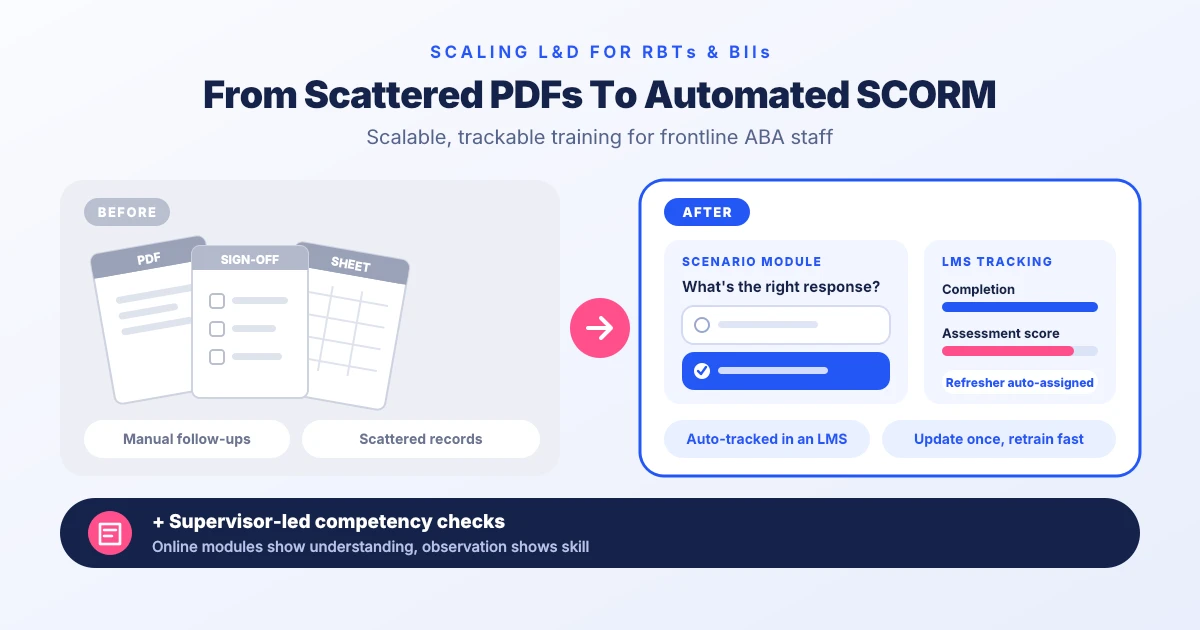
“Before and after comparison showing scattered PDFs, sign-off sheets, and spreadsheets replaced by a scenario-based SCORM module with automated LMS tracking, plus a bar noting supervisor-led competency checks for RBTs and BIIs.”

Scaling L&D for Frontline RBTs and BIIs: Moving Beyond Unscalable PDFs to Automated SCORM Compliance

This article explores the challenges ABA providers face when training frontline employees, including Registered Behavior Technicians (RBTs) and Behavior Interventionists (BIIs). It explains how SCORM-based compliance training can turn workplace policies and safety procedures into interactive learning modules, while compatible Learning Management Systems track employee progress, completion, and assessment scores. It also discusses combining digital training records with practical competency assessments, supervisor observations, and structured onboarding workflows to support consistent staff training across multiple locations.

• 4 min read
Read Article
Why high-ticket coaches and keynote speakers cannot afford DIY course builds

Why High-Ticket Coaches and Speakers Cannot Afford DIY Course Builds [2027 Blueprint]

This authoritative guide breaks down the reputation risk high-ticket coaches and keynote speakers face with DIY or cheap freelance course builds. It covers the 5% completion curse, instructional scaffolding, client knowledge bases, 360 diagnostic tooling, and turnkey academy architecture.

• 7 min read
Read Article
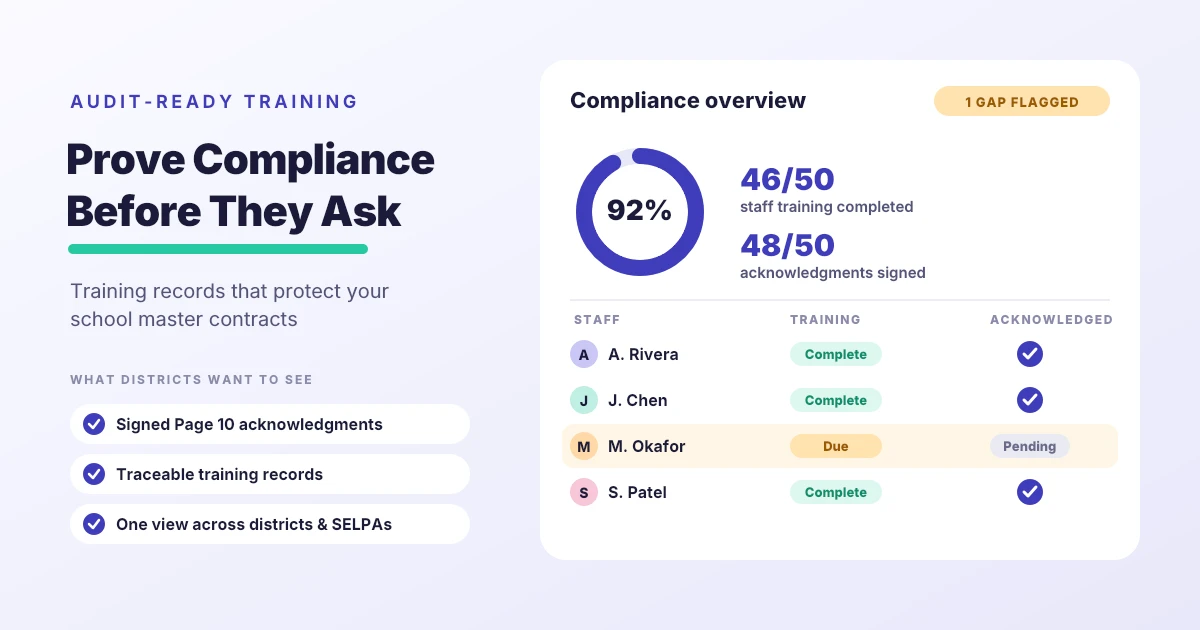
“Compliance dashboard mockup showing a 92 percent completion ring, staff training and signed acknowledgment counts, and a staff table with one flagged gap, illustrating auditable training records for school district master contracts.”

Protecting Your Revenue and School Partnerships: How Auditable Protocol Training Secures Master Contracts

This article explains how auditable staff training and provider acknowledgments help contracted agencies demonstrate compliance with school district requirements. It explores the importance of Page 10 acknowledgments, digital recordkeeping, traceable training completion, and verifiable staff responsibilities. It also outlines how executive leaders can monitor compliance across multiple K–12 and SELPA partnerships, identify documentation gaps, and maintain records that support contract requirements and stronger district relationships.

• 4 min read
Read Article
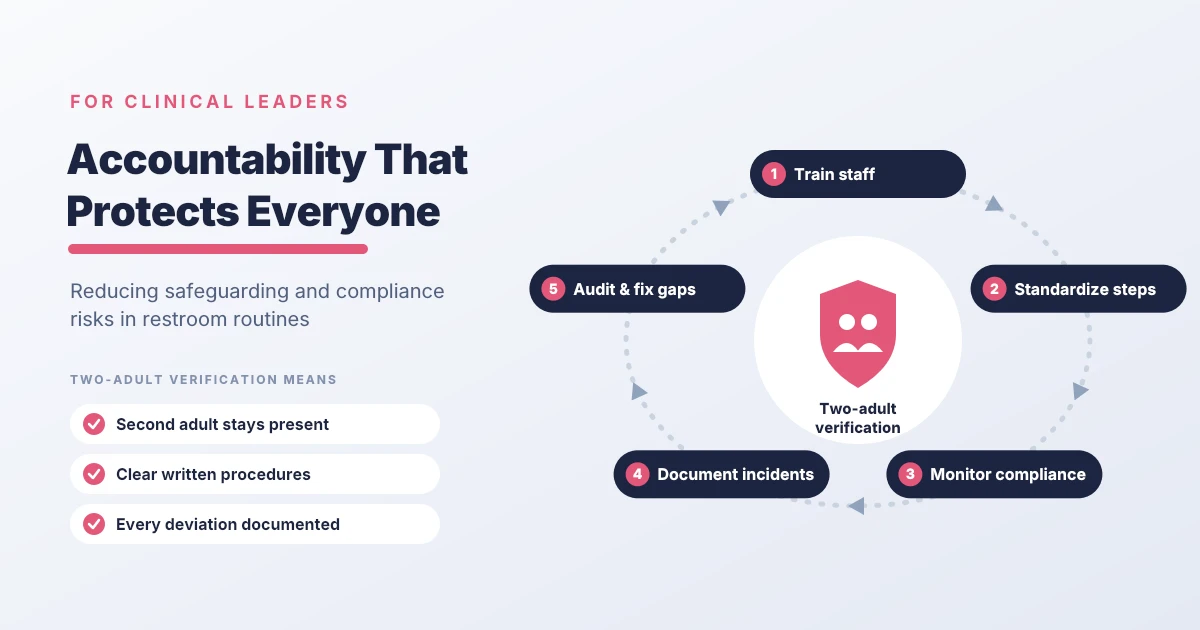
Cycle diagram around a shield labeled two-adult verification, showing five steps for clinical leaders: train staff, standardize steps, monitor compliance, document incidents, and audit and fix gaps.

Mitigating Legal & Compliance Risks for Clinical Leaders: The Hidden Dangers of Unwitnessed Restroom Interventions

This article examines the safety and compliance concerns associated with single-staff restroom interventions involving students who require toileting or diapering support. It explains the importance of two-adult supervision, witness and chaperone responsibilities, appropriate student handling, and consistent documentation. It also outlines how clinical leaders can establish standardized restroom procedures, train staff, audit practices, and address compliance gaps to strengthen student safeguarding and organizational accountability.

• 4 min read
Read Article
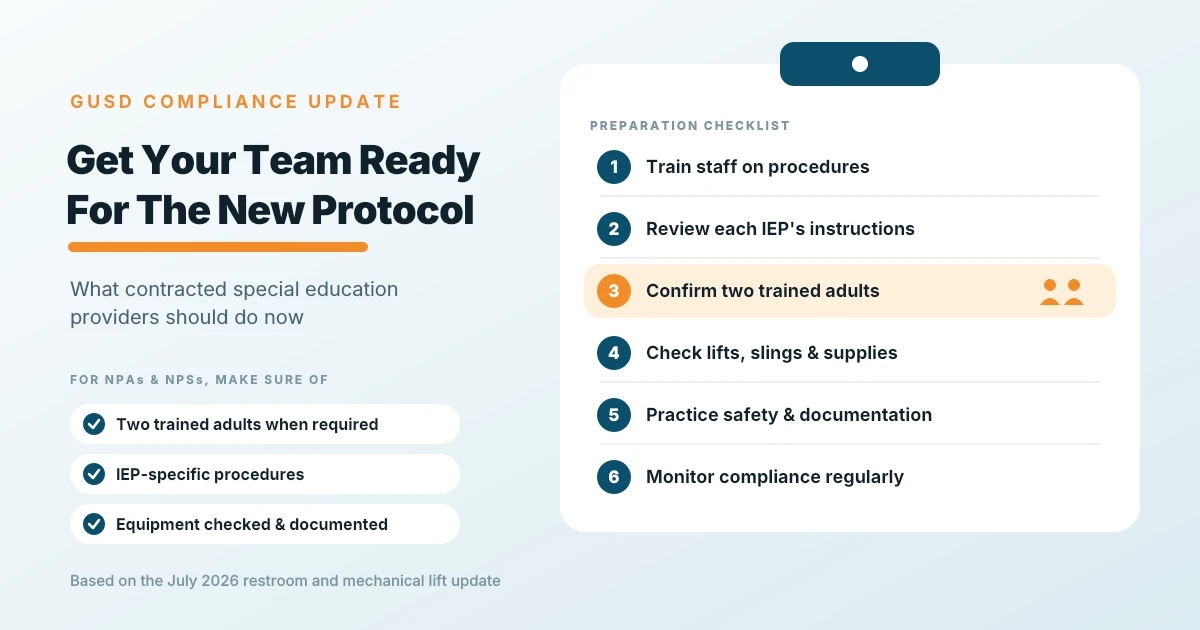
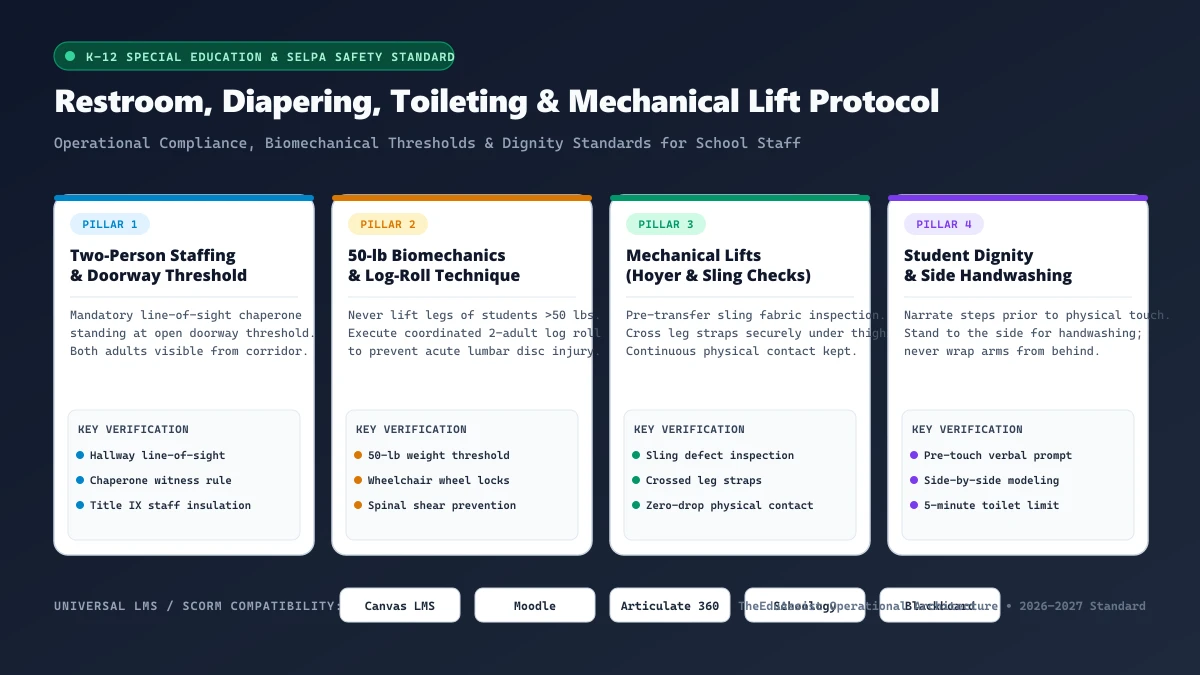
“Clipboard-style preparation checklist for contracted special education providers with six steps: train staff, review IEP instructions, confirm two trained adults, check lifts and supplies, practice safety and documentation, and monitor compliance.”

Mastering the GUSD Restroom Protocol: Why Contracted Special Education Staff Must Pivot Now

This guide explains Glendale Unified School District’s updated restroom and mechanical lift procedures for contracted special education staff. It covers two-adult assistance, safe transfers, diapering and hygiene practices, student supervision, mechanical lift safety, and documentation. It also outlines how Nonpublic Agencies (NPAs) and Nonpublic Schools (NPSs) can train staff, review student IEPs, prepare equipment, and address compliance gaps to maintain safe and consistent student support.

• 5 min read
Read Article
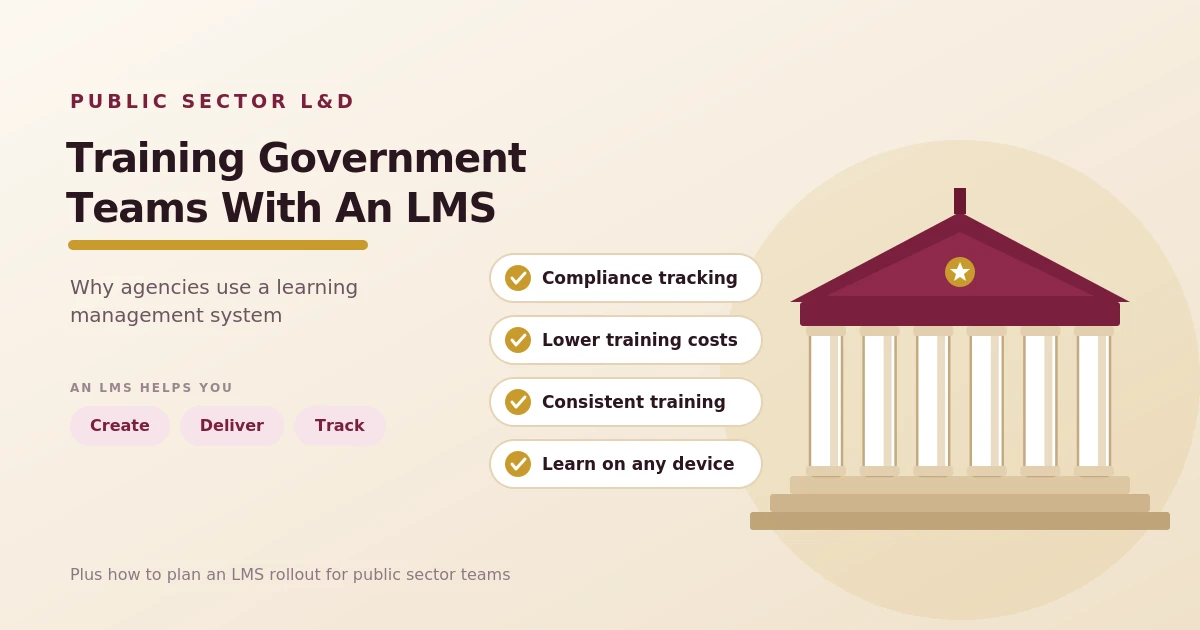
UK local council and Australian municipal contractor safety compliance and site verification policy guide

UK Local Council & Australian Local Government Municipal Training Policy Guide (CDM & WHS)

Local councils in the United Kingdom and local government authorities in Australia carry strict non-delegable safety and statutory duties across internal highways, parks, and housing workforces as well as external tier-one contractors. UK councils operate under the Health and Safety at Work etc. Act 1974, CDM Regulations 2015, Public Sector Equality Duty, and Worker Protection Act 2024, while Australian councils operate under Model WHS Act Section 19 primary duties and Section 46 overlapping PCBU consultation mandates.

• 3 min read
Read Article
US city and county public works OSHA and ADA Title II compliance training policy dashboard

US Municipal & County Public Works Compliance Training Policy: OSHA, DOT & ADA Title II

United States municipalities, county governments, and public utilities face strict compliance audits across OSHA 29 CFR 1910 and 1926 public works regulations, DOT municipal fleet mandates, and the Department of Justice ADA Title II digital accessibility rule (with major compliance deadlines across 2026 and 2027). Automated SCORM training pipelines verify confined space, excavation, lockout/tagout, and accessibility competencies across civil employees and external contractors.

• 3 min read
Read Article
Canadian municipal public works inspector verifying contractor safety training orientation using offline QR SitePass

Canadian Municipal Contractor & Public Works Mandatory Training Policy Matrix (2026 to 2027)

Canadian municipalities, water treatment authorities, and regional districts enforce strict prime contractor and owner orientation policies before visiting contractors enter public works yards or civil jobsites. Provincial statutory requirements span Alberta OHS Act Section 10 and POPA, British Columbia WorkSafeBC Part 2 and BC FIPPA, Ontario OHSA Constructor duties and AODA, and Québec CNESST CSTC and Law 25, all verified through domestic Canadian cloud LMS infrastructure and offline QR credentials.

• 3 min read
Read Article
UAE and GCC school inclusive education Learning Support Assistant training policy aligned with KHDA and ADEK inspections

UAE & GCC Inclusive Education Training Policy: KHDA, ADEK & Learning Support Assistants (LSAs)

International and private school groups in the United Arab Emirates and wider GCC must meet strict inclusion inspection standards under Dubai's KHDA Inclusive Education Policy Framework, Abu Dhabi's ADEK People of Determination policies, and UAE Federal Law No. 29 of 2006. Effective Learning Support Assistant (LSA) training combines bilingual Arabic/English SCORM modules covering Individualized Education Plans (IEPs), safeguarding, and dignity-focused personal care.

• 3 min read
Read Article
Australian school Education Support Officer training policy aligned with Disability Standards for Education 2005 and Model WHS Act

Australia Special Education & ESO Training Policy: Disability Standards (DSE 2005) & WHS Compliance

Australian schools, independent school networks, and state education systems governing Education Support Officers (ESOs) and Teacher Aides must align staff onboarding with the federal Disability Standards for Education 2005 (DSE), the Disability Discrimination Act 1992, the Model Work Health and Safety (WHS) Act 2011, and state Child Safe Standards, requiring verifiable training on reasonable adjustments, personal care dignity, and mechanical hoist transfers.

• 3 min read
Read Article
UK local authority and Multi-Academy Trust SEND Teaching Assistant compliance policy framework

UK SEND Code of Practice & KCSIE Training Policy for Teaching Assistants and Special Schools

United Kingdom local authorities, Multi-Academy Trusts (MATs), and specialist SEN schools must satisfy statutory staff training requirements spanning the SEND Code of Practice (0 to 25 years), Keeping Children Safe in Education (KCSIE), the Equality Act 2010, the Manual Handling Operations Regulations 1992 (MHOR), and school Intimate Care Policies, verified through timestamped SCORM completion logs ready for Ofsted inspections.

• 4 min read
Read Article

Complete Editorial Archive (517 Additional Guides)

Not sure which article applies to your course or LMS?

Share your course, Kajabi setup, LMS, training content, or platform question. TheEduAssist will review your setup within 24–48 hours and suggest the next best step.