Generate Self-Help eLearning Course That Sells in 2026: Ultimate Guide for Victoria Coaches
Learn how Victoria coaches can create and launch profitable self-help eLearning courses in 2026 using proven instructional design, engaging content strategies, and marketing tactics tailored for the Australian market.
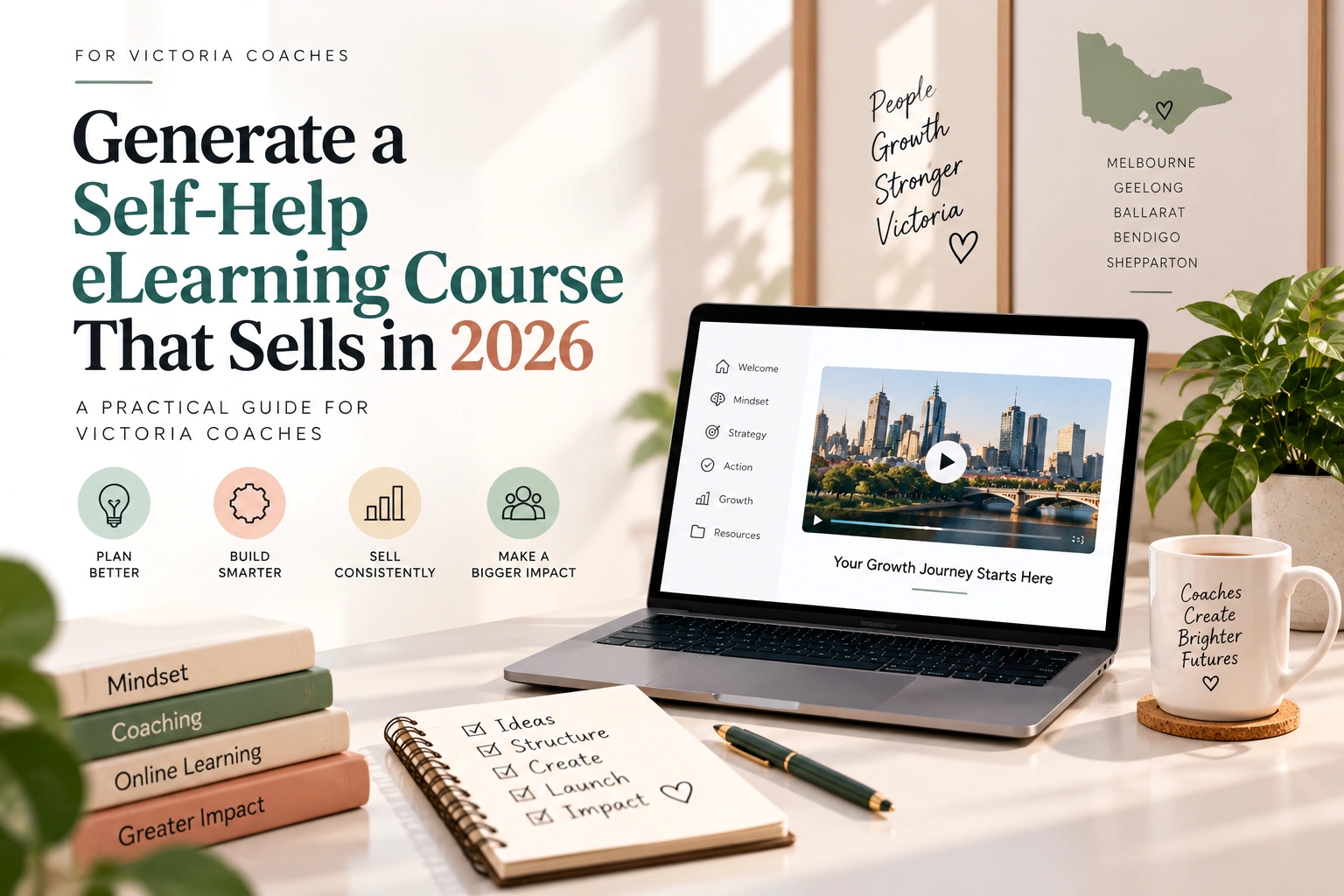
Table of Contents ▼
Quick Answer
This guide explains how coaching businesses in Victoria can create self-help eLearning courses that focus on transformation rather than simply delivering content. It covers instructional design, learner engagement, course structure, learning assets, platform selection, marketing alignment, and common course creation mistakes.
Key Takeaways
- Focus on transformation, not just content: Define what learners should achieve and build the course around that outcome.
- Use instructional design and engagement: Combine structured modules with exercises, applications, reflection, and measurable progress.
- 1. Align learning with business goals: Your course structure, learner experience, platform, and marketing promise should work together.
Many coaching businesses in Victoria, whether in Melbourne, Geelong, Ballarat, Bendigo, or Shepparton, have powerful transformation stories, proven frameworks, and meaningful missions. Yet, when it comes to turning that into a profitable online course, most struggle with one core issue: They try to “create content” instead of building a structured, outcome-driven learning experience.
The result?
- Courses that feel scattered
- Low completion rates
- Weak student transformation
- Poor sales despite strong messaging
In 2026, self-help eLearning is no longer about inspiration; it’s about transformation backed by structure, psychology, and execution.
Why Most Self-Help eLearning Courses Fail (Even With Great Content)
Let’s break down the real gaps:
- No Clear Transformation Path: Most creators focus on what they want to teach, not what the learner must achieve.
- Weak Instructional Design: Without proper instructional design, even the best ideas become overwhelming or unclear.
- Lack of Engagement Systems: Courses often miss:
Reflection exercises
Action-based tasks
Real-life application
What Actually Works in 2026: The New Standard for Self-Help eLearning
Modern self-help courses must combine:
- Psychology + Structure (Instructional Design)
- Storytelling + Systems
- Motivation + Measurable Outcomes
This is especially important for coaching businesses in Victoria, where competition is rising in:
- Life coaching
- Business coaching
- Mindset and resilience programs
How do I sell my learning on self empowerment byu/Sheenpipin inHowToEntrepreneur
Step-by-Step Framework for Building a Self-Help Course That Sells:
Step 1: Define the Transformation (Not Just Content)
Instead of: “Teach mindset and resilience”
Define: “Help learners move from burnout to structured daily performance in 6 weeks”
This becomes your:
- Core promise
- Marketing message
- Course structure foundation
Step 2: Use Instructional Design to Structure the Journey
Break your program into a clear Module Flow:
- Awareness (Where am I now?)
- Belief Reset (Mindset shift)
- Strategy (Tools and frameworks)
- Application (Real-world exercises)
- Optimization (Feedback and iteration)
- Transformation (Sustained habits)
This aligns with adult learning (andragogy) — people learn best when content is:
- Relevant
- Practical
- Immediately usable
Step 3: Turn Ideas Into Engaging Learning Assets
From your raw ideas, create:
- Video lessons (clear, focused, 5–15 min segments)
- Worksheets (reflection + action)
- Checklists (implementation clarity)
- Quizzes (reinforce learning)
This is where most creators fail — they skip the content development layer.
Step 4: Design for Real Transformation (Not Just Consumption)
Ask this for every lesson: “What will the learner DO after this?”
Add:
- Scenario-based exercises
- Real-life applications
- Personal reflection prompts
This is what turns a course into a premium experience.
Step 5: Choose the Right Platform for Delivery
Popular platforms for Victoria-based coaching businesses:
- Kajabi
- Thinkific
- Teachable
Focus on:
- Clean user experience
- Easy navigation
- Progress tracking
- Mobile-friendly learning
Avoid overcomplicating tech because learning experience matters more than features.
Step 6: Align Course Design With Marketing
Your course should match your positioning.
If your brand promises:
- Transformation
- Real results
- Practical frameworks
Your course must deliver:
- Structured modules
- Clear outcomes
- Measurable progress
This alignment is what makes a course sell consistently.
Why Coaching Businesses in Victoria Have a Unique Advantage:
Victoria’s coaching ecosystem is strong due to:
- Diverse audience (urban + regional markets)
- High demand for personal growth programs
- Growing acceptance of digital learning
Cities like Melbourne, Geelong, Ballarat, Bendigo, and Shepparton are seeing increasing demand for:
- Flexible online learning
- Hybrid coaching programs
- Scalable digital products
This makes 2026 the perfect time to build a self-help eLearning course that scales beyond local clients.
The Real Opportunity: From Course Creator to Impact Builder
This isn’t just about selling a course.
It’s about:
- Building a scalable transformation system
- Creating long-term intellectual property
- Expanding beyond 1:1 coaching
- Reaching global audiences
The biggest shift? Stop thinking like a freelancer delivering content. Start thinking like a partner building a learning experience that transforms lives.
Common Mistakes to Avoid:
- Creating long, unstructured videos
- Ignoring learner engagement
- Skipping instructional design
- Overloading with theory
- Underestimating user experience
Final Takeaway:
If you want to create a self-help eLearning course that sells in 2026, focus on:
- Transformation, not just information
- Structure, not just inspiration
- Experience, not just delivery
For coaching businesses in Victoria, the opportunity is massive. But only for those who treat course creation as a strategic business asset, not just content.
Authored by: Sofia Arif
Sources & References
- How to Create, Market, and Sell a Profitable Online Course
- 15 Ways 100 Self-Help Gurus Deliver Value and Make Money
- Instructional Design in Action: Practical Solutions for Learner Problems
- e-Learning Videos for Students and Teachers Who Actually Love
- How to Create Engaging Educational Content for Online Platform 2026
Frequently Asked Questions
QHow long should a self-help eLearning course be?
Ideally 4–8 weeks with structured modules and clear outcomes.
QHow do I ensure my course sells?
Align your course structure with your marketing promise and learner outcomes.
QCan I create a course without video?
Yes, but video significantly improves engagement and perceived value.
QWhich platform is best for beginners?
Kajabi and Thinkific are popular for ease of use and scalability.
QDo I need instructional design for a small course?
Yes. Even short courses benefit from proper structure and flow.