How to Boost Employee Training With the Right LMS Technology
Discover how the right LMS technology can make employee training more flexible, engaging, measurable, and easier to manage.
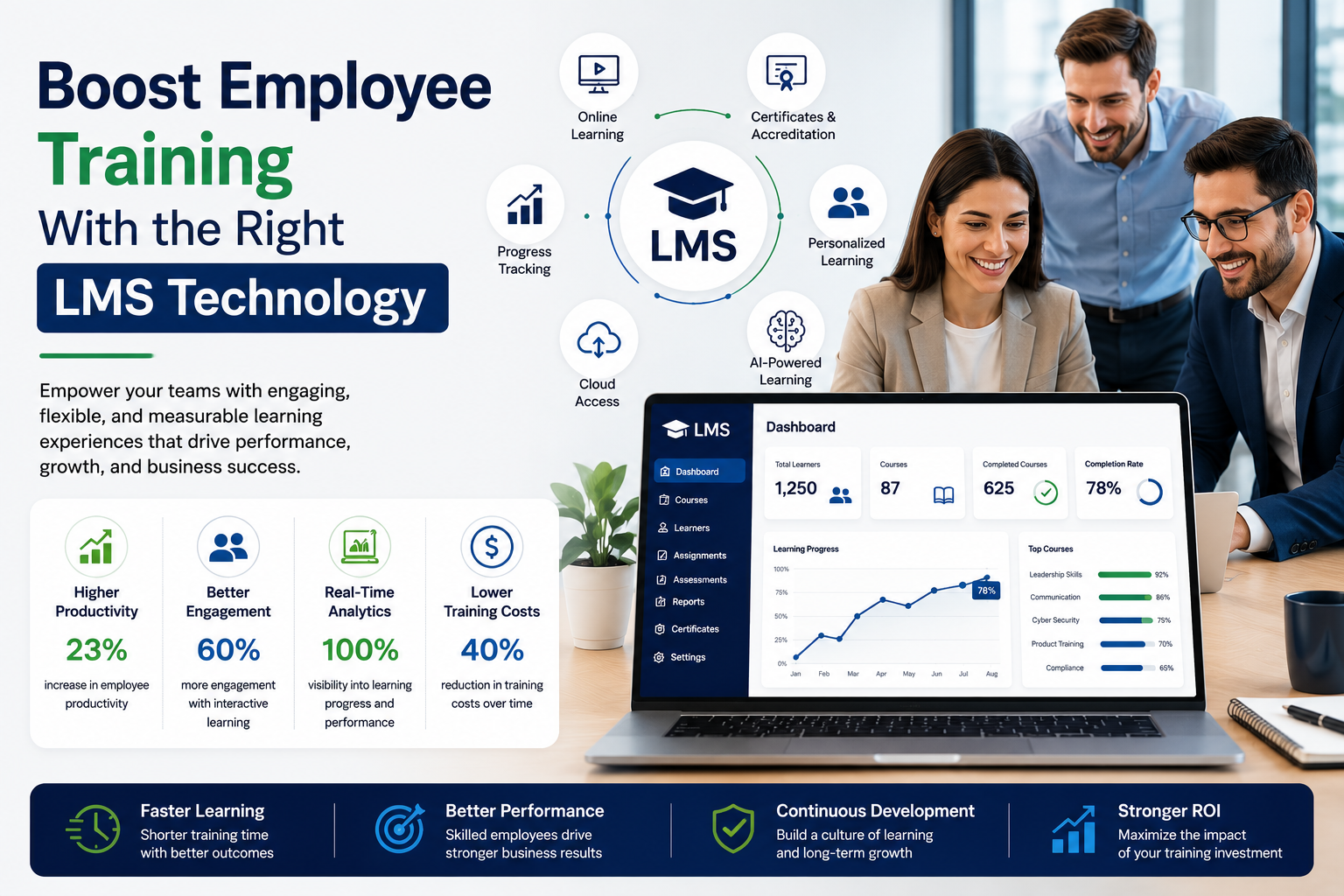
Table of Contents ▼
Quick Answer
The right LMS technology can make employee training more flexible, engaging, and easier to measure. Learn how LMS features can improve learning, streamline training, and support employee performance.
Key Takeaways
- Flexible Learning
- Employee Engagement
- Personalized Training
- Real-Time Analytics
- Training Efficiency
Employee training should build skills, not create extra frustration. Yet many businesses still rely on outdated training methods that take time and are difficult to track. The right Learning Management System (LMS) can make training more flexible, engaging, and easier to measure.
With the right LMS, employees can learn at their own pace while managers can track progress and identify areas for improvement. This makes workplace training more effective and supports better business performance.
Why Employee Training Matters More Than Ever
The workplace is changing fast. Employees need to keep up with new technology, customer expectations, and changing job requirements. If skills are not used continuously, then they can become out of date, confidence will drop, and performance will suffer.
Continuous learning prepares staff for change and helps businesses remain competitive. When businesses invest in employee development, they can see benefits such as:
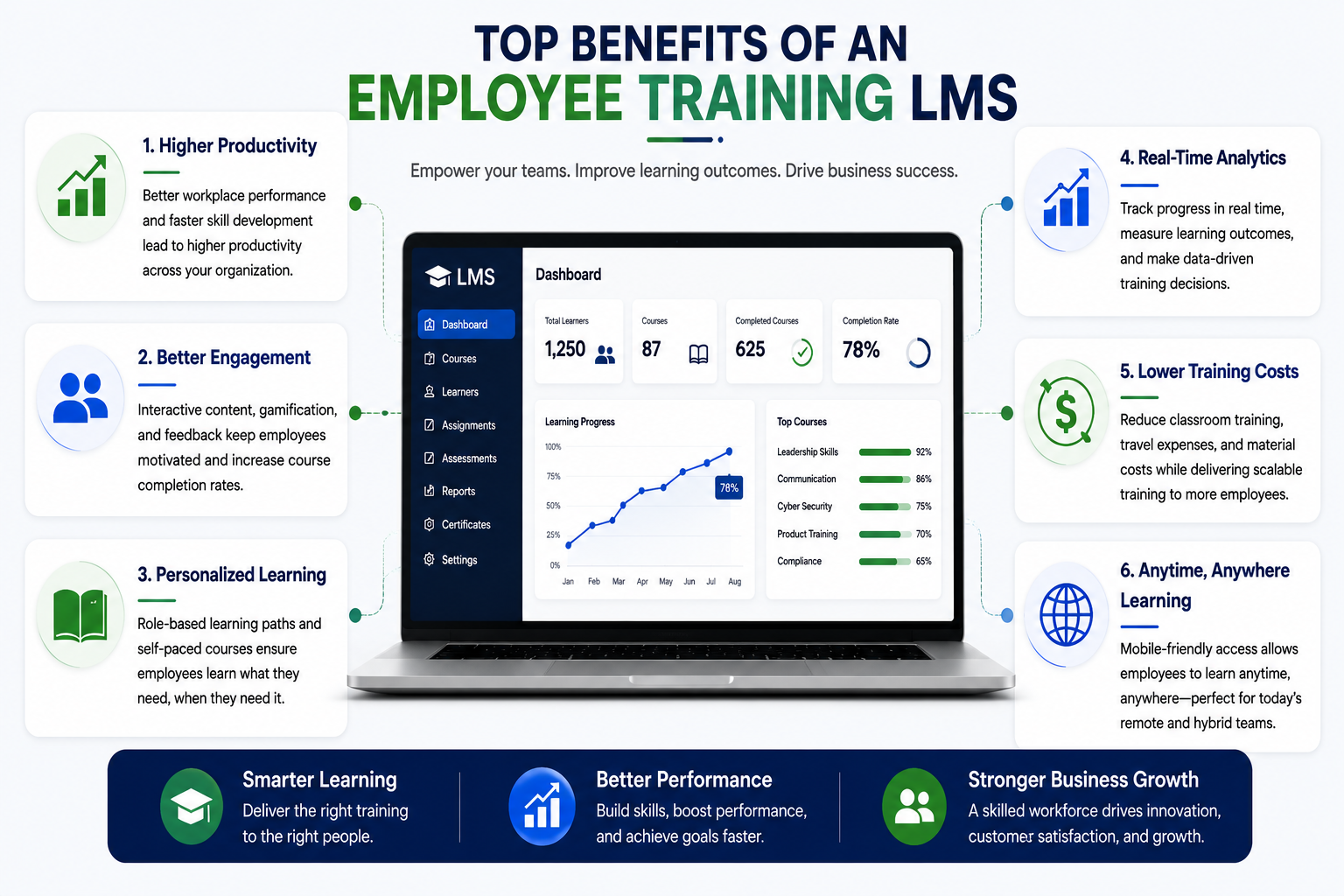
- Higher productivity
- Better employee retention
- Improved customer satisfaction
- Greater workplace confidence
- Faster business growth
Training is also a key element for long-term success. Professional workers can find solutions more quickly, make better choices, and give innovative suggestions. All organizations have the advantage of qualified workers. Therefore, training employees is a wise investment for long-term development.
What Is an Employee Training LMS?
An employee training LMS is a learning platform that helps businesses create, deliver, and manage workplace training in one place. Employees can access courses from a laptop, tablet, or smartphone. Managers can assign training, monitor progress, and keep learning records without relying on spreadsheets or manual paperwork.
Courses are assigned, progress is monitored, and training is organised easily and with minimal manual effort from managers. The system also securely records learning in a single location. This keeps the training data organized and readily accessible.
The majority of Learning Management Systems have a range of features including:
- Interactive video lessons
- Online assessments
- Personalized learning paths
- Completion certificates
- Mobile learning
- Gamification
- Progress tracking
- Advanced analytics
These tools make training management easier and make the training more interesting.
Why Traditional Training No Longer Meets Business Needs
The traditional training still has value. In many cases, however, it falls short of how required by today’s work environment. Classroom sessions require careful scheduling and remove staff from their everyday duties.
The information in printable materials is often outdated, and the information provided may vary from instructor to instructor. All of these difficulties add to the cost of training and decrease its effectiveness. Employee Training LMS is an answer to ensure uniformity of training for all employees.
Training can be provided as per requirement. Managers don’t have to rely on paperwork or manual tracking to monitor progress. This helps to improve learning results and productivity. This also saves time on manual operations.
| Feature | Traditional Training | Employee Training LMS |
|---|---|---|
| Learning Location | Classroom only | Learn anytime, anywhere |
| Flexibility | Fixed schedules | Self-paced learning |
| Progress Tracking | Manual records | Automated tracking |
| Training Materials | Printed documents | Digital courses |
| Employee Engagement | Limited | Interactive learning |
| Scalability | Difficult | Easily scalable |
| Reporting | Basic | Real-time analytics |
| Long-Term Cost | Higher | More cost-effective |
How the Right LMS Technology Improves Employee Training
Your selection of the best LMS isn’t just about providing online instruction. It offers fun learning opportunities and enhances capabilities, while enabling long-term business success.****
1. Makes Learning More Flexible
Employees don’t always have time to attend training at a fixed place and time. An LMS lets them access training when it fits their schedule.
This is especially useful for remote and hybrid teams. Employees can build new skills without stepping away from their daily responsibilities for long periods.
2. Increases Employee Engagement
Training is easier to remember when employees actively participate. Modern LMS platforms can make learning more engaging through interactive videos, short quizzes, gamification, discussion forums, badges, and certificates.
These features give employees more ways to interact with the content. As a result, training feels less like a task and more like an active learning experience.
3. Delivers Personalized Learning
Employees have different roles, experience levels, and learning needs. A modern LMS can support personalized learning paths based on these differences.
For example, a new employee may need onboarding content, while a manager may need leadership training. Giving employees relevant training helps them focus on skills they actually need.
4. Tracks Learning Progress in Real Time
Training is difficult to improve when managers cannot see what is happening. An LMS provides real-time data on course completion, quiz scores, learning time, skill development, and certifications.
These insights help managers identify skill gaps and see where employees may need additional support.
5. Improves Knowledge Retention
Completing a course does not always mean an employee has mastered the topic. Learners also need opportunities to practice and apply what they have learned.
Features such as scenario-based training, simulations, microlearning, and knowledge checks can reinforce important concepts. This helps employees feel more confident when applying new skills at work.
6. Supports Continuous Learning
Learning shouldn’t stop after onboarding. Technology, customer expectations, and industry standards continue to change, so employees need opportunities to build new skills over time.
An employee training LMS makes continuous learning easier by giving employees access to updated courses and learning resources. This helps businesses build teams that can adapt as their needs change.
7. Reduces Training Costs
Conventional training can have costs associated with it, such as travel, training venues, printed resources and instructor-led training. By offering online training, an LMS can help to eliminate many of these costs. Digital courses eliminate the need for multiple classroom sessions.
Staff members can study at their own speed and access at their own time. The employee training LMS can save businesses time and money. This makes it a good investment opportunity in the long run. Hundreds of employees can be trained without any additional cost of delivery with a single course.****
8. Ensures Consistent Training
For effective workplace learning, consistency is key! All employees should be provided with good training, no matter who teaches or where they are located. There can be differences amongst trainers in traditional training. Can lead to gaps in knowledge between teams.
A Learning Management System provides a uniform learning experience. Delivers the same content, assessments, and learning paths to all employees. This uniformity promotes adherence, enhances knowledge retention, and maintains work standards.****
9. Speeds Up Employee Onboarding
A smooth onboarding process helps new employees become productive faster. An LMS can simplify onboarding by providing structured training from day one.
Managers can assign courses and monitor progress while new employees complete training at their own pace. This gives new hires a clear learning path and helps them become comfortable in their roles sooner.
Key Features to Look for in an Employee Training LMS
Not all LMS are created equal. Only simple course management is provided on some platforms. The best solutions offer tools to enhance learning. They make administration and help business expansion easy.
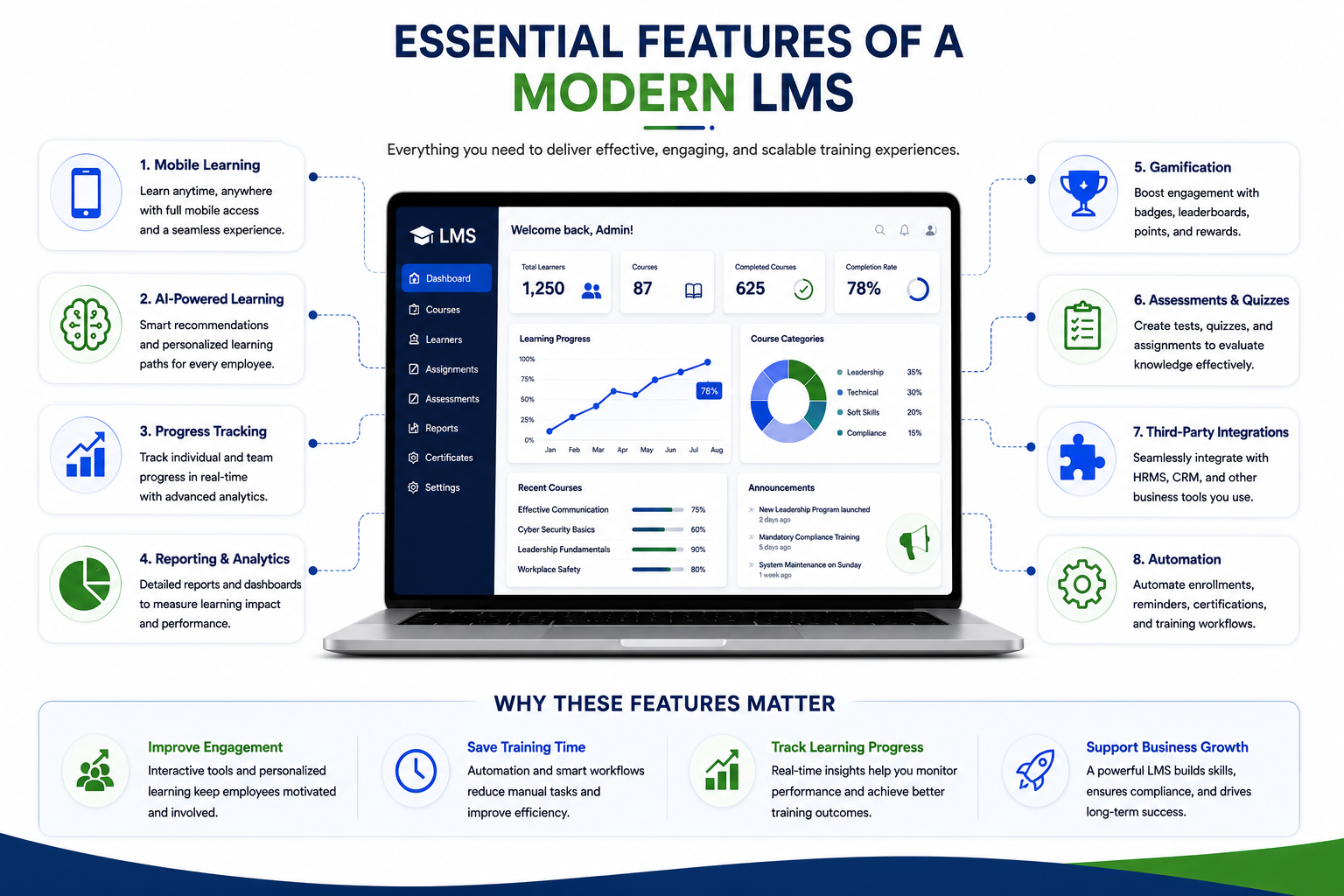
When comparing LMS platforms, make sure you are looking at those that are relevant to your training goals. These features should also enhance the learning process.
1. User-Friendly Interface
Employees should not need extensive training just to learn how to use the LMS. A simple interface makes it easier to find courses, access resources, and complete assigned training.
Easy navigation also reduces confusion for managers and administrators.
2. Mobile Learning
Employees may need to learn while working remotely, traveling, or working flexible hours. A mobile-friendly LMS allows them to access training from smartphones, tablets, and other devices.
This gives employees more flexibility and makes learning easier to fit into the workday.
3. AI-Powered Learning
Some modern LMS platforms use AI to make learning more personalized. Depending on the platform, AI may recommend relevant content, identify skill gaps, or suggest learning paths.
These capabilities can help managers deliver more relevant training instead of giving every employee the same learning experience.
4. Reporting and Analytics
It’s hard to measure the success of any training program if data is not accurate. A robust LMS offers real-time reports and dashboards. These tools measure key performance metrics such as:
- Course completion
- Assessment results
- Learning time
- Skill development
- Training trends
These are lessons learned to gauge progress by managers. They see areas for improvement and develop more effective training strategies.
5. Automation
The manual management of workplace training can be time-consuming. Automation makes routine tasks easy. It automates course assignment, reminders, and tracking and automatically generates certificates.
Administrative tasks are reduced, which means that managers have more time to work on learning outcomes. They can reduce the time they spend on repetitive tasks.
6. Integrations
- Search for integrations with:
- HR software
- Video conferencing platforms
- Communication tools
- CRM systems
- Productivity applications
Integrations that are seamless lead to a connected learning environment. They streamline processes and decrease manual tasks throughout departments.
7. Gamification
It is more fun to learn if the employees are motivated to participate in learning. Gamification incorporates elements such as badges, points, leaderboards, and rewards.
All of these help to keep learners motivated in their learning process. These features help boost engagement, enhance knowledge retention, and make learning at work more fun.
How to Choose the Right LMS Technology
The choice of the right LMS needs planning. Choosing the incorrect solution can be time-consuming, costly, and problematic.
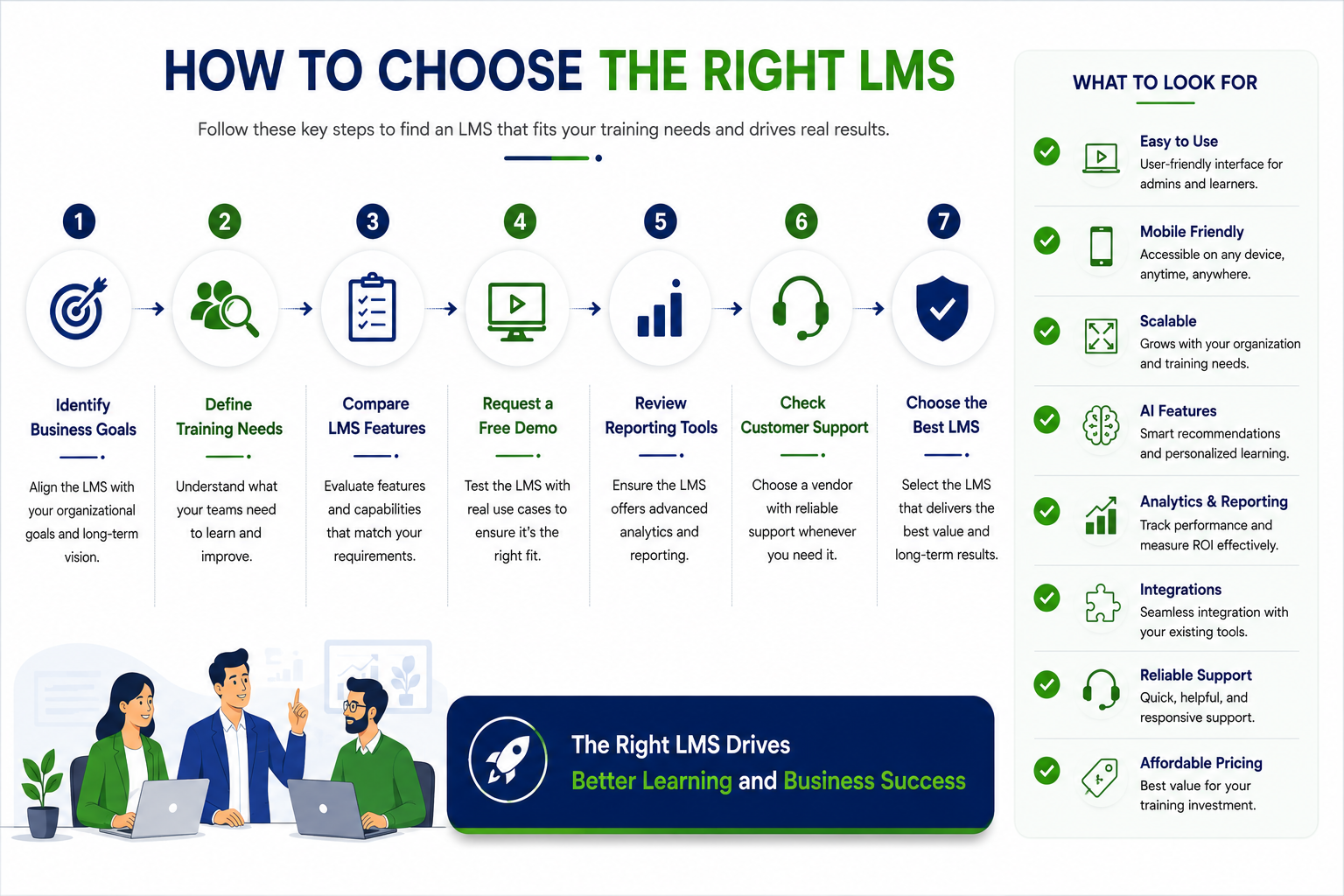
What is most feature-rich is not necessarily best. Choose one that aligns with your business objectives and growth potential.
1. Define Your Training Goals
First, consider why you will have a training program. Having clear objectives improves LMS evaluation. They assist you in comparing various platforms and deciding on which one would be the best fit.
Ask questions such as:
- What are the areas for development?
- Who needs training?
- What will be the criteria for success?
- Who needs help?
- Which is the ideal form of learning?
Clear objectives result in better decisions and training programs.
2. Prioritize Ease of Use
The most robust LMS will be ineffective if its employees struggle to use it. Select a platform that offers an easy-to-use interface. It should make it easy for learners and administrators to accomplish tasks with little effort.
Simple navigation promotes engagement, decreases support tickets, and improves course completion.
3. Look for Scalability
As your business expands, your training requirements will increase. Choose an LMS that will accommodate an increased workforce, course volume, and evolving business needs. It should continue to deliver good results as your organization expands.
A scalable solution ensures that you don’t lose your money. It also eliminates impacts from platform changes in the future.
4. Check Reporting Features
Successful training is based on results that can be quantified. Look for an LMS that offers dashboards and reports on metrics like:
- Course completion
- Assessment performance
- Learning progress
- Skill development
- Certification status
Real-time data enables managers to make informed decisions. It also enables them to make continuous improvements in training programmes.
5. Evaluate Customer Support
Even the best LMS can come with some technical hurdles. Opt for a vendor with responsive customer support. It should also provide good documentation and easy learning tools. Having reliable support helps to reduce downtime and run the training smoothly.
6. Compare Pricing Carefully
While price is a significant factor, it shouldn’t be the only consideration. Make a comparison of the features, scalability, support, and long-term value of each platform. Don’t just consider the up-front price.
A good corporate training platform is more valuable with time. It enhances employee performance and aids in business growth over the long haul.
Common LMS Mistakes to Avoid
There are numerous errors that many companies make when implementing an LMS. By steering clear of these, time is saved, training costs are minimised, and training outcomes are better.
Choosing Price Over Quality
A low-cost LMS may look attractive at first. However, it may lack important features or support as your business grows.
Instead of looking only at the initial price, consider the platform’s features, support, scalability, and long-term value.
Ignoring Employee Feedback
Your employees use the LMS on a daily basis, and their input is invaluable. Gather constructive feedback on a regular basis to know what is effective and what needs to be improved.
It is important to listen to learners to make the training a better experience. Increases engagement, participation, and course completion rates.
Skipping Mobile Learning
Modern employees want learning to be available anywhere, anytime. Not selecting an LMS that is mobile-friendly decreases participation and learning opportunities.
With a mobile-friendly platform, workers can take training at any time. They can learn while working remotely, traveling, or in the office.
Forgetting to Update Training Content
Training materials should grow with your business. Employees with outdated courses will have inaccurate information and reduced credibility. Regularly check on learning content.
Keep it up to date when processes, technologies, and industry regulations change. Current content helps to keep employees informed, engaged, and ready for the next challenge.
Measuring Completion Instead of Results
It doesn’t stop there when it comes to course completion. Employees may not be the most skilled if they have finished a course.
Assess the results of interventions, including knowledge gained, skills acquired, performance in the workplace, and business impact. These are the metrics that will give a better idea of how effective your training program is.
How Does an LMS Improve Employee Performance?
An LMS enhances employee performance with personalized learning. It keeps up to date with progress and detects gaps in skill at an early stage. Employees develop practical skills through interactive courses, periodic testing, and ongoing feedback. They are more confident in using these skills.
Managers also get a lot of information that will help them coach and make better training decisions. Businesses have improved outcomes as employees continue to grow their skills. They have more productive collaboration and better long-term performance.
Conclusion
The right LMS can make employee training easier to manage and more effective. It gives employees flexible learning options while helping managers track progress, identify skill gaps, and improve training outcomes.
When choosing an LMS, focus on your business goals, employee needs, and future growth. The right technology can help your team build skills and perform better over time.
Sources & References
- The Lesser-Known Benefits of Employee Training
- Benefits of Continuous Learning in the Workplace
- What Is a Learning Management System
- Mobile Learning Benefits: The Advantages Of Learning On-The-Go
- Gamification in online training
- Personalized Learning Transforms Leadership at State Street
- Closing the skills gap: Creating workforce-development programs that work for everyone
- Why Is the Onboarding Process So Important? 5 Key Purposes
Frequently Asked Questions
QWhat is an employee training LMS?
An employee training LMS is a platform businesses use to create, deliver, and manage workplace training. It can help with course delivery, employee progress tracking, assessments, and training records.
QWhy should businesses use an LMS for employee training?
An LMS makes training easier to organize and manage. Employees can access courses online, while managers can track progress, automate routine tasks, and measure training results.
QWhat features should a good LMS include?
Important features include mobile learning, personalized learning paths, assessments, progress tracking, analytics, automation, integrations, and gamification. The right features depend on your business needs.
QHow does an LMS improve employee performance?
An LMS helps employees access relevant training and build new skills. Managers can also use training data to identify skill gaps and provide additional support where needed.
QCan small businesses benefit from an employee training LMS?
Yes. Small businesses can use an LMS to organize training without relying heavily on manual processes. It can also make it easier to expand training as the team grows.
QHow do I choose the right LMS technology?
Start with your training goals and employee needs. Then compare platforms based on ease of use, features, reporting, integrations, support, pricing, and scalability.
QHow often should employee training content be updated?
Review training content regularly and update it whenever processes, technology, regulations, or industry requirements change. Keeping content current helps employees learn accurate and useful information.