6 Critical Reasons Leadership Training Fails: How to Fix Them Fast?
Discover 6 critical reasons leadership training fails and how to fix them. Learn proven strategies to improve engagement, retention, and leadership development

Table of Contents ▼
Quick Answer
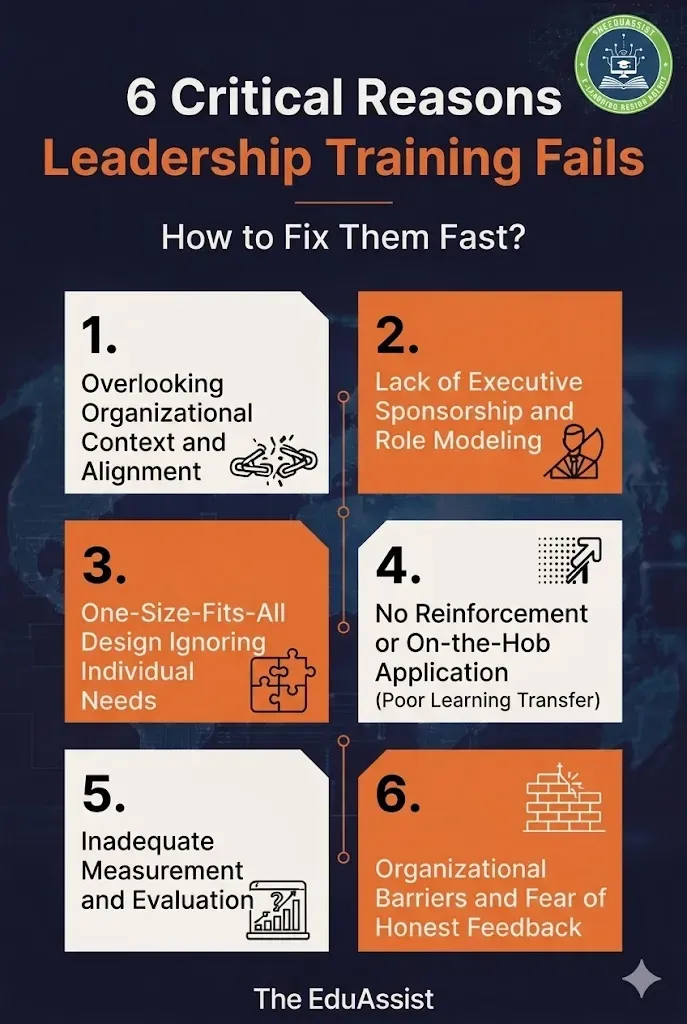
Leadership training fails when organizations treat it as a standalone event instead of an integrated development strategy. This guide identifies six critical causes: poor organizational alignment, lack of executive sponsorship, one-size-fits-all design, weak reinforcement, inadequate measurement, and systemic organizational barriers.
Key Takeaways
- Align leadership training with organizational strategy, culture, roles, and real workplace challenges.
- Personalization, executive sponsorship, and ongoing reinforcement are essential for lasting behavior change.
- Measure behavior, business outcomes, and ROI instead of relying only on participant reactions or short-term knowledge gains.
Leadership Training remains one of the highest-priority investments for organizations worldwide. Companies continue to pour billions into programs designed to build stronger leaders, boost engagement, and drive performance. Yet, despite massive spending $102.8 billion in the U.S. in 2024 - 2025 and global corporate training investments exceeding $390 billion in 2024 most initiatives deliver disappointing results. Participants return to their desks energized for a few weeks, then slip back into old habits. Organizational performance barely moves. Alarmingly, 40 - 50% of new leaders still fail within their first 18 months, and only about 11 - 18% of organizations report that their Leadership Training achieves sustained, effective results.
At TheEduAssist, we’ve analyzed decades of research from sources including Harvard Business Review, ERIC, McKinsey, ATD’s 2025 State of the Industry Report, and leading edtech journals. The data is clear: Leadership Training fails not because leaders lack potential or trainers lack skill, but because programs ignore systemic, contextual, and human realities. The good news? These failures can be fixed quickly when organizations address root causes with targeted, research-backed changes.
This article reveals the 6 critical reasons Leadership Training fails and provides practical, actionable fixes you can implement immediately. Whether you run corporate L&D, higher-education leadership programs, or talent development initiatives, these insights will help you redesign programs for real impact. Drawing from peer-reviewed studies and industry reports, we show how to turn expensive failures into measurable success.
Reason 1: Overlooking Organizational Context and Strategy Alignment in Leadership Training:
The number-one killer of Leadership Training? Treating it as a standalone event disconnected from the organization’s real challenges, strategy, and culture. Programs assume one universal set of skills works everywhere, ignoring unique contexts like industry pressures, team dynamics, or regional differences.
Research confirms this repeatedly. A landmark HBR study found that unclear strategic direction and conflicting priorities create barriers that make new leadership behaviors impossible to sustain. McKinsey’s analysis echoes this: too many initiatives rest on the flawed assumption that “one size fits all” and the same leadership style suits every situation. ERIC studies in higher education and public sectors highlight similar issues - programs fail when they ignore local governance needs or cultural nuances.
Result? Leaders learn concepts in the classroom but cannot apply them back at work. Training becomes irrelevant, and ROI evaporates.
How to Fix It Fast:
- Conduct a rapid context audit before designing any program: interview stakeholders, review strategy documents, and map pain points.
- Align every module to 2 - 3 specific business outcomes (e.g., improve cross-functional collaboration to hit revenue targets).
- Use tools like TheEduAssist’s AI-powered needs-assessment platform to personalize content based on role, department, and organizational goals.
- Integrate real-work scenarios and case studies drawn from your own data.
Organizations that align Leadership Training to strategy see dramatically higher transfer rates. One telecom firm in the research reversed course after discovering its programs had zero business linkage - simple realignment turned the tide.
Reason 2: Lack of Executive Sponsorship and Role Modeling:
Senior leaders often treat Leadership Training as something “for everyone else.” They approve budgets but don’t participate, model behaviors, or hold themselves accountable. This sends a powerful message: the training isn’t truly important.
HBR research identifies this as a core barrier: senior executives who fail to work as a team or acknowledge their own needed behavior changes doom programs from the start. When leaders don’t model new skills, participants quickly revert. Studies from Training Industry and ATD confirm low executive engagement correlates directly with program failure.
How to Fix It Fast:
- Require C-suite participation in the same (or a parallel executive) programpublicly and visibly.
- Build “leadership covenants” where executives commit to specific behavior changes and report progress in town halls.
- Use 360-degree feedback tools integrated into TheEduAssist platform to create transparency and accountability at the top.
- Tie executive bonuses or performance reviews to program outcomes.
When senior teams commit, the entire organization follows. Research shows this single change can multiply impact by removing the “do as I say, not as I do” hypocrisy.
Reason 3: One-Size-Fits-All Design Ignoring Individual Needs:
Generic workshops treat emerging leaders, mid-level managers, and executives the same. They ignore learning styles, experience levels, career stages, and personal mindsets. Adults retain far more when learning is relevant and applied immediately yet most programs deliver passive lectures.
HCI and other analyses list “narrow focus” and “being one-dimensional” as top failure reasons. ERIC papers on higher education note that Western-centric or prescriptive models fail in diverse global contexts. McKinsey research highlights that programs assuming identical skill needs across leaders waste resources.
How to Fix It Fast:
- Segment participants by level and role; customize 70% of content while keeping core principles universal.
- Leverage AI-driven adaptive learning (like TheEduAssist’s personalized pathways) to adjust difficulty, format, and examples in real time.
- Incorporate the 70-20-10 model: 70% experiential, 20% coaching/relationships, 10% formal training.
- Use pre-assessments to baseline skills and create individualized development plans.
Personalization turns generic training into transformative growth. Studies show tailored programs achieve significantly higher skill adoption.
Reason 4: No Reinforcement or On-the-Job Application (Poor Learning Transfer) Leadership Training:
Classroom learning fades without follow-up. Participants return to unchanged workflows, reward systems, and cultures that punish new behaviors. Xerox research cited in multiple sources found 87% of training is lost without coaching.
HBR’s six barriers explicitly include poor organizational design and insufficient time for talent issues both block transfer. Training Industry reports confirm lack of accountability and follow-up as fundamental flaws.
How to Fix It Fast
- Embed 90-day action plans with built-in check-ins, peer coaching, and manager accountability sessions.
- Deploy micro-learning nudges via mobile apps (TheEduAssist’s bite-sized modules reinforce concepts weekly).
- Redesign performance metrics and rewards to support new behaviors.
- Schedule “application sprints” where leaders tackle real projects using program tools.
Reinforcement turns one-off events into lasting habits. Organizations using structured follow-up report 2 - 3x better results.
Reason 5: Inadequate Measurement and Evaluation for Leadership Training:
Most programs measure only smilesheets or short-term knowledge gains. Few track behavior change, team performance, or business impact. Without data, it’s impossible to improve or prove value.
MIT Sloan research reveals that 70% of programs rely on reaction data instead of rigorous impact measurement. ERIC studies on corporate and educational programs repeatedly cite lack of proper evaluation as a core failure point. Phillips & Phillips’ analysis of hundreds of programs lists poor ROI tracking as a top reason training fails.
How to Fix It Fast
- Adopt the Kirkpatrick/Phillips model: measure reaction, learning, behavior, results, and ROI.
- Use The EduAssist analytics dashboard for pre/post assessments, 360 feedback, and business KPI linkage.
- Conduct 3-, 6-, and 12-month follow-ups with control groups for credible impact data.
- Share transparent reports with leadership to secure ongoing investment.
Measurement turns Leadership Training from cost center to strategic asset. Programs with strong evaluation consistently outperform others.
Reason 6: Organizational Barriers and Fear of Honest Feedback
Even motivated learners fail when systems politics, poor coordination, top-down cultures, or fear of speaking up block change. Employees hide obstacles from senior teams, and leadership time for talent issues remains inadequate.
HBR research names these six systemic barriers explicitly, warning that unchanged systems set people up to fail. Additional studies cite low expectations, cultural resistance, and lack of psychological safety.
How to Fix It Fast
- Create safe feedback channels (anonymous pulse surveys via TheEduAssist tools).
- Redesign structures for better cross-functional coordination and dedicate executive time to talent reviews.
- Train managers to coach rather than command shifting from top-down to collaborative styles.
- Run organization-wide “barrier-busting” workshops tied directly to the leadership program.
Removing systemic obstacles unleashes the full power of training. When organizations address these, behavior change sticks.
Conclusion: Turn Leadership Training Failures into Fast Wins with TheEduAssist
Leadership Training doesn’t have to fail. The six reasons outlined here drawn from rigorous research across HBR, ERIC, McKinsey, ATD’s 2025 reports, and edtech literature are common, but entirely preventable. By aligning with strategy, securing executive commitment, personalizing learning, reinforcing application, measuring rigorously, and dismantling organizational barriers, you can deliver programs that actually transform leaders and organizations.
In today’s environment with AI disruption, hybrid work challenges, and persistent leadership skills gaps, effective leadership training is more critical than ever. Yet studies show that up to 75% of organizations still rate their current programs as “not very effective.” The difference between wasted budgets and real ROI lies in moving from one-off events to integrated, AI-supported systems that drive measurable behavior change and business results.
At The EduAssist, we’ve built AI-powered tools, adaptive platforms, and data dashboards specifically to solve these exact six problems. Our solutions integrate seamlessly with existing L&D ecosystems, draw on vast open resources from DOAJ, ERIC, and Semantic Scholar, and deliver faster, more measurable results than traditional approaches.
The era of expensive, in Effective Leadership Training is over. The future belongs to organizations that fix these critical issues quickly, intelligently, and with the right technology.
Authored By : Atiqa Sajid http://www.linkedin.com/in/atiqa-sajid-747b57137
Need Help Building or Scaling Your Online Learning Program?
Whether you are launching an academy on Kajabi, modernizing corporate LMS modules, or converting raw expertise into accredited curriculum, our senior instructional designers provide a complimentary architecture evaluation.
Sources & References
- Beer, M., Finnström, M., & Schrader, D. (2016). Why Leadership Training Fails - and What to Do About It. Harvard Business Review (HBR), October 2016.
- McKinsey & Company (2014). Why leadership-development programs fail.
- MIT Sloan Management Review (2023). Leadership Development Is Failing Us. Here’s How to Fix It.
- New leader failure rates (40 - 50% within 18 months): Multiple sources, including Forbes (2025) citing McKinsey research and ongoing industry data
Frequently Asked Questions
QWhy does most Leadership Training fail despite huge investments?
Most **Leadership Training** fails due to disconnection from business strategy, lack of reinforcement, and systemic barriers rather than poor content. Recent 2025 - 2026 data shows 40 - 50% of new leaders fail within 18 months, and only 11 - 18% of organizations believe their programs deliver sustained results.
QHow important is executive sponsorship for Leadership Training success?
Critical. Without senior leaders modeling behaviors and holding themselves accountable, participants revert quickly. Programs with strong C-suite involvement see significantly higher impact and transfer rates.
QWhat is the fastest way to fix a failing Leadership Training program?
Start with a context audit, secure visible executive sponsorship, add structured 90-day reinforcement with micro-learning, and implement full Kirkpatrick/Phillips measurement. AI tools like TheEduAssist can accelerate these fixes in weeks.
QDoes one-size-fits-all Leadership Training ever work?
Rarely. Generic programs ignore individual and organizational needs, leading to low application. Personalized, adaptive learning (powered by AI) consistently delivers higher engagement and skill adoption.
QWhy is measurement so crucial in Leadership Training?
Most programs only track reactions, not behavior change or business impact. Proper evaluation using Kirkpatrick/Phillips levels turns **Leadership Training** into a provable ROI driver and helps continuously improve the program.
QHow can TheEduAssist help fix my organization’s Leadership Training?
TheEduAssist offers an AI-powered platform that directly addresses the six failure reasons through needs assessment, personalized pathways, automated reinforcement, executive dashboards, and robust analytics delivering measurable results faster.
QWhat are the latest statistics on Leadership Training effectiveness in 2026?
Key insights include: 40 - 50% new leader failure rate within 18 months; only 18% of organizations rate leaders as “very effective” at business goals; and global training investments in the hundreds of billions with persistently low sustained impact. Targeted fixes in alignment, reinforcement, and measurement can reverse these trends rapidly.