
RBT Restroom & Toileting Protocols: The Clinical Supervision Guide for ABA Therapy Centers
Personal care and potty training are central to pediatric ABA therapy, yet toileting routines carry extreme clinical and institutional liability. Learn how ABA clinic owners and BCBAs train Registered Behavior Technicians (RBTs) on the 2-person supervision rule, behavioral de-escalation in restroom spaces, and BACB Ethics Code compliance ahead of the January 2027 client expansion.
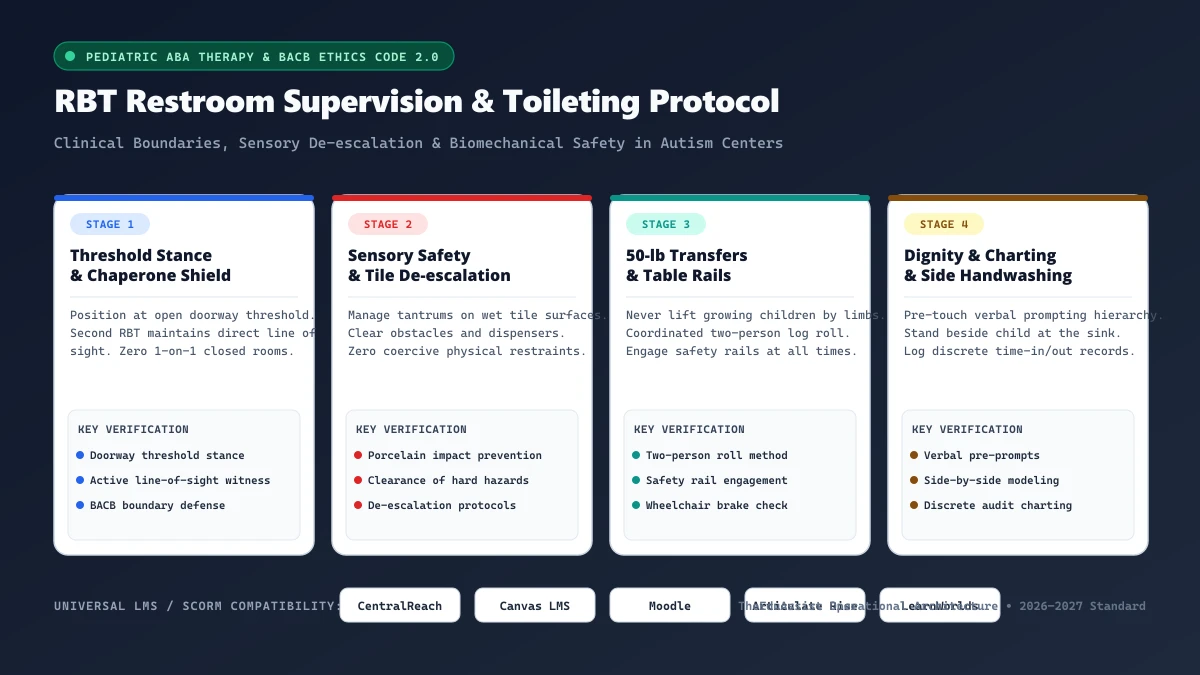
Table of Contents ▼
Quick Answer
A specialized clinical and regulatory guide for ABA clinic owners, Clinical Directors, and BCBAs. Examines RBT personal care training, the Two-Adult Chaperone Model under BACB Ethics Code 2.0, threshold positioning during client meltdowns or elopement, safe physical transfers, and strategies to convert paper clinical SOPs into 20-minute SCORM modules for rapid December onboarding.
Key Takeaways
- Toileting routines are critical developmental milestones in ABA therapy, but personal care spaces represent the highest risk zone for client elopement, injury, and uncorroborated abuse allegations.
- The Two-Person Supervision Model is essential for ABA clinics: an RBT should never be isolated behind closed restroom doors with a client without a second clinician in direct line of sight.
- Under the BACB Ethics Code for Behavior Analysts (Standards 2.08 & 2.14), clinicians must preserve client dignity by narrating steps, standing to the side during handwashing, and limiting toilet sitting to five minutes.
- Clinics onboarding new RBTs in December to meet January insurance authorization surges must provide verifiable digital training before technicians ever assist clients in private restrooms.
- Converting clinic clinical binders into interactive SCORM microlearning modules equips technicians with realistic decision-branching scenarios that paper manuals cannot simulate.
In pediatric autism clinics and multidisciplinary therapy centers, teaching toileting independence is one of the most transformative goals a clinical team can achieve for a child and their family.
Mastering bowel and bladder continence unlocks access to public school classrooms, eliminates severe social stigma, and relieves immense caregiver stress. However, while Board Certified Behavior Analysts (BCBAs) carefully design individualized toileting plans and task analyses, the physical execution almost always falls upon Registered Behavior Technicians (RBTs).
RBTs are often young, entry-level professionals who face high-stakes, real-world friction inside therapy restrooms:
- How do you support a 60-pound child during a violent sensory meltdown in a tile restroom without risking injury?
- How do you assist with diapering without violating professional physical boundaries or exposing yourself to false abuse allegations?
- What is the legally required procedure when a client drops to the floor and refuses to transition?
When clinic owners and clinical directors rely solely on an 80-page employee handbook or a 10-minute verbal walkthrough, protocols inevitably break down.
With the January 2027 insurance authorization expansion approaching, leading ABA therapy networks are modernizing their personal care training by replacing paper checklists with interactive, scenario-based digital learning.
1. The High-Risk Realities of Clinic Restroom Routines
Private restrooms in pediatric therapy clinics represent an intersection of clinical progress and severe organizational risk:
┌────────────────────────────────────────────────────────────────────────┐
│             THE 4 VULNERABILITY ZONES IN PEDIATRIC THERAPY             │
├────────────────────┬────────────────────┬──────────────────────────────┤
│ 1. BOUNDARY &      │ 2. SENSORY &       │ 3. STAFF BACK INJURIES       │
│    ALLEGATION RISKS│    ELOPEMENT DANGERS│    DURING TRANSFERS          │
│ A technician alone │ Wet tile floors,   │ Lifting growing children     │
│ with a non-verbal  │ porcelain fixtures,│ over 50 lbs off changing     │
│ child in a closed  │ and slamming doors │ tables without a 2-person    │
│ stall has zero     │ turn meltdowns     │ log-roll causes severe       │
│ witness protection.│ into head traumas. │ lumbar disc damage.          │
├────────────────────┴────────────────────┴──────────────────────────────┤
│ 4. BACB ETHICS CITATIONS & CLINIC LICENSE LOSS                          │
│ Unnarrated touch, wrapping arms around children from behind, or leaving │
│ students unattended violates BACB Standard 2.08 (Client Dignity).       │
└────────────────────────────────────────────────────────────────────────┘
A. Protecting the Client and Technician (The Two-Adult Rule)
In an ABA setting, non-verbal or minimally verbal children cannot always articulate what occurred during a personal care routine. Conversely, a stressed or confused child may exhibit behavioral regression that prompts alarming statements to parents.
The Two-Adult Witness Rule is the absolute operational standard:
- Dependent Clients: Two staff members must be present in the restroom suite throughout the changing routine.
- Independent Clients with Behavioral Challenges: The primary RBT positions themselves at the doorway threshold, prompting verbally. A second technician stands in the corridor within direct line of sight. Both adults must be clearly visible from the main hallway. Staff only enter the stall if physical safety is compromised, and they enter together.
B. Client Dignity Under BACB Ethics Code 2.0
Under the Behavior Analyst Certification Board (BACB) Ethics Code, treating clients with dignity is a mandatory professional standard:
- Narration Before Contact: Technicians must explain every step before touching the client: “Sam, I’m going to help you pull up your trousers now.”
- Side-by-Side Handwashing Modeling: Staff must stand to the side of the child when guiding handwashing. Wrapping arms around a child from behind to guide their hands is strictly prohibited; it restricts movement and can trigger severe sensory trauma.
- The 5-Minute Maximum: Staff must never force a child to sit on a toilet for extended periods. If the child does not urinate or defecate within five minutes, the routine ends with positive reinforcement for cooperation.
2. Core Curriculum: What We Build from Your Clinic SOP
At TheEduAssist, we turn your clinic’s personal care guidelines into a five-part interactive SCORM suite that RBTs can complete on tablets or smartphones:
┌────────────────────────────────────────────────────────────────────────┐
│             ABA CLINICAL TOILETING SCORM SUITE                         │
├────────────────────┬────────────────────┬──────────────────────────────┤
│ MODULE 1:          │ MODULE 2:          │ MODULE 3:                    │
│ Supervision & The  │ De-escalation &    │ Ergonomic Transfers &        │
│ Threshold Standard │ Sensory Safety     │ 50-lb Log Roll               │
│ Hallway visibility │ Managing tantrums  │ Two-person rolling,          │
│ and chaperone     │ on wet tile floors │ table safety rails, and      │
│ documentation.     │ without restraint. │ wheelchair wheel locks.      │
├────────────────────┴────────────────────┴──────────────────────────────┤
│ MODULE 4: DIGNITY & SIDE-BY-SIDE HYGIENE MODELING                       │
│ Verbal prompting hierarchy, non-restrictive modeling, and 5-min rules.  │
├────────────────────────────────────────────────────────────────────────┤
│ MODULE 5: INFECTION CONTROL, GLOVE PROTOCOLS & DATA COLLECTION          │
│ Front-to-back wiping, biohazard bagging, and discrete digital charting. │
└────────────────────────────────────────────────────────────────────────┘
Module 1: The Doorway Threshold & Chaperone Standard
Technicians navigate interactive scenarios: deciding when to stay at the door, when to call for a chaperone, and how to position themselves so hallway visibility is never broken.
Module 2: Restroom De-escalation & Environmental Safety
Technicians practice handling behavioral outbursts on tile surfaces: clearing hazardous items (dispensers, bins), stepping back to provide space, and calling the behavioral lead without abandoning the client.
Module 3: Safe Transfers & The 50-Pound Rule
Interactive simulations train technicians never to lift legs directly for clients over 50 pounds. Technicians practice the coordinated two-adult log-roll and verify wheelchair brake engagement before transfers.
Module 4: Client Dignity & Boundary Protection
Technicians identify boundary violations: demonstrating correct side-by-side positioning at the sink, verbalizing steps in advance, and avoiding physical touch when verbal or gestural prompts suffice.
Module 5: Biohazard PPE, Disinfection & Charting
Step-by-step drills on non-latex glove removal, front-to-back wiping, sanitizing surfaces with certified hospital-grade disinfectants, and recording prompt-level data for BCBA review.
3. The December Onboarding Wave for January 2027
January 1st is the annual reset date for private insurance authorizations and state Medicaid funding. ABA therapy clinics experience their largest hiring wave in December:
- New RBT Hires: College graduates and paraprofessionals joining therapy teams.
- Clinical Credentialing Deadlines: Clinics must prove that every technician handling personal care has completed accredited training before billable therapy hours commence.
- Audit Protection: When state licensing inspectors or insurance auditors review clinic files, automated digital certificates prove that 100% of technicians passed verified competency evaluations.
4. Deploying Your Custom Course with TheEduAssist
Rather than pulling senior BCBAs away from billable clinical supervision to write training decks, TheEduAssist handles the entire transformation in 5 to 7 business days:
-
Universal LMS Integration: Upload our SCORM packages directly into your clinic’s CentralReach, LearnWorlds, Canvas, or Moodle LMS.
-
Turnkey Managed Portal: If your clinic lacks an LMS, we host your course on our dedicated portal with automated user management and supervisor reporting dashboards.
-
Full Asset Ownership: You receive 100% of the uncompiled Articulate Storyline source files with no recurring per-user licensing taxes.
-
Have an existing clinic toileting policy or task analysis? Submit your document for a free 24 to 48 hour course architecture review.
-
Need to speak with an enterprise learning architect? Contact our clinical e-learning team today.
Need Help Building or Scaling Your Online Learning Program?
Whether you are launching an academy on Kajabi, modernizing corporate LMS modules, or converting raw expertise into accredited curriculum, our senior instructional designers provide a complimentary architecture evaluation.
Frequently Asked Questions
QHow does the Two-Person Staffing Model operate in an ABA therapy clinic?
In an ABA center, when a client requires physical assistance or diapering, a primary RBT interacts with the client while a second staff member acts as an active chaperone. For clients who toilet independently but exhibit behavioral triggers (such as aggression or property destruction), the primary RBT prompts from the open restroom doorway, while a second RBT remains in the corridor within clear line of sight.
QWhat does the BACB Ethics Code mandate regarding client dignity during personal care?
BACB Ethics Code 2.0 (specifically Standard 2.08: Conducting Responsible Research, and Standard 1.07/2.14: Dignity and Treatment) requires behavior analysts to treat clients with compassion, protect their physical boundaries, minimize discomfort, and never use coercive physical restraint during toileting routines.
QWhy is December the most critical training month for autism therapy clinics?
Many commercial insurance and Medicaid prior-authorizations for pediatric ABA therapy renew on January 1st, prompting clinics to onboard cohorts of new technicians in December. Verifiable SCORM e-learning ensures new hires are 100% compliant with hygiene, transfers, and supervision before their first clinical session.
