
The Kirkpatrick Model: 4 Levels of Training Evaluation [2026 Guide]
The Kirkpatrick Model is the world's leading framework for evaluating training effectiveness. Master the 4 levels (Reaction, Learning, Behavior, Results), plus Level 5 ROI, with real corporate metrics and evaluation rubrics.
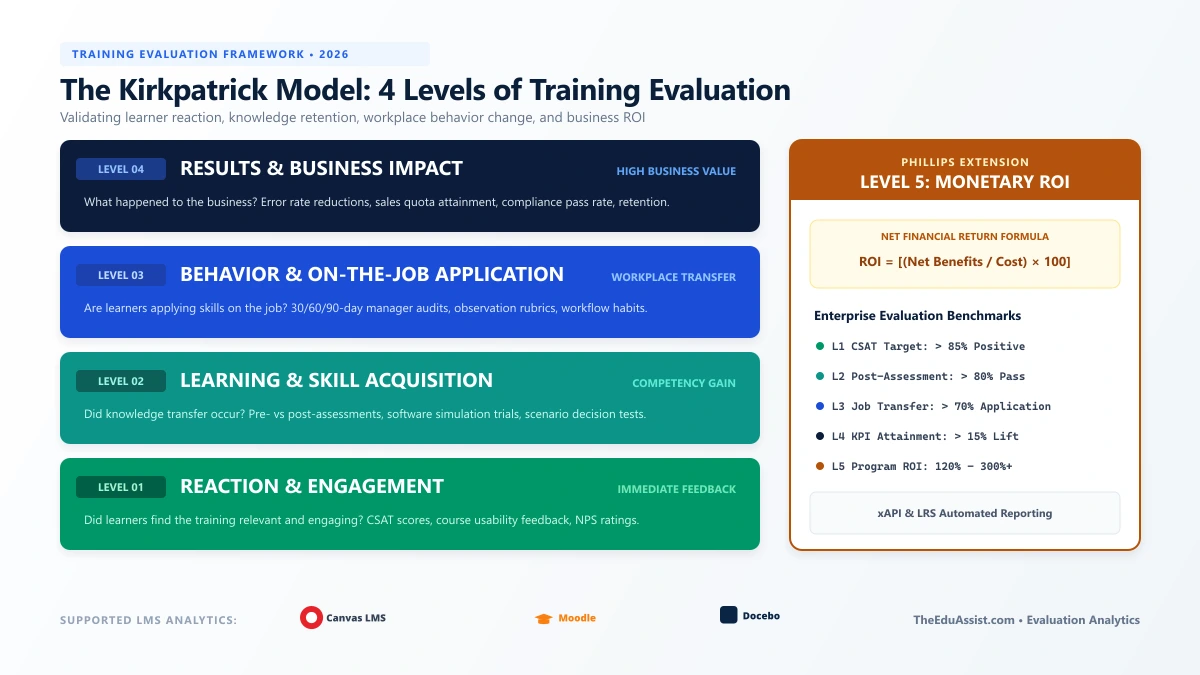
Table of Contents ▼
Quick Answer
Comprehensive 2026 guide to Donald Kirkpatrick's 4-Level Training Evaluation Model. Breaks down Level 1 (Reaction), Level 2 (Learning), Level 3 (Behavior), and Level 4 (Results), alongside Jack Phillips' Level 5 ROI calculation, with practical enterprise metrics, survey templates, and measurement strategies.
Key Takeaways
- The Kirkpatrick Model evaluates training across 4 progressive tiers: Level 1 (Reaction), Level 2 (Learning), Level 3 (Behavior), and Level 4 (Results).
- Over 80% of organizations measure only Level 1 ('smile sheets'), failing to prove business ROI to executive leadership.
- Level 3 (Behavior) measures true on-the-job application 30 to 90 days post-training, representing the critical bridge to business impact.
- The Phillips ROI Methodology adds Level 5, converting Level 4 business outcomes into clear financial dollar returns.
- Modern xAPI and LMS telemetry allow automated data collection for Levels 1, 2, and 3 without intrusive manual surveys.
When executive leadership invests tens of thousands of dollars into workforce training, software rollouts, or compliance upskilling, the first question CFOs ask is: “What was the return on this investment?”
Unfortunately, more than 80% of corporate L&D teams answer this question with “smile sheets”—post-course satisfaction surveys that reveal whether employees liked the instructor or thought the slides looked clean.
To prove genuine business value, learning leaders rely on the Kirkpatrick Model—the world’s most recognized and respected framework for evaluating training effectiveness.
First introduced by Dr. Donald Kirkpatrick in 1959 and refined by the Kirkpatrick Partners over decades, the model provides a rigorous, 4-tier chain of evidence linking learner satisfaction directly to bottom-line organizational profitability.
Here is the definitive guide to applying the Kirkpatrick Model in modern enterprise environments.
What is the Kirkpatrick Model? (Direct Definition)
The Kirkpatrick Model is a four-level framework used to measure the effectiveness of training and educational programs. The four levels are: Level 1: Reaction (learner engagement and satisfaction), Level 2: Learning (knowledge and skill acquisition), Level 3: Behavior (on-the-job application and habit change), and Level 4: Results (tangible organizational impact and business ROI).
+-----------------------------------------------------------------------------------+
|                         THE KIRKPATRICK 4-LEVEL PYRAMID                           |
|                                                                                   |
|     [ LEVEL 4: RESULTS ]   -> Profit, cost reduction, error reduction, safety    |
|               ▲                                                                   |
|               │                                                                   |
|     [ LEVEL 3: BEHAVIOR ]  -> On-the-job application, 30/60/90-day habit change   |
|               ▲                                                                   |
|               │                                                                   |
|     [ LEVEL 2: LEARNING ]  -> Post-test score gains, simulation pass rates        |
|               ▲                                                                   |
|               │                                                                   |
|     [ LEVEL 1: REACTION ]  -> Learner satisfaction, perceived utility, NPS       |
+-----------------------------------------------------------------------------------+Need to Build Training That Proves Hard Business ROI? If your leadership team requires quantifiable metrics, xAPI learner tracking, or performance-driven curriculum design:
- Review our Learning Strategy Consulting & Custom eLearning Development
- Inspect transparent fixed-scope budgets on our eLearning Pricing Architecture
- Or Book a Free 24–48h Training Architecture Review.
Level 1: Reaction (Engagement, Relevance & Utility)
Level 1 measures how learners respond to the training experience. In the past, this was limited to generic questions like “Did you enjoy the presentation?”
In modern corporate instructional design, Level 1 focuses on perceived utility and job relevance. If a learner does not find the training immediately applicable to their daily frustrations, they will not engage cognitively.
High-Signal Level 1 Questions to Ask:
- “How directly does this module apply to your daily workplace challenges?” (1–5 scale)
- “Do you feel confident you can perform [specific procedure] after completing this simulation?” (Yes / Partially / No)
- “Would you recommend this course to a colleague in your role?” (Net Promoter Score - NPS)
Key Metrics:
- Course Net Promoter Score (NPS)
- Perceived Job Relevance Index (>85% target)
- Module drop-off rate and time-on-task analytics
Level 2: Learning (Knowledge, Skill & Attitude Acquisition)
Level 2 measures whether participants actually acquired the intended knowledge, capabilities, and procedural confidence during the training event.
Unlike Level 1 (which measures sentiment), Level 2 requires objective competency verification.
How to Measure Level 2 Effectively:
- Pre-Test vs. Post-Test Benchmarks: Administering an identical 10-question scenario pre-test before the course and post-test upon completion. A 30%+ score improvement indicates genuine knowledge transfer.
- Interactive Software Simulations: Rather than multiple-choice questions, placing learners in a sandboxed ERP or CRM simulation where they must complete standard workflows without error.
- Branching Scenario Assessments: Evaluating whether learners can navigate nuanced client objections or compliance gray areas.
Key Metrics:
- Pre-to-post knowledge delta (% gain)
- First-time scenario simulation pass rates (>80% benchmark)
- Assessment attempt counts before mastery
Level 3: Behavior (On-the-Job Application & Transfer)
Level 3 is the critical inflection point of the entire model. An employee can achieve 100% on a post-test (Level 2), but if they return to their desk and continue using outdated, inefficient habits, the training has failed.
Level 3 measures behavioral transfer—whether the knowledge acquired is consistently applied in the live workplace over 30, 60, and 90 days.
Why Level 3 Requires Organizational Support:
Behavior change does not happen in a vacuum. It requires Required Drivers:
- On-the-Job Aids: Quick-reference checklists and digital job aids at the point of work.
- Managerial Reinforcement: Supervisors who monitor and reward new behaviors during weekly 1-on-1s.
- Psychological Safety: Encouraging employees to apply new methods without fear of immediate reprimand if speed temporarily dips during the learning curve.
Key Metrics:
- 60-day supervisor behavioral observation rubrics
- Self-reported frequency of tool usage
- Audit compliance scores in operational reviews
Level 4: Results (Tangible Organizational Impact)
Level 4 evaluates the final business outcomes that occurred because participants applied the training on the job. This is the language executive leadership speaks: profit, speed, retention, and risk mitigation.
Aligning Training with Business Metrics:
| Business Sector | Common Training Objective | Level 4 Business Metric Evaluated |
|---|---|---|
| Sales Enablement | Enterprise Discovery Call Overhaul | +18% increase in Qualified Pipeline Conversion; 14-day shorter sales cycle |
| Customer Support | De-escalation & CRM Navigation | -28% reduction in First-Contact Resolution time; +12 pt CSAT improvement |
| Manufacturing / Industrial | Lockout/Tagout (LOTO) Safety Training | 0 OSHA reportable incidents over 12 months; -35% machine downtime |
| SaaS Customer Onboarding | Product Adoption Academy | +22% Net Revenue Retention (NRR); -40% reduction in Day-30 churn |
Level 5: The Phillips ROI Methodology (Financial Return)
While Donald Kirkpatrick’s original framework stopped at Level 4, Dr. Jack Phillips introduced Level 5 to provide a direct mathematical calculation of financial ROI:
$$\text{Training ROI (%)} = \left( \frac{\text{Net Financial Benefits}}{\text{Total Program Costs}} \right) \times 100$$
Real-World Example: Customer Support Training
- Program Cost: $35,000 (instructional design, SCORM authoring, LMS setup).
- Measurable Benefit: Reduced average handle time saved 4,200 agent hours annually, valued at $105,000 in operational capacity.
- Net Financial Benefit: $105,000 - $35,000 = $70,000.
- ROI Calculation:
($70,000 / $35,000) * 100 = 200% ROI. The program paid for itself twice over in Year 1.
Step-by-Step Implementation Framework: The “Backward Planning” Rule
Top instructional designers do not apply the Kirkpatrick Model from Level 1 up to Level 4. They apply it in reverse during the design phase:
[ Step 1: Define Level 4 Business Goal ]  --> What business metric must change?
                     │
                     ▼
[ Step 2: Define Level 3 Target Behaviors ] --> What must employees DO differently?
                     │
                     ▼
[ Step 3: Define Level 2 Learning Skills ] --> What knowledge & skills do they need?
                     │
                     ▼
[ Step 4: Design Level 1 Engaging Course ] --> What experience will inspire them?
By planning backward from business results to curriculum design, you guarantee that every slide, simulation, and quiz question serves a measurable operational purpose.
Frequently Asked Questions
Which level of the Kirkpatrick model is the most difficult to measure?
Level 3 (Behavior) is universally recognized as the most challenging to measure because it occurs outside the LMS environment. It requires cross-departmental coordination, manager observations, and data tracking over a 30 to 90-day post-training window.
Can microlearning be evaluated using the Kirkpatrick model?
Yes. Microlearning is particularly effective for Level 3 measurement because modular 3-minute lessons can be paired with immediate digital checklists or xAPI telemetry tracking whether a learner accessed an SOP right before executing a workplace task.
What tools are used to track Kirkpatrick metrics in 2026?
Modern L&D teams use enterprise Learning Management Systems (Docebo, Canvas, Moodle), Learning Record Stores (LRS) via xAPI (Experience API), Power BI / Tableau dashboards, and automated pulse survey tools (Qualtrics, Culture Amp).
How does TheEduAssist ensure training programs deliver ROI?
TheEduAssist works with organizations to define measurable Level 3 and Level 4 metrics before building courseware. We develop interactive SCORM modules, software simulations, and job aids designed specifically for on-the-job transfer. Book a Free 24–48h Consultation to review your training evaluation roadmap.
Need Help Building or Scaling Your Online Learning Program?
Whether you are launching an academy on Kajabi, modernizing corporate LMS modules, or converting raw expertise into accredited curriculum, our senior instructional designers provide a complimentary architecture evaluation.
Sources & References
Frequently Asked Questions
QWhat are the 4 levels of the Kirkpatrick model?
The 4 levels created by Donald Kirkpatrick are: 1. Reaction (how learners perceive the training), 2. Learning (knowledge, skills, and confidence acquired), 3. Behavior (on-the-job application and behavioral transfer), and 4. Results (targeted organizational outcomes like revenue, speed, and safety).
QWhat is Level 5 in training evaluation?
Level 5 was added by Dr. Jack Phillips and represents Return on Investment (ROI). It mathematically converts Level 4 business results into monetary benefits and compares them directly against the total cost of program development and delivery: ROI (%) = [(Net Financial Benefits / Total Training Costs) * 100].
QWhy do most training programs fail to measure Level 3 and Level 4?
Measuring Level 3 (Behavior) and Level 4 (Results) requires cross-departmental data collaboration with sales, operations, or HRIS systems 30 to 90 days after training. Most L&D teams operate in silos and lack automated xAPI telemetry or managerial observation rubrics.
QHow do you measure Level 3 Behavior effectively?
Through 30/60/90-day supervisor behavioral rubrics, self-assessments, pulse surveys, and direct operational metrics (e.g., error rates, CRM documentation adherence, or safety audit compliance).
QHow does TheEduAssist design courses for measurable Kirkpatrick outcomes?
TheEduAssist applies Cathy Moore's Action Mapping and backward design, beginning with Level 4 business goals and engineering scenario-based practice modules that directly drive Level 3 workplace behaviors. Explore our learning strategy services to measure true training impact.
