
Special Education Paraprofessional Restroom & Hoyer Lift Training: The K-12 District Playbook
Special education paraprofessionals and 1-on-1 aides provide vital classroom and personal care support, but improper toileting and mechanical lift handling expose school districts to severe liabilities. Learn how school districts and SELPAs modernize personal care SOPs into interactive SCORM training for December onboarding ahead of the January 2027 Spring semester.
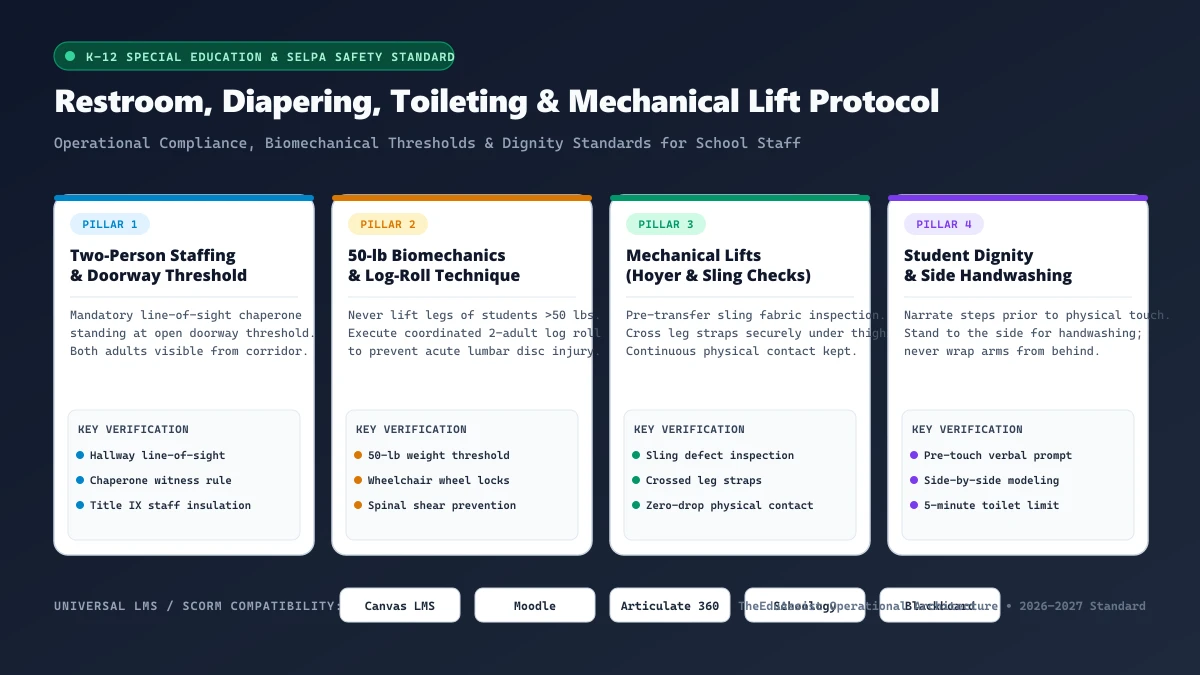
Table of Contents ▼
Quick Answer
A comprehensive K-12 district operational guide for Special Education Directors, SELPA administrators, and District Lead Nurses. Details California Education Code § 49423.5 requirements, the Two-Adult Supervision Rule, 50-lb log-roll biomechanics, Hoyer lift safety checklists, and how to convert district paper SOP binders into 20-minute SCORM modules in December for immediate January deployment.
Key Takeaways
- Under state education codes and IDEA, paraprofessionals performing specialized physical health care services (toileting, diapering, lifting) must receive documented, verifiable training before assisting students.
- The Two-Person Supervision Rule is the primary shield protecting both the student's civil rights and the paraprofessional against uncorroborated misconduct or abuse allegations.
- Lifting students over 50 pounds without a coordinated two-person log-roll technique causes severe lumbar disc damage and represents the leading worker's compensation cost for school districts.
- Hoyer and mechanical sling lifts require pre-transfer fabric inspections, locked wheelchair wheels, cross-leg strap routing, and continuous physical contact during elevation.
- School districts converting paper binders into 20-minute SCORM microlearning modules during December ensure that incoming January aides and substitute staff are 100% certified on Day 1.
Across the United States and international school systems, thousands of dedicated special education paraprofessionals, instructional assistants, and 1-on-1 aides arrive on K-12 campuses every morning to support students with severe physical, medical, and cognitive disabilities.
These professionals are the backbone of inclusive public education. They assist students with autism, cerebral palsy, muscular dystrophy, and traumatic brain injuries, ensuring they can participate in general education environments alongside their peers.
Yet, among all duties assigned to instructional aides, personal care assistance (diapering, toileting, and wheelchair transfers) represents the single highest area of institutional liability for a school district:
- What happens when an aide attempts to manually lift a 65-pound student off a changing table and suffers an acute disc herniation?
- What happens when an aide enters a closed restroom stall alone with a student, and an uncorroborated abuse allegation is filed by a family member?
- What happens when an untrained substitute aide hooks a Hoyer lift sling incorrectly, causing a catastrophic student fall?
When school districts and Special Education Local Plan Areas (SELPAs) rely on static paper binders handed out during orientation, critical safety protocols are skipped.
With the January 2027 Spring semester approaching, forward-thinking Superintendents, Special Education Directors, and District Lead Nurses are replacing static paper SOPs with interactive, audit-defensible digital learning.
1. The Legal Mandates Governing School District Personal Care
In public K-12 education, personal care protocols are not internal suggestions; they are anchored in state and federal law:
┌────────────────────────────────────────────────────────────────────────┐
│           LEGAL & REGULATORY PILLARS IN K-12 SPECIAL EDUCATION         │
├────────────────────┬────────────────────┬──────────────────────────────┤
│ 1. CALIFORNIA ED   │ 2. TITLE IX &      │ 3. WORKER'S COMP & OSHA      │
│    CODE § 49423.5  │    CHILD ADVOCACY  │    ERGONOMIC MANDATES        │
│ Mandates documented│ The Two-Adult Rule │ Lifting students over        │
│ training before non│ protects students  │ 50 lbs without mechanical    │
│ licensed staff can │ from boundary harm │ aids causes chronic spinal   │
│ assist with health │ and aides from     │ disc injuries costing        │
│ care protocols.    │ false allegations. │ districts $80,000+ per claim.│
└────────────────────┴────────────────────┴──────────────────────────────┘
A. State Specialized Health Care Codes
Under statutes such as California Education Code § 49423.5 and corresponding state health mandates nationwide, non-licensed school employees who assist with specialized physical health care services (toileting, catheterization, suctioning, and mechanical transfers) must receive documented, specialized training under the direction of a credentialed school nurse. If an untrained aide injures a child or themselves, the district faces direct administrative and tort liability.
B. Title IX, Section 504 & The Two-Adult Supervision Shield
School restrooms are high-risk private spaces. A single adult alone behind a closed stall door with a vulnerable child exposes the district to catastrophic liability.
The standard protocol enforces a strict dual-staff structure:
- The Doorway Threshold Standard: For students who toilet independently but exhibit behavioral triggers, the primary aide prompts from the open bathroom door while a second adult stands in the main corridor within direct line of sight. Both adults must be clearly visible from the hallway.
- The Two-Person Restroom Model: For dependent students requiring hands-on diapering or lifting, two trained staff members must be present inside the space throughout the entire routine.
C. The 50-Pound Log-Roll & Biomechanical Protection
Paraprofessionals frequently sustain career-ending spinal injuries when lifting a student’s legs into the air to change a soiled pull-up. The protocol strictly establishes the 50-pound threshold: for any student over 50 pounds, staff are prohibited from lifting legs and must execute a synchronized, two-adult log-roll technique.
2. The 5-Module Turnkey SCORM Suite for School Districts
At TheEduAssist, we turn your district or SELPA’s paper SOP binder into an interactive, mobile-ready digital learning suite:
┌────────────────────────────────────────────────────────────────────────┐
│            K-12 SPECIAL EDUCATION PERSONAL CARE SUITE                  │
├────────────────────┬────────────────────┬──────────────────────────────┤
│ MODULE 1:          │ MODULE 2:          │ MODULE 3:                    │
│ Supervision & The  │ Transfers & The    │ Hoyer & Mechanical           │
│ Doorway Threshold  │ 50-lb Log Roll     │ Lift Operations              │
│ Line-of-sight and  │ Wheelchair wheel   │ Sling inspections,           │
│ chaperone rules.  │ locks & log rolls. │ cross-leg loops, and pump.   │
├────────────────────┴────────────────────┴──────────────────────────────┤
│ MODULE 4: DIGNITY & SIDE-BY-SIDE HANDWASHING MODELING                   │
│ Step narration, non-intrusive modeling (never wrap arms from behind).   │
├────────────────────────────────────────────────────────────────────────┤
│ MODULE 5: INFECTION CONTROL, PPE & REAL-TIME DIGITAL CHARTING           │
│ Glove changes, front-to-back hygiene, and time-in/out audit defense.    │
└────────────────────────────────────────────────────────────────────────┘
Module 1: The Doorway Threshold & Chaperone Standard
Staff navigate real-world school campus scenarios: identifying correct corridor visibility, knowing when to call a second adult, and upholding Title IX boundary protections.
Module 2: Safe Wheelchair Transfers & The 50-lb Log-Roll
Interactive biomechanical animations demonstrate wheelchair wheel locking, slide sheet placement, and the synchronized two-person log-roll technique for students over 50 lbs.
Module 3: Hoyer & Mechanical Lift Operations
Interactive drag-and-drop drills train staff to inspect sling stitching, match assigned sling sizes to student IEPs, cross leg straps securely, and maintain continuous physical contact during elevation.
Module 4: Student Dignity & Respectful Communication
Staff practice verbalizing steps prior to touch, maintaining privacy, and learning proper side-by-side positioning during handwashing (strictly avoiding wrapping arms around students from behind).
Module 5: Infection Control & Real-Time Documentation
Step-by-step procedures for non-latex glove disposal, front-to-back wiping, sanitizing surfaces with district-approved disinfectants, and recording time-in/time-out logs for legal verification.
3. Why December Training is Critical for the January 2027 Semester
School districts experience intense staffing turnover during the winter break. In December, district HR departments hire cohorts of new paraprofessionals, 1-on-1 aides, and substitute assistants to begin on the first day of the Spring semester in January:
- Remote Pre-Boarding: Incoming aides complete self-paced, mobile SCORM modules from home during December break, arriving on campus on Day 1 already certified.
- Relieving District Nurses: Credentialed school nurses are overwhelmed with IEP meetings and caseload management. Digital microlearning eliminates the need for nurses to repeat 3-hour manual lectures for every new hire.
- Verifiable Audit Records: When state education inspectors or administrative law judges review district compliance files, automated time-stamped certificates prove that 100% of staff completed verified training before entering restrooms with students.
4. Turnkey Delivery with TheEduAssist
TheEduAssist converts your district’s paper protocols into production-ready digital learning in under 7 business days:
-
Universal LMS Compatibility: Standard SCORM 1.2, 2004, or xAPI packages ready for Canvas, Schoology, Blackboard, Google Classroom, or Moodle.
-
Turnkey Managed District Portal: If your district lacks an LMS for classified staff, we host your course on our dedicated portal with automated reporting dashboards.
-
100% Source Asset Ownership: Your district receives complete, uncompiled Articulate Storyline (
.story) files with zero recurring software taxes. -
Have an existing district restroom or lift protocol? Submit your document for a free 24 to 48 hour course architecture review.
-
Need to speak with an educational learning architect? Contact our special education e-learning team today.
Need Help Building or Scaling Your Online Learning Program?
Whether you are launching an academy on Kajabi, modernizing corporate LMS modules, or converting raw expertise into accredited curriculum, our senior instructional designers provide a complimentary architecture evaluation.
Frequently Asked Questions
QAre paraprofessionals legally permitted to perform toileting and catheterization?
Yes, under state guidelines such as California Education Code § 49423.5 (Specialized Physical Health Care Services), qualified designated personnel (including instructional aides and paraprofessionals) may assist students with routine personal health care tasks, provided they have received documented training and ongoing supervision by a credentialed school nurse or physician.
QHow does the Two-Adult Supervision Rule apply to school campus restrooms?
A single adult must never be alone with a student in an enclosed restroom. For dependent students requiring physical diapering or transfers, two staff members must be present. For independent students with behavioral triggers, one aide prompts from the open doorway threshold while a second adult stands in the hallway in direct line of sight.
QWhy is December the most critical training window for K-12 school districts?
School districts face significant mid-year staff turnover. In December, districts hire cohorts of new paraprofessionals, 1-on-1 aides, and substitute assistants to begin on the first day of the January Spring semester. Deploying self-paced SCORM training ensures complete compliance before staff step onto campuses.
