
Choosing Between an LXP and LMS: Everything You Need to Know
Compare LMS and LXP platforms in 2026, including their differences, use cases, personalization, reporting, AI, accessibility, and training ROI.
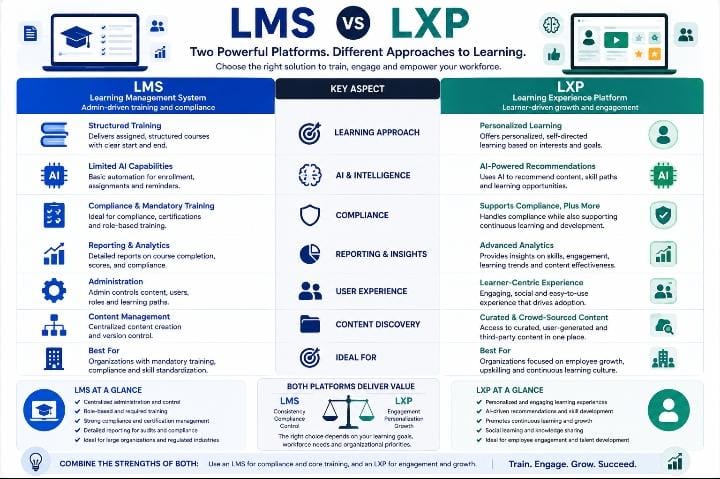
Table of Contents ▼
Quick Answer
This guide explains the differences between Learning Management Systems (LMS) and Learning Experience Platforms (LXP) and how each supports workplace learning in 2026. It covers LMS structure, LXP personalization, content sources, reporting, learner experience, AI-powered learning, data standards, accessibility, and training ROI. The article also explains when organizations may use an LMS, an LXP, or both together.
Key Takeaways
- An LMS focuses on structured training, compliance, onboarding, certification, and detailed tracking.
- An LXP focuses on personalized learning, content discovery, employee engagement, and continuous development.
- LMS platforms generally provide more structured learning paths and compliance reporting.
- LXP platforms allow learners to explore content from multiple sources at their own pace.
- AI is increasingly being used for content recommendations, skill-gap identification, and personalized learning paths.
- Organizations may use an LMS, an LXP, or both depending on their training goals.
- Data tracking and standards are important for both platforms.
- Accessibility should be considered when selecting and implementing learning platforms.
- Training ROI should be measured after an LMS or LXP is implemented.
Choosing Between an LXP and LMS: Everything You Need to Know
Training has changed a lot in the last few years. Companies in the USA and across the world no longer want training that feels like homework. They want learning that feels useful, quick, and personal. This shift has put two platforms at the center of every conversation about workforce training. The first is the Learning Management System, known as LMS. The second is the Learning Experience Platform, known as LXP.
If you are planning your training budget for 2026, you have likely asked yourself which one your business actually needs. This guide breaks down both platforms in plain language. It explains how they work, where they differ, and how to pick the right one for your team.
What Is an LMS?
A Learning Management System is software built to organize, deliver, and track structured training. Think of it as the backbone of corporate learning. HR teams use it to assign onboarding courses. Compliance teams use it to track certifications. Trainers use it to build courses, run quizzes, and issue completion reports.
An LMS works best when training needs structure. For example, new hire onboarding, safety training, or compliance courses all follow a fixed path. Learners complete modules in order, and the system records every step.
If you want a deeper breakdown of features, pricing, and what to look for in a platform, our guide on how to choose the right LMS for your organization in 2026 covers it step by step.
You can also explore best learning management systems to understand different LMS options.
What Is an LXP?
A Learning Experience Platform takes a different approach. Instead of pushing fixed courses, it suggests content based on what each learner needs. It works much like a streaming app. Learners get recommendations based on their role, their goals, and their past activity.
An LXP pulls content from many sources. This can include videos, articles, podcasts, and even content created by employees themselves. Because of this, learning feels less like a task and more like discovery. Employees can explore topics on their own time, at their own pace.
As a result, LXPs are popular with companies that care about continuous learning, upskilling, and employee engagement rather than just compliance.
LXP vs LMS: The Core Differences
Although both platforms support workplace learning, they solve different problems. Here is how they compare on the points that matter most.
1. Learning Structure
An LMS follows a top down structure. Admins build the path, and learners follow it. An LXP flips this. Learners explore content based on recommendations, and the system adapts as their interests change.
2. Content Source
An LMS usually hosts content created by the organization. An LXP, on the other hand, aggregates content from multiple sources, including outside providers and peer generated material.
3. Personalization
This is where the two platforms differ the most. An LMS treats every learner the same unless an admin manually assigns different paths. An LXP uses data and AI to personalize recommendations automatically. If you want to understand how AI plays a role here, our article on AI powered learning and smarter ways to train employees explains this in more depth.
4. Reporting and Compliance
Compliance training needs proof. Therefore, an LMS shines here with detailed completion records, certificates, and audit trails. An LXP focuses less on tracking completion and more on tracking engagement and skill growth.
5. User Experience
An LMS interface often feels formal and administrative. An LXP feels more like a consumer app, with search bars, playlists, and social features such as comments or ratings.
Quick Comparison Table
To make this easier, here is a simple side by side summary.
- Purpose: LMS manages and tracks formal training. LXP curates and personalizes learning content.
- Best for: LMS suits compliance, onboarding, and certification. LXP suits upskilling, reskilling, and continuous development.
- Content style: LMS relies on structured courses. LXP pulls from videos, articles, and user generated material.
- Learner control: LMS gives learners little choice in path. LXP gives learners freedom to explore.
- Reporting depth: LMS offers strong compliance reporting. LXP offers engagement and skill insights.
Which One Does Your Business Need in 2026?
There is no universal answer here, since the right choice depends on your goals. However, a few questions can help guide your decision.
Choose an LMS If
- Your industry requires strict compliance training and audit trails.
- You need a structured onboarding path for new hires.
- You must track certifications for legal or regulatory reasons.
- Your training content rarely changes and follows a fixed curriculum.
Choose an LXP If
- Your priority is employee engagement and self directed growth.
- You want to mix internal and external content in one place.
- Your workforce values flexibility over rigid course paths.
- You are focused on long term upskilling rather than one time compliance.
Choose Both If
Many companies in the USA are now combining both systems. They use an LMS for compliance and certification, while layering an LXP on top for skill development and engagement. This hybrid model is becoming one of the biggest learning trends heading into 2026.
How AI Is Changing This Decision
AI has quietly become the deciding factor in many LXP versus LMS conversations. Modern platforms now use AI to recommend content, predict skill gaps, and personalize learning paths automatically. This blurs the line between the two systems, since some LMS platforms now offer LXP like personalization features.
If your organization is exploring how AI fits into course design, our piece on AI versus traditional instructional design walks through the tradeoffs.
You can also explore AI insights powering skills based learning and professional growth in 2026 for more on AI and learning.
Why Data Standards Matter for Both Platforms
Whichever platform you pick, data tracking is essential. Modern LMS and LXP platforms rely on data standards to record learner activity accurately. This is especially true once learning moves outside a single course player.
Accessibility Is Non Negotiable
Regardless of which platform you choose, accessibility should never be an afterthought. Many companies in the USA face legal requirements around accessible training content. Before you launch any new platform, it helps to run a quick internal review.
Measuring ROI After You Choose
Picking a platform is only half the job. After implementation, you still need to prove that training is working. Otherwise, leadership will question the investment.
To track this properly, take a look at our resource on corporate training ROI and measuring learning effectiveness. It walks through the exact metrics worth tracking once your LMS or LXP is live.
You can also explore proven ways to measure training ROI for additional guidance.
Final Thoughts
In 2026, the LXP versus LMS debate is not really about picking a winner. Instead, it is about understanding what your workforce actually needs. If compliance and structure matter most, an LMS remains the safer bet. If engagement and continuous growth matter more, an LXP brings real value. For many growing businesses, combining both delivers the best of structure and flexibility.
Frequently Asked Questions
1. What are the key differences between a Learning Experience Platform and a traditional LMS?
A traditional LMS focuses on structured courses, compliance tracking, and certification. A Learning Experience Platform focuses on personalized content discovery, pulling from many sources and adapting to each learner. In short, an LMS manages training, while an LXP curates a learning journey.
2. Which is better for corporate training, an LXP or an LMS?
It depends on the goal. For compliance heavy corporate training, an LMS is usually better because of its reporting and audit features. For skill building and engagement focused training, an LXP often performs better since it adapts to individual learner needs.
3. LMS vs LXP: Which Platform Does Your Company Actually Need?
Start by listing your training goals. If certification, audit trails, and structured onboarding top the list, an LMS fits best. If your goal is ongoing upskilling and a more flexible learning culture, an LXP fits best. Many companies in the USA now use both together for a complete solution.
4. How to Choose Between an LMS and LXP Without Getting Confused by Marketing
Ignore buzzwords and focus on outcomes. Ask what problem you are solving, who your learners are, and how you will measure success. Vendors often blend LMS and LXP features, so judge a platform by its actual capabilities during a demo, not by its label.
5. Recommendations for an LMS that integrates well with existing HR software?
Look for platforms that offer ready made integrations or open APIs for HRIS systems such as Workday, BambooHR, or ADP. Strong single sign on support and automatic user syncing are also important. A consulting partner can help test these integrations before you commit to a contract.
References
- Gallup. Global Employee Engagement Report.
https://www.gallup.com - LinkedIn Learning. Workplace Learning Report.
https://learning.linkedin.com - Model Context Protocol Documentation.
https://modelcontextprotocol.io - eLearning Industry. LMS and LXP Software Directory.
https://elearningindustry.com - TheEduAssist. How to Choose the Right LMS for Your Organization in 2026.
https://theeduassist.com/blog/how-to-choose-the-right-lms-for-your-organization-in-2026/ - TheEduAssist. AI Powered Learning: A Smarter Way to Train and Upskill Employees.
https://theeduassist.com/blog/ai-powered-learning-a-smarter-way-to-train-and-upskill-employees/ - TheEduAssist. xAPI Learning Record Store (LRS): Everything You Need to Know in 2026.
https://theeduassist.com/blog/xapi-learning-record-store-lrs-everything-you-need-to-know-in-2026/
Authorised By
Hifza Naeem
Sources & References
Frequently Asked Questions
QWhat are the key differences between a Learning Experience Platform and a traditional LMS?
A traditional LMS focuses on structured courses, compliance tracking, and certification. A Learning Experience Platform focuses on personalized content discovery, pulling from many sources and adapting to each learner. In short, an LMS manages training, while an LXP curates a learning journey.
QWhich is better for corporate training, an LXP or an LMS?
It depends on the goal. For compliance heavy corporate training, an LMS is usually better because of its reporting and audit features. For skill building and engagement focused training, an LXP often performs better since it adapts to individual learner needs.
QLMS vs LXP: Which Platform Does Your Company Actually Need?
Start by listing your training goals. If certification, audit trails, and structured onboarding top the list, an LMS fits best. If your goal is ongoing upskilling and a more flexible learning culture, an LXP fits best. Many companies in the USA now use both together for a complete solution.
QHow to Choose Between an LMS and LXP Without Getting Confused by Marketing
Ignore buzzwords and focus on outcomes. Ask what problem you are solving, who your learners are, and how you will measure success. Vendors often blend LMS and LXP features, so judge a platform by its actual capabilities during a demo, not by its label.
QRecommendations for an LMS that integrates well with existing HR software?
Look for platforms that offer ready made integrations or open APIs for HRIS systems such as Workday, BambooHR, or ADP. Strong single sign on support and automatic user syncing are also important. A consulting partner can help test these integrations before you commit to a contract.