
How to Master Kajabi Keyword Research for Higher Rankings
Learn how to conduct Kajabi keyword research, find low-difficulty keywords, optimize course pages, and grow organic traffic with a strategic blogging approach.
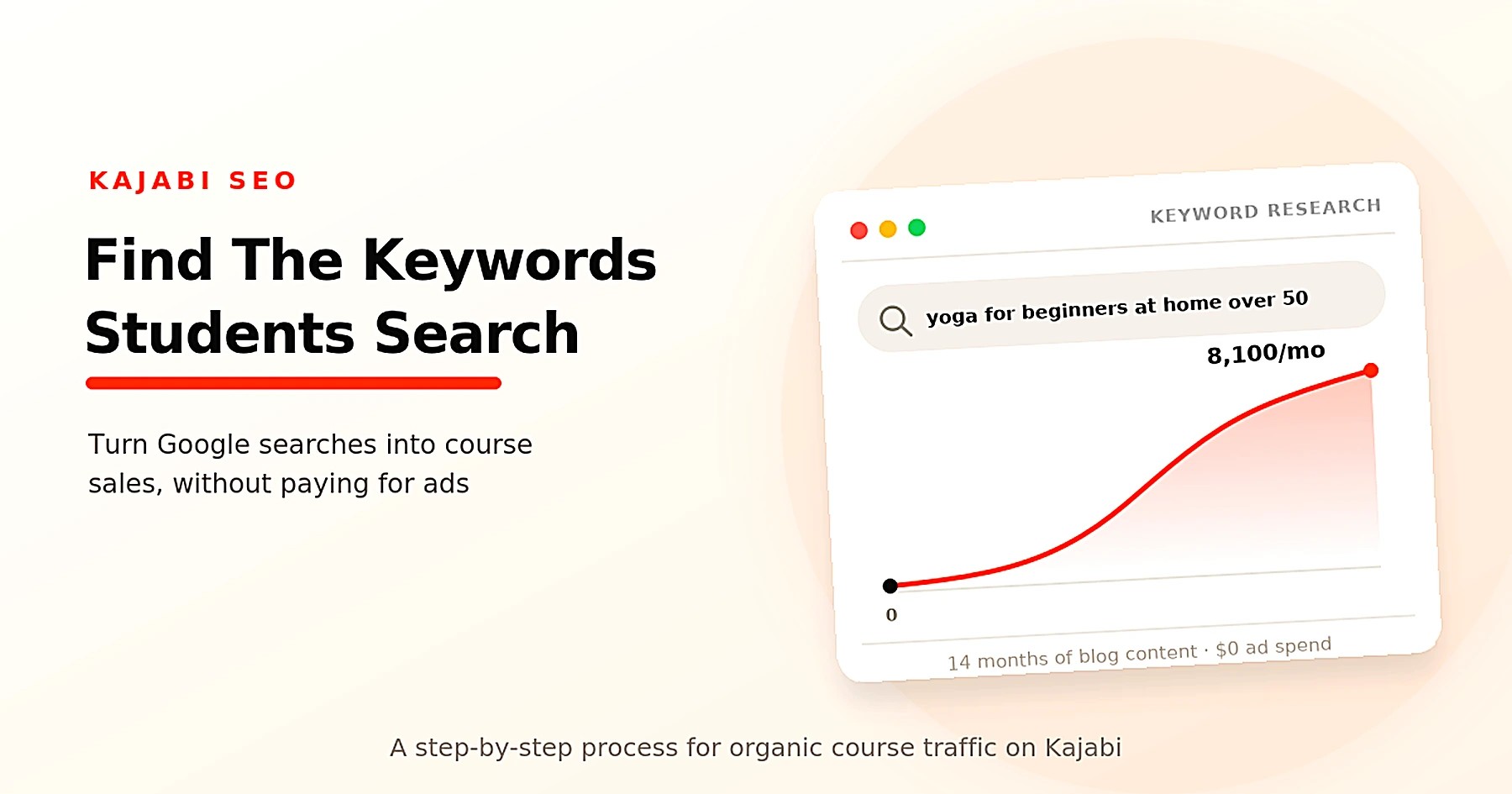
Table of Contents ▼
Quick Answer
This guide explains how to conduct keyword research for Kajabi websites, from defining your audience and finding seed keywords to analyzing search intent, keyword difficulty, and search volume. It covers keyword research tools, on-page optimization, blogging strategies, content clusters, common mistakes, and a practical SEO checklist.
Key Takeaways
- Identify your target audience and research relevant keywords based on search intent, volume, and difficulty.
- Use tools such as Semrush, Google Search Console, and Google Autocomplete to discover and evaluate keywords.
- Optimize Kajabi pages with primary and secondary keywords, descriptive headings, meta descriptions, and internal links.
- Build organic traffic through consistent blogging, content clusters, and links between blog posts and course pages.
So, you built a great Kajabi course. But nobody finds it on Google. That happens because most creators skip Kajabi keyword research. As a result, their pages stay buried under competitors’
Fortunately, this guide solves that problem. It walks you through Kajabi keyword research from start to finish. If you want a team to handle this work for you, you can use professional Kajabi SEO services to grow organic traffic for your business.
What Is Kajabi Keyword Research and Why Does It Matter?
Simply put, Kajabi keyword research is how you find words your students type into Google. Then, you use those words to optimize your pages. Because of this, your courses show up when people are ready to buy.
Moreover, good keyword research builds trust with Google over time. In other words, it helps you grow without paying for ads.
Here are the three big benefits:
- Higher visibility: So your pages appear in more searches.
- Better conversions: Because organic visitors already want what you sell.
- Long-term growth: Unlike ads, SEO keeps working for free.
Is Kajabi Good for SEO?
Yes, but first, you need to know both its strengths and limits.
So, Kajabi works well for niche course topics. To master all the basic settings, read our complete Kajabi SEO optimization guide for beginners. With a solid plan, page-one rankings are totally within reach.
Step-by-Step Kajabi Keyword Research Process
Step 1: Define Your Audience
First, think about who you want to reach. Specifically, ask, “What does my ideal student search for before buying?” For example, a Kajabi yoga teacher might target people who search for “gentle yoga for beginners at home.”
Step 2: Find Seed Keywords
Next, brainstorm 8–10 broad terms about your course topic. Then, use Semrush or Google Autocomplete to turn those into hundreds of specific phrases. As a result, you get a full list to work from.
Step 3: Match Search Intent
After that, check the intent behind each keyword. In other words, why is someone searching that phrase? Consequently, you must match your content type to that intent.
Step 4: Check Keyword Difficulty
Now, filter your list by difficulty. Specifically, look for a Keyword Difficulty (KD) score under 40. Also, aim for monthly searches between 100 and 2,000. That way, you pick battles you can actually win.
Step 5: Pick Your Keywords
Finally, give each page one primary keyword. Then, add two to four related secondary keywords. For instance, use “Kajabi keyword research” as primary and “Kajabi SEO tips” as secondary.
Best Tools for Kajabi Keyword Research
So, which tools should you use? Here are the top four:
- Semrush: Best for search volume, difficulty scores, and gap analysis.
- Google Search Console: Shows you which queries already send traffic.
- Google Autocomplete: Free, fast, and based on real searches.
- People Also Ask: Perfect for FAQ content and featured snippets.
How to Optimize Keywords on Your Kajabi Site
Once your Kajabi keyword research is done, placement matters just as much. You should also follow smart Kajabi website speed optimization tips to keep your pages fast and responsive. Then, use this table as your guide:
Kajabi Blogging: Your Biggest SEO Lever
Above all, do not ignore the Kajabi blog. Yet, most creators never use it for SEO. However, establishing a structured Kajabi blogging strategy is the fastest way to build topical authority and group your posts into high-ranking content clusters.
So, here is what to do:
- First, write posts around questions your audience searches.
- Then, link every post to a relevant course page.
- Finally, cluster related posts around one main pillar page.
For example, a business coach might write 10 posts about pricing, marketing, and launching, all of which link to their core Kajabi coaching program.
Real Case Study: From Zero to 8,000 Monthly Visitors
To illustrate, let us look at Sarah. She is a Kajabi yoga instructor from Austin, Texas. In early 2022, she had zero organic traffic. However, after doing proper Kajabi keyword research with Semrush, she found long-tail phrases like “yoga for beginners at home over 50.”
Then, over 14 months, she published 32 short blog posts. Each one targeted a low-difficulty keyword. Also, each post linked back to her main course page. By month 8, her site reached 3,200 monthly visitors. By month 14, that number grew to 8,100. Moreover, 67% of all her course sales came from organic search.
Her total ad spend: zero.
Key takeaway: So, consistent keyword-matched content beats paid ads every time. To learn more about long-tail strategies like Sarah’s, read the Ahrefs Long-Tail Keywords Guide.
Common Mistakes to Avoid
- Chasing broad keywords: Instead, go narrow first, then expand later.
- Ignoring intent: Otherwise, your content will not rank no matter how good it is.
- Keyword stuffing: On the contrary, natural use always wins over forced repetition.
- Not tracking results: Without data, you simply cannot improve.
Kajabi Keyword Research Checklist
So, before you hit publish, run through this list:
- Primary keyword confirmed with volume and difficulty data
- Search intent matched to your content type
- Primary keyword in SEO title, H1, meta description, and URL
- Secondary keywords placed in H2 and H3 headings
- At least two internal links with descriptive anchor text
- Page added to Google Search Console for tracking
Final Thoughts
So, let us recap. Kajabi keyword research is the foundation of all Kajabi SEO growth. First, know your audience well. Then, find low-difficulty keywords they actually search. After that, match your content to their intent. Finally, optimize every page and blog consistently.
In short, the creators who win on Google are not always the most talented. Rather, they are simply the most strategic. So, start today, pick one keyword, write one post, and build from there. Over time, the results will compound.
Sources & References
Frequently Asked Questions
QIs Kajabi SEO-friendly?
Yes. Specifically, Kajabi supports custom meta tags, clean URLs, fast pages, and a built-in blog. So, it covers the basics well.
QIs Kajabi good for SEO?
Absolutely, especially for niche topics. However, you still need smart keyword research to see results
QHow do I boost SEO on Kajabi sites?
First, do proper Kajabi keyword research. Then, optimize every page element. After that, publish consistent blog content around low-difficulty keywords.
QDoes Kajabi blogging help rankings?
Yes, it does. In fact, blogging is one of the fastest ways to grow your Kajabi organic traffic over time