The Ultimate Guide to Launching a 6-Week Online Course on New LMS in Tasmania
Learn how Tasmanian course creators can successfully launch a 6-week online course on a new LMS in 2026 with practical steps, instructional design tips, and strategies tailored for Tasmania.
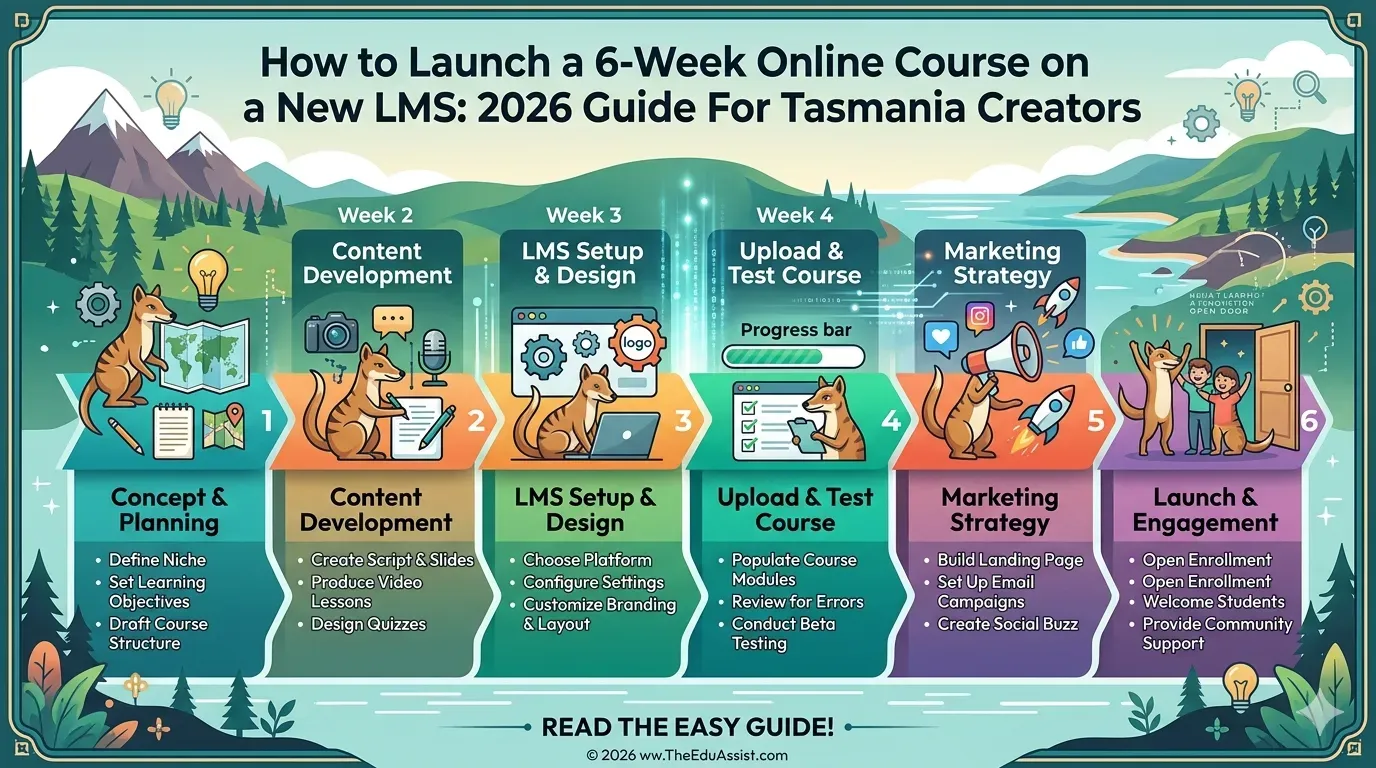
Table of Contents ▼
Quick Answer
This guide explains how to launch a structured 6-week online course on an LMS in Tasmania. It covers defining learning outcomes, organizing weekly modules, choosing an LMS platform, using drip content, creating interactive learning experiences, combining live and self-paced learning, and tracking learner progress. The guide also explores the growing role of cohort-based learning in modern online education.
Key Takeaways
- Structure the six weeks around a clear learner transformation, progressing from foundational knowledge to practical application and mastery.
- Use LMS features such as modules, drip scheduling, assessments, and analytics to create a guided and measurable learning experience.
- Combine self-paced content with interactive activities and live support to improve engagement, accountability, and course completion.
Launching a structured online course is one of the fastest ways to turn expertise into a scalable digital product. However, many course creators struggle when transitioning from raw content to a fully functional LMS-based course.
Across Tasmania, especially in Hobart, Launceston, Devonport, and Burnie, educators, coaches, and EdTech startups are increasingly building structured programs, but often face the same challenge:
- Content is ready
- Lessons are recorded
- But the course is not properly structured, sequenced, or deployed on an LMS
This is where most 6-week courses fail, not because of poor content, but due to a lack of instructional design, LMS planning, and structured delivery.
Why Structured eLearning Programs Work (Research Insight)
Research shows that well-designed eLearning programs improve knowledge acquisition, skill development, and real-world performance when they include structured delivery and relevant content.
Additionally, effective eLearning programs combine:
- Synchronous learning (live sessions)
- Asynchronous learning (self-paced modules)
- Practical application
These blended approaches significantly improve learner engagement and outcomes.
Another key insight:Courses that use short lessons, sequential release, and frequent assessments show higher engagement and completion rates.
This is exactly what a 6-week course model is designed to achieve.
The Core Problem: Why Most 6-Week Courses Fail
Many creators design 6-week courses as:
- A collection of videos
- Loosely organized modules
- Inconsistent lesson delivery
This leads to:
- Low completion rates
- Learner confusion
- Poor engagement
The missing element is structured curriculum design and LMS strategy.
Step 1: Define the 6-Week Transformation
A successful course starts with a clear outcome.
Instead of: “Teach a topic over 6 weeks”
Define: “What transformation will learners achieve in 6 weeks?”
Example:
- Week 1–2 → Foundational knowledge
- Week 3–4 → Skill development
- Week 5–6 → Application and mastery
This aligns with instructional design best practices and ensures logical progression.
Step 2: Structure Weekly Modules (The 6-Week Framework)
A well-designed 6-week course should follow a consistent structure:
- Week 1: Introduction + fundamentals
- Week 2: Core concepts
- Week 3: Applied learning
- Week 4: Advanced strategies
- Week 5: Real-world projects
- Week 6: Final implementation + review
Each week should include:
- Short video lessons
- Interactive activities
- Assignments
- Feedback loops
This supports microlearning and structured content development.
Step 3: Choose the Right LMS Platform
Your LMS determines how learners experience your course.
Popular platforms include:
- Kajabi
- Thinkific
- Teachable
- Organize weekly modules
- Drip content over 6 weeks
- Track learner progress
- Manage student engagement
For creators in Tasmania, LMS platforms ensure your course is scalable and professionally delivered.
Step 4: Use Drip Content for Better Engagement
One of the biggest mistakes is releasing all content at once.
Instead, use drip scheduling:
- Release content weekly
- Guide learners step-by-step
- Prevent overwhelm
Research shows that sequential content delivery improves engagement and completion rates.
This approach is essential for 6-week programs.
Step 5: Build Interactive Learning Experiences
To increase engagement, include:
- Quizzes and assessments
- Scenario-based exercises
- Practical assignments
- Discussion prompts
Interactive elements help learners:
- Apply knowledge
- Stay engaged
- Retain information
These activities should be built into well-structured eLearning modules to support consistent learner engagement.
This is a core part of custom eLearning and modern L&D strategies.
Step 6: Combine Live + Self-Paced Learning
A high-performing 6-week course uses a blended learning model:
- Self-paced lessons (videos + modules)
- Live sessions (Q&A, coaching, feedback)
You can also explore how audio, video, and workbook-based learning can create a richer online learning experience.
Research shows that combining synchronous and asynchronous learning improves outcomes and learner satisfaction.
Step 7: Track Progress and Optimize
Use LMS analytics to monitor:
- Completion rates
- Quiz scores
- Engagement levels
This helps you:
- Identify weak modules
- Improve content
- Optimize learner experience
Data-driven improvement is a key part of consulting services and advanced course optimization.
Cost Reality Check: Launching a 6-Week Course
| Category | Estimated |
|---|---|
| Instructional design | $2,000 – $6,000 |
| Video production | $1,000 – $4,000 |
| LMS subscription | $39 – $199/month |
| Content development | $500 – $2,000 |
While many creators start DIY, investing in custom eLearning and structured content development significantly improves results.
Unique Perspective: The “Cohort-Based Learning Advantage”
In 2026, 6-week courses are evolving into cohort-based programs.
This means:
- Learners move together
- Deadlines create accountability
- Interaction increases engagement
Cohort-based models often result in:
- Higher completion rates
- Better learner outcomes
- Stronger community building
This aligns with eLearning trends 2026 and modern course design strategies.
Final Thoughts
For creators in Tasmania, launching a 6-week online course is a powerful way to scale expertise into a structured digital product.
However, success depends on:
- Clear learning outcomes
- Structured weekly modules
- LMS-based delivery
- Interactive learning design
- Data-driven optimization
By combining instructional design, content development, and LMS strategy, you can create a course that is not only functional, but engaging, scalable, and results-driven.
Need Help Building or Scaling Your Online Learning Program?
Whether you are launching an academy on Kajabi, modernizing corporate LMS modules, or converting raw expertise into accredited curriculum, our senior instructional designers provide a complimentary architecture evaluation.
Sources & References
- Effectiveness of eLearning programme for capacity building of healthcare professionals: a systematic review
- Methods to achieve effective web-based learning management modules: MyGJU versus Moodle
- Practical tips for a fast and successful transition to an online curriculum
- Study E-learning Design Mistakes That Prevents Retention Rate of the Learner
- Instructional Design in Action: Practical Solutions for Learner Problems
- Want to Airbnb Skills? Start with this Course Framework
- 10 Best Learning Management Systems Compared
- LMS Implementation Guide: Steps for a Successful Launch
- Thinkific Courses that Learners of US Actually Complete
- How to Create Engaging Educational Content for Online Platforms
- Stop Ineffective Training: How to Build Uplifting eLearning Modules?
- The Ultimate 2026 Guide for Audio, Video, and Workbook Based Lifestyle eLearning Courses
Frequently Asked Questions
QWhat is the best structure for a 6-week online course?
A 6-week course should include weekly modules, progressive learning, assignments, and final implementation projects.
QHow long should lessons be in a 6-week course?
Short lessons (5–10 minutes) are ideal for maintaining engagement.
QShould I release all course content at once?
No, drip content delivery improves engagement and prevents overwhelm.
QWhich LMS is best for launching a course?
Platforms like Kajabi, Thinkific, and Teachable are popular choices.
QHow can TheEduAssist help launch a 6-week course?
Through edu-assist consulting services, [TheEduAssist.com](https://www.theeduassist.com) helps creators design custom eLearning programs, LMS setup, and structured content development for scalable courses.