AI Insights Powering Skills-Based Learning and Professional Growth in 2026
Discover 7 AI insights shaping Learning and Development in 2026, from personalized learning and skills intelligence to predictive analytics, AI assistants, and workforce planning.
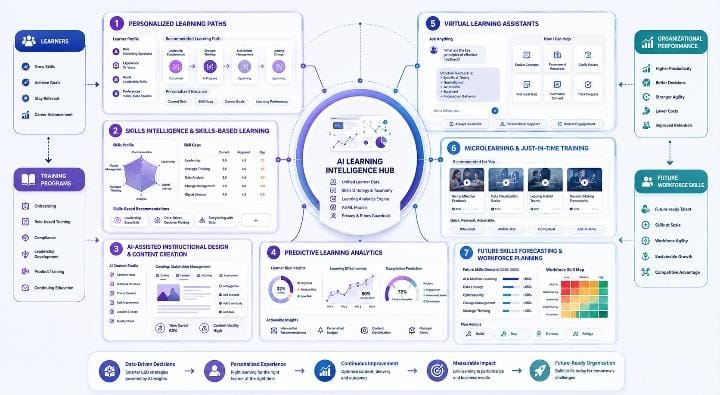
Table of Contents ▼
Quick Answer
This article explores seven major AI insights shaping Learning and Development in 2026. It explains how AI is enabling personalized learning paths, skills-based learning, AI-assisted instructional design, predictive learning analytics, virtual learning assistants, microlearning optimization, and future skills forecasting. The article also highlights the importance of responsible AI adoption, including privacy, fairness, human oversight, and alignment between learning and organizational goals.
Key Takeaways
- AI is becoming a major driver of Learning and Development, influencing training, skills development, learner engagement, and workforce planning.
- Personalized learning paths allow AI systems to adapt learning experiences according to learner roles, skills, performance, and needs.
- Skills intelligence is shifting L&D toward skills-based learning, helping organizations identify current and future skill gaps.
- AI can support instructional design and content development, but human expertise remains important for maintaining quality and meaningful learning experiences.
- Predictive learning analytics can help identify disengagement risks and provide organizations with insights for earlier intervention.
- AI-powered virtual coaches and learning assistants can provide learners with real-time guidance and support.
- Microlearning and just-in-time training can become more targeted when AI uses performance and workflow information to recommend relevant learning.
- AI can connect learning with strategic workforce planning, helping organizations prepare for changing skill requirements.
- Responsible AI adoption is essential, particularly regarding privacy, fairness, transparency, and human oversight.
- The future of L&D is likely to combine AI capabilities with human instructional expertise, rather than treating AI as a complete replacement for people.
AI Insights Powering Skills-Based Learning and Professional Growth in 2026
7 AI Insights Shaping Learning and Development in 2026
Learn the 7 best AI insights changing Learning and Development in 2026. Understand the future of workplace growth through artificial intelligence, personalized learning, skills based training, and analytics, and how TheEduAssist helps organizations put these insights into practice.
The Emergence of AI in Learning and Development
Artificial Intelligence (AI) is no longer a new topic in Learning and Development (L&D), it is now a driving force behind organizational training, upskilling, and workforce readiness. In 2026, AI is transforming how instruction is designed, how learners engage, how performance is measured, and how workforce planning happens.
Organizations today face rapid technological change, shifting job roles, and a widening skills gap. Traditional training models simply cannot keep pace. AI driven learning solutions address these challenges by making training smarter, faster, and far more personalized. This article walks through the 7 most important AI insights shaping Learning and Development in 2026, covering practical applications, future impact, and strategic value.
What Are AI Insights in Learning and Development?
AI insights in L&D are findings generated through artificial intelligence technologies such as machine learning, natural language processing, and predictive analytics. These insights help organizations better understand learners, identify skill gaps, and optimize content and training in line with business goals.
Rather than relying on assumptions, AI insights support evidence based decision making, which improves both the effectiveness and efficiency of learning while making it easier to scale. Many organizations now partner with providers like TheEduAssist to turn these insights into working learning strategies.
Why Organizations Are Using AI in Learning and Development
The shift toward AI in workplace training is driven by several pressing needs:
- Managing large and diverse groups of learners
- Delivering personalized instruction at scale
- Reducing training costs and development time
- Measuring the real impact of learning
- Closing employee skill gaps through targeted training
By 2026, AI has become essential for any organization committed to lifelong learning and long term employability.
Where AI Is Most Useful in Learning and Development
AI supports L&D across the entire learning lifecycle, including:
- Skills mapping and learning needs analysis
- Instructional design and content creation
- Learner engagement and online mentoring
- Assessment and evaluation
- Learning analytics and reporting
- Workforce planning and reskilling
These capabilities have made AI one of the central pillars of modern learning systems, and a core focus of TheEduAssist’s learning solutions.
The 7 AI Insights Shaping the Future of Learning and Development in 2026
1. AI Powered Individualized Learning Paths
AI driven personalized learning has matured significantly by 2026. AI applications analyze a learner’s role, skill level, performance, and preferences to build tailored learning experiences.
The right content reaches learners at the right time, reducing cognitive overload while maximizing understanding. This shift improves both learner satisfaction and overall learning outcomes.
2. Skills Intelligence and Skills Based Learning Models
AI insights help organizations move away from traditional course catalogs toward learning ecosystems built around skills. AI compares current workforce competencies against future job demands to identify gaps, systematically mapping primary and secondary technical domain skills across departments.
This insight-driven strategy allows L&D teams to focus on high-impact competencies, objectively measure technical proficiency levels, and foster organizational teachability and learning agility to prepare teams for automated workflows.
3. AI Powered Content Generation and Instructional Design
Instructional designers now use AI to help create course outlines, assessments, microlearning modules, and knowledge checks. In 2026, the best results come from pairing human expertise with AI efficiency.
This partnership shortens development timelines while maintaining strong instructional quality and consistency.
4. Predictive Learning Analytics and Performance Insights
AI enabled learning analytics in 2026 go far beyond descriptive reporting. Predictive models identify learners who may disengage during training and forecast likely training outcomes.
This allows L&D teams to intervene early, improving completion rates and overall educational effectiveness.
5. Virtual Coaches and Intelligent Learning Assistants
AI powered chatbots and virtual learning assistants provide real time guidance, answer learner questions, and reinforce key concepts. These tools now serve as scalable support within LMS platforms.
They help learners build independence while reducing their reliance on instructors for routine questions.Where AI Is Most Useful in Learning and Development
AI supports L&D across the entire learning lifecycle, including:
- Skills mapping and learning needs analysis
- Instructional design and content creation
- Learner engagement and online mentoring
- Assessment and evaluation
- Learning analytics and reporting
- Workforce planning and reskilling
These capabilities have made AI one of the central pillars of modern learning systems, and a core focus of TheEduAssist’s learning solutions.
The 7 AI Insights Shaping the Future of Learning and Development in 2026
1. AI Powered Individualized Learning Paths
AI driven personalized learning has matured significantly by 2026. AI applications analyze a learner’s role, skill level, performance, and preferences to build tailored learning experiences.
The right content reaches learners at the right time, reducing cognitive overload while maximizing understanding. This shift improves both learner satisfaction and overall learning outcomes.
2. Skills Intelligence and Skills Based Learning Models
AI insights help organizations move away from traditional course catalogs toward learning ecosystems built around skills. AI compares current workforce competencies against future job demands to identify gaps.
This insight driven strategy allows L&D teams to focus on high impact skills and design targeted learning interventions aligned with business strategy.
3. AI Powered Content Generation and Instructional Design
Instructional designers now use AI to help create course outlines, assessments, microlearning modules, and knowledge checks. In 2026, the best results come from pairing human expertise with AI efficiency.
This partnership shortens development timelines while maintaining strong instructional quality and consistency.
4. Predictive Learning Analytics and Performance Insights
AI enabled learning analytics in 2026 go far beyond descriptive reporting. Predictive models identify learners who may disengage during training and forecast likely training outcomes.
This allows L&D teams to intervene early, improving completion rates and overall educational effectiveness.
5. Virtual Coaches and Intelligent Learning Assistants
AI powered chatbots and virtual learning assistants provide real time guidance, answer learner questions, and reinforce key concepts. These tools now serve as scalable support within LMS platforms.
They help learners build independence while reducing their reliance on instructors for routine questions.
6. Microlearning and Just In Time Training Optimization
AI insights make it possible to deliver microlearning content exactly when learners need it. Short, focused modules are suggested based on task requirements, performance gaps, and workflow context.
This approach improves retention and embeds learning directly into the flow of work.
7. Future Skills Forecasting and Strategic Workforce Planning
By 2026, AI connects learning data directly to workforce planning. Organizations use AI insights to forecast future skill needs, align training investments, and support long term talent strategy.
This positions L&D as a genuine strategic partner rather than simply a support function.
The Future of Learning and Development: The Role of AI
AI will continue evolving from a support tool into a true strategy enabler. Its expanding role includes:
- Empowering lifelong learning models
- Supporting organization wide reskilling
- Increasing access to learning opportunities
- Improving decision making through real time insights
Organizations that adopt AI responsibly will build a sustainable competitive advantage in talent development.
Important AI Applications in Learning and Development
By 2026, responsible AI adoption in L&D includes several key priorities:
- Promoting fair and ethical learning recommendations
- Protecting learner privacy and data
- Enhancing, not replacing, human instructional expertise
- Helping businesses connect training to real outcomes
Responsible AI adoption is essential for maintaining both effectiveness and trust.
Conclusion
The most important AI insights shaping Learning and Development in 2026 reflect a clear shift toward personalization, skills intelligence, predictive analytics, and strategic alignment. AI enables organizations to deliver learning experiences that are meaningful, scalable, and built for the future.
By using AI driven insights responsibly, L&D leaders can turn training from a reactive task into a proactive driver of organizational success. Working with a partner like TheEduAssist can help organizations apply these insights effectively and build learning systems ready for what comes next.
As the future of work continues to take shape, AI driven Learning and Development will remain a foundation for workforce resilience and program.
Need Help Building or Scaling Your Online Learning Program?
Whether you are launching an academy on Kajabi, modernizing corporate LMS modules, or converting raw expertise into accredited curriculum, our senior instructional designers provide a complimentary architecture evaluation.
Sources & References
Frequently Asked Questions
QWhat is AI in Learning and Development?
AI in Learning and Development refers to using artificial intelligence technologies to improve how organizations design, deliver, personalize, assess, and manage learning. AI can help identify skills gaps, personalize learning experiences, analyze learner data, and support instructional design.
QHow is AI changing Learning and Development in 2026?
AI is changing L&D through personalized learning paths, skills intelligence, AI-assisted content development, predictive analytics, virtual learning assistants, microlearning recommendations, and workforce skills forecasting.
QWhat are the biggest AI trends in L&D?
The major trends discussed in this article are individualized learning paths, skills-based learning, AI-powered instructional design, predictive learning analytics, virtual learning assistants, AI-optimized microlearning, and future skills forecasting.
QHow does AI personalize learning?
AI can analyze information such as a learner's role, skill level, performance, and learning needs to recommend content and learning activities that are more relevant to that individual.
QWhat is skills intelligence?
Skills intelligence uses data and AI-based analysis to understand the skills an organization currently has, identify gaps, and compare existing capabilities with future workforce requirements.
QCan AI replace instructional designers?
AI can assist instructional designers with tasks such as creating outlines, assessments, microlearning content, and knowledge checks. However, the article emphasizes combining AI efficiency with human expertise rather than treating AI as a replacement for instructional professionals.