LearnWorlds for Corporate Training: Does It Scale?
LearnWorlds can support corporate training through course creation, learner management, assessments, analytics, and customization. Explore whether it can scale with growing teams and increasingly complex training needs.
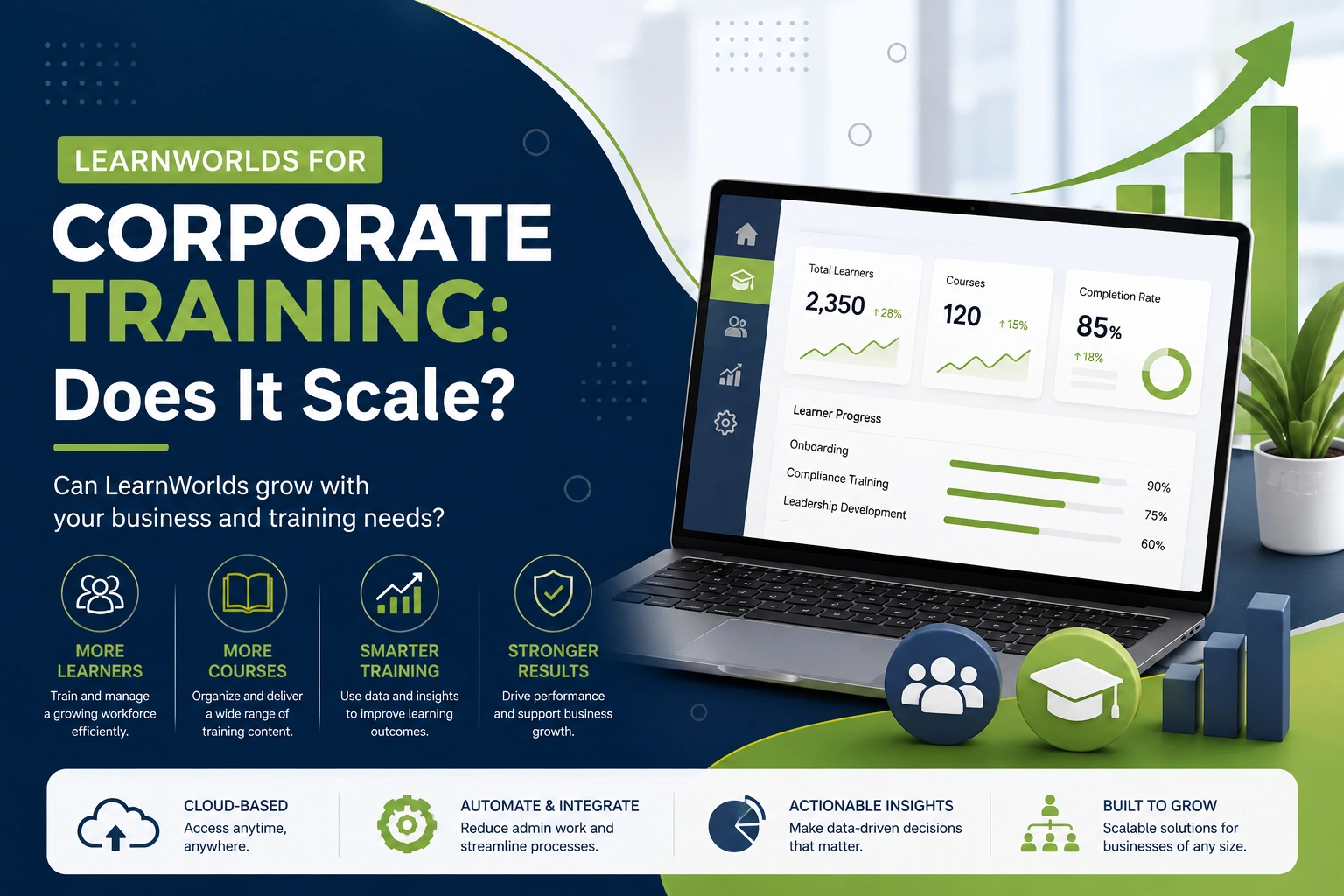
Table of Contents ▼
Quick Answer
LearnWorlds can support corporate training for growing businesses with tools for course creation, assessments, learner management, analytics, and customization. It may be a strong fit for small and mid-sized organizations, while larger enterprises should evaluate integrations, permissions, reporting, and administrative requirements before choosing it.
Key Takeaways
- LearnWorlds supports employee onboarding and ongoing training.
- It can organize courses for different teams and departments.
- Scalability involves learners, content, and administration.
- Growing companies should evaluate integrations and reporting.
- Large organizations may need more advanced enterprise features.
What happens when your company outgrows its training system?
As your workforce grows, training becomes harder to manage. More employees mean more onboarding. Different teams need different skills. More learners also create more tracking and administrative work. A system that works for 50 employees may struggle with 500.
This is where scalability becomes important. LearnWorlds for corporate training provides tools for course creation, assessments, learner management, and progress tracking. These features can help businesses build structured training programs as they grow.
But can LearnWorlds handle larger teams, growing training libraries, and increasing administrative demands? This guide explores its scalability and helps you decide if it fits your company’s long-term training needs.
What Is LearnWorlds?
LearnWorlds is a cloud-based learning management system (LMS). It helps businesses create, manage, and deliver online training. It includes tools for courses, assessments, learner management, analytics, and customization. Businesses can use it for employee onboarding, professional development, and corporate training.
Why Use LearnWorlds for Corporate Training?
Corporate training is rarely one-size-fits-all. New hires need onboarding. Sales teams need product training. Managers may need leadership programs. Different departments may also need different learning paths. A flexible corporate learning platform can manage these needs in one place.
Make Employee Onboarding Easier
New employees have a lot to learn. A structured employee onboarding process can make the transition easier. Companies can create onboarding courses for policies, tools, and processes. They can also explain key job responsibilities.
New hires can then access the same core training. Even better, companies can reuse these courses for future employees.
Support Ongoing Employee Development
Employee training should not end after onboarding. Employee development helps people build new skills as their roles change. Businesses can create training for leadership, communication, sales, and technical skills. They can also build programs for customer service and professional development. This keeps employee learning active beyond onboarding.
Train Customers and Partners
Corporate learning can go beyond employees. Companies may also train customers, partners, contractors, or resellers. An online corporate training platform can give each audience access to relevant learning. This can make external training easier to manage.
What Features Make LearnWorlds Useful?
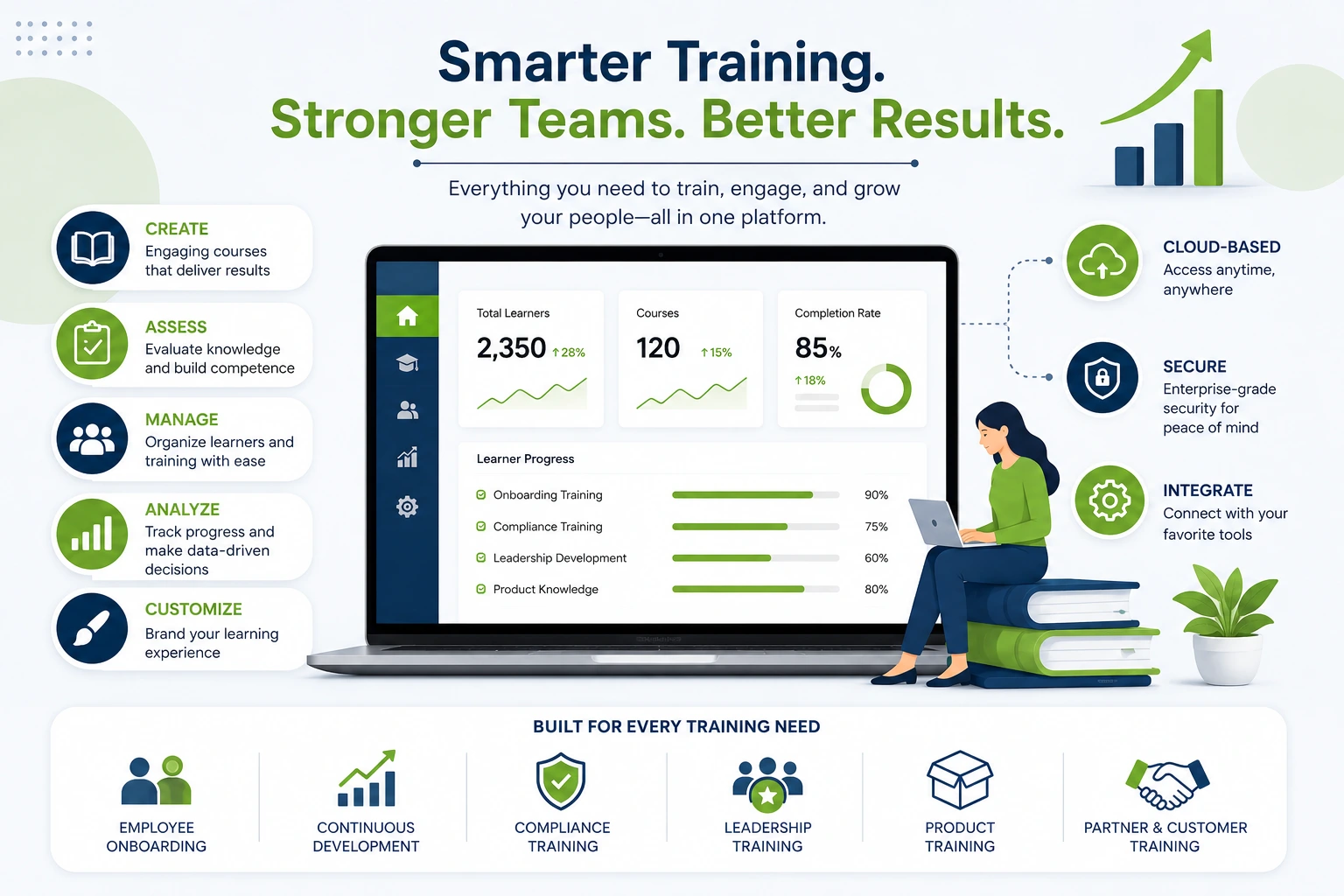
A corporate LMS needs to do more than host videos. Training teams need tools to create content, assess learners, and measure results. LearnWorlds brings these functions into one platform.
Course Creation
Effective training starts with clear and organized content. LearnWorlds lets businesses create courses and organize them into learning programs. This allows teams to tailor training to specific roles and departments.
Assessments and Certificates
Course completion does not always prove understanding. Assessments can help check learner knowledge. Certificates can also confirm completed training. This can be useful for structured employee programs.
Learner Management
Managing learners becomes more complex as companies grow. An LMS for employee training should help teams organize learners. It should also make relevant training easier to deliver. This becomes especially useful when departments follow different programs.
Analytics and Reporting
Training managers need useful data. They may want to track course completion and learner progress. Analytics can help identify areas that need attention. This gives training teams a clearer view of learner progress and engagement.
Branding and Customization
Training should feel connected to your company. LearnWorlds offers customization options for the learning environment. Businesses can use these options to create a more branded experience.
Can LearnWorlds Scale With Business Growth?
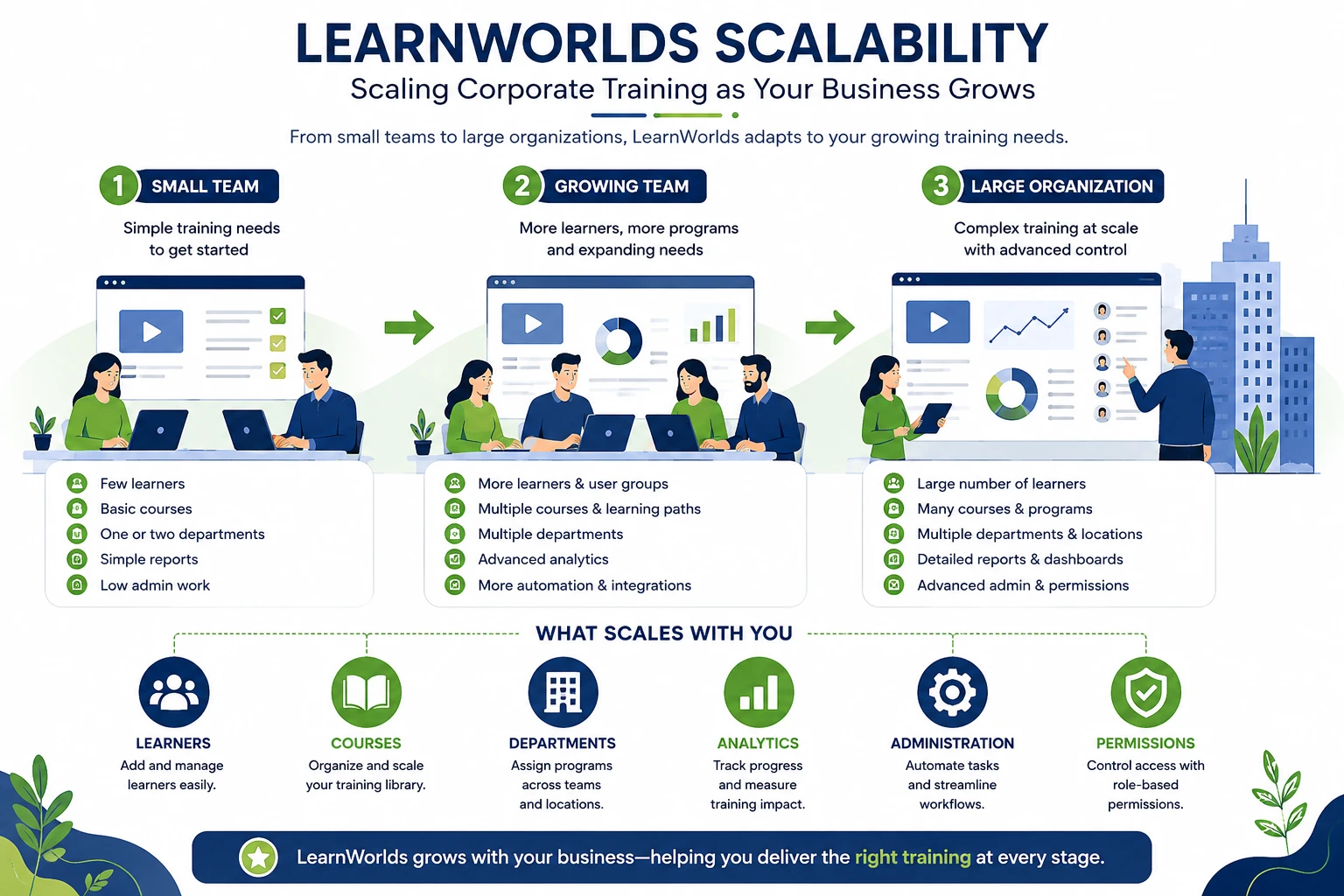
But here is the bigger question: can it handle growth? Scalability is about more than learner numbers. Growth also brings more courses, teams, programs, and administrative tasks. The real test is how well it handles that growth.
Managing More Learners
Picture a company with five departments. Sales needs product training. HR needs compliance training. Managers need leadership training. Each group may need different content. As the workforce grows, manual management becomes harder.
Businesses should assess how easily they can organize growing learner groups. They should also consider how efficiently they can assign courses. This is a key part of evaluating LearnWorlds scalability.
Organizing More Training Content
Business growth often brings a larger training library. A small business may have only a few courses. A larger company may have dozens of programs. These could cover onboarding, compliance, leadership, and products.
Without structure, employees may struggle to find the right course. A scalable learning environment should keep content organized. Simple navigation can help employees find the right training faster.
Reducing Administrative Work
A larger workforce can also increase repetitive administrative work. Training teams may need to assign courses, track progress, and manage learner records. This is where automation and integrations become important. These tools can reduce manual tasks and connect training with other business processes.
So, can LearnWorlds scale with business growth?
Look beyond the number of users. Evaluate the complete training workflow.
Is LearnWorlds Suitable for Different Company Sizes?
The right LMS can vary by company size and training needs. A small company may want simplicity. A growing company may need stronger organization. A large enterprise may need advanced controls and integrations.
Small Businesses
Small teams often need a simple training setup. LearnWorlds can provide one place for online training. Businesses can create structured courses without adding unnecessary complexity.
Growing Companies
As companies grow, their training programs often become more diverse. They may need separate programs for onboarding and leadership. Sales, compliance, and professional development may need separate courses too.
LearnWorlds can help organize these different learning needs. However, companies should also consider their future needs. Their administration and integration requirements may change as they grow.
Large Organizations
For large organizations, learner numbers are only one part of the equation. They may have multiple locations and departments. They may also have different business units. Advanced permissions may become important.
Detailed reporting may also be necessary. HR integrations can become another priority. Complex workflows need careful evaluation too. This makes due diligence important for LearnWorlds for large organizations.
What Are the Benefits of LearnWorlds for Corporate Training?
A good LMS should make training easier to manage and deliver. LearnWorlds can offer several benefits:
- Centralized learning: Keep training content in one place.
- Flexible access: Let employees learn at convenient times.
- Reusable content: Use courses for future employees.
- Progress tracking: Track learner activity and completion.
- Branded learning: Create an experience that reflects your company.
- Multiple use cases: Support onboarding, skills training, and product education.
For companies building an employee development platform, these features can provide a useful foundation.
What Should Businesses Consider Before Choosing It?
An LMS may look impressive during the initial evaluation. The real test is simple:
Does it fit your business?
Start by identifying both your current and future training needs.
- Will you need HR integrations?
- Will departments need different access rules?
- Will managers need detailed reports?
- Will your training become more complex?
These questions matter when asking, “Can LearnWorlds support large teams?”
Pricing also deserves attention. Review the current LearnWorlds plans before making a decision. Then estimate your future costs. Consider your learners, required features, and integrations. Businesses with complex training needs should also compare enterprise LMS options.
LearnWorlds vs. Enterprise LMS Platforms
The biggest LMS is not always the best choice. The right platform should match your needs. When comparing LearnWorlds vs enterprise LMS solutions, consider these factors:
| Factor | LearnWorlds | Enterprise LMS |
| Course creation | Strong | Strong |
| Ease of use | User-friendly | Varies |
| Customization | Strong | Often extensive |
| Corporate training | Suitable for many businesses | Built for complex needs |
| Integrations | Available | Often broader |
| Administration | Suitable for growing teams | Designed for complex structures |
| Enterprise requirements | Depends on needs | Usually stronger |
LearnWorlds may suit businesses seeking flexible online training. It can also appeal to companies that want a simpler learning environment. An enterprise LMS may be better for complex organizations. This is especially true when advanced controls and integrations are essential.
Is LearnWorlds Good for Corporate Training?
For many businesses, yes. It offers tools for course creation and assessments. It also supports learner management, analytics, and customization. These features can support several training needs.
Examples include onboarding, professional development, and product training. However, the best choice depends on the organization. A growing company with straightforward needs may find LearnWorlds a strong fit.
A large organization may need more advanced capabilities. It may require complex HR integrations or specialized workflows. In that case, an enterprise-focused LMS may be worth considering. The best approach is to compare the platform with your actual requirements.
Final Verdict: Does LearnWorlds Scale?
LearnWorlds can be a strong choice for growing businesses. But true scalability is not just about adding more learners. It also means managing larger training libraries, different teams, growing workloads, and evolving business needs.
For small and mid-sized businesses, LearnWorlds can offer a solid balance of flexibility and functionality. Larger organizations should take a closer look at integrations, reporting, permissions, and administrative requirements before making a decision.
The real question is not simply whether LearnWorlds can handle more learners. It is whether it can keep your training efficient as your business grows.
If it can support your people, processes, and future training goals, it can become a valuable part of your long-term learning strategy.
Sources & References
- Society for Human Resource Management (SHRM). Employee Onboarding.
- Chartered Institute of Personnel and Development (CIPD). Learning and Development.
- LearnWorlds. Pricing Plans.
- Chartered Institute of Personnel and Development (CIPD). Learning and Development Strategy.
- LearnWorlds. LearnWorlds Features and Integrations.
Frequently Asked Questions
QIs LearnWorlds good for corporate training?
Yes. LearnWorlds can support employee onboarding, professional development, product training, and other corporate learning programs.
QCan LearnWorlds handle a growing number of employees?
LearnWorlds can support growing learner groups. However, businesses should also evaluate administration, integrations, reporting, and future training needs.
QWhat can LearnWorlds be used for in corporate training?
Companies can use LearnWorlds for onboarding, compliance training, leadership development, skills training, product education, and employee development.
QIs LearnWorlds suitable for large organizations?
It can be suitable for some large organizations. However, companies with complex structures should carefully assess permissions, reporting, integrations, and workflow requirements.
QHow does LearnWorlds support business growth?
LearnWorlds can help businesses manage growing training needs through course creation, learner management, analytics, customization, and structured learning programs.