Complete Guide to SaaS Curriculum Development and Training Best Practices
Learn how SaaS curriculum development creates effective training through role-based learning, microlearning, simulations, and practical training strategies.
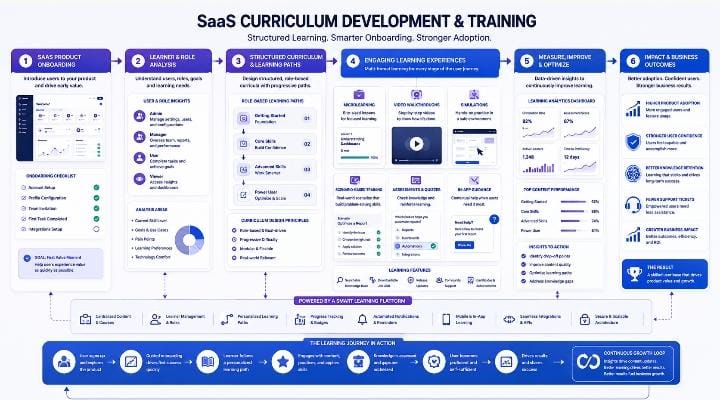
Table of Contents ▼
Quick Answer
SaaS curriculum development creates structured, role-based training that helps users, employees, sales teams, support staff, and partners understand and effectively use SaaS products. The article explains how learner analysis, progressive learning paths, use-case-driven content, microlearning, simulations, assessments, and in-app guidance can improve adoption, retention, onboarding, and business outcomes.
Key Takeaways
- SaaS curriculum development helps users understand and effectively use SaaS products.
- Effective SaaS training should be tailored to different learner roles.
- Progressive learning paths help learners move from beginner to advanced concepts without becoming overwhelmed.
- Use-case-driven and task-oriented training improves practical application.
- Microlearning, video walkthroughs, simulations, scenarios, and in-app guides support just-in-time learning.
- Strong SaaS training can improve onboarding, reduce support needs, and increase customer satisfaction.
- SaaS curriculum needs to remain flexible because products and features change frequently.
- A strong curriculum focuses on delivering the right learning to the right user at the right time.
Complete Guide to SaaS Curriculum Development and Training Best Practices
SaaS Curriculum Development: Building Training That Drives Adoption
SaaS curriculum development is the structured process of building training that helps users, employees, and partners understand and effectively use Software as a Service (SaaS) products. Unlike traditional training, SaaS curriculum development is built around continuous learning, rapid updates, and hands on practice, an approach TheEduAssist specializes in for growing SaaS teams.
[!IMPORTANT] Need an Expert SaaS Curriculum Partner? TheEduAssist designs custom software onboarding, customer academy curricula, and interactive microlearning modules. Explore our Instructional Design Services and Custom eLearning Development to scale user adoption.
What a Seasoned SaaS Curriculum Designer Does
A SaaS curriculum designer does far more than create training materials. Their learning systems are built to solve real business problems.
Breaking Down Complex SaaS Functionality Into Simple Learning Steps
SaaS platforms typically involve integrations, dashboards, automation, and data flows. A skilled curriculum designer breaks these down into:
- Role based learning tracks (end users, admins, sales, support)
- Progressive courses that move from beginner to advanced
- Real use case based, task oriented lessons
This ensures learners understand not just how the software works, but why it works that way.
Key Elements of SaaS Curriculum Development
Learner and Role Analysis
Strong SaaS curriculum development starts with understanding who the learners are and how they will actually use the product. Typical audiences include end users, administrators, sales teams, support staff, and partners, each with different learning objectives and content depth.
Organized Learning Progressions
An effective SaaS course follows a logical structure, typically including:
- Introductory onboarding modules
- Intermediate workflow and feature usage training
- Advanced automation, integrations, and analytics content
This progression helps learners build knowledge steadily without becoming overwhelmed.
Use Case Driven Content
SaaS training works best when content is grounded in real actions. Lessons are built around daily user workflows, common issues and solutions, and scenario based problem solving. This approach significantly improves both retention and practical application, a principle TheEduAssist’s instructional design team applies across every curriculum it builds.
Instructional Methods for SaaS Curriculum Learning
Modern SaaS curriculum development relies on several proven instructional strategies:
- Microlearning for feature updates
- Video tours and product simulations
- Interactive scenarios and assessments
- In app guides and job aids
These methods support just in time learning and speed up user adoption.
Designing Training for Different SaaS Audiences
SaaS training is never one size fits all. A skilled designer tailors content for:
- Customer onboarding initiatives
- Internal sales enablement
- Customer care and support teams
- Reseller and partner training
Each audience has distinct goals, pain points, and success metrics.
Solving Adoption and Retention Challenges
Well designed SaaS curriculum helps overcome common adoption barriers by:
- Shortening time to value
- Delivering just in time, contextual learning
- Reinforcing key workflows through practice and scenarios
When users see value quickly, retention naturally follows.
Training Strategy in SaaS Training Programs
An experienced curriculum designer applies proven instructional design practices to SaaS products, including:
- Microlearning for quick wins and feature updates
- Simulations built around real user tasks
- Instructional videos, product walkthroughs, and guided simulations
- Performance support resources like job aids and in app instructions
The focus stays on usability, clarity, and measurable results, the same standards TheEduAssist applies when building training programs for SaaS companies.
The Business Impact of a Strong SaaS Training Curriculum
A professionally designed SaaS training program delivers real, measurable results:
- Faster customer and employee onboarding
- Fewer support tickets and lower training costs
- Higher customer satisfaction and loyalty
- Stronger alignment between product, sales, and support teams
In competitive SaaS markets, training becomes a genuine growth driver, not just a support function.
Why Experience Matters in SaaS Curriculum Design
SaaS products evolve quickly. An experienced curriculum designer understands agile product development cycles, frequent feature releases and updates, and the need for scalable, easily updatable content. This experience keeps training accurate, relevant, and closely aligned with business goals over the long term.
Final Thoughts
A SaaS curriculum designer is a strategic asset, not simply a content creator. By addressing adoption challenges, simplifying complex systems, and aligning training with business goals, they help SaaS companies maximize product value and drive long term success.
Great SaaS training is not about producing more content, it is about delivering the right learning to the right user at the right time.
Call to Action
Want to strengthen SaaS adoption and training outcomes? Partner with TheEduAssist to build learning programs that empower users, reduce support burden, and drive measurable business growth. Get in touch and start building today.
Frequently Asked Questions
What defines a SaaS curriculum designer?
An expert who builds structured learning experiences for SaaS platforms, focused on user adoption, efficiency, and measurable results.
Why does experience matter in SaaS training design?
Experienced designers understand product updates, user needs, and how to build scalable content that keeps training relevant and effective.
What benefits does a strong SaaS curriculum offer for adoption?
By offering role based learning paths, real world scenarios, and just in time learning, users reach value faster, which improves both adoption and retention.
Which training methods work best for SaaS training?
Microlearning, scenario based learning, video walkthroughs, and in app guides consistently improve learning outcomes.
Does a well planned curriculum reduce costs?
Yes. Well trained users need less support, which lowers support ticket volume and improves overall customer satisfaction.
Need Help Building or Scaling Your Online Learning Program?
Whether you are launching an academy on Kajabi, modernizing corporate LMS modules, or converting raw expertise into accredited curriculum, our senior instructional designers provide a complimentary architecture evaluation.
Sources & References
Frequently Asked Questions
QWhat defines a SaaS curriculum designer?
A SaaS curriculum designer builds structured learning experiences for SaaS platforms, focusing on user adoption, efficiency, and measurable results.
QWhy does experience matter in SaaS training design?
Experienced designers understand product updates, user needs, and how to create scalable content that keeps training relevant and effective.
QWhat benefits does a strong SaaS curriculum offer for adoption?
Role-based learning paths, real-world scenarios, and just-in-time learning can help users reach value faster and improve adoption and retention.
QWhich training methods work best for SaaS training?
Microlearning, scenario-based learning, video walkthroughs, product simulations, and in-app guides are effective methods for SaaS training.
QDoes a well-planned curriculum reduce costs?
Yes. Well-trained users generally require less support, which can reduce support ticket volume and improve customer satisfaction