
Ergonomics and Safety on the School Floor: Preventing 50+ lb Lifting Injuries and Cal/OSHA Violations
Learn how schools and special education providers can prevent staff lifting injuries through safe student-handling procedures, two-adult assistance, mechanical lifts, and Cal/OSHA workplace safety practices.
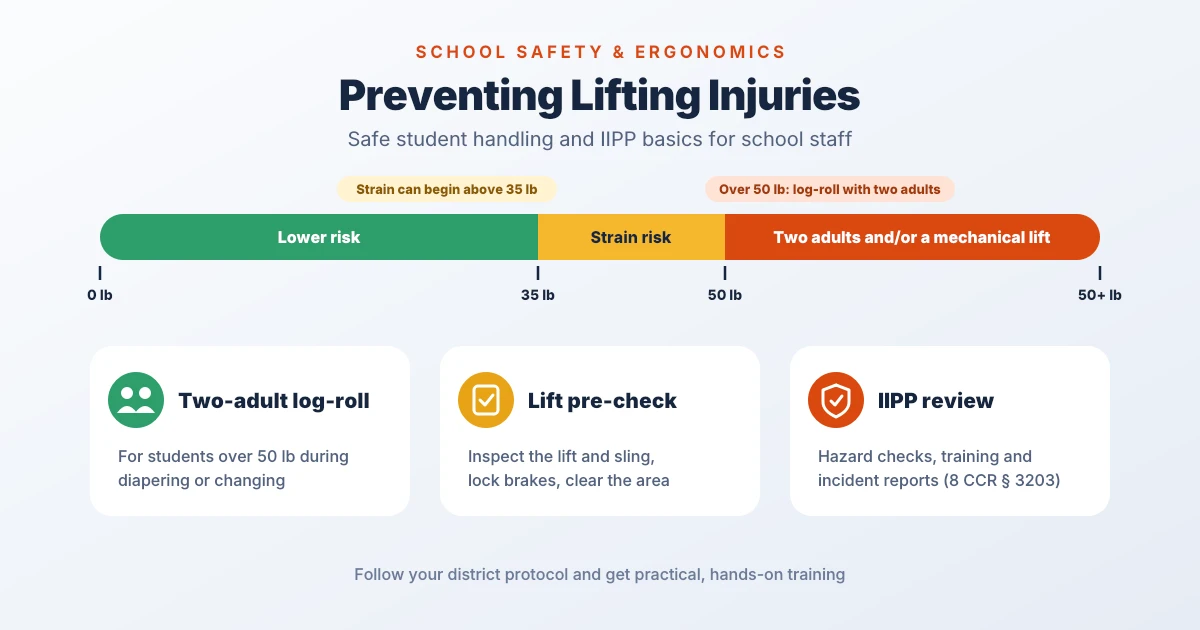
Table of Contents ▼
Quick Answer
This article explores ergonomic risks faced by school staff and special education professionals when lifting, transferring, and repositioning students. It explains the importance of the two-adult log-roll method, mechanical Hoyer lift inspections, and safe student-handling procedures. It also discusses how schools can reduce workplace injuries, strengthen their Injury and Illness Prevention Programs (IIPPs), and monitor compliance with Cal/OSHA requirements through staff training, equipment inspections, and incident reporting.
Key Takeaways
- Repeated lifting, transferring, and repositioning tasks can expose special education staff to back injuries and musculoskeletal disorders.
- Two-adult assistance, appropriate repositioning techniques, and mechanical lifts can help reduce the need for unsafe manual lifting.
- Staff should check mechanical lifts, slings, attachments, and transfer areas before use and follow manufacturer instructions.
- Schools can address student-handling hazards through staff training, inspections, incident reporting, and corrective actions under Cal/OSHA requirements.
Why Is Staff Ergonomics a Safety Concern in Special Education Settings?
Ergonomic safety focuses on improving systems to keep people safe and healthy. Most of the ergonomic safety concerns arise in the workplace. The main concern is the employees, and the goal is to match the workplace to the employee. In special education settings, concerns arise because educators and staff can face high rates of work-related musculoskeletal disorders (WMSDs) caused by physical care tasks, child-sized environments, and unpredictable student behaviour.
What Are the Risks of Lifting and Transferring Students Over 50 Pounds?
Lifting and transporting students weighing over 50 pounds can lead to musculoskeletal injuries that can affect educators. The Occupational Safety and Health Administration (OSHA) addresses this in the Ergonomics for the Prevention of Musculoskeletal Disorders guideline. They state that lifting should be kept to a minimum or not done at all in such settings; further research shows that lifts that exceed 35 pounds can cause strain and lead to further injury.
Why Is a Two-Adult Log-Roll Method Important for Safe Student Handling?
The two-adult log-roll method helps staff reposition students who weigh over 50 pounds during diapering or changing procedures. Instead of lifting the student’s legs individually, two trained adults work together to roll and reposition the student while maintaining support. This reduces the need for one employee to manage the student’s weight alone and helps limit awkward movements that can strain the back and shoulders. Staff should follow the applicable district protocol and receive practical training before performing the procedure.
What Should Staff Check Before Using a Mechanical Hoyer Lift?
Before using a mechanical Hoyer lift, staff should inspect the equipment and the student’s assigned sling for visible damage, worn straps, or faulty attachments. They should also confirm that the sling is appropriate for the student, the weight capacity is sufficient, and all loops and clips can be secured correctly. The transfer area should be clear of obstacles, wheelchair brakes locked, and lift components positioned according to the manufacturer’s instructions. Staff should never use damaged equipment or proceed if they are unsure how to operate the lift safely. Following these checks and the required transfer procedures helps reduce the risk of falls, equipment failure, and staff injuries.
How Can Schools Reduce Back Injuries and Workers’ Compensation Claims?
Schools can reduce back injuries by training staff in safe student-handling techniques and ensuring appropriate equipment is available for transfers and lifting tasks. Employees should follow required two-adult assistance procedures, use mechanical lifts when appropriate, and avoid lifting students alone when the district protocol requires additional support. Regular equipment checks, practical training, and clear reporting procedures can also help identify potential hazards before they lead to injuries. By reviewing incidents and addressing unsafe practices, schools can strengthen workplace safety and potentially reduce workers’ compensation claims.
How Can an Injury and Illness Prevention Program Address Student-Handling Risks?
An Injury and Illness Prevention Program (IIPP) can address student-handling risks by identifying tasks that may expose staff to back injuries, muscle strain, or other physical hazards. Schools and special education providers can include student transfers, manual lifting, diapering, and the use of mechanical lifts in workplace hazard assessments. They should also establish safe handling procedures, provide practical staff training, inspect lifting equipment, and explain how employees can report hazards or injuries. Regularly review incidents and corrective actions to identify recurring problems and improve safety practices. These steps support the IIPP requirements under Cal/OSHA’s 8 CCR § 3203 while helping create a safer environment for both staff and students.
How Can School Administrators Monitor Ergonomics and Workplace Safety?
School administrators can monitor workplace safety by conducting regular inspections, reviewing injury reports, and checking whether staff follow approved student-handling procedures. They should also confirm that employees receive practical training, required two-adult assistance is available, and mechanical lifts and slings are inspected before use. Reviewing incident records can help administrators identify recurring risks, such as unsafe lifting techniques or equipment problems, and take corrective action. Keeping training, inspection, and incident documentation organized also helps demonstrate that the school is actively maintaining its Injury and Illness Prevention Program (IIPP).
Final Thoughts
Preventing lifting injuries in school settings requires clear procedures, proper equipment, and consistent staff training. By following safe student-handling practices, using mechanical lifts correctly, and providing two-adult assistance when required, schools can reduce physical risks for employees and students. Including these hazards in an Injury and Illness Prevention Program also helps administrators identify problems, document incidents, and address unsafe practices. A consistent approach to ergonomics and workplace safety supports a safer school environment and may help reduce avoidable injuries and workers’ compensation costs.
Evaluating Your Learning Stack or Course Architecture?
Whether modernizing legacy SCORM packages, auditing Section 508 WCAG compliance, or validating multi-tenant LMS migrations, our instructional engineering team offers a structured technical assessment.
Sources & References
- What Is Ergonomics?
- Lifting our loved ones doesn't have to be dangerous
- Cheng, H. K., Wong, M. T., Yu, Y. C., & Ju, Y. Y. (2016). Work-related musculoskeletal disorders and ergonomic risk factors in special education teachers and teacher's aides. BMC public health, 16, 137.
- Lifting Heavy Objects Safely At Work
Frequently Asked Questions
QWhat are the most common ergonomic risks for special education staff?
Common risks include repeated lifting, awkward bending, transferring students, repositioning students during diapering, and working in environments that require uncomfortable postures. These activities can contribute to back, shoulder, and other musculoskeletal injuries.
QWhen should school staff use a mechanical Hoyer lift?
Staff should use a mechanical lift when the student's individual transfer needs, care plan, district procedures, or equipment guidance require it. Employees must receive appropriate training and use a compatible sling and lift with sufficient weight capacity.
QDoes Cal/OSHA require schools to have an Injury and Illness Prevention Program?
California employers generally must establish, implement, and maintain an effective written IIPP under Title 8, Section 3203. The program addresses workplace hazard identification, injury prevention, employee communication, training, and corrective action.
