Primary and Secondary Technical Domain Skills: Complete Guide & Examples [2026]
Confused about how to answer 'list your primary and secondary technical domain skills'? Discover exact definitions, role-specific examples, and winning application strategies for Amazon and enterprise hiring.
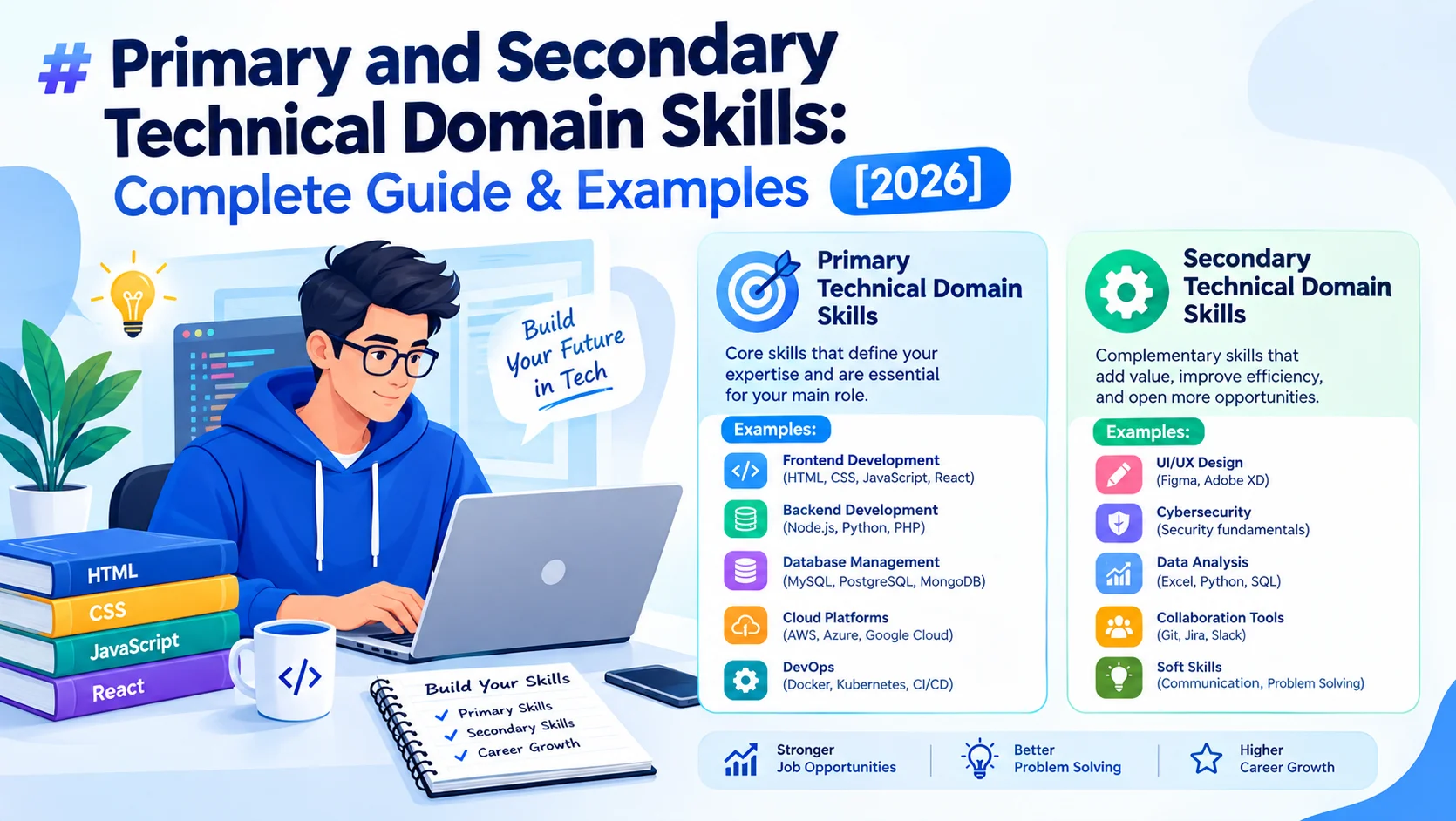
Table of Contents ▼
Quick Answer
This guide explains primary and secondary technical domain skills, the T-shaped professional framework, role-specific examples, and how candidates can present their technical skills effectively in enterprise job applications.
Key Takeaways
- Primary skills represent your core expertise.
- Secondary skills support your main specialization.
- The T-shaped model combines depth and breadth.
- Match skills to the specific job role.
- Use clear keywords for job applications and ATS.
When applying for technical, managerial, or specialized roles at top enterprise organizations—most notably in application questionnaires for technology giants like Amazon, Microsoft, and global consulting firms—candidates routinely encounter a mandatory question:
“Please list your primary and secondary technical domain skills.”
For thousands of professionals, this prompt creates immediate confusion. What exactly constitutes a “domain skill”? How do “primary” skills differ from “secondary” skills? And how can you categorize your technical abilities to pass automated Applicant Tracking Systems (ATS) and impress hiring committees?
This comprehensive guide breaks down definitions, role-specific frameworks, real-world examples, and winning application strategies.
What Are Primary and Secondary Technical Domain Skills?
Primary technical domain skills are your core, specialized proficiencies that represent your primary area of functional expertise and day-to-day job execution. Secondary technical domain skills are supporting or complementary technical capabilities that enhance your primary role, enable cross-functional collaboration, or broaden your operational scope.
A domain skill refers to technical knowledge tied to a specific industry vertical or operational discipline (such as Cloud Architecture, E-Learning Instructional Design, FinTech Data Pipelines, or Healthcare Compliance Systems).
Primary vs. Secondary Technical Domain Skills: The Core Differences
| AttributePrimary Technical Domain SkillsSecondary Technical Domain Skills | ||
|---|---|---|
| Depth of Expertise | Expert / Mastery level (Deep functional knowledge) | Working knowledge / Competent practitioner level |
| Day-to-Day Application | Core deliverable of your primary job title | Utilized for integration, collaboration, or edge tasks |
| Autonomy Level | Complete independence; sets architecture & guides others | Capable of executing standard tasks; collaborates with specialists |
| Years of Experience | Typically 3 to 10+ years of active immersion | Typically 1 to 3 years of contextual or project-based use |
| Hiring Weight | The mandatory requirement to clear the technical bar | The differentiator that separates good candidates from great ones |
The T-Shaped Professional Framework
In modern corporate talent development, categorizing your primary and secondary domain skills aligns with the widely recognized T-Shaped Skills Model:
                 [Secondary Technical Domain Skills - Broad Cross-Functional Breadth]
         ┌───────────────────┬───────────────────┬───────────────────┬───────────────────┐
         │ UI/UX Design      │ SQL / Analytics   │ API Integrations  │ Agile Management  │
         └───────────────────┴─────────┬─────────┴───────────────────┴───────────────────┘
                                       │
                                       │  [Primary Technical Domain Skill]
                                       │  Deep Mastery (e.g., Enterprise LMS Migration
                                       │  & Instructional System Architecture)
                                       │
                                       ▼
- The Vertical Stem: Your primary technical domain skill represents your deep specialization.
- The Horizontal Bar: Your secondary skills represent adjacent capabilities that allow you to interface seamlessly with adjacent engineering, marketing, compliance, and design teams.
Role-by-Role Examples of Primary & Secondary Domain Skills
Below are concrete breakdowns across high-demand modern technology and learning roles:
1. Instructional Designer / E-Learning Architect
- Primary Technical Domain Skills: Curriculum Architecture (ADDIE/SAM models), SCORM/xAPI Packaging, Articulate Storyline 360, Kajabi/Docebo Course Engineering.
- Secondary Technical Domain Skills: HTML5/CSS customization, Graphic Design (Adobe Illustrator/Figma), Video Editing (Premiere/Camtasia), Learning Analytics (LRS reporting).
For more information about SCORM and xAPI learning technologies, explore TheEduAssist’s related guide.
2. Software / Cloud Engineer (Amazon / Big Tech Application)
- Primary Technical Domain Skills: Distributed Systems Architecture, Python/Go Backend Services, AWS Infrastructure (Lambda, ECS, DynamoDB, S3).
- Secondary Technical Domain Skills: CI/CD Pipeline Automation (GitHub Actions/Terraform), Docker Containerization, Relational Database Tuning (PostgreSQL), API Gateway Security.
AWS documentation provides additional technical information about AWS Lambda and its integration with services such as DynamoDB and S3.
3. Data Analyst / Business Intelligence Specialist
- Primary Technical Domain Skills: Complex SQL Query Optimization, Data Modeling, Tableau/Power BI Dashboard Architecture, Statistical Hypothesis Testing.
- Secondary Technical Domain Skills: Python (Pandas/Scikit-learn), ETL Pipeline Automation, Cloud Warehousing (Snowflake/BigQuery), Git Version Control.
4. Technical Product Manager
- Primary Technical Domain Skills: Product Lifecycle Management, API Specifications, System Requirements Documentation (PRDs), Agile/Scrum Sprint Architecture.
- Secondary Technical Domain Skills: SQL Data Extraction, Wireframing (Figma), Mixpanel/Amplitude Event Tracking, Cloud Architecture Fundamentals.
How to Answer: “Please List Your Primary and Secondary Technical Domain Skills” for Amazon
When completing candidate questionnaires for enterprise applications (including Amazon candidate portals), avoid writing unstructured run-on sentences. Use a clean, formatted structure that highlights depth and breadth clearly:
Amazon’s official application guidance explains that its application process can include screening questions and, for technology positions, technical assessments.
High-Impact Template:
PRIMARY TECHNICAL DOMAIN SKILLS:
1. Enterprise Cloud Infrastructure & Distributed Architecture (AWS: EC2, S3, RDS, Lambda)
2. Backend Microservices Engineering (Python, Go, REST/gRPC API Design)
3. Relational & NoSQL Database Optimization (PostgreSQL, DynamoDB)

SECONDARY TECHNICAL DOMAIN SKILLS:
1. Infrastructure as Code & DevOps (Terraform, Docker, GitHub Actions CI/CD)
2. Observability & System Reliability (Datadog, CloudWatch, Prometheus)
3. Front-End Integration Basics (React, TypeScript)
Why This Format Succeeds:
- ATS Scannability: Applicant Tracking Systems identify explicit keyword entities instantly.
- Contextual Proof: Mentioning specific tools inside parentheses demonstrates actual hands-on application rather than buzzword stuffing.
- Clear Demarcation: The hiring manager instantly grasps your core strength versus your supplementary breadth.
How Organizations Build Cross-Domain Technical Capabilities
High-performing enterprises realize that training specialists solely in one isolated discipline creates organizational silos. To foster cross-functional technical agility, leading organizations invest in:
- Structured Learning Pathways: Transforming single-skill workers into multi-domain contributors through sequential learning roadmaps.
- Interactive Microlearning Modules: Delivering targeted training in secondary domains without pulling employees away from full-time primary duties.
- Enterprise LMS Architectures: Utilizing modern learning management platforms with role-based tracks. At TheEduAssist LMS implementation division, we build learning ecosystems that track primary and secondary competency milestones across global enterprise teams.
You can also explore Best Learning Management Systems for more information about LMS platforms and their role in enterprise learning.
For organizations using microlearning for employee training, short, focused learning modules can complement broader technical development programs.
Frequently Asked Questions
What is the difference between technical skills and domain skills?
A technical skill is a specific tool or methodology (such as Python, Figma, or Excel). A domain skill is specialized operational knowledge within an industry or functional vertical (such as E-Learning Design, Healthcare Informatics, or Cloud Infrastructure). Technical domain skills combine both: using specialized tools within a specific domain.
How many primary and secondary skills should I list?
Aim for 2 to 3 primary technical domain skills that represent your core expertise, accompanied by 3 to 4 secondary technical domain skills that demonstrate valuable adjacent breadth.
Can a secondary skill become a primary skill over time?
Yes. Many professionals start with a secondary skill (such as an instructional designer learning LMS administration), and as project demands increase, that capability matures into their primary career specialization.
What should I write if I am a recent graduate or changing careers?
Identify the technical domain where you completed your capstone projects, internships, or certifications as your primary domain skill, and list your academic coursework, secondary coding languages, or analytical tools as your secondary domain skills.
How does TheEduAssist support enterprise technical skill development?
TheEduAssist designs custom corporate e-learning programs, LMS migration pathways, and interactive training modules that help organizations systematically upskill their workforces. Request a free 24–48 hour training consultation with our instructional design experts today.
Sources & References
Frequently Asked Questions
QWhat is the difference between technical skills and domain skills?
A technical skill is a specific tool or methodology (such as Python, Figma, or Excel). A domain skill is specialized operational knowledge within an industry or functional vertical (such as E-Learning Design, Healthcare Informatics, or Cloud Infrastructure). Technical domain skills combine both: using specialized tools within a specific domain.
QHow many primary and secondary skills should I list?
Aim for **2 to 3 primary technical domain skills** that represent your core expertise, accompanied by **3 to 4 secondary technical domain skills** that demonstrate valuable adjacent breadth.
QCan a secondary skill become a primary skill over time?
Yes. Many professionals start with a secondary skill (such as an instructional designer learning LMS administration), and as project demands increase, that capability matures into their primary career specialization.
QWhat should I write if I am a recent graduate or changing careers?
Identify the technical domain where you completed your capstone projects, internships, or certifications as your primary domain skill, and list your academic coursework, secondary coding languages, or analytical tools as your secondary domain skills.
QHow does TheEduAssist support enterprise technical skill development?
TheEduAssist designs custom corporate e-learning programs, LMS migration pathways, and interactive training modules that help organizations systematically upskill their workforces. **[Request a free 24–48 hour training consultation](https://www.theeduassist.com/book-free-audit/)** with our instructional design experts today.