
Restroom, Diapering, Toileting and Mechanical Lift Protocols: The Operational Compliance Guide for School Districts & Care Facilities
Assisting students and vulnerable individuals with personal care, toileting, and mechanical transfers carries immense legal, physical, and ethical liability. Discover the operational standards behind the 2-person staffing rule, the 50-lb log-roll threshold, and Hoyer lift safety, and see how leading organizations convert paper SOP binders into audit-defensible SCORM training ahead of January intakes.
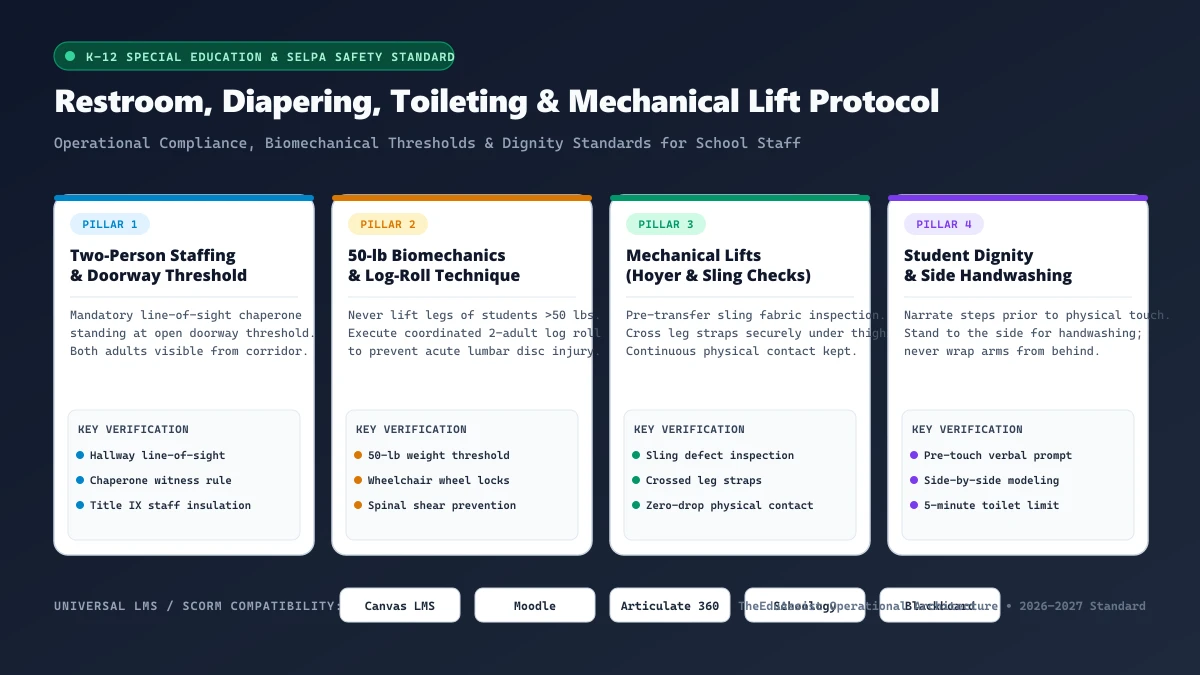
Table of Contents ▼
Quick Answer
A comprehensive operational and legal analysis of Restroom, Diapering, Toileting, and Mechanical Lift Protocols for K-12 public school districts, special education programs (SELPAs), pediatric therapy clinics, and assisted care facilities. Examines the Two-Adult Supervision Standard, biomechanical safety (the 50-lb rule), Hoyer sling inspection checklists, student dignity protocols, and the urgent December-to-January onboarding cycle.
Key Takeaways
- The Two-Person Staffing Model is the non-negotiable cornerstone of special education personal care, protecting vulnerable individuals from abuse while insulating staff from career-ending false allegations.
- Lifting any client or student over 50 pounds mandates a synchronized two-adult log-roll technique; single-person leg lifting causes severe lumbar disc injuries and risks catastrophic drops.
- Mechanical lifts (Hoyer/Sling) require pre-use sling defect inspections, cross-leg strap routing, wheel lock timing, and continuous physical contact throughout elevation.
- Pediatric dignity protocols dictate verbalizing every step before physical contact and standing to the side (never wrapping arms from behind) during handwashing guidance.
- Forward-thinking school districts, therapy clinics, and care facilities convert static paper binders into interactive SCORM microlearning in December to ensure new January staff are certified on Day 1.
In public school districts, specialized education co-ops (SELPAs), pediatric clinics, and assisted care facilities, few responsibilities carry higher emotional, physical, and legal stakes than personal care assistance.
Assisting an individual who cannot independently toilet, diaper, or transfer out of a wheelchair requires an extraordinary standard of care. When performed correctly, it preserves the individual’s dignity, maintains sterile infection control, and prevents traumatic physical injury. When performed incorrectly, or governed only by unread paper binders sitting in an administrative office, it can lead to catastrophic patient drops, permanent spinal injuries for staff, civil rights lawsuits, and devastating abuse allegations.
Across the United States and international educational systems, public school districts (such as the comprehensive protocols established by the Glendale Unified School District) have formalized rigid, non-negotiable standards: The Restroom, Diapering, Toileting and Mechanical Lift Protocol.
This operational guide deconstructs why these protocols exist, analyzes the critical biomechanical and supervision rules organizations must enforce, and outlines how institutions can turn dense paper guidelines into audit-proof digital training before the January 2027 operational cycle.
1. The Legal & Institutional Rationale: Why These Policies Exist
Institutions do not enact strict toileting and lift protocols out of bureaucratic preference; they enact them because the alternative is catastrophic institutional failure.
Every personal care protocol is shaped by three legal and regulatory pillars:
┌────────────────────────────────────────────────────────────────────────┐
│               THE TRIAD OF PERSONAL CARE COMPLIANCE                    │
├────────────────────┬────────────────────┬──────────────────────────────┤
│ 1. CIVIL RIGHTS &  │ 2. REPUTATION &    │ 3. WORKPLACE SAFETY &        │
│    INDIVIDUAL DIGNITY│   STAFF PROTECTION │    BIOMECHANICAL INJURIES    │
│ Individuals with   │ A single staff     │ Lifting adults or heavy      │
│ disabilities are   │ member behind a    │ children without mechanical  │
│ guaranteed dignity │ closed door faces  │ aids causes permanent lumbar │
│ and equal access   │ career-ending false│ disc injuries. OSHA mandates │
│ under IDEA & ADA.  │ abuse allegations. │ safe ergonomic controls.     │
└────────────────────┴────────────────────┴──────────────────────────────┘
A. Protecting Vulnerable Individuals (IDEA & Title IX)
Under the Individuals with Disabilities Education Act (IDEA) and Americans with Disabilities Act (ADA Title II/III), students and clients with physical, developmental, or medical delays have a federally protected right to safe, sanitary, and dignified accommodation. Any failure in hygiene (such as improper front-to-back wiping leading to recurrent urinary tract infections) or dignity (failing to prompt and narrate steps) represents an actionable civil rights violation.
B. Protecting Staff from False Allegations
Working with children or dependent adults in private personal care spaces exposes staff to profound vulnerability. If a student exhibits behavioral outbursts, regression, or makes an uncorroborated statement regarding touch, an employee who was alone with that student in a closed stall has zero legal defense. The Two-Adult Witness Model is insurance for the employee, ensuring that an independent colleague verifies every touch was professional, necessary, and aligned with the student’s Individualized Education Program (IEP).
C. Worker’s Compensation & OSHA Bloodborne Pathogens
Lifting a 60-pound child or 150-pound adult repeatedly throughout a shift without mechanical assistance is an ergonomic disaster. Back injuries represent the single largest worker’s compensation expense for school districts and nursing facilities. Furthermore, handling human waste without strict non-latex glove protocols and foot-operated disposal violates OSHA Bloodborne Pathogens Standard (29 CFR 1910.1030), risking norovirus, C. diff, and E. coli cross-contamination.
2. Core Operational Pillars of the Protocol
A robust Restroom and Mechanical Lift SOP is built around four fundamental operational rules that every staff member, paraprofessional, substitute aide, and nurse must master:
Pillar 1: The Two-Adult Supervision Standard
The protocol recognizes three distinct tiers of individuals:
- Independent Individuals: Those who manage clothing, hygiene, and toileting completely on their own. They enter restrooms unaccompanied.
- Independent Individuals with Behaviors: Those who physically do not need assistance with toileting, but who have behavioral triggers that could cause property damage, self-harm, or elopement.
- The Doorway Threshold Rule: One adult prompts and monitors from the open main bathroom doorway. A second adult stands in the hallway in direct line of sight. Both adults must be clearly visible from the corridor. Staff do not enter the stall unless behavior escalates, at which point both adults enter together.
- Dependent Individuals: Those who require direct physical diapering, wiping, or transfers. Two trained adults must be present inside the restroom space from start to finish. No exceptions.
Pillar 2: The 50-Pound Biomechanical Log-Roll Rule
One of the most dangerous and widespread errors in assisted care is lifting a supine individual by their ankles or knees to slip a clean diaper or pad underneath them.
       WRONG (High Injury Risk)                  CORRECT (Ergonomic Standard)
┌──────────────────────────────────────┐  ┌──────────────────────────────────────┐
│  Single staff member lifts client's  │  │  Two staff members execute a smooth  │
│  legs upward from supine position.   │  │  coordinated LOG-ROLL technique.     │
│  ✖ Severe shear force on lower back  │  │  ✔ Zero spinal shear force on staff  │
│  ✖ Strains client hips and joints    │  │  ✔ Full joint stability for client   │
│  ✖ Risk of client slipping off table │  │  ✔ Continuous physical contact kept  │
└──────────────────────────────────────┘ └──────────────────────────────────────┘- Under 50 lbs: Staff may gently lift legs while maintaining physical contact with the changing surface.
- Over 50 lbs: Staff are strictly prohibited from lifting legs. They must use a two-adult log-roll technique: one staff member stabilizes the torso and rolls the individual onto their side, while the second cleans and slides the clean diaper and liner into place.
Pillar 3: Mechanical Lift (Hoyer/Sling) Step-by-Step Operations
Mechanical lifts eliminate manual lifting risks, but introduce mechanical drop hazards if operators skip safety checks. A compliant protocol requires a mandatory four-stage checklist:
- Pre-Lift Inspection: Clear all obstacles between the wheelchair and the changing table. Inspect the sling fabric and stitching for fraying, tears, or heat damage from industrial laundries. Verify the sling size and serial number matches the specific client’s plan.
- Sling Application:
- From Wheelchair: Lean the client forward gently; slide the sling behind their back down to the sacrum, and pull the leg flaps under the thighs.
- From Changing Table: Log-roll the client to one side, tuck the rolled sling underneath, roll them back, and pull through so the sling is centered from shoulders to mid-thigh.
- Lifting & Elevation:
- Lock the wheelchair wheels prior to starting.
- Position the lift legs around the chair or under the table.
- Cross the leg straps underneath the client’s legs before hooking into the spreader bar loops.
- Elevate slowly using the pump handle or electric button. One staff member must maintain gentle, stabilizing physical contact with the client at all times while suspended.
- Lowering & Transfer:
- Position the client over the destination surface.
- Lock the lift wheels once in position over the surface.
- Lower smoothly, unhook loops, remove the sling, and immediately lock wheelchair brakes and fasten safety lap belts before moving the lift apparatus away.
Pillar 4: Child Dignity & Side-by-Side Handwashing
Technical competence is meaningless without human dignity. Protocols must explicitly forbid impersonal or dehumanizing handling:
- Pre-Touch Narration: Staff must speak to the client before touching them: “Michael, I’m going to help you unbutton your trousers now,” giving the individual time to process and participate.
- Privacy & Timing: Toilet sitting must be limited to five (5) minutes if the individual is not actively urinating or having a bowel movement, preventing skin breakdown and psychological discomfort.
- Handwashing Modeling: Staff frequently wrap their arms around a child from behind to guide their hands under the faucet. The protocol strictly forbids this. Staff must stand to the side of the client to model handwashing. Wrapping arms from behind is a severe boundary violation that can feel coercive or traumatic to neurodivergent individuals.
3. Why Training in December is Urgent for January 2027 Operations
Waiting until January to train staff on personal care protocols is an operational disaster.
Every year, January represents a massive institutional inflection point across six key industries:
| Sector | Why December Training is Non-Negotiable |
|---|---|
| K-12 School Districts & SELPAs | Mid-year hiring creates an influx of new paraprofessionals, substitute aides, and special education bus attendants starting on the first day of the Spring semester. |
| Pediatric Therapy & Autism (ABA) Centers | Rapid expansion of new client insurance authorizations starting January 1st requires newly credentialed Registered Behavior Technicians (RBTs). |
| Inclusive Resorts, Cruises & Theme Parks | Peak winter and holiday tourist volumes bring guests requiring ADA Title III accessible restroom and attraction transfer assistance. |
| Assisted Living & Adult Day Programs | State Department of Health (DOH) annual safety and zero-lift certifications reset on January 1st. Facilities must show 100% compliant staff rosters. |
| Municipal Winter Camps & Adaptive Rec | Seasonal counselors oversee children with developmental and physical disabilities during winter breaks and community sports leagues. |
| Healthcare Staffing Agencies | Traveling aides and PCAs cannot be deployed to school or home assignments without verifiable, time-stamped lift credentials. |
4. How TheEduAssist Converts Your Paper SOP into an LMS Course in Days
School districts and healthcare organizations do not have the time or budget to spend six months working with high-overhead consulting firms. They need their existing PDF protocol transformed into interactive training immediately.
At TheEduAssist, we take your district or organization’s exact policy handbook and execute a rapid 4-step transformation:
┌────────────────────────────────────────────────────────────────────────┐
│                   THE 7-DAY CONVERSION PIPELINE                        │
├────────────────────┬────────────────────┬──────────────────────────────┤
│ DAY 1 to 2: AUDIT &   │ DAY 3 to 4: SCENARIO  │ DAY 5 to 6: SCORM PACKAGING     │
│ PEDAGOGY BLUEPRINT │ BRANCHING & MEDIA  │ & LMS STAGING                │
│ We extract core    │ We script doorway  │ We build the course in       │
│ thresholds, 50-lb  │ threshold dilemmas,│ Articulate 360, configure    │
│ rules, and lift    │ 3D sling animation,│ SCORM 1.2/2004/xAPI, and     │
│ checklists.        │ and audio prompts. │ stage on your LMS.           │
├────────────────────┴────────────────────┴──────────────────────────────┤
│ DAY 7: 100% AUDIT CERTIFICATION & ROLLOUT                               │
│ Staff complete the 20-minute module, pass the knowledge check (80%),   │
│ and receive auto-generated digital certificates for district files.    │
└────────────────────────────────────────────────────────────────────────┘
Flexible Delivery Models
- Drop-in SCORM Packages: If your district uses Canvas, Moodle, Schoology, Blackboard, Workday, or Cornerstone, we hand you the production-ready SCORM package. You upload it in five minutes.
- Turnkey Managed Portal: If your agency or facility does not have an LMS, we host your course on our dedicated managed learning portal. We manage user rosters, track completion timestamps, and email you automated compliance spreadsheets.
- 100% Source Asset Ownership: You receive the uncompiled Articulate Storyline (
.story) source files. Your organization owns its training forever.
5. Summary & Action Plan
Personal care protocols should never live in forgotten binders on an administrative shelf. They belong on the screens of every aide, teacher, and caregiver before they ever assist an individual in need.
By converting your Restroom, Diapering, Toileting, and Mechanical Lift Protocol into an interactive, mobile-ready digital learning suite this December, your organization eliminates liability, protects staff, and ensures every client receives safe, dignified care throughout 2027.
- Have an existing personal care or lift protocol? Submit your raw document for a free 24 to 48 hour course architecture review.
- Need to speak with our compliance learning architects? Contact our enterprise learning team to schedule a live walkthrough of our compliance course prototypes.
Need Help Building or Scaling Your Online Learning Program?
Whether you are launching an academy on Kajabi, modernizing corporate LMS modules, or converting raw expertise into accredited curriculum, our senior instructional designers provide a complimentary architecture evaluation.
Frequently Asked Questions
QWhy is a two-person staffing model legally required during student toileting and diapering?
A single adult behind a closed restroom door creates catastrophic institutional liability. The two-adult rule (whether both assisting hands-on or one acting as a dedicated doorway witness/chaperone in direct line of sight) protects the student’s physical safety and civil rights under IDEA and Title IX, while safeguarding the employee from uncorroborated allegations of abuse or boundary violations.
QWhat is the 50-pound log-roll rule in personal care protocols?
Biomechanical research shows that lifting an individual’s legs while they are supine to change a diaper or clean soiled clothing exerts extreme shear forces on the lumbar spine. For any individual weighing over 50 pounds, protocols strictly forbid lifting legs; staff must instead execute a coordinated two-person log-roll to protect both the worker's spine and the client's joints.
QWhat are the most common mechanical lift mistakes cited in safety audits?
The four most frequent violations are: using a damaged or frayed sling, failing to cross the leg straps underneath the thighs, locking the lift wheels while lifting instead of letting the apparatus center itself, and walking away from a client while they are elevated or on a changing surface.
QHow can organizations train seasonal or new staff before January operations begin?
By converting their paper SOPs and policy handbooks into interactive SCORM 1.2/2004 or xAPI microlearning modules. Staff complete 20 minutes of scenario-based simulations on their mobile devices during December, passing a verifiable knowledge check before ever assisting a client in January.
