
Why New Coaches and Creators Must Start by Teaching for Free (The Skill-Polishing Playbook)
Building an online course in isolation is the fastest way to fail. Discover why top coaches and creators start by teaching for free to stress-test their curriculum, sharpen their delivery, and uncover the exact questions learners pay to solve.

Table of Contents ▼
Quick Answer
A definitive guide for emerging coaches, creators, and subject matter experts on why early pro-bono teaching is the critical foundation of commercial online course success. This playbook details how free webinars, workshops, and speaking sessions pressure-test instructional content, dismantle the curse of knowledge, capture organic learner objections, and create the validation bridge required before productizing into scalable courses.
Key Takeaways
- Recording an online course in isolation without live student validation leads to low completion rates, high refund requests, and audience disconnect.
- Teaching for free across webinars, lunch-and-learns, and community sessions provides rapid curriculum pressure-testing with zero commercial penalty.
- The questions, hesitations, and misunderstandings voiced in live Q&A sessions become the exact module titles, assignments, and sales copy for your future paid offerings.
- Pro-bono teaching dismantles the 'Curse of Knowledge,' forcing subject matter experts to identify cognitive friction points that beginners face.
- Free delivery generates authentic social proof, builds early relationship equity, and establishes a seamless bridge to booked-out 1-on-1 client work.
The Loneliness of the Recording Booth: The Common Fallacy
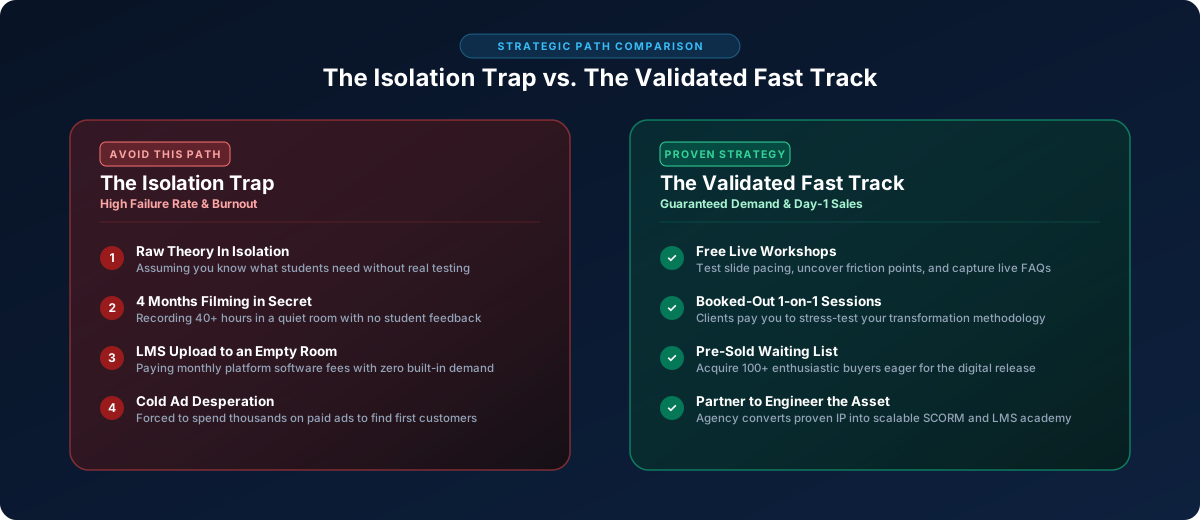
Every month, thousands of aspiring coaches, corporate executives, and subject matter experts make the exact same high-cost mistake.
They decide to launch a digital education business. They invest $1,500 in a Shure SM7B microphone, purchase a 4K mirrorless camera, rent an acoustic studio, and lock themselves away for four months writing 200 presentation slides. They record 40 video lessons in a vacuum, edit the footage, purchase an expensive software subscription on Kajabi, Teachable, or LearnWorlds, upload the course, and post a link on LinkedIn.
Then: silence. No sales. No engagement. No community discussions.
When a sales drought happens, creators blame their camera quality, their landing page copy, or the social media algorithm. But the root cause is far more fundamental: they built a product based on theoretical assumptions rather than observed human behavior.
The most successful educators, master coaches, and corporate instructional leaders never begin inside a soundproof booth. They begin in the messy, interactive arena of free, live teaching.
The 5 Core Engines of the “Free Teaching” Validation Model
Offering pro-bono training—whether through a local chamber of commerce, a live Zoom workshop, an industry association guest lecture, or an open community meetup—is not volunteer charity. It is the most rigorous, high-ROI research and development sprint you will ever execute.
Here is how live, unpaid teaching fundamentally transforms your coaching career.
1. Rapid Curriculum Stress-Testing & Friction Discovery
When you write curriculum in your head, everything seems logical, linear, and clear. But domain experts suffer from what cognitive psychologists call the Curse of Knowledge: once you understand a complex subject, it is cognitively impossible to remember what it was like not to understand it.
When you teach live in front of real people, the illusion of clarity evaporates immediately:
- You notice where participants look visibly confused or stop nodding.
- You see which metaphors land with an audible “aha!” and which fall completely flat.
- You discover pacing bottlenecks where 10 minutes of technical detail caused everyone to zone out.
In a live room, you can pivot in real time: “I see some furrowed brows on that concept—let me pause and give an alternative concrete analogy.” When you discover what works, you permanently integrate that explanation into your core framework. In a pre-recorded course, a confusing explanation simply leads to a closed browser tab and an abandoned course.
2. Pedagogical Delivery & Vocal Pacing Calibration
Subject-matter expertise does not equal instructional competency. Knowing how to run financial models, lead a remote engineering team, or navigate clinical triage does not automatically mean you know how to command a digital classroom.
Live teaching polishes your mechanical delivery in ways no teleprompter can replicate:
- Vocal Modulation & Cadence: You eliminate verbal fillers (“um”, “like”, “you know”) because you are actively reading the energy of your listeners.
- Energy Management: You learn how to structure high-cognitive-load concepts between low-cognitive-load stories and interactive checkpoints.
- Presence & Authority: After presenting the same foundational principles across 10 different free webinars, you stop sounding like someone reading textbook notes and start sounding like a decisive authority who has lived the material.
| Delivery Dimension | Filming in Isolation | Teaching Live for Free |
|---|---|---|
| Feedback Loop | 3 to 6 months post-launch (usually via refunds or silence) | Instant (facial expressions, chat messages, unmuted questions) |
| Instructional Polish | Rigid, scripted, robotic delivery | Fluid, responsive, story-driven conversational mastery |
| Cognitive Calibration | Prone to overwhelming beginners with jargon | Dialed-in scaffolding tailored to exact student comprehension levels |
| Financial Risk | High (software fees, production costs, wasted labor) | Zero (free Zoom account, organic speaking opportunities) |
| Audience Relationship | One-way broadcast | Two-way dialogue building deep trust and emotional rapport |
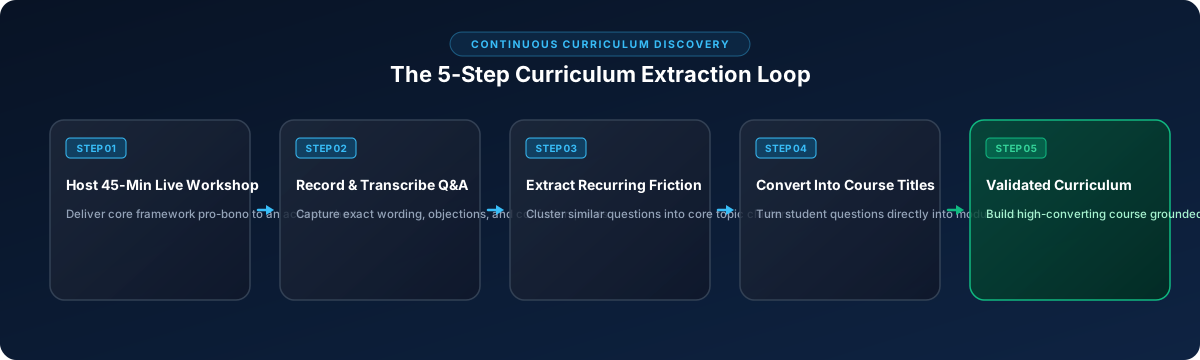
3. The Live Q&A Goldmine: How Student Questions Write Your Course
The most valuable 20 minutes of any educational presentation is the unscripted Q&A session at the end.
When you teach a free workshop, your audience will ask questions you never anticipated. They will ask about edge cases, operational constraints, budget hurdles, and real-world implementation fears that your original slides skipped over entirely.
Every single recurring question asked during a free workshop represents an essential sub-module, downloadable checklist, or high-converting sales objection handler for your future paid product.
If five separate managers in five separate free leadership sessions ask: “What do I do when an employee agrees in our meeting but reverts to old habits 48 hours later?”, that is not an interruption—that is the exact title of Module 3, Lesson 4 of your future premium leadership academy. You are no longer guessing what the market wants to learn; the market is dictating the syllabus to you.
4. Direct Validation Across Diverse Niches
Whether your specialty is corporate enterprise development or lifestyle coaching, early free teaching validates your model across specialized industry realities:
- Executive & Leadership Coaches: Delivering a free pro-bono seminar on “Navigating Difficult Cross-Functional Conversations” for a local association reveals that technical directors don’t struggle with communication theory—they struggle with conflict avoidance and stakeholder prioritization.
- Healthcare & Clinical Educators: Running free clinical education webinars exposes the specific regulatory anxieties, documentation bottlenecks, and shift-fatigue challenges that staff nurses actually face on the ward.
- Sales & Operations Consultants: Conducting a free pipeline audit workshop shows you whether business owners need help with CRM automation or whether their underlying qualification script is broken.
In every case, pro-bono teaching ensures your eventual paid curriculum is grounded in dirty, tactical reality rather than sterile academic theory.
5. Authentic Social Proof & The “Trojan Horse” of Advocacy
When you deliver immense, actionable value to an audience without demanding their credit card, something powerful happens in the human psyche: the principle of reciprocity.
Attendees who experienced a breakthrough in your free 45-minute workshop will:
- Write unsolicited, glowing LinkedIn posts tagging your profile.
- Provide video testimonials highlighting how your single session resolved an issue they had battled for months.
- Introduce you to their department heads, HR managers, and peers.
- Send you direct messages asking: “Do you offer 1-on-1 consulting or deeper corporate training on this?”
You don’t need a complex digital marketing funnel to win your first clients. You need five people who experienced your teaching live and are eager to tell their professional network about you.
The 90-Day Free-to-Paid Implementation Framework
To execute this strategy without getting stuck in an endless loop of uncompensated labor, structure your free teaching as a time-boxed, 90-day sprint.
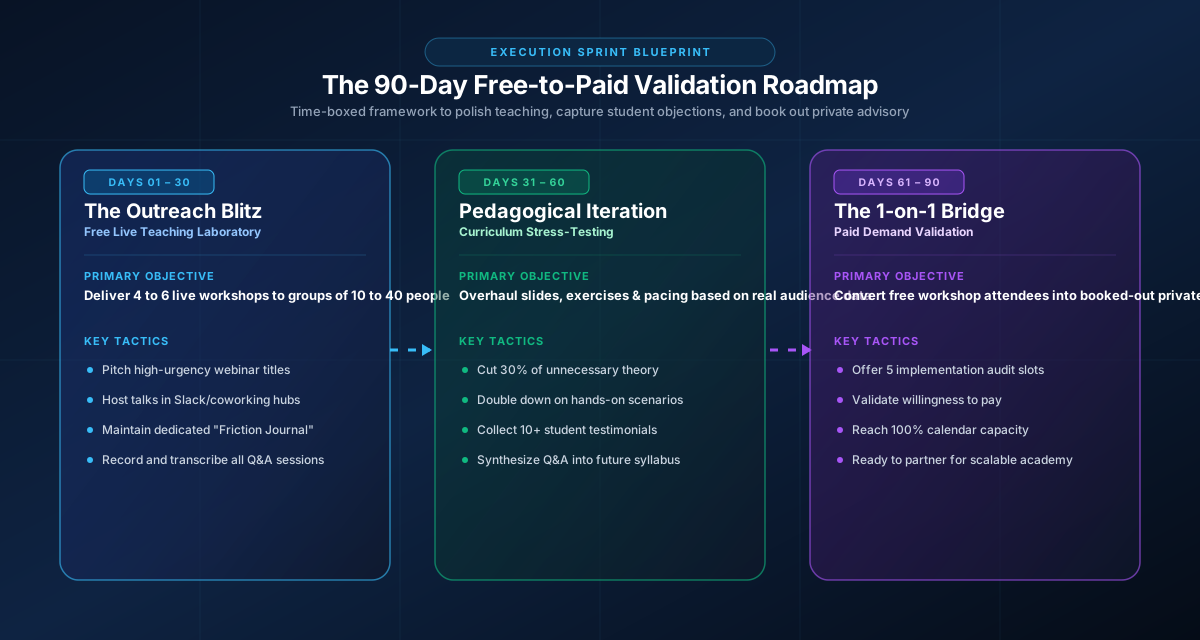
Month 1: The Outreach Blitz (Days 1–30)
- Goal: Deliver 4 to 6 live, interactive presentations to groups of 10 to 40 people.
- Tactics:
- Reach out to podcast hosts, industry Slack communities, local coworking hubs, and professional associations.
- Pitch a specific, high-urgency title: e.g., “The 3 Conflict Frameworks Every First-Time Engineering Manager Needs in 2026.”
- Establish a dedicated “Friction Journal” where you log every student question, blank stare, and breakthrough moment.
Month 2: Pedagogical Iteration (Days 31–60)
- Goal: Overhaul your slide deck, exercises, and examples based on Month 1 data.
- Tactics:
- Cut 30% of your introductory theory slides; double down on hands-on scenario analysis.
- Test two different live exercises to see which produces faster learner comprehension.
- Gather 10+ written or video testimonials from attendees highlighting specific takeaways.
Month 3: The 1-on-1 Bridge (Days 61–90)
- Goal: Convert your most engaged free learners into paid individual coaching or advisory clients.
- The Transition Call-to-Action: At the end of your free presentation, offer a private assessment:
“If you want help applying this exact framework to your specific organization, I have opened up 5 slots next week for a 45-minute implementation audit.”
- Book these slots. When clients begin paying you for private advisory, your curriculum moves from group theory to personalized, high-stakes application.
When to Scale: The Bridge to Your Digital Academy
Teaching for free is the laboratory where your expertise is refined into pedagogical gold. But free teaching is not the end goal; it is the launchpad.
Once your free workshops generate consistent demand, and your calendar becomes completely booked with paid 1-on-1 coaching clients, you hit the natural ceiling of personal time. You can no longer trade hours for dollars.
That is the exact moment when you transition from service provider to course creator.
However, as you prepare to build that digital course, there is a dangerous trap waiting to catch you: thinking that building a course is enough to make it sell.
To understand how high-performing creators structure their business, validate their audience, and partner with production specialists to build world-class digital academies, explore the complete series:
- Part 2: Don’t Build a Course Just Because You’re Motivated: The “Boeing vs. Pilot” Blueprint
- Part 3: What an eLearning Agency Actually Does (And the Brutal Truth About What We Won’t)
Need Help Structuring Your Curriculum for Scale?
At TheEduAssist, we work with coaches, creators, and enterprise organizations who have validated their methodology and are ready to build world-class, accredited digital academies. From rigorous instructional design and interactive SCORM packaging to sovereign cloud hosting and learning management systems, we engineer the learning infrastructure that turns expertise into enterprise assets.
- Explore our Instructional Design Services to transform your presentation slides into an accredited digital curriculum.
- Review our Custom eLearning Development capabilities for interactive scenarios, simulations, and mobile learning.
- Book a 30-Minute Architecture Consultation with our learning strategists today.
Need Help Building or Scaling Your Online Learning Program?
Whether you are launching an academy on Kajabi, modernizing corporate LMS modules, or converting raw expertise into accredited curriculum, our senior instructional designers provide a complimentary architecture evaluation.
Frequently Asked Questions
QWhy shouldn't I just build and sell my online course immediately?
When you build an online course in isolation, you are authoring based on assumptions rather than observed student behavior. Without testing your concepts on live humans, you cannot know where learners get confused, which examples resonate, or what questions remain unanswered. Teaching for free first allows you to refine your methodology risk-free before spending weeks on video production.
QDoesn't teaching for free devalue my expertise or make me look like an amateur?
No. The world's most sought-after consultants, keynote speakers, and authors regularly deliver free guest lectures, podcast breakdowns, and community workshops. Teaching for free signals extreme confidence in your subject matter and establishes immediate authority. You aren't giving away your entire playbook forever; you are running structured validation sprints to sharpen your delivery and collect real-world case evidence.
QHow many free workshops or sessions should I run before charging?
A standard benchmark is 10 to 15 structured sessions or reaching a cumulative total of 50 to 100 engaged participants. This sample size is large enough to notice recurring patterns, common misunderstandings, and distinct student breakthroughs that confirm your instructional framework works reliably.
QWhat should I do if nobody shows up to my free webinars?
If you cannot attract attendees to a free live session, it is an invaluable early warning that your topic hook, positioning, or problem statement is misaligned. Partner with existing platforms: offer guest training inside established communities, deliver pro-bono workshops for regional non-profits, speak at corporate brown-bag lunches, or pitch guest presentations to local associations.
QHow do I transition from free teaching to paid course enrollments?
Never jump directly from free talks to a self-paced digital course. Transition first from free group sessions to paid 1-on-1 coaching or high-touch consulting. Once your calendar is fully booked with 1-on-1 clients and you identify the exact transformation sequence, you partner with an instructional design team to codify your framework into a scalable digital academy.
