
Bloom's Taxonomy for Corporate Training & eLearning [2026 Guide]
Bloom's Taxonomy is the essential framework for writing measurable learning objectives. Discover how to apply the 6 cognitive tiers (Remember to Create), action verb charts, and eLearning interactive formats in 2026.
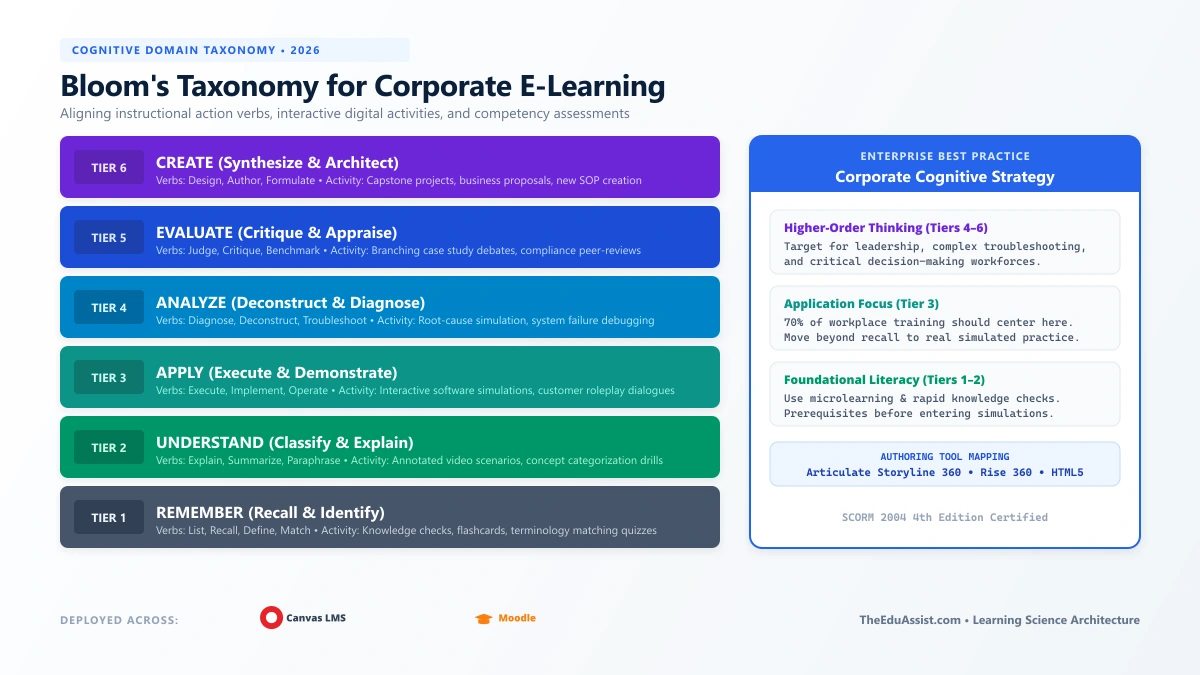
Table of Contents ▼
Quick Answer
The definitive 2026 guide to applying Bloom's Revised Taxonomy in corporate learning and instructional design. Details all 6 cognitive domains (Remember, Understand, Apply, Analyze, Evaluate, Create), provides actionable verb matrices, assessment pairing strategies, and before-and-after corporate objective transformations.
Key Takeaways
- Bloom's Revised Taxonomy categorizes cognitive learning into 6 hierarchical tiers: Remember, Understand, Apply, Analyze, Evaluate, and Create.
- Over 90% of ineffective corporate compliance courses get stuck at Level 1 (Remember), leading to high failure and disengagement rates.
- Measurable learning objectives require specific, observable action verbs (e.g., 'Execute', 'Troubleshoot', 'Differentiate') rather than vague words like 'Know' or 'Understand'.
- Higher cognitive levels (Apply and Evaluate) require interactive branching scenarios, software simulations, and peer case critiques rather than multiple-choice quizzes.
- Scaffolding learning along Bloom's hierarchy guarantees progressive cognitive confidence and measurable on-the-job competency.
Every corporate training failure begins with the same fatal mistake in the course syllabus:
“By the end of this course, the employee will understand the new enterprise cybersecurity protocol.”
What does “understand” actually mean? Does it mean the employee can define phishing in a multiple-choice quiz? Does it mean they can inspect an email header and identify a spoofed domain? Or does it mean they can isolate a compromised workstation during a live ransomware breach?
Because “understand” cannot be objectively measured or observed, training programs built on vague objectives invariably deliver zero operational change.
To build learning that drives measurable workplace performance, instructional designers rely on Bloom’s Taxonomy—the world’s standard cognitive framework for designing learning objectives, assessments, and interactive course architectures.
Here is how modern corporate L&D teams apply Bloom’s Revised Taxonomy in 2026.
What is Bloom’s Taxonomy? (Direct Definition)
Bloom’s Taxonomy is a hierarchical educational framework that classifies cognitive learning objectives into six progressive tiers of increasing complexity: Remember, Understand, Apply, Analyze, Evaluate, and Create. Originally created by Dr. Benjamin Bloom in 1956 and revised by Lorin Anderson and David Krathwohl in 2001, it guides educators to scaffold instruction from basic recall to autonomous real-world problem-solving.
+-----------------------------------------------------------------------------------+
|                        BLOOM'S REVISED COGNITIVE PYRAMID                          |
|                                                                                   |
|     [ 6. CREATE ]     -> Design, architect, formulate, invent new workflows       |
|            ▲                                                                      |
|            │                                                                      |
|     [ 5. EVALUATE ]   -> Judge, critique, audit, justify strategic decisions      |
|            ▲                                                                      |
|            │                                                                      |
|     [ 4. ANALYZE ]    -> Troubleshoot, differentiate, diagnose system failures    |
|            ▲                                                                      |
|            │                                                                      |
|     [ 3. APPLY ]      -> Execute, calculate, implement SOPs in live scenarios     |
|            ▲                                                                      |
|            │                                                                      |
|     [ 2. UNDERSTAND ] -> Summarize, explain, classify core concepts & policies     |
|            ▲                                                                      |
|            │                                                                      |
|     [ 1. REMEMBER ]   -> Recall, recognize, list terms, rules, and definitions    |
+-----------------------------------------------------------------------------------+Need High-Impact Learning Objectives & Scenario-Based Courseware? If your organization is upgrading employee capabilities, modernizing compliance slides, or building technical simulations:
- Review our Instructional Design Services & Custom eLearning Development
- Inspect transparent fixed-scope budgets on our eLearning Pricing Architecture
- Or Book a Free 24–48h Training Architecture Review.
The 6 Cognitive Levels of Bloom’s Taxonomy in Corporate Training
Level 1: Remember (Knowledge Recall)
The foundational level involves retrieving, recognizing, and recalling relevant terminology, facts, and standard policies from memory.
- Workplace Example: A healthcare worker reciting the 5 stages of patient handoff protocol.
- Measurable Action Verbs: List, state, define, label, identify, recall, name.
- eLearning Format: Digital flashcards, interactive glossary lookups, drag-and-drop matching.
Level 2: Understand (Comprehension & Translation)
Learners construct meaning from instructional messages, explaining principles in their own words rather than simply parroting definitions.
- Workplace Example: A frontline supervisor explaining why safety goggles are mandatory in specific chemical zones.
- Measurable Action Verbs: Explain, summarize, describe, classify, translate, paraphrase.
- eLearning Format: Interactive accordion reveals, conceptual video walkthroughs with embedded check-ins.
Level 3: Apply (Execution & Implementation)
Learners apply an abstract rule, SOP, or software workflow to solve an authentic workplace challenge. This is where true workplace training begins.
- Workplace Example: A customer service representative entering a refund transaction in SAP according to billing guidelines.
- Measurable Action Verbs: Execute, implement, solve, operate, calculate, demonstrate.
- eLearning Format: Software sandbox simulations (Show/Try/Do), procedural interactive walkthroughs.
Level 4: Analyze (Diagnosis & Breakdown)
Learners break complex information into constituent parts, examining relationships and identifying root causes.
- Workplace Example: A systems engineer diagnosing why a cloud server latency spiked after an API deployment.
- Measurable Action Verbs: Differentiate, diagnose, troubleshoot, deconstruct, correlate.
- eLearning Format: Branching decision-tree scenarios, error log analysis exercises, consequence simulations.
Level 5: Evaluate (Judgment & Justification)
Learners make informed, defensible decisions based on criteria, operational standards, and trade-offs.
- Workplace Example: An executive choosing between two vendor RFPs based on SOC 2 security compliance and 3-year TCO.
- Measurable Action Verbs: Assess, critique, audit, justify, prioritize, select.
- eLearning Format: Complex case study challenges, peer review forums, rubric-based scorecards.
Level 6: Create (Synthesis & Innovation)
Learners combine disparate elements to form a coherent, novel, or optimized operational structure.
- Workplace Example: An instructional designer architecting an end-to-end employee onboarding curriculum for 5,000 global staff.
- Measurable Action Verbs: Design, architect, formulate, construct, author, devise.
- eLearning Format: Capstone project submissions, digital sandbox design labs, curriculum authoring.
Bloom’s Taxonomy Action Verbs Matrix for Course Creators
Use this comprehensive verb matrix when writing syllabus objectives and performance rubrics:
| Cognitive Tier | Approved Action Verbs | Verbs to Avoid (Unmeasurable) |
|---|---|---|
| 1. Remember | Define, Identify, Label, List, Match, Name, Recall, State | Understand, Know, Learn, Be familiar with |
| 2. Understand | Clarify, Classify, Convert, Discuss, Explain, Paraphrase, Summarize | Comprehend, Appreciate, Grasp, Realize |
| 3. Apply | Calculate, Construct, Demonstrate, Execute, Implement, Operate, Solve | Think about, Deal with, Handle (vague) |
| 4. Analyze | Breakdown, Correlate, Differentiate, Diagnose, Dissect, Investigate, Troubleshoot | Be aware of, Look into |
| 5. Evaluate | Appraise, Audit, Choose, Critique, Defend, Judge, Prioritize, Validate | Sense, Believe, Feel |
| 6. Create | Architect, Author, Compose, Devise, Formulate, Generate, Plan, Produce | Conceive (without artifact) |
The Corporate Training Trap: Stuck at Level 1
The biggest failure in corporate compliance, safety, and employee onboarding is the “Level 1 Recall Trap”:
- A legal team hands over a 90-slide PDF on anti-bribery policies.
- The course asks employees to read definitions (Level 1: Remember).
- The final exam tests if they remember which federal statute applies (Level 1).
- The Result: When an actual vendor offers an inappropriate gift in a gray-area business setting, the employee does not know how to handle it, because they were never trained to Apply or Evaluate.
How Modern Instructional Designers Fix This:
Instead of testing memory, modern courseware places learners into a branching scenario (Levels 3 & 4):
- “You are negotiating a contract with Supplier X. They invite you to an all-expenses-paid resort weekend. Choose your next response.”
- The learner makes a decision, sees the real-world consequence unfold, and receives immediate corrective feedback explaining the policy boundaries.
Transforming Weak Learning Objectives: Before vs. After
| Target Role | ❌ Weak Objective (Passive Recall) | ✅ Bloom’s Aligned Objective (Measurable Workplace Action) |
|---|---|---|
| Software Support | “Understand how our ticketing software works.” | “Execute a complete ticket escalation in Zendesk within 4 minutes, correctly tagging priority and SLA thresholds (Level 3 - Apply).” |
| Sales Executive | “Know the features of Product XYZ.” | “Differentiate our product features from top 3 competitors and formulate tailored responses to client pricing objections (Level 4 - Analyze).” |
| Compliance Officer | “Be aware of OSHA workspace regulations.” | “Audit a simulated warehouse floor, identify 5 critical safety violations, and document corrective actions using standard Form 102 (Level 5 - Evaluate).” |
Frequently Asked Questions
What is the difference between Bloom’s Original (1956) and Revised (2001) Taxonomy?
The original 1956 taxonomy used nouns (Knowledge, Comprehension, Application, Analysis, Synthesis, Evaluation). The 2001 revision by Anderson and Krathwohl converted the categories into dynamic action verbs (Remember, Understand, Apply, Analyze, Evaluate, Create) and swapped the top two tiers, placing “Create” at the highest pinnacle of cognitive complexity.
Does every corporate course need to reach Level 6 (Create)?
No. In fact, most operational employee training targets Level 3 (Apply) and Level 4 (Analyze). Operational training should focus on doing the job correctly and troubleshooting failures; reserving Level 6 for leadership, architecture, and engineering roles.
How do authoring tools like Articulate Storyline support Bloom’s Taxonomy?
Articulate Storyline supports variables, states, and branching logic, allowing designers to build complex Level 3 and Level 4 scenarios. For lower tiers (Levels 1 and 2), fluid tools like Articulate Rise provide rapid, clean responsive microlearning layouts.
How does TheEduAssist ensure instructional rigor?
TheEduAssist conducts thorough cognitive task analyses, mapping each curriculum module against Bloom’s Taxonomy and Kirkpatrick’s evaluation levels. We build certified SCORM modules and software simulations that guarantee measurable performance outcomes. Book a Free 24–48h Consultation to evaluate your corporate training framework.
Need Help Building or Scaling Your Online Learning Program?
Whether you are launching an academy on Kajabi, modernizing corporate LMS modules, or converting raw expertise into accredited curriculum, our senior instructional designers provide a complimentary architecture evaluation.
Sources & References
Frequently Asked Questions
QWhat are the 6 levels of Bloom's Taxonomy?
The 6 levels of Bloom's Revised Taxonomy (Anderson & Krathwohl, 2001) in ascending cognitive order are: 1. Remember (recall facts), 2. Understand (explain concepts), 3. Apply (use information in new situations), 4. Analyze (draw connections and diagnose root causes), 5. Evaluate (justify decisions and critique alternatives), and 6. Create (produce new or original work).
QWhy is Bloom's Taxonomy important in corporate instructional design?
It prevents training teams from wasting budget on passive, memory-based courses when the business actually requires practical behavioral execution. Bloom's Taxonomy ensures instructional designers align the complexity of the course activities directly with the required workplace performance.
QWhat are bad words to use in learning objectives?
Vague, unmeasurable verbs should be strictly avoided, including: 'understand', 'learn', 'know', 'be aware of', 'appreciate', and 'comprehend'. These cannot be objectively measured or observed in an assessment or on the job.
QHow do you test 'Apply' and 'Analyze' in an eLearning course?
By replacing passive multiple-choice recall questions with interactive software sandboxes (Show/Try/Do), branching decision trees where learners must diagnose errors, and scenario simulations with consequence-based feedback.
QHow does TheEduAssist utilize Bloom's Taxonomy in course builds?
TheEduAssist maps every client curriculum against Bloom's cognitive tiers, designing interactive Articulate Storyline and Rise modules that push learners past passive recall into operational application and analytical decision-making. Explore our instructional design services to learn more.
