
Don't Build a Course Just Because You're Motivated: The "Boeing vs. Pilot" Blueprint
Motivation alone won't sell a digital course. Discover the 'Boeing vs. Pilot' framework: why building an audience and booking out 1-on-1 sessions must always happen before recording your curriculum or choosing an LMS.

Table of Contents ▼
Quick Answer
An executive guide for experts, consultants, and coaches on the proper sequencing of digital course creation. Using the 'Boeing vs. Pilot' analogy, this article explains why technical production (the aircraft) is useless without an existing audience of ticket-holding passengers. It outlines a proven 4-tier validation ladder from free teaching to booked-out 1-on-1 consulting, establishes the two economic pillars of successful courses (making money or saving money), and deconstructs why LMS platform selection must always follow audience validation.
Key Takeaways
- Motivation is an internal feeling; distribution is an economic reality. Building a course first and hoping an audience arrives leads to failure.
- The Boeing vs. Pilot Model: Specialized agencies engineer the aircraft (instructional architecture and LMS), but the creator is the pilot who must supply the ticket-buying passengers.
- You should only build a digital course when your calendar is 100% booked out with paid 1-on-1 coaching or high-touch consulting clients.
- Every successful course must deliver on one of two economic mandates: it must either make the learner money or save the learner/organization money.
- LMS platform selection (Kajabi, LearnWorlds, Moodle, Teachable) is a tactical decision driven by stakeholder KPIs, not a substitute for audience demand.
The Motivation Trap: Why Passion Without Distribution Fails
There is a moment of pure creative euphoria that strikes every ambitious professional.
You master a skill, solve a complex business challenge, or build a thriving consulting practice. A surge of motivation washes over you: “I need to build an online course! I can package my knowledge into 10 modules, charge $497, sell it to 1,000 people, and generate half a million dollars while I sleep.”
You buy course creation software, draft lesson outlines, record voiceovers on weekends, and spend three months perfecting lesson worksheets.
Then, launch day arrives. You post the checkout link on Twitter and LinkedIn. You send an email to the 87 people on your newsletter.
Total sales: 2. One from your former colleague, and one from a supportive family member.
Now what?
The cold reality hits: the course is built, but nobody is waiting to take it. You suddenly realize you aren’t an educator—you are now a full-time, exhausted digital marketer forced to cold-pitch strangers on the internet just to recoup your production costs.
Building an online course simply because you feel motivated is like opening a luxury steakhouse in the middle of the Mojave Desert and wondering why diners haven’t walked through the front door.
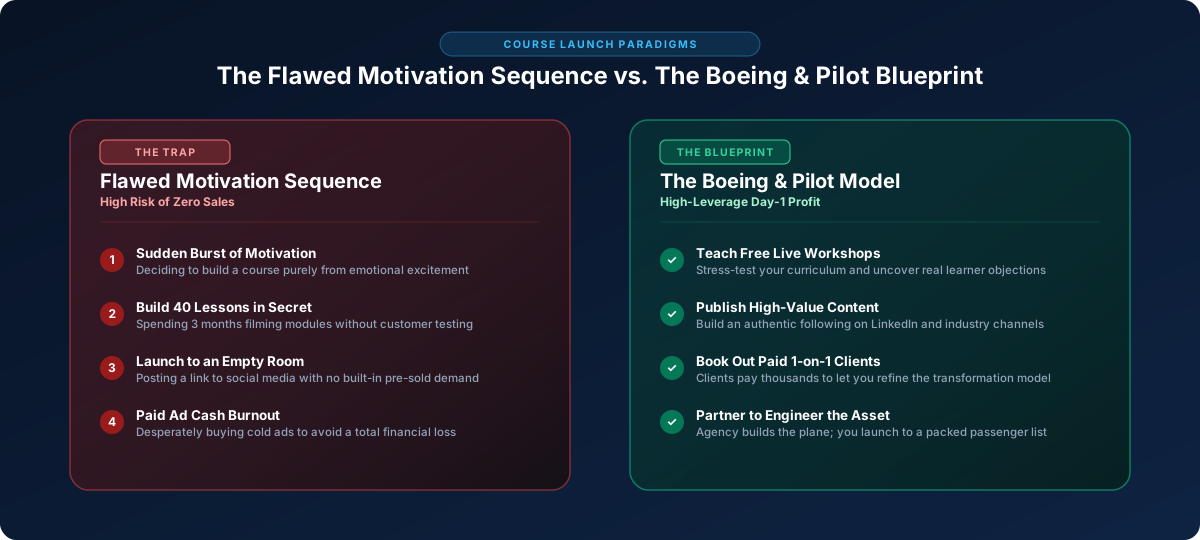
The “Boeing vs. Pilot” Model of Digital Learning
To build a sustainable education business or corporate training academy, you must understand the separation of roles between instructional architecture and audience distribution.
At TheEduAssist, we view the agency-creator relationship through the Boeing Model:
We are the aircraft manufacturers. You are the pilot.
- We engineer the airplane: We build the instructional design frameworks, interactive SCORM packages, microlearning video sequences, WCAG 2.2 accessibility architectures, and enterprise LMS deployments. We ensure the jet engine operates with zero latency, complete audit-readiness, and flawless pedagogy.
- You are the pilot: You hold the domain credentials, command the cockpit, set the flight route, and build emotional authority with your students.
- The Passenger Reality: But an aircraft cannot take off from the runway without passengers who have purchased tickets. If you have no passengers, building a multi-million-dollar Boeing 787 Dreamliner just leaves you with an empty, depreciating jet parked on the tarmac.
Instructional Engineering
- •Curriculum backward-design & pedagogy
- •Interactive SCORM & xAPI packages
- •LMS infrastructure & sovereign hosting
- •WCAG 2.2 accessibility compliance
Authority & Navigation
- •20+ years of ground-truth domain expertise
- •Authentic industry reputation & voice
- •Community leadership & live mentorship
- •Strategic decision-making & vision
Ticketed Demand
- •Free webinar & workshop attendees
- •Booked-out 1-on-1 private clients
- •Waitlisted academy enrollees
- •Word-of-mouth student advocates
If you don’t have passengers waiting at the boarding gate, do not build the aircraft yet. Your job as a creator is to establish the passenger manifest first.
The 4-Tier Validation Ladder: From Zero to Scalable Academy
Before writing a single line of script for an asynchronous digital course, you must progress through four sequential stages of market validation.
Free Group Teaching
Polishing your message, discovering friction points, and gathering live testimonials.
Inbound Social Content
Building digital trust, answering real questions publicly, and generating organic leads.
Booked-Out 1-on-1s
High-ticket private advisory proves willing payers and validates the transformation blueprint.
Scalable Digital Academy
Converting the proven framework into an automated, interactive course for hundreds of students.
Tier 1: Free Delivery & Concept Stress-Testing
As detailed in our foundational guide on why new creators must start by teaching for free, your earliest priority is to present live in front of real humans.
- Speak at free community events, host open Zoom workshops, and deliver guest lectures for established associations.
- Observe where students get stuck, capture recurring Q&A questions, and refine your core message until you can explain complex ideas in simple, memorable language.
Tier 2: Inbound Authority & Value-First Content
Once your foundational message is dialed in, focus on building an audience on one or two key channels (LinkedIn, YouTube, or an email newsletter):
- Stop posting generic quotes or high-level platitudes. Post tactical problem-and-solution breakdowns.
- Show the exact templates, spreadsheets, and decision trees you use in your work.
- Provide content that is so detailed and practical that other professionals can implement it immediately and see results.
Tier 3: The Booked-Out 1-on-1 Benchmark (The Non-Negotiable Gate)
This is the single most critical threshold in your entire educational career:
Do not build a self-paced digital course until your 1-on-1 coaching, consulting, or client calendar is completely, undeniably full.
Why is this rule non-negotiable?
- Demand Verification: If you cannot convince 10 individual clients to pay you for direct, personalized 1-on-1 access, you will never convince 500 strangers to buy an automated video course without personal access.
- Process Perfection: Working 1-on-1 forces you to walk 15 to 20 different individuals through your methodology step-by-step. You discover every nuance, every unique constraint, and every edge case.
- The Natural Ceiling: When your calendar is 100% booked, your hourly rate hits a ceiling. You have zero open hours left in your week. That is the only time when creating a digital course is a smart strategic decision—because you are productizing a system that already has excess demand waiting in line.
Tier 4: Engineering the Scalable Academy
Once you have an overflowing waitlist of people who cannot afford your 1-on-1 consulting rate or cannot fit into your calendar, you finally build the digital course.
Now, you aren’t hoping for buyers. You can announce:
“My private 1-on-1 advisory is booked through next quarter. But for those who want to execute this exact transformation on their own schedule, I have partnered with an instructional design team to codify the entire curriculum into our flagship digital academy.”
Your course launches to an enthusiastic, pre-qualified waitlist.
The Two Universal Value Metrics of High-Converting Courses
Regardless of whether you teach corporate leadership, healthcare operations, cloud infrastructure, or creative skills, every successful digital course is bought for one of two economic reasons:
| Value Dimension | The “Money Maker” Course | The “Money Saver” Course |
|---|---|---|
| Primary Learner Objective | Generate revenue, earn a career promotion, win new clients, or acquire high-income skills. | Eliminate costly errors, automate manual labor, reduce operational downtime, or prevent regulatory penalties. |
| Example: Executive Leadership | Training corporate directors how to win high-ticket enterprise contracts and lead strategic transformations. | Teaching supervisors how to handle internal grievances to prevent costly union arbitrations and talent turnover. |
| Example: Healthcare & Clinical | Training specialized nurse practitioners how to launch profitable private clinical practices. | Training hospital staff on mandatory HIPAA and clinical compliance protocols to avoid massive regulatory fines. |
| Example: Technical & Software | Teaching developers how to build production-grade agentic AI systems that command $180,000 salaries. | Teaching engineering teams how to implement automated CI/CD pipelines that eliminate 40 hours of manual QA per sprint. |
| Pricing Justification | “If this course helps you win one new client, it pays for itself 10x over.” | “If this training prevents one critical operational error, it saves your company $50,000.” |
If your course idea cannot be directly tied to making money or saving money, it is an elective hobby course. Hobby courses suffer from abysmal conversion rates and high price sensitivity. Business-impact courses command premium pricing and generate enduring customer lifetime value.
The LMS Reality Check: Technology Follows Strategy
Creators often spend weeks agonizing over technology:
- “Should I build on Kajabi?”
- “Is LearnWorlds better for interactive testing?”
- “Should I look at Teachable alternatives or self-host on Moodle?”
Here is the truth: every major Learning Management System on the market is viable. Each platform has distinct architectural advantages depending on your specific stakeholders and KPIs:
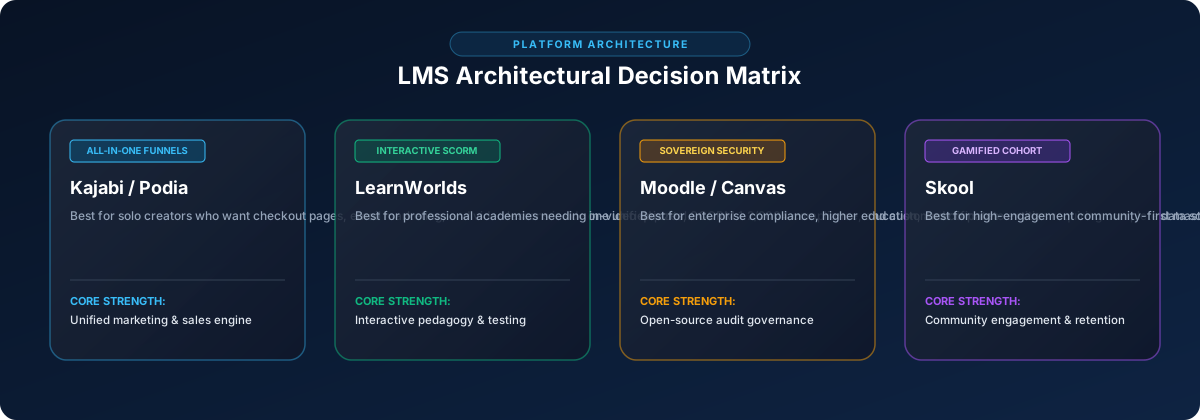
- Kajabi: Unbeatable for solo creators who want their landing pages, email marketing funnels, and membership portal in one unified dashboard.
- LearnWorlds: Exceptional for academies requiring interactive video assessments, SCORM package compatibility, and sophisticated transcript styling.
- Moodle / Open-Source: Essential for public-sector compliance, universities, and enterprise corporate environments requiring on-premise data governance.
- Skool: Highly effective for community-first, gamified cohort environments where peer discussion drives engagement.
An LMS is an operational amplifier, not a magic wand. If you build an empty course with zero student validation on a $500/month platform, you simply have a more expensive way to make zero sales. Select your LMS only after your audience, curriculum, and 1-on-1 validation are locked in.
The Final Takeoff: When You Are Ready for Boeing
When you have done the ground work—teaching free workshops, writing high-value content, and booking out your 1-on-1 client pipeline—you will reach the point where your educational business outgrows amateur DIY production.
You don’t want a course that looks like someone recorded their webcam in a bedroom. You want an accredited, enterprise-grade learning asset that commands industry authority and drives real career transformation.
That is where we come in.
Free Teaching & Live Q&A
Deliver free live workshops to collect unfiltered learner questions and identify curriculum bottlenecks.
Booked-Out 1-on-1 Advisory
Charge for 1-on-1 consulting until your weekly calendar hits 100% capacity.
Hand Over Validated IP to Agency Engineers
TheEduAssist deconstructs your proven exercises into interactive SCORM modules and accredited curriculum.
Launch to Pre-Sold Waitlist
Open enrollments to eager waiting clients with guaranteed day-1 revenue and high completion rates.
At TheEduAssist, we partner with established coaches, enterprise consultants, and corporate leaders to build institutional-quality digital learning ecosystems:
- Pedagogical Engineering: We turn your raw consulting slides into structured, cognitive-load-balanced curriculum based on proven instructional design standards.
- Custom Interactive Modules: We author compliant SCORM and xAPI interactive simulations, branching scenario engines, and automated knowledge checks through our Custom eLearning Development practice.
- Flawless Platform Integration: We configure, brand, and secure your learning management system—whether that means high-performance LearnWorlds architecture or enterprise LMS implementation and migration.
You focus on piloting the journey and serving your passengers. We build the plane.
Next in the Series: Read our unfiltered manifesto on What an eLearning Agency Actually Does (And the Brutal Truth About What We Won’t) to understand the exact 60/40 division of responsibility, why agencies love busy creators, and why we will never motivate you or research your niche.
Ready to Architect Your Flagship Digital Academy?
If your calendar is booked out with 1-on-1 clients and you are ready to engineer a scalable, institutional-grade online course:
- Review our Instructional Design Services to see how we transform raw knowledge into accredited learning programs.
- Explore our Enterprise Case Studies to see how leading organizations scale digital education globally.
- Book an Architecture Discovery Call with our senior instructional strategists today.
Need Help Building or Scaling Your Online Learning Program?
Whether you are launching an academy on Kajabi, modernizing corporate LMS modules, or converting raw expertise into accredited curriculum, our senior instructional designers provide a complimentary architecture evaluation.
Frequently Asked Questions
QWhy is building a course before having an audience so risky?
Creating a high-caliber digital course requires dozens of hours of scripting, filming, and instructional architecture. If you complete that production without an existing distribution channel or email list, you are forced to spend months desperate for sales, running cold ad campaigns, or discounting your expertise. Validating demand first ensures you are building for customers already eager to buy.
QWhat is the 'Boeing vs. Pilot' analogy in course creation?
At TheEduAssist, we operate like Boeing: we engineer the high-performance plane—the pedagogical blueprints, SCORM packages, interactive simulations, and enterprise LMS setup. You are the pilot who flies the plane and leads the student journey. But an aircraft cannot take off without passengers who have purchased tickets. That audience is the pilot's responsibility to assemble before ordering the aircraft.
QHow do I know when I am finally ready to build an online course?
You are ready to build a course when three criteria are met: (1) You have validated your teaching through live free workshops, (2) Your calendar is 100% booked with paid 1-on-1 clients and you can no longer take on manual hours, and (3) You have identified the exact, repeatable sequence of transformations that delivers results.
QDoes the choice of LMS matter if I don't have an audience yet?
No. An LMS is simply an execution tool. Whether you host on Kajabi, LearnWorlds, Teachable, or a custom Moodle instance, no learning management system has ever created organic audience demand. Focus on audience building and content value first; select your LMS platform later based on technical requirements, user experience, and corporate reporting KPIs.
QWhat makes a digital course commercially viable?
A course is commercially viable when it delivers clear, measurable economic impact. It must either help the student/organization make money (career promotion, sales growth, acquiring high-income skills) or save money (reducing downtime, automating workflows, preventing regulatory fines, streamlining onboarding).
