Instructional Design in Action: Practical Solutions for Learner Problems
Learn how instructional design solves common learner problems through clear structure, practical learning, better engagement, and learner-centered experiences.
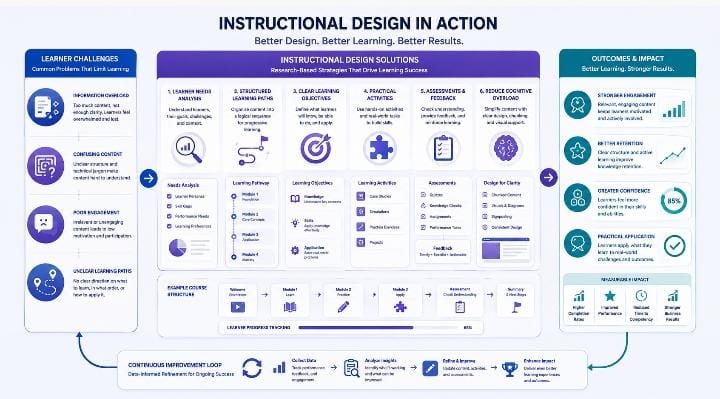
Table of Contents ▼
Quick Answer
This article explains what an instructional designer does and why instructional design is essential for effective learning. It explores common learner problems such as poor structure, information overload, lack of practical application, and unclear learning paths. The article explains how instructional designers assess learner needs, organize learning structures, create practical learning experiences, improve retention, and ensure technology supports rather than replaces good learning design. It also discusses the future of instructional design and TheEduAssist's learner-centered approach.
Key Takeaways
- Instructional design turns information into structured learning experiences that are easier to understand and apply.
- An instructional designer focuses on how people learn, not simply on delivering information.
- Common learner problems include poor structure, information overload, unclear learning paths, and limited practical application.
- Poor learning design can lead to low motivation, weak knowledge retention, reduced confidence, and wasted time.
- Instructional designers assess learner needs and create learning structures around real learner challenges.
- Effective instructional design breaks complex information into manageable steps and logical learning sequences.
- Practical activities, scenarios, assessments, and problem-solving tasks help learners apply knowledge rather than simply memorize it.
- Instructional design can reduce cognitive overload and improve focus, engagement, and retention.
- Technology alone cannot solve learning problems. Good instructional design gives learning technology purpose and structure.
- The future of instructional design includes digital learning, personalization, microlearning, adaptive learning, AI-assisted learning, and lifelong reskilling.
Instructional Design in Action: Practical Solutions for Learner Problems
What Is an Instructional Designer, and Why Does Learning Need One?
Struggling with disorganized courses, poor participation, or ineffective learning? Understand why instructional design matters, how it addresses the real problems learners face, and how TheEduAssist helps make learning genuinely meaningful.
What Is an Instructional Designer?
If you have ever taken a course, gone through training, or studied for an exam and felt unsure, unprepared, or disconnected, the problem is probably not you. In most cases, the real issue is how the learning was designed.
An Instructional Designer is someone who organizes, plans, and structures learning experiences so that they become clear, engaging, and relevant. When organizations say they need an instructional designer, they are recognizing something important, they need someone who can help learners actually make sense of what they are being asked to learn.
Instructional design focuses on how people learn, not just what they learn. Done well, it turns learning into something that builds real comprehension, confidence, and practical application.
Why We Need Instructional Designers
Today’s learners face a unique set of challenges. Education no longer happens only in classrooms, it happens online, at work, and often under real time pressure. Unlimited access to information does not automatically make learning easier.
Common issues include:
- Poorly structured learning materials
- Overwhelming, unfamiliar information
- A focus on theory instead of real world application
- No clear direction or learning path
Without instructional design, learning quickly becomes stressful instead of supportive. This is exactly why instructional designers play such a critical role in building effective learning programs, and it is a core focus of TheEduAssist’s instructional design work.
The Real Problems Learners Face Today
Many learners feel frustrated, even if they rarely say so out loud. You may recognize thoughts like:
- I finished the material, but I do not know where to start applying it.
- The course felt long, and I still do not feel confident.
- I understand the concept, but I cannot actually practice it.
- There was too much information with no clear focus.
These are not signs of learner failure. They are signs of design failure. Even highly motivated learners get lost when learning is not built around them.
How Poor Learning Design Affects Learners and Professionals
Without strong instructional design:
- Learners lose motivation
- Knowledge is quickly forgotten
- Confidence declines
- Time and effort feel wasted
This can directly affect professional performance, contributing to anxiety, weaker outcomes, and a loss of interest in learning altogether. Thoughtful instructional design helps prevent these outcomes by making learning explicit, applicable, and genuinely supportive.
Key Roles of an Instructional Designer in the Development Process
Instructional Designers do far more than create content. They shape the entire learning experience.
Understanding Learner Needs Instructional Designers assess who the learners are, what challenges they face, and what skills or knowledge they actually need. This ensures learning is built around real people, not assumptions.
Building Effective Learning Structures They break complex tasks into manageable steps, map out logical learning sequences, and set clear learning goals, so learners always understand what they are studying and why it matters.
Designing Learning for Real Application Instructional Designers focus on real world scenarios, hands on activities, assessments, and problem solving tasks. The goal is learning that learners can actually use, not just remember.
Improving Support and Retention By applying proven learning theories and best practices, they reduce cognitive overload, strengthen focus and engagement, and improve long term retention.
How Instructional Design Solves Learner Problems
Instructional design addresses core learner challenges by:
- Replacing vague content with clear direction
- Turning raw information into practical knowledge
- Making learning feel manageable and achievable
- Supporting learners emotionally through clarity and structure
When learning is properly structured, learners stop feeling pressured and start making real progress.
The Role of Instructional Designers in the Future of Learning
The future of learning is changing quickly. Learning is becoming:
- Digital and remote
- Personalized and flexible
- Continuous rather than one time
Instructional Designers will play a key role in shaping online and blended learning relationships, modular courses and microlearning, adaptive and AI assisted learning, and lifelong reskilling. As learning continues to evolve, instructional design ensures that technology supports learners instead of confusing them, something organizations increasingly rely on TheEduAssist to help navigate.
Why Instructional Design Matters More Than Technology
Many organizations focus heavily on platforms, tools, and systems. But technology alone cannot solve learning problems.
Without solid instructional design:
- Forums become little more than content storage
- Courses turn into digital textbooks
- Learners disengage entirely
Instructional design gives learning technology real purpose and structure. It ensures learners use the tools effectively, rather than the tools controlling the learning experience.
How Instructional Design Helps Learners Overcome Real Challenges
Instructional design benefits learners by:
- Clarifying expectations from the start
- Building trust gradually through consistent structure
- Connecting learning directly to real goals
- Encouraging genuine growth rather than pressure or coercion
When instructional design is implemented well, learners stop feeling stuck and start moving forward with confidence.
How TheEduAssist Supports Learning as a Trusted Partner
TheEduAssist believes learning should feel supportive, not stressful. Behind every course or training program are real people trying to grow, learn, and succeed.
TheEduAssist supports learning by:
- Building instructional solutions centered on learners
- Organizing content around real world problems
- Ensuring clarity, interaction, and relevance
- Supporting educators, institutions, and learners alike
We treat instructional design as a collaborative process focused on understanding learning challenges and solving them directly.
Learning Must Be Built, Not Assumed
When an organization says it needs an instructional designer, it is acknowledging something important: effective education does not happen by accident, it happens by design.
Instructional design turns confusion into clarity, information into understanding, and learning into confidence. It respects the time, effort, and goals of every learner.
With thoughtful instructional design and support from TheEduAssist, learning becomes a genuinely valuable and empowering process.
Call to Action
If learning feels confusing, overwhelming, or ineffective, you are not alone. TheEduAssist is here to help design learning that is built around clarity, understanding, and real progress.
Frequently Asked Questions
What is the role of an Instructional Designer in development?
An Instructional Designer creates purposeful, learner centered experiences that improve comprehension, engagement, and practical application.
Why is instructional design important for learners?
It makes learning understandable, applicable, and manageable, helping learners absorb and apply knowledge with confidence instead of fear.
How does instructional design solve learning problems? It breaks down content, reduces overload, aligns learning with clear goals, and focuses on real application rather than memorization.
Who benefits from instructional design? Students, professionals, educators, and organizations building learning programs that aim for real impact and performance improvement.
What role does TheEduAssist play in instructional design? TheEduAssist partners with individual learners and organizations to create meaningful, learner centered instructional solutions that drive real learning s
Need Help Building or Scaling Your Online Learning Program?
Whether you are launching an academy on Kajabi, modernizing corporate LMS modules, or converting raw expertise into accredited curriculum, our senior instructional designers provide a complimentary architecture evaluation.
Sources & References
Frequently Asked Questions
QWhat is the role of an Instructional Designer in development?
An Instructional Designer creates purposeful, learner-centered learning experiences that improve comprehension, engagement, retention, and practical application.
QWhy is instructional design important for learners?
Instructional design makes learning more understandable, applicable, and manageable. It helps learners absorb and apply knowledge with greater clarity and confidence.
QHow does instructional design solve learning problems?
It breaks complex content into manageable parts, reduces information overload, establishes clear learning goals, creates logical learning paths, and emphasizes practical application rather than memorization alone.
QWho benefits from instructional design?
Students, professionals, educators, and organizations can all benefit from instructional design when they are developing or participating in learning programs designed for meaningful learning and performance improvement.
QWhat role does TheEduAssist play in instructional design?
TheEduAssist works with learners and organizations to create learner-centered instructional solutions focused on clarity, relevance, interaction, practical application, and meaningful learning outcomes.