Stop Ineffective Training: How to Build Uplifting eLearning Modules?
Discover how to create uplifting eLearning modules that improve engagement, retention, accessibility, and workplace performance through practical instructional design strategies.
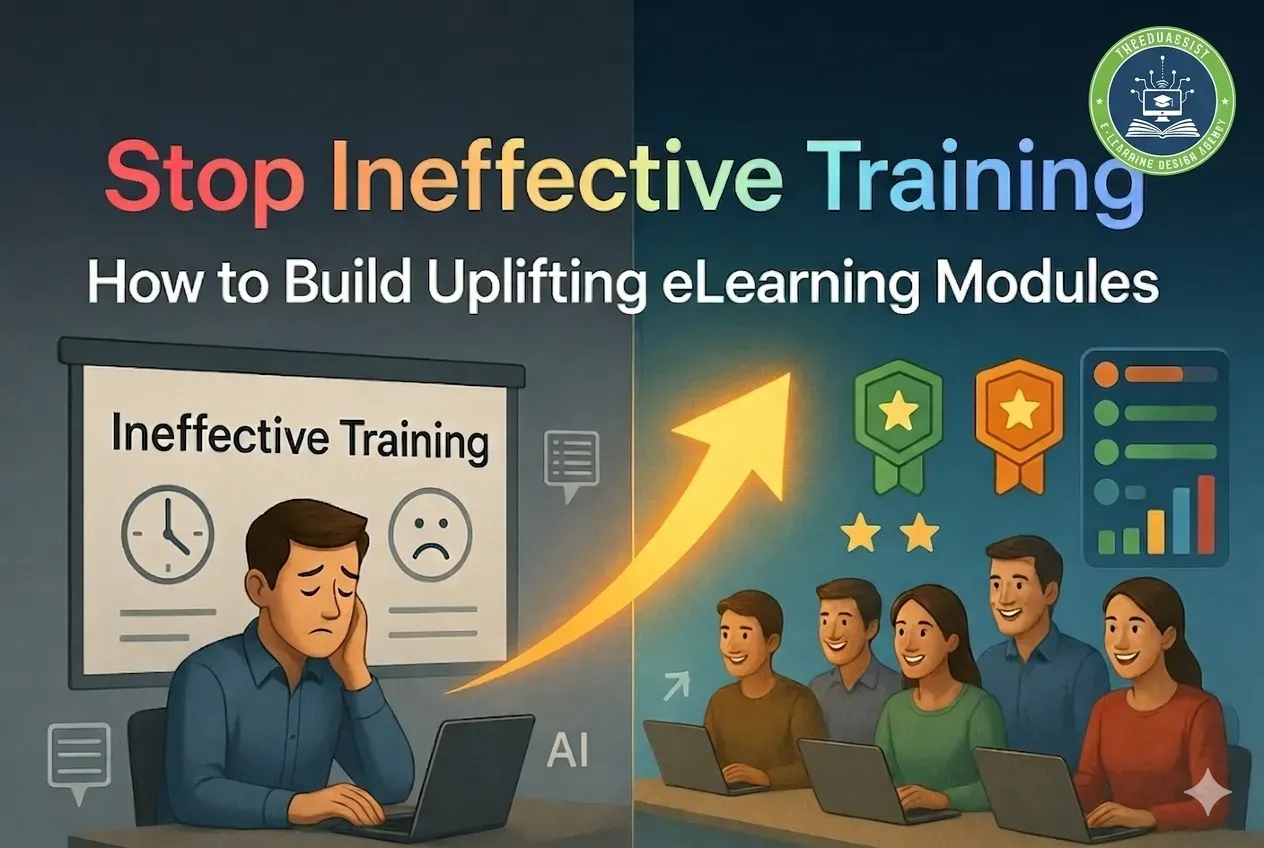
Table of Contents ▼
Quick Answer
This guide explains how to build uplifting eLearning modules using evidence-based instructional design, Mayer’s multimedia principles, Gagné’s events, microlearning, gamification, AI personalization, accessibility, assessments, and learning analytics. It provides a practical seven-step process for creating engaging and measurable learning experiences.
Key Takeaways
- Design around learners and measurable objectives rather than simply delivering information. The article recommends learner analysis, Bloom’s Taxonomy, problem-centered design, and clear objectives.
- Use microlearning, multimedia, interaction, and gamification to reduce cognitive overload and improve engagement and retention.
- Measure, personalize, and continuously improve modules using AI, accessibility practices, assessments, analytics, and feedback.
In a world where skills demands shift rapidly, many training programs still fall flat.Uplifting eLearning modules flip this script. They are learner-centered, interactive, personalized, and grounded in cognitive science and real-world application. Drawing from peer-reviewed research in journals like the British Journal of Educational Technology, recent instructional design models for 2025-2026, and industry reports, this guide outlines how to design modules that boost engagement, retention (25-60% higher than traditional methods), performance (15-25% gains), and business impact.
Focus on the keyword eLearning modules to emphasize practical, uplifting experiences over rote training. Corporate eLearning continues to expand, but low engagement and poor retention plague the field. Traditional classroom instruction yields retention rates of just 8-10%, while even standard eLearning often struggles with completion rates around 20-30% for long-form courses. Microlearning, by contrast, achieves ~80% completion on average, and gamified modules can reach 90%. The stakes are high: the World Economic Forum’s Future of Jobs Report 2025 indicates that job disruption could affect 22% of roles by 2030, creating 170 million new positions while displacing 92 million, with 59% of the global workforce needing reskilling. Yet many learners disengage because modules feel passive, irrelevant, or overwhelming.
LinkedIn’s Workplace Learning Report 2025 highlights a skills crisis: 49% of L&D leaders note executive concern that employees lack the skills to execute business strategy. Only 36% of organizations qualify as “career development champions” with robust programs driving profitability, talent attraction, retention, and AI adoption. These champions deploy more career-focused tactics, measure outcomes better, and are 42% more likely to lead in generative AI. Employees crave learning that adds purpose - 84% say it does when done right - but ineffective modules waste resources and erode motivation.
The High Cost of Ineffective Training:
Poorly designed training costs organizations dearly in time, money, and talent. Low completion stems from cognitive overload, lack of relevance, and passive formats. eLearning can reduce training time by 40-60% compared to classroom sessions, yet without strong design, learners forget 50% of information within an hour. Microlearning counters this with 25-60% better retention and 80%+ completion rates, while gamification pushes completion toward 90%.
WEF data shows 39% of core skills will transform by 2030, with technological skills rising fastest alongside human-centric ones like analytical thinking, resilience, and creativity. Without uplifting eLearning modules, companies risk skill gaps that hinder agility. Career development champions, however, report higher confidence in profitability, talent retention, and AI readiness. The gap is clear: ineffective training demotivates; uplifting design inspires application and growth.
Core Principles of Uplifting eLearning Modules
Strong eLearning modules rest on evidence-based foundations from cognitive psychology and instructional design.
Richard Mayer’s Cognitive Theory of Multimedia Learning provides 12 principles to minimize overload and maximize understanding. Key ones include:
- Multimedia Principle: Learners absorb more from words + pictures than words alone.
- Modality Principle: Narration outperforms on-screen text with visuals.
- Contiguity Principle: Align words and images spatially and temporally.
- Coherence Principle: Remove extraneous material.
- Segmenting Principle: Break content into manageable chunks.
- Personalization Principle: Use conversational style for direct engagement.
These principles, rooted in dual-channel, limited-capacity, and active-processing assumptions, directly address why many modules fail.
Gagné’s Nine Events of Instruction offer another practical framework: gain attention, inform objectives, stimulate recall, present content, provide guidance, elicit performance, give feedback, assess, and enhance retention/transfer. Recent 2025-2026 guides combine these with Universal Design for Learning (UDL) for accessibility and inclusivity.
Gamification delivers measurable lifts. A 2024 meta-analysis in the British Journal of Educational Technology found positive effects on academic performance. Broader reviews show medium-to-large effect sizes when elements like points, badges, leaderboards, progress bars, feedback, and collaboration align with learning goals and Self-Determination Theory (autonomy, competence, relatedness). Gamified eLearning modules particularly help motivation and deep learning in higher education and professional settings.
Microlearning aligns with attention spans and the spacing effect. Bite-sized 5-10 minute modules yield 18-60% retention gains, support just-in-time application, and fit busy workflows. 2025 research confirms microlearning enhances cognitive, affective, and psychomotor outcomes across disciplines.
Additional principles for 2026 include learner analysis, problem-centered design, multimodality, personalization via AI, collaboration, and intentional visual/pedagogical choices. Focus on meaning over mere information, embed modules in broader ecosystems (blended or social learning), and prioritize accessibility (captions, mobile optimization, multiple representations).
Step-by-Step: How to Build Uplifting eLearning Modules?
Step 1: Analyze Needs and Define Objectives.
Begin with learner analysis: Who are they? What skills gaps exist? Align with business goals using internal data, performance reviews, and surveys. Reference WEF priorities and LinkedIn insights strategic thinking, AI literacy, adaptability, leadership. Use Bloom’s Taxonomy for measurable objectives (e.g., “Apply conflict resolution in a simulated team scenario”). Career champions excel by linking learning to internal mobility and promotions. Involve stakeholders early.
Step 2: Storyboard the Learner Journey
Treat the module like a narrative: hook with relevance or surprise, build through challenges, resolve with application, and close with reflection. Segment content per Mayer to avoid overload. Incorporate branching scenarios, real-world examples, and conversational tone. Tools like Miro or Articulate support collaborative planning. Integrate Gagné’s events: gain attention immediately, state objectives clearly, and plan for guidance and feedback.
Step 3: Design Engaging Multimedia and Interactions
Apply Mayer rigorously - pair narration with relevant visuals, eliminate redundancy, and use signaling for key points. Add interactivity: quizzes with instant feedback, drag-and-drop, simulations, and decision trees. Incorporate gamification thoughtfully: points for milestones, badges for mastery, progress tracking, and optional leaderboards. Research shows elements like responsive feedback and collaboration yield stronger outcomes. Use authoring tools (Articulate, Genially, or AI-assisted platforms) for rapid development. Ensure multimodality (video, animation, text alternatives) and problem-centered activities.
Step 4: Personalize with AI and Adaptive Elements
2025-2026 trends emphasize hyper-personalization. AI can recommend paths based on role, prior knowledge, and performance; generate custom scenarios; or adapt difficulty. Microlearning platforms deliver just-in-time content. Career champions use internal skills data more effectively. Balance AI with human touch - ethical considerations, privacy, and options for self-directed pacing remain essential.
Step 5: Prioritize Accessibility, Inclusivity, and Mobile Design
Follow UDL: multiple means of engagement, representation, and expression. Add captions, alt text, screen-reader support, multilingual options, and high-contrast visuals. Design mobile-first (many learners access via phones). Address DEI to make eLearning modules relevant across diverse audiences 83% of employers prioritize this for workforce readiness.
Step 6: Incorporate Assessment, Feedback, and Iteration
Use formative and scenario-based assessments aligned with objectives. Provide specific, timely feedback to reinforce learning. Track behavior change through application exercises or manager follow-ups. Adopt agile models like SAM (Successive Approximation Model) alongside ADDIE for rapid prototyping: build, test with users, gather analytics and feedback, then refine. This iteration is critical for fast-evolving skills needs.
Step 7: Deploy, Support, and Measure
Select an LMS supporting xAPI/SCORM for detailed tracking. Train managers (a frequent gap - many employees lack support for development plans). Blend with social learning, mentoring, or on-the-job reinforcement. Promote modules by tying them explicitly to career growth. Post-launch, analyze engagement, completion, and impact data to iterate.
Evidence from Research and Practice
Recent studies validate these approaches. Microlearning yields positive effects on learning outcomes across higher education and workplaces, with gains in retention, soft skills (e.g., leadership, emotional intelligence), and application. Gamification meta-analyses confirm benefits for motivation and performance, especially in moderate-duration programs with well-aligned elements. Instructional design models for 2026 stress combining classic frameworks (Mayer, Gagné, Merrill) with AI, UDL, and data-driven personalization.
Organizations replacing long courses with microlearning report 40% higher completion and 30% better retention. Gamified experiences boost engagement dramatically. Career development champions outperform peers on profitability, talent metrics, and AI adoption by investing in meaningful, measurable learning.
Real-world success appears in AI-augmented sales training increasing confidence or immersive scenarios building frontline skills. Universities applying UDL + interactive design see higher asynchronous engagement.
Measuring Success and ROI
Move beyond completion rates. Apply Kirkpatrick’s levels: reaction (surveys), learning (pre/post assessments), behavior (on-the-job application), and results (business KPIs like productivity or error reduction). Track ROI through time savings (40-60% less), retention gains (25-67%), and performance lifts (15-25%). Use learning analytics for granular insights. Champions measure engagement, promotions, skills acquired, and internal mobility leading to stronger business outcomes.
Future-Proofing Your eLearning Modules
In 2026, AI will accelerate content creation, personalization, and analytics. Expect more immersive XR, micro-credentials, and continuous learning ecosystems. Uplifting eLearning modules will augment human skills - creativity, collaboration, resilience that AI cannot fully replace. Focus on human-centered design: meaningful problems, emotional connection, and lifelong learning habits.
Trends include stronger emphasis on accessibility as standard (not accommodation), social/collaborative elements, and integration into daily workflows via mobile and just-in-time delivery.
Conclusion: From Ineffective to Uplifting
Stopping ineffective training requires intention, not just investment. By grounding eLearning modules in Mayer’s principles, Gagné’s events, gamification research, microlearning, AI personalization, and agile iteration, L&D teams can create experiences learners complete, remember, enjoy, and apply. The result: higher retention, stronger skills pipelines, better ROI, and employees who feel genuinely supported in their growth.
The research, tools, and frameworks are readily available. Organizations that commit to uplifting design starting small, iterating based on data, and tying learning to real career impact will lead in adaptability and talent attraction. Ineffective modules drain potential; uplifting ones unlock it. Build the future of learning that inspires rather than checks boxes. Your learners and your organization will thank you.
Authored By: Atiqa Sajid http://www.linkedin.com/in/atiqa-sajid-747b57137
Need Help Building or Scaling Your Online Learning Program?
Whether you are launching an academy on Kajabi, modernizing corporate LMS modules, or converting raw expertise into accredited curriculum, our senior instructional designers provide a complimentary architecture evaluation.
Sources & References
- LinkedIn. (2025). Workplace Learning Report 2025.
- World Economic Forum. (2025). The Future of Jobs Report 2025.
- Zeng, J. et al. (2024). Exploring the impact of gamification on students’ academic performance. British Journal of Educational Technology.
- Mayer, R.E. (2008). Applying the science of learning… American Psychologist.
- Mayer’s 12 Principles of Multimedia Learning (Practical explanation & application)
- Evidence-Based Principles for Multimedia Instruction (Mayer, 2008 - foundational paper)
- e-Learning and the Science of Instruction by Ruth Clark & Richard Mayer (Book reference, 4th edition)
- (Wiley) Recent retrospective on 30+ years of Mayer’s research (2024/2025)
Frequently Asked Questions
QWhat are uplifting eLearning modules and how do they differ from standard training?
Uplifting **eLearning modules** are learner-centered, interactive, and personalized digital experiences designed to motivate and deliver results. They incorporate microlearning, gamification, and Mayer’s multimedia principles to achieve 25 - 60% better retention and 80%+ completion rates, unlike passive formats that often see 20 - 30% completion and rapid forgetting.
QWhy do many eLearning modules suffer from low completion rates?
Primary reasons include cognitive overload, irrelevant content, passive delivery, and lack of immediate application. Long-form courses frequently finish at 20 - 30%, while microlearning and interactive designs reach 80 - 90% by respecting attention spans and providing engaging elements.
QDoes gamification actually improve eLearning modules?
Yes, when properly designed and aligned with learning goals and Self-Determination Theory. Meta-analyses show positive effects on motivation, deep learning, and performance, especially in moderate-length programs using structured frameworks. Elements like points, badges, and feedback work best.
QHow can organizations measure the ROI of uplifting eLearning modules?
Use Kirkpatrick’s levels (reaction, learning, behavior, results) combined with business KPIs. Track via xAPI analytics. Effective modules typically deliver 15 - 25% performance improvements, 40 - 60% reduced training time, and gains in engagement and retention.
QWhat tools are recommended for building uplifting eLearning modules?
Popular authoring tools include Articulate Rise/Storyline and Genially. Platforms with AI features (e.g., Docebo, TalentLMS) help with personalization. Use Miro for storyboarding and ensure the LMS supports xAPI/SCORM tracking. No advanced coding is usually required.
QHow does AI help create better eLearning modules in 2026?
AI supports adaptive pathways, custom scenario generation, difficulty adjustment, and personalized recommendations. It enables efficient skills-gap analysis and just-in-time delivery while allowing designers to focus on creative, human-centered aspects. Career champions adopt AI more readily.
QWhere can I find reliable research on designing effective eLearning modules?
Key sources include the *British Journal of Educational Technology*, Mayer’s Cognitive Theory of Multimedia Learning, the WEF Future of Jobs Report 2025, LinkedIn Workplace Learning Report 2025, and sites like eLearning Industry and ATD. Start with a pilot module, collect feedback, and iterate.
QHow do I make eLearning modules accessible and inclusive?
Apply Universal Design for Learning (UDL): offer multiple ways to engage, represent information, and demonstrate knowledge. Include captions, alt text, mobile optimization, high contrast, and multilingual options to serve diverse learners effectively.
QHow long should a good eLearning module be?
Target 5 - 15 minutes per module using a microlearning approach. This follows the segmenting principle, supports higher retention (up to 80 - 90%), and improves completion compared to longer sessions.
QHow soon can results be expected from improved eLearning modules?
Engagement and completion rates often rise within 1 - 3 months. Measurable performance gains and ROI typically appear in 3 - 6 months when modules address genuine skills gaps and receive manager support. Ongoing analytics help accelerate improvements.