
Caregiver and Assisted Care Training: Preventing Medicaid Clawbacks and Hoyer Lift Liabilities
IDD residential care providers, assisted living facilities, and special education contractors face devastating Medicaid recoupments and catastrophic patient injury claims. Discover how digital SCORM training automates 30-day DSP onboarding, Hoyer lift safety, and state administrative compliance.
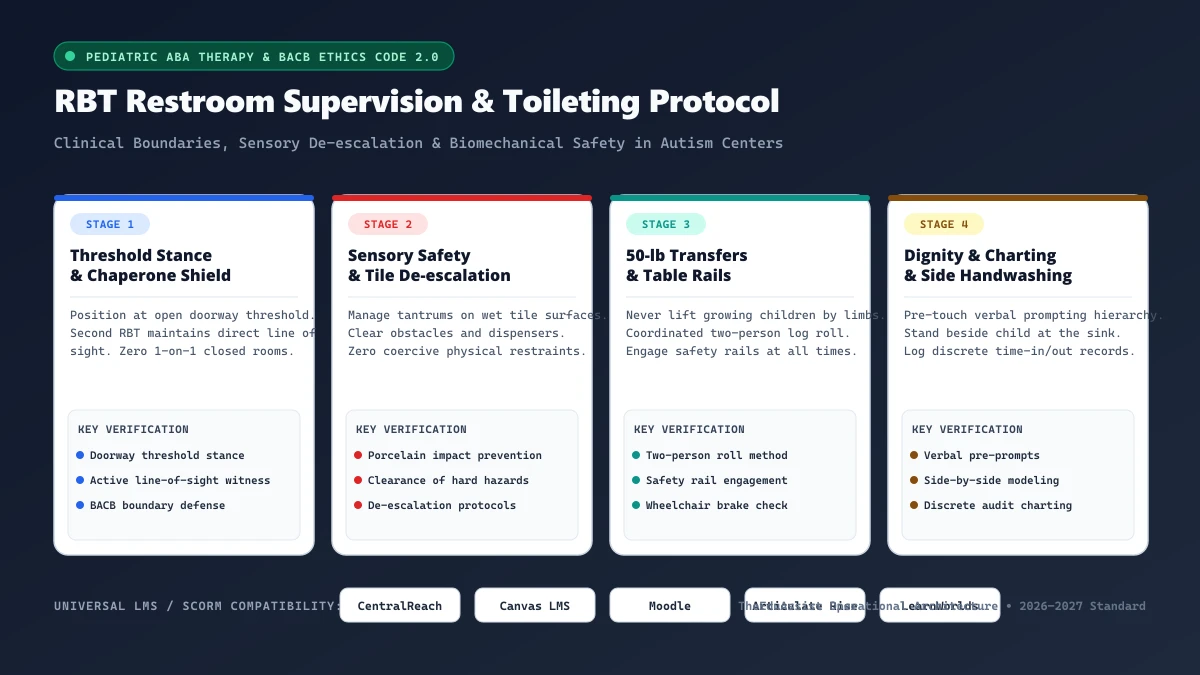
Table of Contents ▼
Quick Answer
A comprehensive compliance and operational guide for Residential Care Licensees, IDD Group Home Administrators, Assisted Living Directors, and Special Education Leaders. Covers Medicaid HCBS waiver audit defense, state administrative personnel codes, Hoyer mechanical lift sling checklists, 50-pound log-roll biomechanics, and the Two-Person Supervision Rule.
Key Takeaways
- State Medicaid fraud control units and MCO auditors regularly initiate retrospective billing clawbacks ($50,000 to $500,000+) when provider DSP training files lack verified seat time.
- Direct Support Professionals (DSPs) must complete mandatory 30-day orientation requirements covering client rights, incident reporting, and abuse registry clearances before unsupervised care.
- Mechanical patient transfers represent the highest area of physical liability in assisted living; improper sling fabric inspection or uncrossed leg straps cause severe patient drops and caregiver lumbar injuries.
- The Two-Person Supervision Rule protects both dependent individuals from physical injury and caregivers against uncorroborated abuse or neglect allegations in private spaces.
- Replacing paper employee sign-in sheets with interactive SCORM 2004 microlearning modules provides affirmative legal proof of staff competency during state licensing surveys.
Across the United States, thousands of dedicated Direct Support Professionals (DSPs), personal care aides, and assisted care workers provide vital daily living support to individuals with intellectual and developmental disabilities (IDD), traumatic brain injuries (TBI), and complex geriatric conditions.
These caregivers manage medication administration, assist with personal hygiene, prepare meals, and facilitate community integration.
However, behind the noble mission of human care lies an unforgiving regulatory environment. Residential group homes, supported living agencies, and special care facilities operate under intense scrutiny from state licensing agencies and Medicaid Managed Care Organizations (MCOs):
- What happens when an auditor discovers that a caregiver billed 160 hours of residential support before completing their mandatory 30-day state orientation?
- What happens when an aide attempts to manually lift an 80-pound adult resident off a bed, causing an acute lumbar disc rupture?
- What happens when an improperly attached Hoyer lift sling tears, dropping a fragile resident onto a tiled floor?
When care agencies rely on static paper binders or unmonitored video playlists, compliance records are incomplete.
During surprise state licensing surveys or retrospective Medicaid audits, missing training documentation leads directly to provisional license downgrades, catastrophic billing recoupments, and facility closures.
1. The Financial Reality: Retrospective Medicaid Billing Clawbacks
In Medicaid-funded residential care, training documentation is not an internal HR record; it is a condition of payment.
┌────────────────────────────────────────────────────────────────────────┐
│           THE REGULATORY FOUNDATIONS OF CAREGIVER COMPLIANCE           │
├────────────────────┬────────────────────┬──────────────────────────────┤
│ 1. STATE PERSONNEL │ 2. RETROSPECTIVE   │ 3. INCIDENT REPORTING        │
│    CODES           │    MEDICAID CLAWBACK│    & ABUSE REGISTRIES        │
│ Mandates 30-day DSP│ Missing training   │ Mandatory immediate          │
│ orientation before │ records render all │ documentation of Major       │
│ unsupervised care  │ billed shift hours │ Unusual Incidents (MUI) and  │
│ (10A NCAC, Ch 6100)│ non-reimbursable.  │ medication administration.   │
└────────────────────┴────────────────────┴──────────────────────────────┘
Under federal Medicaid Home and Community-Based Services (HCBS) waiver rules and state administrative codes (such as North Carolina 10A NCAC 27G .0202, Pennsylvania 55 Pa. Code Chapter 6100, and Ohio OAC 5123), providers must ensure that every caregiver completes mandatory core competencies within their initial 30 days (or 160 hours) of employment:
- Client rights and alternatives to restrictive interventions.
- Major Unusual Incident (MUI) reporting and mandated reporter protocols.
- Healthcare Personnel Registry (HCPR) clearances.
- Medication administration certification (Med Pass / Med Admin).
The Audit Clawback Mechanism
If an MCO or state health authority audits a residential facility and requests the training dossier for a former employee, the provider must furnish complete evidence:
- Exact date and time of course completion.
- Verifiable seat time proving the worker did not fast-forward through required statutory hours.
- Randomized assessment scores showing 80%+ mastery.
If the file contains only an unverified paper sign-in sheet, state auditors can declare that the staff member was unqualified.
Auditors then recalculate every single Medicaid billing claim submitted under that worker’s ID over the preceding 12 to 24 months, demanding retrospective repayment of $50,000 to $500,000+.
For mid-sized care agencies, a single failed audit can force bankruptcy.
2. Mechanical Lift Safety: The Anatomy of a Hoyer Lift Transfer
Patient handling injuries represent the single largest worker’s compensation expenditure for assisted living facilities and school districts.
When a 110-pound female caregiver attempts to manually transfer a 160-pound dependent adult from a wheelchair to a shower commode, spinal disc injury is practically guaranteed.
Mechanical sling lifts (Hoyer lifts, ceiling track hoists, and sit-to-stand devices) are designed to eliminate manual lifting. However, when operated by untrained staff, mechanical lifts turn into severe drop hazards.
┌────────────────────────────────────────────────────────────────────────┐
│            THE 5 CRITICAL CHECKPOINTS OF A HOYER LIFT TRANSFER         │
│                                                                        │
│  [ STEP 1: SLING INTEGRITY ]   Inspect seams, fabric loops, and rating │
│                │                                                       │
│  [ STEP 2: WHEELCHAIR LOCK ]   Lock caster wheels and widen lift base  │
│                │                                                       │
│  [ STEP 3: CROSSED STRAPS  ]   Route leg straps between legs (crossed) │
│                │                                                       │
│  [ STEP 4: 2-INCH HOVER    ]   Elevate 2 inches; verify center-gravity │
│                │                                                       │
│  [ STEP 5: GUIDED DESCENT  ]   Maintain hand contact; lower smoothly   │
└────────────────────────────────────────────────────────────────────────┘
The 5 Non-Negotiable Biomechanical Rules:
- Pre-Transfer Fabric Inspection: Before touching the resident, inspect the canvas sling for fraying, broken stitches, or UV chemical degradation. A sling with torn stitching must be destroyed immediately.
- Base Widening and Wheel Caster Engagement: The mechanical lift base must be locked in the widest open position during transfer to prevent tipping. The wheelchair wheels must be locked, while the lift’s wheels remain unlocked to allow the device to find its center of gravity.
- The Crossed Leg-Strap Protocol: Leg loops must be routed between the resident’s thighs and crossed. Attaching straps straight without crossing creates an open cradle that allows the individual to slide out headfirst.
- The Two-Inch Safety Hover: Lift the resident two inches off the mattress or chair. Pause. Verify that all 4 or 6 hooks are securely seated in the spreader bar cradle and that the resident is stable before proceeding with the room transit.
- Continuous Physical Stabilization: The secondary caregiver must maintain physical contact with the resident’s torso to prevent pendulum swinging and rotational dizziness.
3. The 50-Pound Log-Roll Technique
Not every resident can be hoisted directly with a machine. Repositioning bed-bound individuals to prevent decubitus pressure ulcers (bedsores) requires manual manipulation.
Lifting dead weight exceeding 50 pounds manually creates destructive shear forces on the lumbar vertebrae (L4/L5 and L5/S1).
Our interactive caregiver modules train staff on the Coordinated Two-Person Log-Roll:
- Lower the bed rail on the working side while raising the opposite rail.
- Cross the resident’s far leg over their near leg and place their arms across their chest.
- Caregiver 1 places hands on the resident’s shoulder and hip.
- Caregiver 2 gathers the slide sheet or draw sheet.
- On a count of three, both caregivers roll the resident as an integrated unit, using body weight shift rather than spinal bending.
4. The Two-Person Supervision Rule in Private Spaces
Personal care routines (diapering, sponge bathing, catheter emptying) take place in enclosed restrooms and bedrooms.
These private spaces present dual vulnerabilities:
- The resident is physically exposed and vulnerable to boundary violations.
- The caregiver is exposed to uncorroborated allegations of physical or sexual misconduct.
The Two-Person Supervision Standard is the institutional armor protecting both parties:
- Dependent Care Routine: For non-ambulatory individuals requiring hands-on hygiene, two certified staff members must be present inside the space throughout the procedure. Both names are logged on the care sheet.
- Independent Prompts: For individuals capable of self-toileting but prone to elopement or self-injurious behavior, the primary caregiver stands outside the open doorway threshold, prompting verbally. A second adult remains in the corridor within direct line of sight.
A caregiver must never be alone with a dependent resident behind a closed bathroom door.
5. Converting Paper Policies into SCORM 2004 Digital Academies
How do care agencies modernize dense state policy binders into bulletproof compliance?
TheEduAssist transforms complex clinical guidelines into 20-minute interactive microlearning modules:
- Audio-Visual Scenario Challenges: Caregivers observe realistic care scenarios, spot mechanical lift errors, and make real-time decisions.
- Timed Seat-Time Enforcement: Anti-skip technology ensures learners spend the full statutory seat time required by state administrative codes.
- Randomized Question Banking: 80%+ passing gates pull from large question pools, preventing staff from sharing answers during group shifts.
- One-Click Audit Dossier: Pre-configured compliance reports exportable as CSV/PDF files ready for state licensing surveys and Medicaid MCO audits.
Life Sciences & Assisted Care Regulatory Assurance: Ensure zero care interruptions and audit-defensible training records with our specialized Special Education & Assisted Care Protocols and Healthcare Payors & Medicaid Training Solutions.
Explore our turnkey custom eLearning development services or review our LMS implementation and migration solutions. Request a complimentary review of your care policies through our free compliance audit portal.
Need Help Building or Scaling Your Online Learning Program?
Whether you are launching an academy on Kajabi, modernizing corporate LMS modules, or converting raw expertise into accredited curriculum, our senior instructional designers provide a complimentary architecture evaluation.
Frequently Asked Questions
QHow does unverified caregiver training trigger retrospective Medicaid billing clawbacks?
Medicaid Home and Community-Based Services (HCBS) waivers mandate that every billed service hour must be delivered by fully qualified, compliant staff. If an audit reveals that a Direct Support Professional worked shifts before completing mandatory state training (such as 10A NCAC 27G or Chapter 6100), auditors deem the entire service unbillable and recoup all associated funds retroactively.
QWhat are the essential safety checks required before operating a Hoyer mechanical lift?
Operators must inspect sling fabric for frayed stitching or tears, ensure the patient weight does not exceed the boom limit, lock wheelchair caster wheels, route leg straps in a crossed configuration to prevent patient slipping, and maintain physical stabilizing contact throughout the elevation.
QHow does the Two-Person Supervision Rule apply during personal care routines?
For dependent individuals requiring physical transfers, diapering, or bed repositioning, two trained staff members must be present inside the space. For individuals who can toilet independently but have behavioral triggers, the primary caregiver prompts from the open doorway while a second adult remains within direct line of sight in the hallway.
