
Benefits of xAPI for Modern eLearning
Learn the benefits of xAPI for modern eLearning, including better learning tracking, analytics, mobile learning, simulations, personalized learning, and LMS integration.
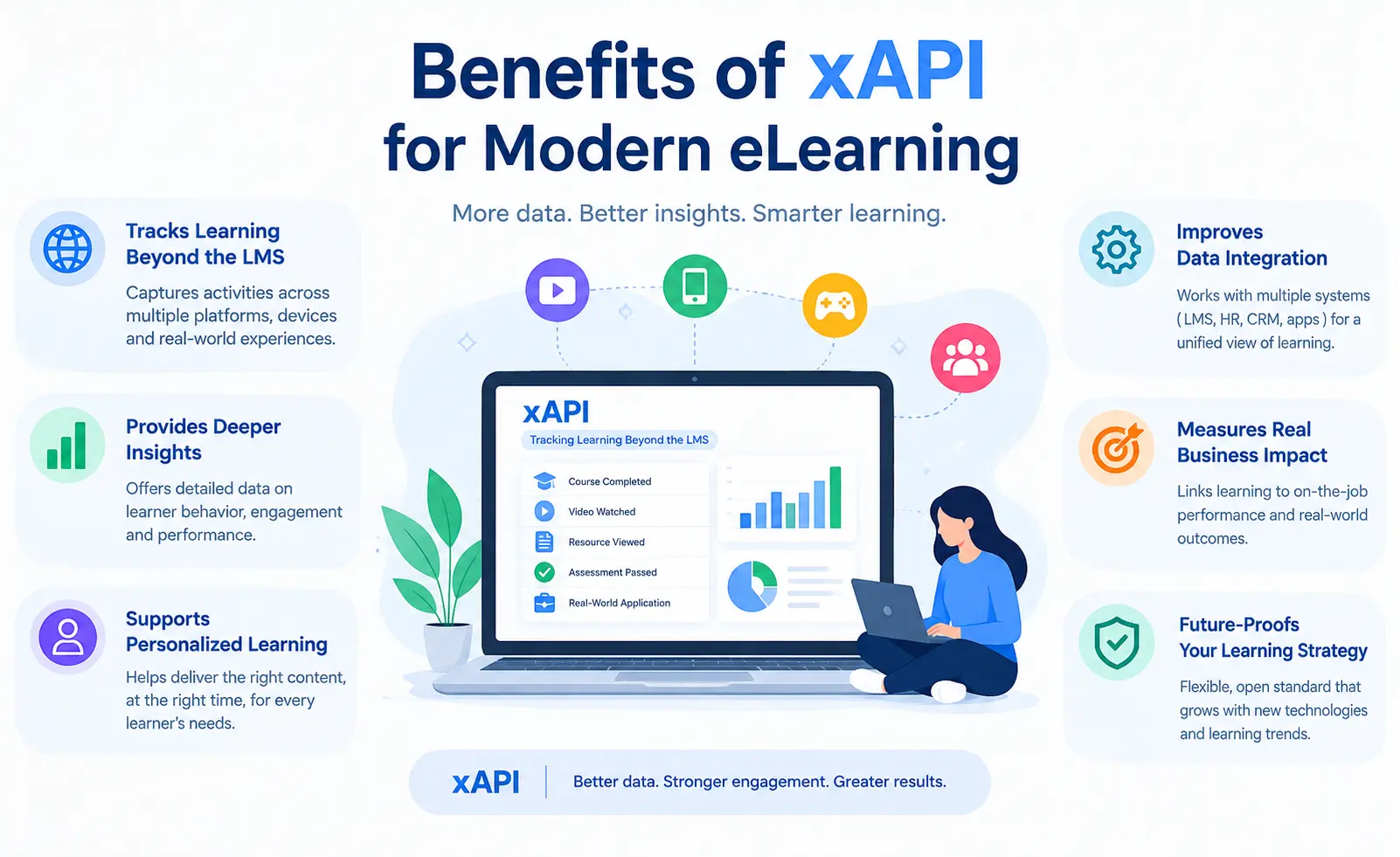
Table of Contents ▼
Quick Answer
This guide explains the key benefits of xAPI, including detailed learning data, learning analytics, personalized learning, blended learning support, and integration with Learning Record Stores.
Key Takeaways
- xAPI tracks learning beyond the LMS, including mobile apps, simulations, workplace activities, and offline learning.
- It provides detailed learning data that can improve learning analytics and reporting.
- xAPI supports personalized and blended learning by connecting different learning experiences.
- A Learning Record Store (LRS) stores xAPI learning statements and makes the data available for analysis.
- xAPI can work alongside SCORM, allowing organizations to keep existing courses while adopting newer tracking capabilities.
Modern learning no longer happens only inside a traditional Learning Management System (LMS). Learners now move between online courses, mobile apps, simulations, videos, virtual environments, and workplace activities. As learning becomes more distributed, organizations need better ways to understand what learners are actually doing.
This is where xAPI, or the Experience API, becomes useful.
xAPI is an eLearning technology standard that allows learning experiences to be recorded and stored in a Learning Record Store (LRS). Unlike traditional tracking approaches that mainly focus on activity inside an LMS, xAPI can capture learning experiences across different platforms, devices, and environments.
For organizations developing modern digital learning programs, this flexibility can provide a more complete view of learner activity.
What Is xAPI?
xAPI stands for Experience API. It was originally known as the Tin Can API and was developed to support learning experiences that traditional eLearning standards could not easily capture.
The key idea behind xAPI is simple: learning can happen anywhere, not just inside an LMS.
For example, an organization could use xAPI to record that a learner:
- Completed an online course
- Watched a training video
- Practiced a skill through a simulation
- Completed a mobile learning activity
- Participated in a virtual training session
- Used an interactive learning application
- Completed an offline workplace activity
- Achieved a particular result in a learning experience
These activities can generate xAPI statements that are sent to an LRS for storage and later analysis.
For more information, visit the official xAPI overview.
How Does xAPI Work?
A basic xAPI implementation involves three main components.
1. Learning Activity Provider
This is the application, course, website, simulator, mobile app, or other system where the learning activity occurs.
2. xAPI Statement
The activity is represented through an xAPI statement describing what happened.
For example:
Learner completed Safety Training.
An xAPI statement generally identifies the learner, the action performed, and the learning activity involved.
3. Learning Record Store
The Learning Record Store, commonly called an LRS, receives and stores xAPI statements. It can then make those records available to other systems for reporting, analysis, and learning-data management.
An LRS can operate independently or as part of another learning system.
You can also explore the xAPI technical overview for more technical information.
1. Tracks Learning Beyond the LMS
One of the biggest benefits of xAPI is that it is not restricted to traditional LMS-based courses.
Traditional eLearning tracking often focuses on activities such as:
- Course completion
- Quiz scores
- Time spent
- Pass or fail status
These metrics are useful, but modern learning environments can be much broader.
Employees may learn through:
- Mobile applications
- Simulations
- Virtual reality
- Social learning
- Coaching
- Video platforms
- Workplace activities
- Interactive tools
- Offline experiences
xAPI can be used to record many of these activities and send the information to an LRS.
This makes xAPI particularly useful for organizations building blended learning and continuous learning programs.
2. Provides More Detailed Learning Data
Another important benefit of xAPI is the ability to collect detailed information about learner experiences.
Instead of simply knowing that someone completed a course, an organization may be able to track specific interactions within an experience.
For example, a training program could potentially capture:
- Which activity the learner completed
- Which simulation they attempted
- Which assessment they passed
- Which learning resource they accessed
- Which action they performed
- How different learning activities relate to one another
The exact information available depends on how the xAPI implementation is designed.
This gives instructional designers and L&D teams more data to understand how learning experiences are being used.
3. Supports Mobile Learning
Mobile learning is an important part of modern digital education and workplace training.
Learners may access educational content from:
- Smartphones
- Tablets
- Laptops
- Mobile applications
- Responsive websites
xAPI’s architecture allows enabled devices and applications to send learning statements to an LRS.
This means organizations can design learning experiences that are not dependent on a learner sitting at a desktop computer inside an LMS.
For example, a field employee could complete a mobile training activity while traveling between locations, while the relevant learning activity is recorded through xAPI.
The ability to track learning across different devices is one reason xAPI is frequently associated with modern learning ecosystems.
4. Enables Better Learning Analytics
Learning analytics becomes more useful when organizations have access to meaningful learning data.
xAPI can provide a broader dataset by collecting activity from multiple learning environments.
For example, an organization might combine information from:
- LMS courses
- Mobile learning
- Simulations
- Assessments
- Virtual training
- Workplace learning activities
This can help L&D teams investigate questions such as:
- Which learning activities are being used most frequently?
- Where are learners struggling?
- Which activities are associated with successful assessments?
- How are employees progressing through a learning pathway?
- Which types of training experiences generate useful engagement?
The purpose is not simply to collect more data. The goal is to collect useful data that can support better learning decisions.
5. Supports Personalized Learning
Personalized learning requires information about individual learner behavior.
When xAPI captures learning activities from different environments, that data can potentially help learning systems understand how individuals interact with training.
For example, a learning platform could use available activity data to identify that a learner:
- Completed introductory material
- Struggled with a particular topic
- Repeated a simulation
- Successfully completed an assessment
- Participated in additional learning activities
Depending on the wider technology architecture, this information could help support more personalized learning pathways.
For example, a learner who repeatedly struggles with a specific concept could be directed toward additional practice material instead of simply moving to the next module.
6. Supports Blended and Hybrid Learning
Modern training is often a combination of different learning formats.
A single learning program may include:
- Online lessons
- Instructor-led workshops
- Videos
- Simulations
- Assessments
- Workplace practice
- Coaching sessions
Traditional LMS reporting may not provide a complete picture of all these experiences.
xAPI can help connect learning activity from different environments through a common statement-based approach.
This is particularly useful for organizations using blended learning, where learning takes place through both digital and physical experiences.
7. Makes Simulation-Based Learning Easier to Track
Simulations can provide valuable opportunities for learners to practice skills in realistic environments.
Examples include:
- Healthcare simulations
- Safety training
- Technical simulations
- Business scenarios
- Customer-service simulations
- Virtual reality training
- Equipment training
xAPI is well suited to these environments because the standard can capture learning experiences that occur outside a conventional LMS.
For example, instead of recording only whether a learner completed a simulation, an xAPI implementation can be designed to capture specific activities within that simulation.
This creates opportunities for more detailed analysis of practical learning.
8. Supports Offline Learning Scenarios
Not every learner has a reliable internet connection at all times.
Some employees may work:
- In remote locations
- On construction sites
- In warehouses
- On aircraft or ships
- In field-service environments
- In locations with limited connectivity
xAPI can support learning scenarios where continuous connectivity is not always available. Depending on the application and implementation, learning activities can be recorded and synchronized when connectivity becomes available.
This can make xAPI useful for organizations with distributed workforces.
9. Connects Different Learning Systems
Organizations often use several technologies for learning.
For example:
LMS → Mobile App → Simulation → LRS → Analytics Platform
Without a common method for exchanging learning experience data, connecting these systems can become complicated.
xAPI provides a standardized approach for communicating learning experience information.
An LRS can receive xAPI statements from different sources and make those records available to other systems for analysis and reporting.
This can help organizations build a more connected learning technology ecosystem.
10. Works Alongside Existing SCORM Content
Organizations do not necessarily have to abandon existing SCORM courses when adopting xAPI.
SCORM remains useful for traditional LMS-based eLearning, while xAPI can be introduced for newer learning experiences.
For example:
- Existing compliance courses → SCORM
- Mobile learning → xAPI
- Simulations → xAPI
- Workplace activities → xAPI
- Traditional LMS courses → SCORM
Organizations can therefore use both technologies where appropriate.
For a deeper comparison, read xAPI vs SCORM: Everything You Need to Know Before Choosing an LMS in 2026.
11. Supports More Flexible eLearning Experiences
Traditional eLearning often follows a relatively structured path:
Launch course → Complete lesson → Take quiz → Receive score
Modern learning can be much less linear.
Learners may:
- Watch a video
- Read an article
- Participate in a discussion
- Practice a skill
- Complete a simulation
- Ask a question
- Attend a workshop
- Return to the course later
xAPI’s flexible statement model can support the recording of different types of experiences.
This gives instructional designers more freedom when developing learning programs.
12. Helps Organizations Understand the Complete Learning Journey
One of the valuable applications of xAPI is building a broader picture of the learner journey.
Consider an employee learning a new software platform.
Their journey might look like:
Online Course → Product Tutorial → Simulation → Live Workshop → Workplace Practice → Assessment
If each relevant activity is tracked through xAPI, the organization can potentially analyze the learning journey as a connected set of experiences.
Instead of asking only:
Did the employee complete the course?
The organization can explore:
What learning experiences did the employee complete, and how did they interact with the training?
That distinction can be valuable for instructional design and learning analytics.
13. Supports Data-Driven Instructional Design
Instructional designers can use learning data to identify areas where training experiences may need improvement.
Suppose analytics show that many learners repeatedly attempt the same simulation activity before succeeding.
That information could indicate that the simulation is challenging or that learners need additional supporting material.
The instructional design team could then:
- Improve the instructions
- Add examples
- Provide additional practice
- Change the difficulty level
- Introduce prerequisite content
In this way, xAPI data can become part of an ongoing course-improvement process.
14. Supports Modern Workplace Learning
Workplace learning is no longer limited to formal courses.
Employees learn while:
- Solving problems
- Working with colleagues
- Practicing new skills
- Using software
- Attending workshops
- Completing job-specific tasks
- Participating in professional development
Some of these experiences can be difficult to capture through traditional LMS reporting.
xAPI provides a framework for recording learning experiences from different sources, making it potentially useful for organizations trying to understand learning beyond formal course completion.
15. Supports Future-Ready Learning Technology
Learning technology continues to expand into areas such as:
- Artificial intelligence
- Virtual reality
- Augmented reality
- Mobile learning
- Adaptive learning
- Simulations
- Learning analytics
- Digital credentials
A learning standard needs to work across different types of technology if organizations want to build connected learning ecosystems.
xAPI’s device, system, and workflow flexibility makes it suitable for many of these modern learning scenarios.
xAPI vs Traditional LMS Tracking
The difference can be summarized as follows:
| Feature | Traditional LMS Tracking | xAPI |
|---|---|---|
| LMS course completion | Yes | Yes |
| Quiz scores | Yes | Yes |
| Mobile learning | Depends on LMS | Yes |
| Simulations | Limited depending on system | Yes |
| Workplace activities | Limited | Yes |
| Offline experiences | Limited | Supported |
| Cross-platform tracking | Limited | Yes |
| Learning Record Store | Not required | Core component |
| Detailed experience data | More limited | More flexible |
| Blended learning | Possible | Strong use case |
The exact capabilities depend on the LMS, authoring tools, LRS, and implementation.
What Is a Learning Record Store?
A Learning Record Store, or LRS, is an important part of the xAPI ecosystem.
It is responsible for receiving, storing, and providing access to learning records.
Think of the LRS as a central repository for xAPI statements.
For example:
Mobile App → xAPI Statement → LRS
Simulation → xAPI Statement → LRS
eLearning Course → xAPI Statement → LRS
The LRS can then provide learning data to other systems for reporting and analysis.
Importantly, an LRS does not necessarily replace an LMS. The two systems can serve different purposes.
An LMS can handle course delivery, learner management, scheduling, and other administrative functions, while an LRS focuses on learning records.
What Are the Challenges of Implementing xAPI?
Although xAPI offers flexibility, organizations should also consider implementation requirements.
1. Technical Planning
A successful xAPI implementation requires decisions about:
- What activities should be tracked?
- Which systems will generate statements?
- Where will statements be stored?
- Which LRS will be used?
- How will the data be analyzed?
Without a clear tracking strategy, organizations can collect large amounts of data without knowing how to use it.
2. LRS Requirements
An xAPI implementation generally requires access to an LRS for storing xAPI statements.
Organizations need to evaluate LRS capabilities, integrations, security, scalability, and reporting requirements before implementation.
3. Statement Design
Good xAPI implementation requires thoughtful statement design.
If different systems use inconsistent terminology, combining and analyzing the resulting data can become difficult.
Organizations should therefore establish clear rules for how learning activities, verbs, users, and other data elements are represented.
4. Privacy and Data Governance
Learning data can contain information about individual learners and their activities.
Organizations should therefore consider:
- Data protection
- Access controls
- Authentication
- Data retention
- Security
- Privacy requirements
The technology should be implemented alongside an appropriate data-governance strategy.
How to Get Started With xAPI
Organizations do not necessarily need to convert their entire learning ecosystem to xAPI immediately.
A phased approach can be more practical.
Step 1: Identify the Learning Problem
Start with the question:
What learning activity do we need to understand better?
For example, perhaps your organization cannot track simulation performance through its current LMS.
Step 2: Choose the Activity
Select one learning experience for the initial implementation.
Examples include:
- A simulation
- Mobile learning
- Video learning
- Workplace practice
- An interactive course
Step 3: Define the Data
Decide what you actually need to track.
Avoid collecting data simply because it is technically possible.
Step 4: Choose an LRS
Evaluate LRS options based on:
- Compatibility
- Security
- Reporting
- Scalability
- Integration
- Vendor support
Step 5: Test the Implementation
Start with a small pilot before expanding across the organization.
The official xAPI resources provide additional implementation guidance for organizations getting started.
Step 6: Analyze the Results
Once data is being collected, determine whether it helps answer meaningful learning questions.
The goal should be better learning decisions, not simply more data.
xAPI and SCORM: Can They Work Together?
Yes.
An organization can continue using SCORM for existing LMS-based courses while introducing xAPI for activities that require broader tracking.
For example:
SCORM: Compliance course
xAPI: Mobile practice
xAPI: Simulation
xAPI: Workplace learning activity
SCORM + xAPI: Hybrid course environment
This approach allows organizations to gradually expand their learning-data capabilities without immediately replacing their existing course library.
If you are creating SCORM courses without technical development experience, read How to Create a SCORM Course Without Coding.
The Future of xAPI in eLearning
As learning becomes increasingly distributed across platforms and devices, organizations need ways to connect learning data from different environments.
xAPI is designed around this concept.
The future of digital learning may involve combinations of:
- AI-powered learning
- Adaptive learning
- Mobile training
- Virtual reality
- Simulations
- Microlearning
- Workplace learning
- Learning analytics
- Personalized learning
The value of xAPI is not simply that it records more information. Its larger role is to provide a common way of communicating learning experiences across different technologies.
For organizations building modern learning ecosystems, this flexibility can support better visibility into how, where, and when learning happens.
Conclusion
The benefits of xAPI for modern eLearning go beyond basic course tracking.
xAPI can help organizations:
- Track learning beyond the LMS
- Capture detailed learning experiences
- Support mobile and offline learning
- Connect multiple learning technologies
- Improve learning analytics
- Support personalized learning
- Track simulations and interactive experiences
- Understand blended learning
- Build richer learner journeys
- Improve instructional design through data
However, xAPI is not automatically the right choice for every learning project. Organizations should first identify what they need to track, determine which systems are involved, and establish a clear data strategy.
For simple LMS-based courses, traditional standards such as SCORM may still meet the requirement. For organizations tracking learning across multiple platforms, devices, simulations, and workplace environments, xAPI can provide a broader framework.
As modern eLearning continues to move beyond the traditional LMS, understanding xAPI can help instructional designers, L&D teams, and course developers prepare for more connected and data-driven learning environments.
Frequently Asked Questions
What is xAPI in eLearning?
xAPI, or Experience API, is a learning technology standard that allows organizations to record and exchange information about learning experiences across different systems and environments.
What are the main benefits of xAPI?
The main benefits include broader learning tracking, detailed experience data, mobile and offline support, cross-platform tracking, improved learning analytics, and support for blended learning.
Does xAPI replace an LMS?
No. xAPI and an LMS have different roles. xAPI records learning experiences, while an LMS can provide course delivery, learner management, scheduling, and other administrative functions. An LRS stores xAPI statements.
Is xAPI better than SCORM?
xAPI and SCORM address different tracking needs. SCORM is commonly used for structured LMS-based courses, while xAPI is designed to track a wider range of learning experiences across systems and environments. The appropriate choice depends on the organization’s requirements.
What is an LRS?
An LRS, or Learning Record Store, is a system that receives, stores, and provides access to learning records generated through xAPI.
Can xAPI track mobile learning?
Yes. xAPI can be used to record learning activities from enabled mobile applications and other devices, making it useful for mobile and distributed learning environments.
Can xAPI track offline learning?
xAPI can support learning scenarios where continuous connectivity is not required. The exact offline behavior depends on the application and implementation.
Is xAPI only for online courses?
No. One of xAPI’s key purposes is to capture experiences that happen outside traditional online courses, including simulations, mobile learning, workplace activities, and other learning environments.
Sources & References
Frequently Asked Questions
QWhat is xAPI in eLearning?
xAPI, or Experience API, is a learning technology standard that allows organizations to record and exchange information about learning experiences across different systems and environments.
QWhat are the main benefits of xAPI?
The main benefits include broader learning tracking, detailed experience data, mobile and offline support, cross-platform tracking, improved learning analytics, and support for blended learning.
QDoes xAPI replace an LMS?
No. xAPI and an LMS have different roles. xAPI records learning experiences, while an LMS can provide course delivery, learner management, scheduling, and other administrative functions. An LRS stores xAPI statements.
QIs xAPI better than SCORM?
xAPI and SCORM address different tracking needs. SCORM is commonly used for structured LMS-based courses, while xAPI is designed to track a wider range of learning experiences across systems and environments. The appropriate choice depends on the organization's requirements.
QWhat is an LRS?
An LRS, or Learning Record Store, is a system that receives, stores, and provides access to learning records generated through xAPI.
QCan xAPI track mobile learning?
Yes. xAPI can be used to record learning activities from enabled mobile applications and other devices, making it useful for mobile and distributed learning environments.
QCan xAPI track offline learning?
xAPI can support learning scenarios where continuous connectivity is not required. The exact offline behavior depends on the application and implementation.
QIs xAPI only for online courses?
No. One of xAPI's key purposes is to capture experiences that happen outside traditional online courses, including simulations, mobile learning, workplace activities, and other learning environments.