What is xAPI? Complete Guide to Experience API & LRS
Discover what xAPI is, how it moves beyond binary completion tracking, and how to capture real learner decisions and telemetry using an LRS.
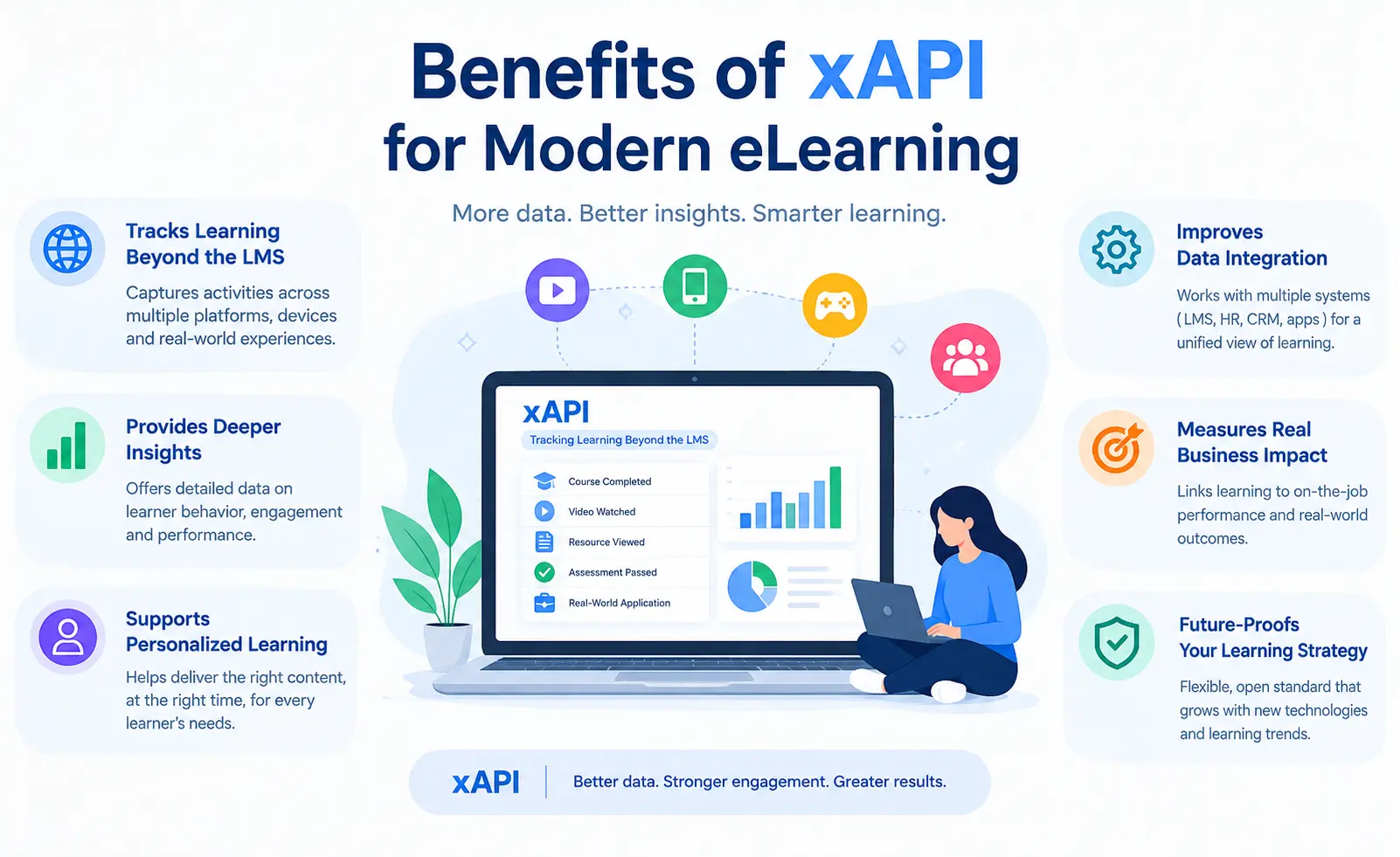
Table of Contents ▼
Quick Answer
A definitive guide to the Experience API (xAPI / Tin Can API) and Learning Record Stores (LRS) for modern course creators and L&D leaders. Explains how xAPI liberates learning telemetry beyond LMS walls, the Actor-Verb-Object JSON data model, tracking scenario branching decisions and drop-off points, interpreting time spent versus cognitive friction, real Reddit discussions on practical adoption, and agency frameworks for iterative course improvement.
Key Takeaways
- xAPI (Experience API / Tin Can) is an open specification that captures learning experiences across any digital platform using simple JSON statements.
- Completion only tells you someone reached the end; xAPI reveals how learners think, where they struggle, and why they fail.
- Statements follow a standardized syntax: Actor, Verb, Object, with optional Result and Context.
- An LRS (Learning Record Store) is the specialized database that receives, stores, and analyzes xAPI telemetry.
- Time spent should be interpreted alongside performance—spending 15 minutes on a 2-minute quiz signals cognitive confusion, not engagement.
In traditional eLearning, an LMS report tells you two things:
- Did the learner open the course? (
CompleteorIncomplete) - What was their final score on the 10-question quiz? (
80% Passed)
That is all.
You have zero insight into how they answered question 4. You don’t know that 72% of learners clicked the wrong diagnosis in your patient simulation. You don’t know that your learners paused on slide 11 for twelve minutes trying to decipher a confusing diagram, or that they skipped three key job aids entirely.
As we discussed in our guide on why you shouldn’t build an online course without understanding core standards, relying on binary completion metrics is like driving a car with a speedometer that only says ‘Moving’ or ‘Stopped’.
This is why xAPI (Experience API) was created. In this comprehensive guide, we unpack how xAPI works, break down the anatomy of an xAPI statement, explain the role of a Learning Record Store (LRS), and share our agency’s framework for tracking learning that actually impacts business performance.
1. The Core Philosophy: Tracking Beyond Completion
At TheEduAssist, we work with both independent course founders and enterprise L&D leaders. The most impactful strategic shift we guide teams through is moving from compliance tracking to behavioral telemetry.
[!IMPORTANT] TheEduAssist Team Stance: Tracking Beyond Completion Completion only tells us someone reached the end.
We also want to understand:
- Their scenario decisions and judgment calls
- Recurring mistakes and common misconceptions
- Assessment attempt patterns and retry behaviors
- Drop-off points where cognitive friction spikes
- Their demonstrated ability to apply the learning on the job
xAPI can support richer tracking when the course is deliberately configured to send that data to a Learning Record Store (LRS).
We collect information that guides continuous course improvements. Crucially, we interpret time spent alongside performance rather than treating it as proof of understanding. A learner spending 15 minutes on a 2-minute scenario is not “deeply engaged”—they are confused.
+-------------------------------------------------------------------------------+
|                       EVOLUTION OF LEARNING TELEMETRY                         |
+-------------------------------------------------------------------------------+
|  TRADITIONAL SCORM (1.2 / 2004)            MODERN xAPI TELEMETRY              |
|                                                                               |
|  - Launch Course                           - "John started Simulation Alpha"  |
|  - Status: "Completed"                     - "John chose High-Risk Strategy"  |
|  - Score: "80%"                            - "John failed budget constraint"  |
|  - Time: "00:24:15"                        - "John revised choice in 32s"     |
|                                            - "John successfully resolved"     |
|  ==================================        - "John downloaded Compliance PDF" |
|  Result: Binary pass/fail. Zero insight    ================================== |
|  into competency or decision-making.       Result: Rich behavioral stream     |
|                                            informing continuous course design.|
+-------------------------------------------------------------------------------+
2. What is xAPI and How Does It Work?
Developed by the ADL Initiative (under the initial working title Project Tin Can), xAPI is an open web standard that captures human experience using lightweight, RESTful JSON statements.
Unlike SCORM—which is tethered to a desktop web browser launching inside an LMS frame—xAPI statements can be emitted by:
- Native mobile apps on iOS and Android
- Interactive eLearning courses (Storyline, Captivate)
- Software simulations and code editors
- Virtual Reality (VR) and Augmented Reality (AR) headsets
- Real-world performance systems (Salesforce CRM, Zendesk, Slack)
- Internet of Things (IoT) sensors and medical simulators
3. The Anatomy of an xAPI Statement: Actor, Verb, Object
Every xAPI statement is written in human-readable JSON and follows a simple grammatical structure:
[ ACTOR ] + [ VERB ] + [ OBJECT ] --> Optional: [ RESULT ] & [ CONTEXT ]{
"actor": {
"name": "Sarah Chen",
"mbox": "mailto:sarah.chen@enterprise.com"
},
"verb": {
"id": "http://adlnet.gov/expapi/verbs/answered",
"display": { "en-US": "answered" }
},
"object": {
"id": "https://theeduassist.com/activities/incident-triage-scenario-q3",
"definition": {
"name": { "en-US": "Data Breach Triage Protocol" },
"description": { "en-US": "Deciding whether to isolate server or notify PR team" }
}
},
"result": {
"response": "isolated_database_cluster",
"success": true,
"duration": "PT45S"
},
"context": {
"contextActivities": {
"parent": [{ "id": "https://theeduassist.com/courses/soc-analyst-certification" }]
}
}
}Deconstructing the Components:
- Actor: Who performed the action (identified by email
mbox, account ID, or OpenID). - Verb: What action did they take? (Uses standardized ADL or IEEE verb URIs like
launched,answered,experienced,failed,mastered,shared). - Object: What activity or digital asset did they interact with?
- Result: How did it turn out? Captures raw response strings, boolean success, scaled scores, and precise ISO 8601 duration (
PT45S= 45 seconds). - Context: Where did this happen? Links the activity to a parent course, instructor, department, or device type.
4. What is a Learning Record Store (LRS)?
An LRS (Learning Record Store) is the database engine that makes xAPI useful. It acts as the central intake pipeline for learning telemetry across an organization.
  [ Mobile App ]        [ Storyline Web Module ]       [ VR Simulator ]
        \                          |                          /
         \                         |                         /
          v                        v                        v
        +-----------------------------------------------------+
        |                     xAPI STATEMENTS                 |
        +-----------------------------------------------------+
                                   |
                                   v
        +-----------------------------------------------------+
        |            LEARNING RECORD STORE (LRS)              |
        |  - Validates JSON against IEEE 9274.1.1 spec        |
        |  - Stores immutable activity streams                |
        |  - Exposes REST Query API                           |
        +-----------------------------------------------------+
                                   |
                     +-------------+-------------+
                     |                           |
                     v                           v
        [ LMS Compliance Dashboard ]     [ BI Analytics (Power BI / Tableau) ]
Leading LRS Solutions:
- Watershed LRS: Enterprise analytics platform specializing in tying learning telemetry to business KPIs.
- Veracity LRS: Powerful, developer-friendly LRS offering robust querying and real-time visualization dashboards.
- Learning Locker: Highly popular open-source and enterprise LRS widely adopted in higher ed and corporate L&D.
- Rustici Engine / SCORM Cloud: The industry standard for hosting both SCORM and xAPI with integrated LRS endpoints.
5. Real-World Telemetry: What Reddit Gets Wrong About xAPI
If you visit instructional design forums, you will find a common thread of skepticism:
[!NOTE] Community Discussion from r/instructionaldesign & r/elearning “Is xAPI actually worth the effort for our team? Every vendor sells it like magic, but setting up custom JavaScript triggers in Storyline and configuring an LRS feels like overkill when our executives only ask for a completion spreadsheet.”
— Summarized from community threads on r/instructionaldesign
This skepticism is understandable when xAPI is treated as an abstract IT project. xAPI is only valuable when tied to specific design questions.
Here are three concrete examples of how our team uses xAPI telemetry to solve real course problems:
Example 1: Identifying Misleading Assessment Questions
- The Metric: In a compliance certification, 61% of learners failed Question 7 on their first attempt.
- The Telemetry: The xAPI response log showed that 85% of those who failed selected Option C (“Contact Legal within 24 hours”) instead of Option B (“Contact Legal immediately”).
- The Fix: The instructional team realized the scenario wording was ambiguous, not that learners lacked ethics. We revised the prompt, and first-time pass rates jumped to 92%.
Example 2: Branching Scenario Decision Audits
- In a leadership development course on handling employee conflict, we tracked which branch managers chose.
- 68% of new managers chose the “Authoritative Directive” branch instead of the “Collaborative Inquiry” branch.
- This telemetry allowed the executive coaching team to focus their live cohort debriefs precisely where managers struggled most.
Example 3: Interpreting “Time Spent” Correctly
- In traditional SCORM, an executive looking at a learner who spent 45 minutes on a 10-minute module might assume they were “highly engaged.”
- With xAPI telemetry, we discovered the learner spent 38 minutes stuck on a malfunctioning drag-and-drop interaction that failed to register clicks. High time spent was a sign of frustration, not learning.
6. The Cost of Cheap Freelancers vs. True Data Architecture
Why can’t a $25/hour freelancer set up your xAPI architecture?
[!TIP] TheEduAssist Agency Stance on Pricing & Value A capable freelancer can build a visually appealing quiz. But configuring valid, schema-compliant xAPI telemetry requires:
- Defining an enterprise xAPI Recipe so statements use standardized verbs and object URIs across all courses
- Writing secure JavaScript triggers that handle authentication tokens without exposing credentials in client-side code
- Configuring LRS endpoint communication with proper fallback retry logic for mobile offline modes
- Designing visual dashboards that translate raw statement dumps into actionable instructional insights
As detailed in our Transparent Course Development Pricing, our value is providing the end-to-end learning engineering: instructional design, authoring, accessibility, and robust data telemetry.
7. How xAPI Bridges Into cmi5
While xAPI provides unprecedented freedom, it created a new problem: how does an LMS launch an xAPI course cleanly?
Because xAPI does not specify how courses should be packaged in a .zip file or how an LMS should authenticate a learner upon launch, the eLearning industry developed cmi5.
Learn how cmi5 combines the best of SCORM and xAPI in our next guide: What is cmi5? The Modern SCORM Successor for LMS.
8. Pre-Flight Checklist for xAPI Implementation
Before rolling out an xAPI-enabled course, ensure your technical foundation is verified:
- LRS Endpoint Verified: Is your endpoint URI, API key, and secret properly configured in your authoring tool or LMS?
- Standardized Verbs: Are you using recognized ADL or IEEE verb registries (
http://adlnet.gov/expapi/verbs/) rather than invented custom verbs? - Meaningful Activity IDs: Do your object IDs point to permanent, canonical URLs (e.g.,
https://domain.com/courses/module-1/quiz) rather than temporary local file paths? - Privacy & PII Protection: Are learner email addresses hashed (
sha1) or pseudonymized if transmitting data across public networks or multi-tenant clouds? - Iterative Design Feedback: Do you have an established review cycle where instructional designers analyze LRS reports to refine underperforming lessons?
Ready to Upgrade Your Course Tracking Beyond Binary Pass/Fail?
Whether you are looking to integrate xAPI into an existing Articulate Storyline course catalog or architect an enterprise telemetry pipeline with a custom LRS, our engineering team can help.
- Explore Transparent Pricing: View our eLearning Engineering & Development Rates
- Get an Architecture Review: Book a 30-Minute Learning Architecture Audit
- Discover Our Services: Learn more about our Custom eLearning Development Services
Need Help Building or Scaling Your Online Learning Program?
Whether you are launching an academy on Kajabi, modernizing corporate LMS modules, or converting raw expertise into accredited curriculum, our senior instructional designers provide a complimentary architecture evaluation.
Sources & References
Frequently Asked Questions
QWhat is xAPI in simple terms?
xAPI (Experience API, originally known as Tin Can API) is an open data interoperability specification that allows applications to capture and share data about learning experiences. Unlike SCORM, which only works inside a web browser tied to an LMS, xAPI can record learning that happens anywhere—in mobile apps, VR simulations, websites, games, or offline tools.
QWhat is a Learning Record Store (LRS)?
An LRS (Learning Record Store) is a specialized database designed to store, validate, and retrieve xAPI learning statements. It can exist as a standalone system (like Watershed, Learning Locker, or Veracity LRS) or be embedded inside a modern Learning Management System.
QHow does xAPI differ from SCORM?
SCORM is a 20-year-old standard that requires courses to launch inside an LMS browser window and primarily reports binary status (Passed/Failed) and final scores. xAPI operates independently of browser sessions, captures granular behavioral telemetry (such as specific choices in branching scenarios), and tracks informal or on-the-job learning.
QDo I need an LMS if I use xAPI and an LRS?
An LRS stores and queries learning data, but it does not manage course catalogs, user enrollments, payment processing, or compliance certificates. For full enterprise learning management, organizations use both—often leveraging the cmi5 standard to launch xAPI courses within an LMS.