Corporate Training Software: 9 Keys to Better Learning
Discover nine ways corporate training software can improve workplace learning, from personalized learning paths and microlearning to analytics, automation, and continuous development.
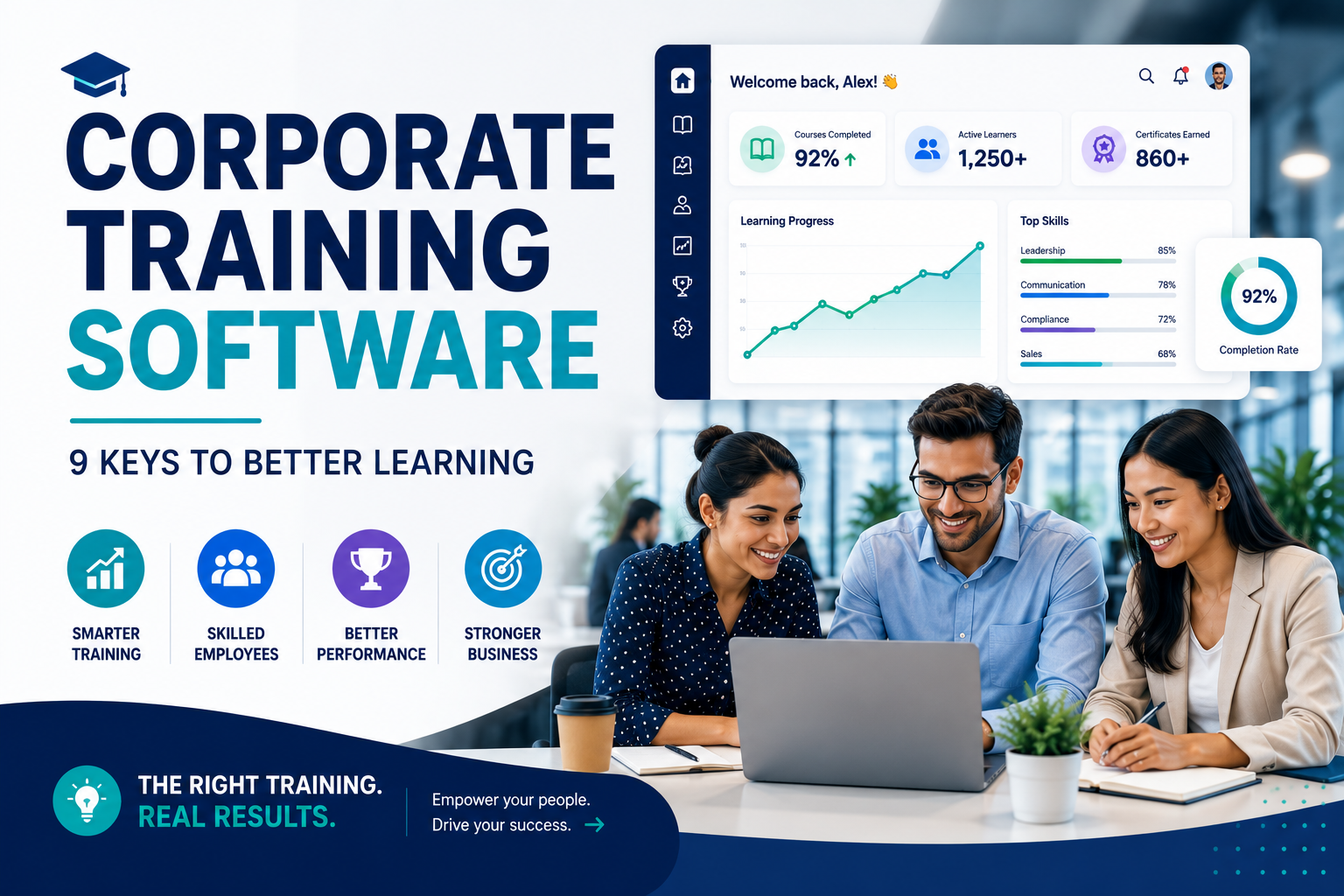
Table of Contents ▼
Quick Answer
Corporate training software makes it easier to manage employee learning in one place. This article shares 9 simple ways to improve workplace learning. It covers personalized learning, flexibility, analytics, microlearning, and automation. These strategies can help employees learn better and perform at their best.
Key Takeaways
- Personalized learning helps employees build relevant skills faster.
- Flexible training makes learning easier for remote and busy teams.
- Interactive learning improves engagement and knowledge retention.
- Learning analytics help managers track progress and identify skill gaps.
- Microlearning makes training easier to fit into the workday.
- Automation saves time and keeps training consistent.
- Continuous learning helps employees grow and supports long-term business success.
What if your biggest competitive advantage isn’t your product, but how quickly your employees learn and adapt? Traditional training methods often struggle to keep up with today’s fast-moving workplace. Corporate training software helps businesses create learning experiences that are engaging and flexible. These systems help employees build the skills and knowledge they need to handle future challenges. Effective training supports better performance and long-term growth. Here are nine ways corporate training software can improve workplace learning.
Why Traditional Employee Training Falls Short
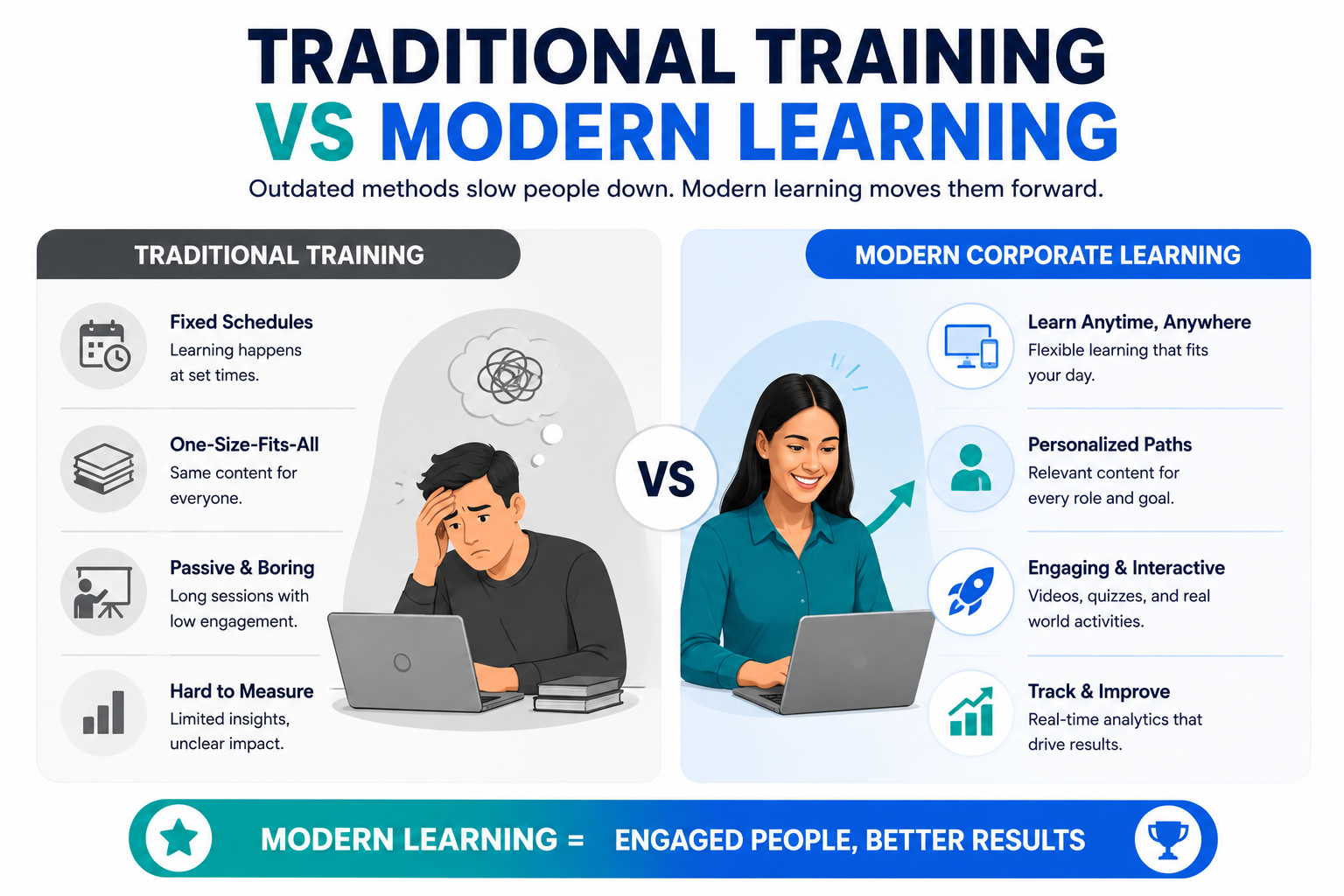
Training costs are high for companies. However, employees have a poor memory of most of it in days. The issue is not that he or she isn’t trying. It’s the training approach. Long presentations and static PDFs don’t hold employees’ attention.
They are inflexible; there is little interaction and little personalization. Today’s employees expect learning that is:
- Appropriate for the task
- Easy to access
- Interactive and engaging
- Ready to use when needed
This change has resulted in a need for training software. It aids companies in creating a sensible and prepared staff. It’s not about more training; it’s about effective learning. It’s about the proper education at the right time.
What Is Corporate Training Software?
Think of corporate training software as a central hub for employee learning. It allows companies to create, deliver, organize, and track training from one platform. It can be used to introduce new members, impart rules, or develop new skills.
It centralizes all your learning in one convenient location. Nowadays, workers can learn at their own pace with the help of modern platforms. They also provide managers with an accurate picture of their progress.
What Can Corporate Training Software Do?
A modern platform can assist organisations with their:
- Develop online courses
- Automate employee onboarding
- Deliver compliance training
Assign roles and learning paths that are specific to the role.
- Track employee progress
- Generate performance reports
- Issue certifications
Modern training platforms can also support remote and hybrid teams, making it easier to deliver consistent training regardless of where employees work. A single platform can manage these tasks without relying on spreadsheets, emails, or disconnected training systems.
Core Features That Drive Better Learning
The best training software offers excellent features. It saves the time of both learners and managers.
Personalized Learning Paths
Staff receive training in their role, skills, and aims.
Mobile Learning
Training is possible on phones, tablets, and laptop computers. On-the-job training is possible in nearly any place.
Learning Analytics
Managers become able to monitor completion rates, scores, and progress. They use real-time dashboards to do it.
Gamification
Points, badges, and leaderboards stimulate participation. They also help to make learning more enjoyable.
AI-Powered Recommendations
Some platforms recommend courses. They rely on employee skills and performance gaps for suggestions.
1. Stop Training Everyone the Same Way
Imagine giving the same training course to a new graduate and an experienced department manager. The new employee may struggle to keep up, while the manager may find the content too basic. Neither employee gets the training they actually need.
Every employee has different responsibilities, experience levels, skills, and career goals. A one-size-fits-all approach can reduce engagement and slow skill development.
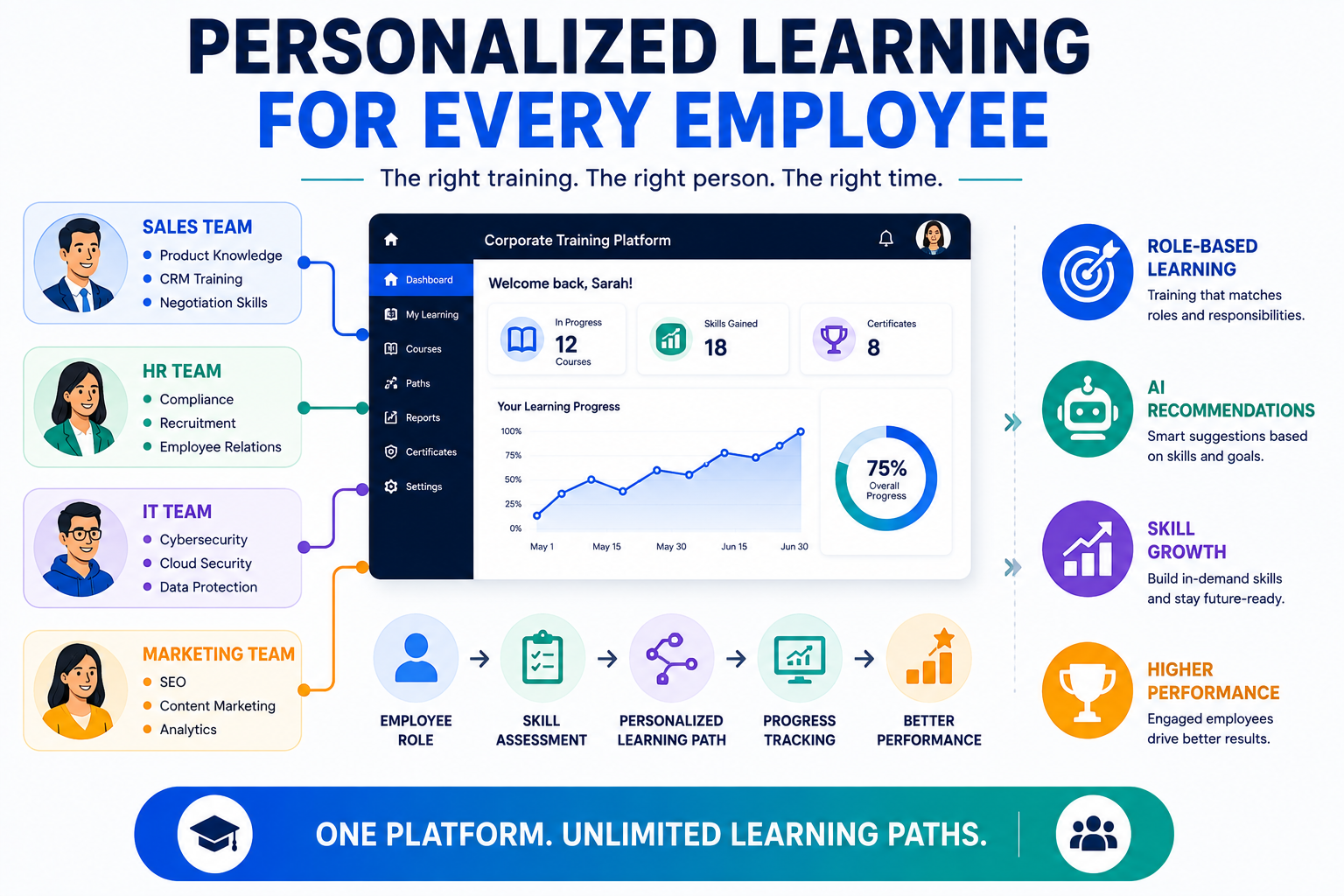
Corporate training software makes personalized learning easier through role-based assignments, custom learning paths, skills assessments, and AI-powered recommendations.
Why Personalized Learning Works
Employees are more likely to stay motivated when training is relevant to their roles and goals. Companies can personalize learning based on:
- Job role
- Department
- Experience level
- Career goals
- Current skills
- Performance data
This helps employees focus their time on learning the skills they need to succeed.
How Corporate Training Software Makes It Possible
Personalization is made easy with smart automation on a modern platform. Common features include:
- Custom learning paths
- Role-based course assignments
- AI-driven recommendations
- Skills assessments
- Progress tracking
- Personalized dashboards
Managers no longer have to assign each course individually. This will save time and aid worker learning.
Business Benefits of Personalized Learning
Personalized learning can create measurable improvements across the workplace. When employees receive training that matches their needs, businesses can benefit from:
- Higher Engagement: Employees undertake more courses that support their work.
- Faster Skill Development: Relevant learning accelerates employees’ productivity.
- Better Knowledge Retention: Memory is more effective if information is relevant to one’s needs.
- Stronger Employee Satisfaction: Continuous learning indicates that the company is willing to invest in employee development.
2. Make Learning Fit the Employee, Not the Schedule
Long training sessions can be difficult to fit into a busy workday. Meetings, deadlines, and daily responsibilities often leave employees with little time for scheduled classes.
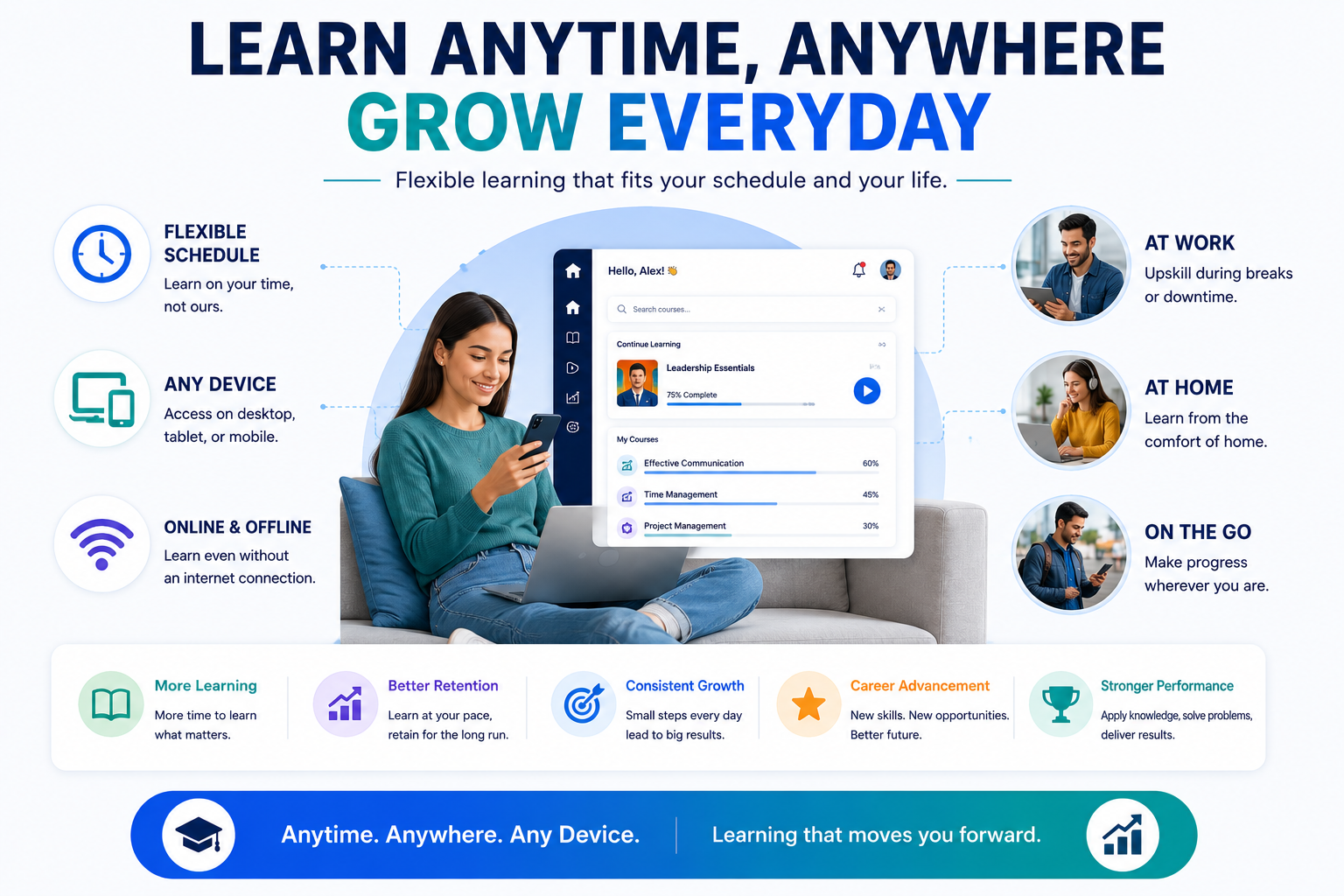
Modern training software gives employees more flexibility. They can access training when it suits their schedule, whether they are at the office, working from home, or traveling.
Why Flexible Learning Matters
On-demand learning puts workers in control of their learning. They can access training at the time they require, rather than waiting for the next workshop. This flexibility supports:
- Remote teams
- Hybrid workplaces
- Shift-based employees
- Global organizations
- Busy professionals
Learning becomes a natural part of the workday rather than an interruption. It does not break the flow.
Features That Support Anywhere Learning
Learning is now available with the help of modern platforms:
- Mobile-friendly courses
- Cloud-based access
- Self-paced modules
- Offline learning options
- Cross-device synchronization
- Automatic progress saving
Employees can start training on one device and continue on another without losing their progress.
Business Benefits of Flexible Learning
Successful learning is flexible, bringing real business value. Organizations often see:
- Improved rates of course completion
- Greater employee participation
- Improved work-life balance
- Uniform approach to training
- Support for new hires to get up and running faster
More significantly, staff members don’t consider training an interruption anymore. Rather, it becomes part of their life. The optimal learning experience is seamlessly integrated into an employee’s workflow. Not vice versa.
3. Make Training Interactive, Not Forgettable
Ever had a training session and forgot most of what you’ve learned a few days later? You’re not alone. Long talks and documents with too much text are boring.
Passive learning can make it difficult for employees to stay focused and remember new information. Interactive training changes that by asking employees to participate, practice new skills, and receive feedback as they learn.
What Makes Interactive Learning Effective?
Interactive learning encourages employees to think, solve problems, and apply new knowledge immediately. Common interactive elements are:
- Short instructional videos
- Knowledge quizzes
- Scenario-based exercises
- Interactive simulations
- Gamification
- Discussion forums
- Digital certificates
Learning is reinforced with each activity. It also increases the fun during training.
Gamification: A Simple Way to Boost Motivation
Everyone loves a challenge and a reward. Gamification of learning is the use of game features in learning. Gamification does not mean turning workplace training into a game. Instead, it uses simple game-like elements to make learning more motivating and engaging.
Common features include badges, points, leaderboards, learning streaks, and completion certificates. These incentives encourage employees to stay in the company and complete courses.
Real-World Example
Envision a customer service team training to deal with challenging conversations. Instead of reading lengthy instructions, employees can use interactive activities to practice handling real customer issues..
They see what they want and immediately get the answer. This will enable them to practice communicating with actual customers without getting it wrong. This hands-on way creates greater confidence than standard lectures.
4. Turn Learning Data Into Better Decisions
Training shouldn’t end when a course is completed. The questions are: Did employees learn anything? Without reliable data, it is difficult to know whether training is effective or simply taking up valuable time. This is where learning analytics are really valuable.
Why Learning Analytics Matter
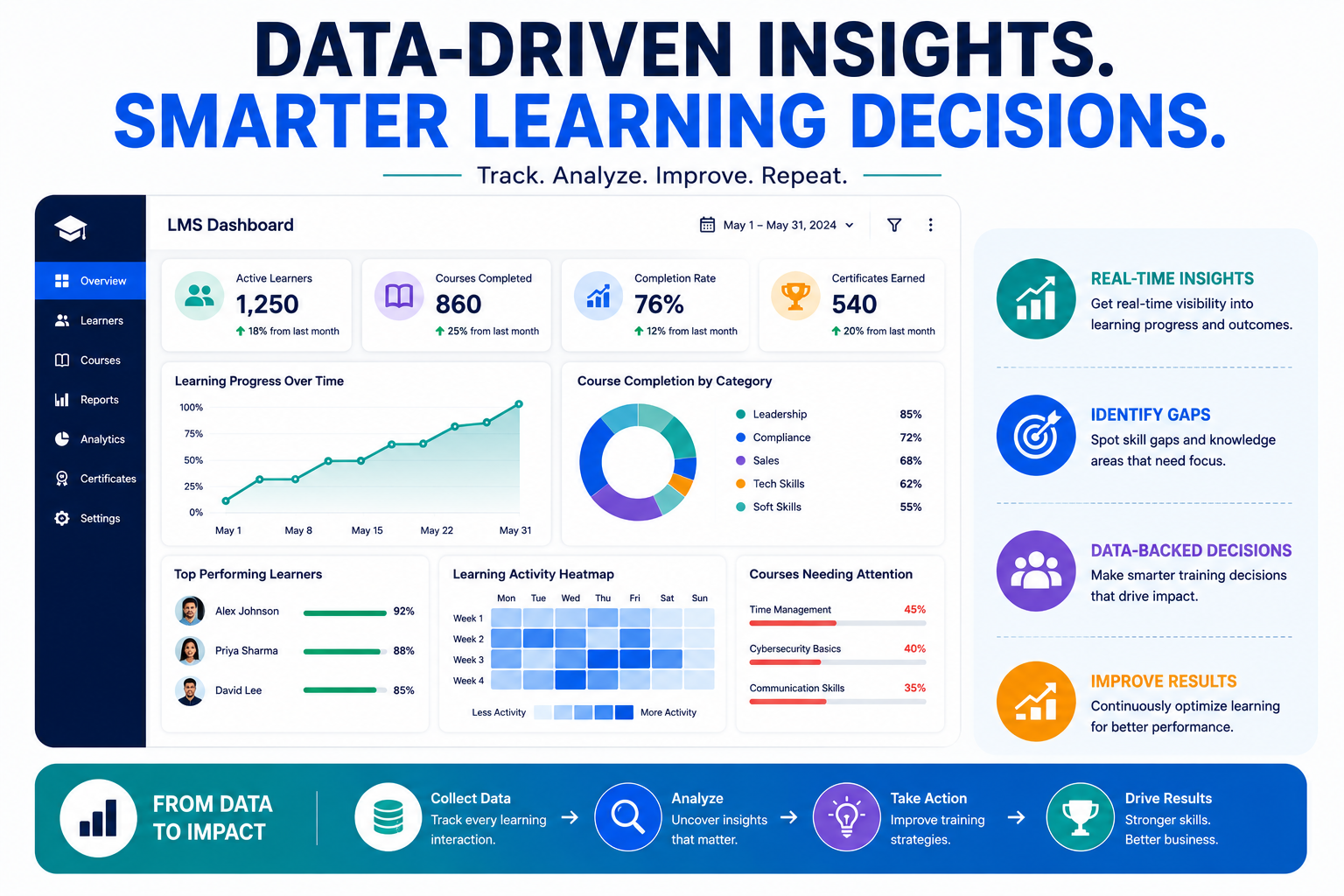
Today’s software features dashboards with real-time worker tracking. Managers can easily determine:
- Course completion rates
- Assessment scores
- Learning time
- Skill gaps
- Certification status
- Employee participation
No more guesswork; decisions are based on actual data.
Spot Skill Gaps Before They Become Problems
Imagine a sales team consistently scoring poorly on product knowledge assessments. With learning analytics, managers can quickly identify the problem and provide targeted training before it affects customer interactions.
Managers can address these gaps before they affect customer interactions. By taking a proactive approach, organizations can:
- Improve employee performance
- Reduce compliance risks
- Strengthen customer experience
- Increase training ROI
Learning analytics transform training from an expense to a savvy business investment. Without measurement, there can be no improvement.
5. Keep Learning Short, Simple, and Consistent
Long training sessions can overwhelm employees and make it harder to stay focused. Microlearning offers a simpler approach by breaking training into short, focused lessons that employees can complete in just a few minutes.
What Is Microlearning?
Microlearning is based on short lessons. These only take 5 to 10 minutes to complete. Workers don’t complete courses all at once. Rather, they learn in small and simple steps. Examples include:
- Five-minute videos
- Quick quizzes
- Interactive flashcards
- Daily learning challenges
- Mini case studies
One concept at a time for employees. This helps employees absorb and retain it.
Why Microlearning Works
Short lessons are more easily done in the middle of a full day of work. Employees can learn:
- Before a meeting
- During lunch breaks
- Between projects
- While traveling
It’s better to do little lessons daily. It’s a better alternative to long hours of study.
Business Benefits
Organizations that implement microlearning typically experience:
- Higher completion rates
- Better knowledge retention
- Reduced learner fatigue
- Faster skill development
- Greater employee satisfaction
These lessons prove that it is possible to do a good job of training without spending hours on end.
6. Encourage Learning Through Collaboration
Employees’ learning becomes more meaningful when they learn from each other. Self-paced courses are valuable, but they should not be the only way employees learn. Collaboration allows employees to share knowledge, ask questions, and learn from each other’s experiences.
Modern training platforms can support this through discussion forums, team learning groups, peer feedback, knowledge-sharing communities, live webinars, and collaborative projects.
Ways to Promote Collaborative Learning
Training platforms come with a lot of features, including:
- Discussion forums
- Team learning groups
- Peer feedback
- Knowledge-sharing communities
- Live webinars
- Collaborative projects
These tools assist workers in working on problems collaboratively. They tend to learn best from on-the-job experience.
Why Social Learning Works
Imagine a new sales representative facing a challenging client meeting. Instead of handling the situation alone, they can use the platform to ask experienced colleagues for advice or review examples of successful sales conversations. The platform can be viewed immediately by the workers.
They may seek advice from professionals. They can look at good sales examples that are good. This shared knowledge access enables a quick boost in confidence and accelerates improvement.
Business Benefits
Companies that foster teamwork typically experience:
- Faster problem-solving
- Stronger teamwork
- Better knowledge sharing
- Increased employee engagement
- A stronger culture of continuous learning
Learning is better when it’s shared within the company. Not only training materials.
7. Automate Training to Save Time and Improve Consistency
As companies scale up, handling training manually becomes more challenging. HR teams spend hours on repetitive tasks. They should work on strategy instead. They spend time assigning courses, checking attendance, and updating spreadsheets.
These repetitive tasks can consume valuable time that HR and L&D teams could spend improving training strategies.
Automation handles routine processes in the background, helping teams save time while keeping training consistent.
Tasks You Can Automate
Automation makes everyday tasks easier, such as:
- Course enrollment
- Employee onboarding
- Compliance reminders
- Certificate generation
- Progress tracking
- Learning notifications
- Recurring training assignments
The platform processes regular jobs. You don’t need to coordinate all of the steps.
Why Automation Matters
Suppose you have to hire 100 people in various departments. HR would do all the work manually. They would give training, monitor progress, and follow each learner. Automated tools can prepare new employees for training from day one.
Reminders and certificates are automatically given to workers. This saves time. It also provides a uniform learning experience for all employees.
Business Benefits
- Automation helps organizations:
- Reduce administrative workload
- Eliminate manual errors
- Improve compliance
- Deliver consistent training
- Scale training as the organization grows.
8. Measure the Impact of Every Training Program
Learning should lead to measurable results. Not only completed courses. Many organizations base their attention on completion rates. However, they ignore the larger question: are they helping to enhance performance? The key is having the right software to provide you with the information to answer that.
Key Metrics Worth Tracking
The right metrics can be used to assess training. Important KPIs include:
- Course completion rate
- Assessment scores
- Time to complete training
- Employee engagement
- Certification completion
- Skill improvement
- Knowledge retention
- Training ROI
These insights help managers understand what is working, where employees are struggling, and which areas need improvement.
Instead of simply tracking course completion, businesses can use these insights to improve employee performance and training ROI.
Turn Insights Into Action
Let’s say that your staff consistently fails cybersecurity exams. Rather than running the program again, managers can:
- Update course content
- Add interactive exercises
- Offer refresher lessons
- Schedule targeted coaching
Data to enhance training is a cycle of learning and growth. Evaluate success in terms of performance at work. Not only in terms of course completion.
9. Build a Culture of Continuous Learning
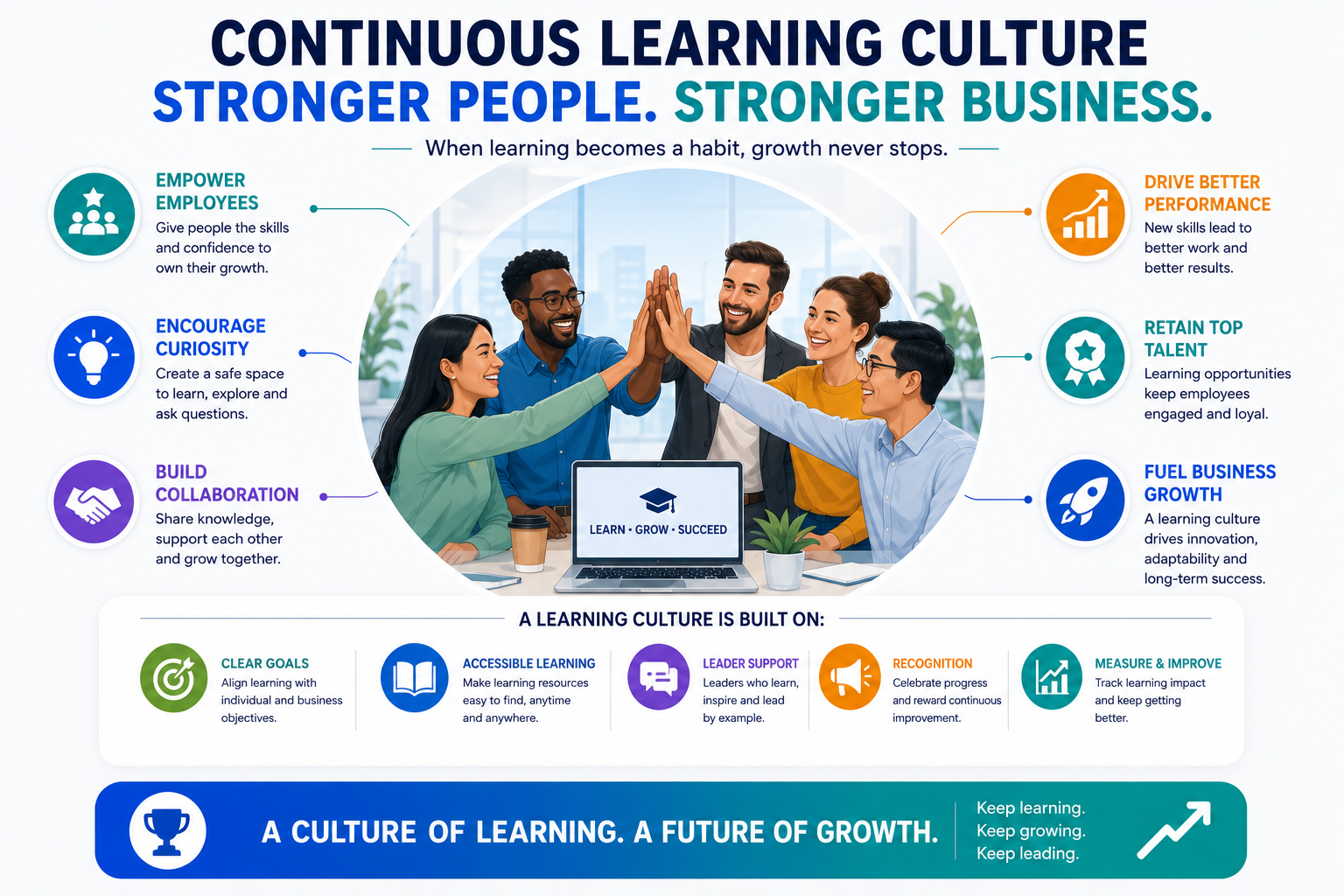
Successful organizations don’t treat training as a one-time event. They create a culture where employees are encouraged to build new skills, share knowledge, and adapt to changing business needs.
A strong learning culture helps employees stay confident and capable while giving businesses a stronger foundation for long-term growth.
What a Learning Culture Looks Like
In the learning organization:
- Staff continually update their skills.
- Managers encourage professional development.
- Learning material is requested and provided as required.
- Ongoing education is encouraged to advance careers.
Knowledge sharing is embedded in work practice. Employment staff become more self-assured. They get creative and prepared to change.
How Corporate Training Software Supports Continuous Learning
It’s simple to learn on the right platform; it offers:
- Personalized learning paths
- Recommended courses
- Skills assessments
- Learning reminders
- Mobile access
- Progress tracking
- Regular content updates
New things are learned by all. This is true for all job and experience levels.
Long-Term Benefits
Companies with a culture of continual education are likely to reap the following benefits:
- Stronger employee retention
- Higher productivity
- Faster innovation
- Improved customer satisfaction
- Better business performance
Organizations that develop continuously are better equipped to grow continuously.
Final Thoughts
Traditional training alone is no longer enough for today’s workplace. Employees need learning that is flexible, engaging, personalized, and easy to access.
Corporate training software helps businesses deliver that experience while simplifying administration and tracking results. The goal isn’t simply to provide more training. It’s to give employees the right learning at the right time and turn that learning into better performance.
With the right approach, businesses can turn training into a valuable investment. Better learning leads to stronger teams, improved performance, and long-term growth. The right platform helps employees keep learning, adapting, and preparing for what comes next.
Sources & References
- Top 10 LMS platforms for corporate training in 2026
- Employee Onboarding Guide
- How to Boost Employee Training With the Right LMS Technology
- What is compliance training? – Meaning and examples
- Learning Analytics: The Ultimate Guide
- Gamification For Learning: Strategies And Examples
- Mobile learning: what it is, benefits, and how to implement it
- Personalized Learning Paths: Navigating the Future of Employee Training
- What Is Microlearning?
- What is Employee Engagement, and How Do You Improve It?
- Training ROI: Proving the Business Value of Learning
Frequently Asked Questions
QWhat is corporate training software?
Corporate training software helps businesses create, deliver, and track employee training in one place. It can support onboarding, skills development, compliance training, and ongoing professional development.
QHow does corporate training software improve workplace learning?
It makes training more flexible and personalized. Employees can learn at their own pace, while managers can track progress, identify skill gaps, and measure results.
QWho can benefit from corporate training software?
Businesses of all sizes can use it for employee onboarding, skills development, compliance, and ongoing learning. HR teams, managers, and L&D professionals can also use it to manage training more efficiently.
QIs corporate training software useful for remote teams?
Yes. Employees can access training from different devices and locations. This makes it easier for remote and hybrid teams to complete training without being tied to a specific schedule.
QWhat features should businesses look for in corporate training software?
Key features include: - Learning Management System (LMS) - [Mobile learning](https://www.iseazy.com/blog/what-is-mobile-learning/) - AI-powered recommendations - Learning analytics - Gamification - Compliance tracking - Automated reporting - Personalized learning paths