
Kajabi Blogging Strategy for Course Creators
A strong Kajabi blogging strategy can help course creators attract organic traffic, build authority, grow their email list, and generate course leads. Learn how to plan keywords, create topic clusters, optimize blog posts, and connect content with your course funnel.
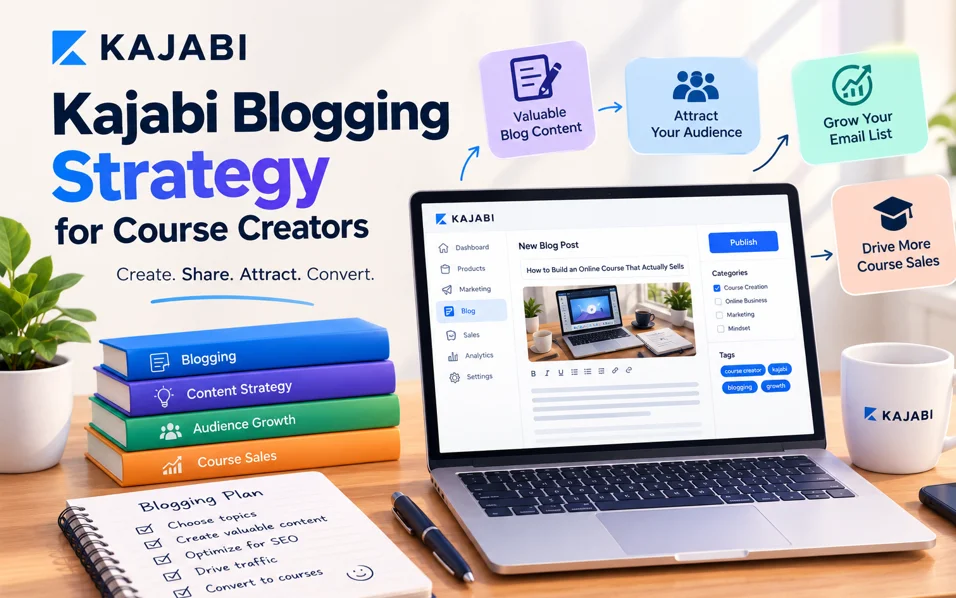
Table of Contents ▼
Quick Answer
This guide explains how course creators can build an effective Kajabi blogging strategy. It covers keyword research, search intent, topic clusters, SEO optimization, internal linking, lead generation, course funnels, content repurposing, a 90-day blogging plan, performance tracking, and common blogging mistakes. The strategy focuses on creating useful, search-focused content that attracts potential students and guides them toward relevant resources and courses.
A Kajabi blogging strategy can help course creators attract organic traffic, answer potential students’ questions, build authority, and turn website visitors into leads. But publishing random blog posts is not enough. Your content needs to connect with what your audience searches for and the courses or services you offer.
For course creators, blogging works best when every article has a clear purpose. One post might introduce a topic, another might solve a specific problem, and another might help a reader decide which solution is right for them.
The goal is to build a content system where your blog supports your entire course business.
What Is a Kajabi Blogging Strategy?
A Kajabi blogging strategy is a planned approach to creating blog content around your audience, course topics, keywords, and business goals.
Instead of choosing topics randomly, you create content based on questions and problems your potential students are already searching for.
A simple strategy looks like this:
Keyword → Helpful article → Relevant resource → Email subscriber → Course
For example, a creator who sells a course about digital marketing could publish articles about keyword research, SEO basics, content marketing, email marketing, and social media strategy.
Each article can attract people interested in learning digital marketing while creating opportunities to introduce the creator’s course.
Why Is Blogging Important for Course Creators?
Course creators often depend heavily on social media, email marketing, referrals, or paid advertising. Blogging adds another channel for reaching potential students.
A well-planned blog can help you:
- Attract organic search traffic
- Answer potential students’ questions
- Demonstrate your expertise
- Build topical authority
- Grow your email list
- Support your course marketing funnel
- Generate leads over time
- Create content that can be repurposed
The biggest advantage is that a useful article can continue attracting visitors after it is published.
Start Your Kajabi Blogging Strategy With Your Course
Your course should be the starting point for your content strategy.
Look at your course curriculum and identify:
- Main topics
- Lessons
- Student questions
- Common mistakes
- Beginner problems
- Advanced questions
- Frequently asked questions
- Learning outcomes
Turn these areas into potential blog topics.
For creators who are still planning or improving their course structure, this Kajabi course design guide can provide additional guidance on creating a structured learning experience. (TheEduAssist)
Example: Online Photography Course
Suppose your course teaches beginner photography.
Your main topic could be:
Beginner Photography
Supporting blog topics could include:
- What Is the Exposure Triangle?
- How Does Aperture Affect Photos?
- Best Camera Settings for Beginners
- How to Take Better Portrait Photos
- Common Photography Mistakes
- How to Photograph in Low Light
- Beginner Photography Composition Tips
These articles are closely connected to the course, which makes it easier to guide readers toward relevant resources and offers.
Find Keywords Before Writing
Keyword research should be an important part of your Kajabi blogging strategy.
Start by identifying what your ideal students type into search engines.
Look for:
- Long-tail keywords
- Question-based keywords
- Problem-based searches
- Beginner searches
- Comparison keywords
- How-to searches
- Commercial keywords
For example, instead of targeting a broad keyword such as photography, you could target more specific searches such as:
- How to use manual camera settings
- What is aperture in photography?
- Best camera settings for beginners
- How to take professional-looking photos
- Photography tips for beginners
Specific searches often give you a clearer idea of what the reader wants.
Match Content With Search Intent
Finding a keyword is only half the job. You also need to understand why someone is searching for it.
There are several common types of search intent.
Informational Intent
The user wants an answer or explanation.
Examples:
- What is instructional design?
- What is email marketing?
- How does SEO work?
Create educational content that directly answers the question.
Commercial Investigation
The user is researching options before making a decision.
Examples:
- Best online course platforms
- Kajabi alternatives
- Best LMS for coaches
These searches can be addressed with comparisons, reviews, and detailed guides.
Transactional Intent
The user is closer to taking action.
Examples:
- Online marketing course
- Buy photography course
- Kajabi course for beginners
These searches can support landing pages, course pages, or conversion-focused content.
Your article should always match the searcher’s intent.
Build Topic Clusters Around Your Course
A strong Kajabi blogging strategy should not consist of disconnected articles.
Instead, create topic clusters.
A topic cluster contains a main pillar topic supported by several related articles.
For example:
Pillar Topic: Online Course Creation
Supporting articles:
- How to Create an Online Course
- How to Create a Course Curriculum
- Best Online Course Formats
- How to Record Course Videos
- How to Create Course Quizzes
- How to Keep Online Students Engaged
- How to Market an Online Course
Connect these pages with relevant internal links.
This gives readers a clear path through your content and helps search engines understand how your articles relate to one another.
Create Different Types of Blog Content
Your blog should contain different content formats rather than repeating the same type of article.
How-To Guides
These teach readers how to accomplish a specific task.
Examples:
- How to Create Your First Online Course
- How to Build an Email List for Your Course
- How to Create a Course Landing Page
Educational Guides
These explain concepts.
Examples:
- What Is Microlearning?
- What Is Instructional Design?
- What Is Search Intent?
Comparison Articles
These help readers evaluate different options.
Examples:
- Kajabi vs Thinkific
- Kajabi vs LearnWorlds
- Kajabi vs Teachable
List Articles
These can address multiple solutions or ideas.
Examples:
- 10 Online Course Marketing Strategies
- 15 Course Content Ideas
- 7 Ways to Increase Student Engagement
Problem-Solving Articles
These focus on a specific pain point.
Examples:
- Why Online Students Stop Completing Courses
- How to Reduce Online Course Dropout Rates
- Why Your Course Website Is Not Getting Traffic
A mixture of content types allows you to target different stages of the customer journey.
Optimize Your Kajabi Blog Posts for SEO
Creating useful content is essential, but your articles also need basic on-page SEO.
Use the Main Keyword Naturally
Your primary keyword is:
Kajabi blogging strategy
Include it naturally in important locations such as:
- Page title
- H1
- Introduction
- One or more relevant headings
- Body content
- Meta description
- URL, where appropriate
- Image alt text when genuinely descriptive
Avoid repeating the keyword unnecessarily.
Google does not need the exact phrase in every paragraph to understand the topic.
Write a Clear SEO Title
Your title should tell readers exactly what they will learn.
For this article:
Kajabi Blogging Strategy for Course Creators
works well because it contains the primary keyword while clearly identifying the target audience.
Create a Short URL
A clean URL could be:
/kajabi-blogging-strategy-course-creators/
Keep URLs descriptive and avoid unnecessary words or numbers.
Use Descriptive Headings
Break your article into logical sections.
Instead of writing large blocks of text, use H2 and H3 headings to make the content easier to scan.
Add Internal Links
Internal links are especially important for course websites.
For example, an article about creating online courses could link to another relevant article about choosing an LMS.
Links should be placed where they genuinely help the reader.
Use Your Blog to Build an Email List
Getting organic traffic is valuable, but turning visitors into subscribers can make that traffic more useful.
Offer something related to the article.
For example:
Blog: How to Create an Online Course
Free resource: Online Course Planning Checklist
Next step: Join the email list
Offer: Online course creation program
The resource should solve a small problem while your course provides the more complete solution.
Connect Blog Posts to Your Course Funnel
Your blog should support your customer journey.
A simple funnel could look like this:
Search Engine
↓
Blog Post
↓
Relevant Free Resource
↓
Email Subscriber
↓
Helpful Email Content
↓
Course Offer
↓
Student
If you use webinars as part of this funnel, a Kajabi webinar funnel can help connect registration, promotion, attendee engagement, and follow-up offers. TheEduAssist’s Kajabi category currently features this guide as a related resource. (TheEduAssist)
Not every visitor will move through every stage immediately.
Some readers may return several times before they are ready to purchase. That’s why useful content and consistent follow-up matter.
Don’t Make Every Article a Sales Pitch
One of the easiest ways to weaken a course blog is to make every article promotional.
Readers usually visit a blog because they want information or help.
Give them that information first.
For example, if someone searches for “how to create an online course curriculum,” don’t spend the first half of the article promoting your course.
Explain how curriculum planning works.
Then, once the reader understands the process, you can introduce your course as an optional next step.
This approach feels more natural and builds trust.
Repurpose Your Blog Content
A blog post does not have to live only on your website.
One well-researched article can become multiple pieces of content.
For example, a blog post about online course marketing could become:
- A LinkedIn post
- A Pinterest Pin
- An email newsletter
- A YouTube video
- An Instagram carousel
- A short-form video
- A downloadable checklist
This allows course creators to get more value from the research that goes into each article.
Follow an 80/20 Content Approach
A useful content mix is to prioritize educational content while keeping a smaller portion focused directly on promotional or commercial topics.
For example:
Educational content
- How to Create a Course Curriculum
- What Is Microlearning?
- How to Improve Student Engagement
Commercial content
- Best Online Course Platforms
- Kajabi Alternatives
- Best LMS for Course Creators
Educational content attracts and informs your audience, while commercial content can capture people who are further along in the buying journey.
Create a 90-Day Kajabi Blogging Strategy
You don’t need hundreds of posts to get started.
A focused 90-day plan can give you a strong foundation.
Month 1: Research and Publish
Start by:
- Defining your ideal student
- Reviewing your course curriculum
- Finding relevant keywords
- Identifying audience questions
- Choosing your priority topics
- Publishing your first foundational articles
Focus on topics closely connected to your course.
Month 2: Build Topic Clusters
Create supporting articles around your main subjects.
Add internal links between related articles.
For example, if your pillar topic is online course creation, create supporting articles about curriculum design, video lessons, assessments, student engagement, and course marketing.
Month 3: Optimize Existing Content
Don’t only publish new articles.
Review your existing posts and identify opportunities to improve them.
Check:
- Search impressions
- Organic clicks
- Keyword rankings
- Internal links
- Outdated information
- Missing FAQs
- Weak introductions
- Poor CTAs
Update articles where improvements can make them more useful.
Measure Your Blogging Results
Publishing articles is not the final step.
Track whether your content is helping your business.
Important metrics include:
- Organic impressions
- Organic clicks
- Click-through rate
- Organic traffic
- Keyword rankings
- Email signups
- Lead magnet downloads
- Course-page visits
- Course conversions
Don’t focus only on traffic volume.
A blog post that attracts 300 highly relevant visitors may be more valuable than one that attracts thousands of visitors who have no interest in your course.
Improve the Conversion Experience
Getting someone to your blog is only the first step. Your course page and checkout experience also need to make the next action easy.
For creators who are already receiving traffic but want to improve conversions, Kajabi checkout optimization is another useful area to consider. It focuses on reducing purchase friction, improving trust, and making better use of Kajabi’s checkout features. (TheEduAssist)
Plan for Growth as Your Audience Increases
A successful blog can gradually bring more visitors, subscribers, and students into your Kajabi ecosystem.
As your audience grows, it is useful to understand how Kajabi handles contacts and students. TheEduAssist’s guide on Kajabi student capacity explains why Kajabi’s capacity is tied to total contacts rather than a single universal student limit. (TheEduAssist)
Planning ahead can help you avoid treating growth as a technical problem after it happens.
Common Kajabi Blogging Mistakes
1. Publishing Without a Strategy
Random articles can make your blog difficult to organize.
Build your topics around your audience and courses.
2. Choosing Keywords Only by Search Volume
High-volume keywords can also be highly competitive.
Look at relevance, competition, search intent, and the actual value the topic can bring to your business.
3. Ignoring Search Intent
An article can target the right keyword but still fail if it doesn’t answer what the searcher wants.
Always study the intent behind the query.
4. Writing for Search Engines Instead of People
Keyword stuffing makes content difficult to read.
Write naturally and focus on solving the reader’s problem.
5. Forgetting Internal Links
Related content should be connected.
Internal links help readers discover more useful information and create a stronger site structure.
6. Never Updating Old Content
Information changes.
Review important articles regularly and update outdated examples, links, facts, and recommendations.
Kajabi Blogging Strategy FAQs
What is a Kajabi blogging strategy?
A Kajabi blogging strategy is a planned system for creating and optimizing blog content around your target audience, keywords, course topics, and business objectives.
Is Kajabi good for blogging?
Kajabi can be a convenient option for course creators who want their website, content, marketing, email, and courses managed within the same ecosystem. The success of a blog still depends on content quality, SEO, audience research, and consistent optimization.
If you’re new to the platform, you can also read Is Kajabi easy to use? to understand Kajabi’s learning curve and its main tools for creating and selling digital products. The article is currently listed in TheEduAssist’s Kajabi category. (TheEduAssist)
Can a Kajabi blog help attract course students?
Yes. A blog can attract people searching for information related to your course topic. Relevant articles can then guide those visitors toward free resources, email subscriptions, webinars, or courses.
How often should a course creator publish blog posts?
There is no single ideal publishing frequency. A sustainable schedule is more useful than publishing large amounts of low-quality content. Start with topics that have a clear connection to your audience and course.
What should I write about on my Kajabi blog?
Start with your course curriculum, student questions, common problems, keyword research, frequently asked questions, and topics related to the transformation your course provides.
How can I turn blog traffic into course sales?
Use relevant calls to action throughout your content. Offer useful lead magnets, free lessons, webinars, or email resources, then nurture subscribers with valuable content before presenting your paid course.
Final Thoughts
A successful Kajabi blogging strategy starts with your audience rather than your publishing schedule.
Identify what your potential students want to learn. Research the keywords they use, create useful articles around those topics, organize related content into clusters, and connect your blog with relevant resources and courses.
Most importantly, don’t treat blogging as a separate activity from your course business.
Your blog can become the top of your marketing funnel, helping people discover your expertise, learn from your content, join your email list, and eventually become students.
When every article has a clear purpose, your Kajabi blog can become a long-term source of organic visibility, leads, and course growth.