
Scaling L&D for Frontline RBTs and BIIs: Moving Beyond Unscalable PDFs to Automated SCORM Compliance
Discover how ABA providers can scale frontline training for RBTs and BIIs using SCORM-based modules, automated LMS tracking, and practical competency assessments instead of relying on PDFs and manual records.
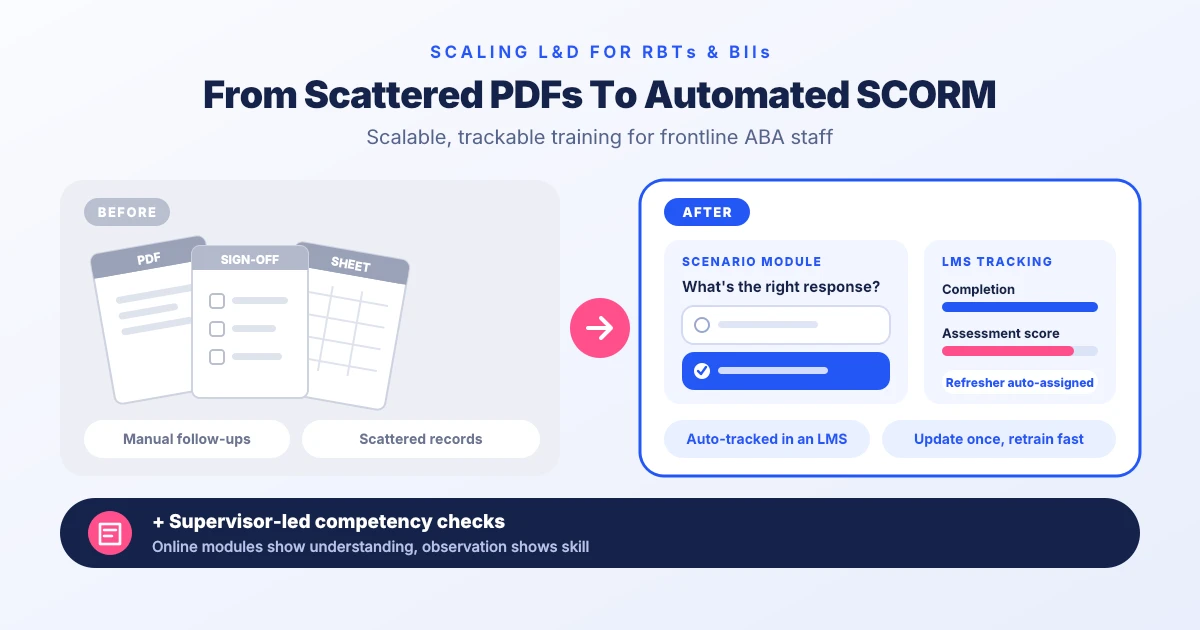
Table of Contents ▼
Quick Answer
This article explores the challenges ABA providers face when training frontline employees, including Registered Behavior Technicians (RBTs) and Behavior Interventionists (BIIs). It explains how SCORM-based compliance training can turn workplace policies and safety procedures into interactive learning modules, while compatible Learning Management Systems track employee progress, completion, and assessment scores. It also discusses combining digital training records with practical competency assessments, supervisor observations, and structured onboarding workflows to support consistent staff training across multiple locations.
Key Takeaways
- PDFs, printed manuals, and spreadsheets create additional administrative work when ABA providers manage frequent onboarding and multiple locations.
- Providers can convert policies, safety procedures, and workplace guidelines into structured lessons with quizzes and scenario-based activities.
- Compatible LMS platforms can record course completion, assessment scores, and learner progress, helping HR teams identify outstanding training.
Why Is Frontline Staff Training Challenging for ABA Providers?
ABA providers must regularly train frontline employees, including Registered Behaviour Technicians (RBTs) and Behaviour Interventionists (BIIs), on safety procedures, behaviour support plans, and workplace policies. Frequent staff turnover, multiple locations, and recurring onboarding can make this difficult to manage. When training relies on PDFs, printed manuals, or in-person sessions, HR teams may also struggle to track attendance, collect acknowledgments, and confirm that employees have reviewed updated procedures. Without a centralized system, training records can become scattered, making it harder to monitor completion and keep staff informed.
Why Are PDFs and Manual Training Records Difficult to Scale?
PDFs and manual sign off sheets can share training information, but they offer limited ways to track employees’ progress. HR teams often have to collect acknowledgments, update spreadsheets, follow up with staff, and check completion records individually. As an ABA provider grows or hires new RBTs and BIIs, this paperwork becomes harder to manage across teams and locations. It can also be difficult to confirm whether employees have reviewed updated procedures or completed required assessments. A digital training system can reduce this administrative work by organizing learning materials and recording completion data in one place.
What Is SCORM-Based Compliance Training?
SCORM-based compliance training uses standardized e-learning modules that can be uploaded to a compatible Learning Management System ( LMS). Instead of relying only on PDFs or printed materials, ABA providers can turn workplace policies, safety procedures, and staff guidelines into interactive lessons with quizzes and scenario- based activities. The LMS can record information such as course completion, assessment scores, and learner progress, depending on the SCORM version and platform. This gives HR and training teams a more organized way to deliver required training and monitor employee participation.
How Can ABA Providers Turn Policies Into Interactive Scenario-Based Modules?
ABA providers can turn written policies into short, interactive lessons built around situations RBTs and BIIs may encounter during their work. For example, a module could present a client interaction and ask employees to choose the appropriate response based on the provider’s procedures. These lessons can include short videos, decision-making activities, and knowledge checks to reinforce key information. Once converted into SCORM packages, the modules can be uploaded to a compatible LMS, where training teams can track employee progress and assessment results.
How Does Automated SCORM Tracking Help HR and Training Teams?
Automated SCORM tracking helps HR and training teams monitor employee learning without relying on manual sign-off sheets or spreadsheets. Through a compatible LMS, providers can track course completion, assessment scores, learner progress, and recorded activity, depending on the SCORM package and platform. These records help managers identify employees who have unfinished training, follow up on outstanding requirements, and check whether staff have completed updated modules. This makes it easier to organize training records across teams and locations while reducing repetitive administrative work.
What Training Records Should ABA Providers Track for RBTs and BIIs?
ABA providers should maintain organized records of employee onboarding, required policy training, course completion dates, assessment results, and signed acknowledgments. For RBTs and BIIs, records may also include refresher training, safety procedures, behavior support protocols, and supervisor-led competency assessments. An LMS with SCORM tracking can help document course progress and completion, while practical evaluations and supervisor sign-offs should be recorded separately. Keeping these records updated helps HR teams identify training gaps and verify that employees have completed the required learning activities.
How Can Leaders Combine SCORM Training With Practical Competency Assessments?
Leaders can combine SCORM-based learning with practical assessments to evaluate both an employee’s understanding and their ability to apply procedures. Staff can first complete online modules covering workplace policies, safety guidelines, and behavior support techniques, followed by supervisor-led demonstrations or observations. For example, an RBT or BII may complete a scenario-based lesson and then demonstrate the relevant procedure during a supervised session. Training teams can use SCORM records to track course completion and assessment scores while maintaining separate records of practical evaluations and supervisor sign-offs. This approach connects digital learning with hands-on skill development.
How to Build a Scalable Training and Compliance Workflow for Frontline Staff
ABA providers can build a scalable training workflow by organizing onboarding, policy education, and competency assessments into a consistent process. Start by identifying the training each RBT and BII needs, then convert relevant policies into short SCORM modules that employees can complete through an LMS. Use automated tracking to monitor course progress, completion dates, and assessment results, and assign refresher modules whenever procedures change. Finally, combine digital records with supervisor observations and practical evaluations to verify that employees can apply what they have learned. This approach helps HR and training teams manage staff development, identify outstanding requirements, and maintain organized records as the workforce grows or changes.
Final Thoughts
Scaling frontline training in ABA organizations requires more than sharing policies through PDFs or manual sign-off sheets. SCORM-based modules give providers a structured way to deliver training, track employee progress, and maintain digital completion records. By combining automated LMS tracking with practical competency assessments and supervisor oversight, ABA providers can make onboarding more consistent, manage training requirements across locations, and keep records organized despite frequent staff turnover.
Evaluating Your Learning Stack or Course Architecture?
Whether modernizing legacy SCORM packages, auditing Section 508 WCAG compliance, or validating multi-tenant LMS migrations, our instructional engineering team offers a structured technical assessment.
Sources & References
Frequently Asked Questions
QWhat is SCORM compliance training for ABA providers?
SCORM compliance training uses standardized e-learning packages to deliver workplace policies, safety procedures, and other required training through a compatible Learning Management System. It allows providers to organize lessons and track certain learner activities.
QCan SCORM track whether an RBT or BII has completed training?
Yes. A compatible LMS can record completion status and other learning information supported by the SCORM package, such as assessment scores and progress. The exact information available depends on the SCORM version, package configuration, and LMS.
QDoes SCORM training replace supervisor-led competency assessments?
No. SCORM can help assess employees' understanding of training content, but it does not independently verify that they can perform practical procedures correctly. Supervisor observations, demonstrations, and competency assessments remain important.
QHow can an LMS help ABA providers manage training across multiple locations?
A centralized LMS can organize training materials, assign courses, monitor completion, and maintain employee learning records. This helps HR teams oversee training requirements across different teams and locations without relying entirely on separate spreadsheets and paper forms.
