AI Skills Gap Analysis: How to Identify Employee Training Needs
Learn how AI skills gap analysis can help businesses identify employee training needs, uncover skill gaps, and create more targeted training programs.
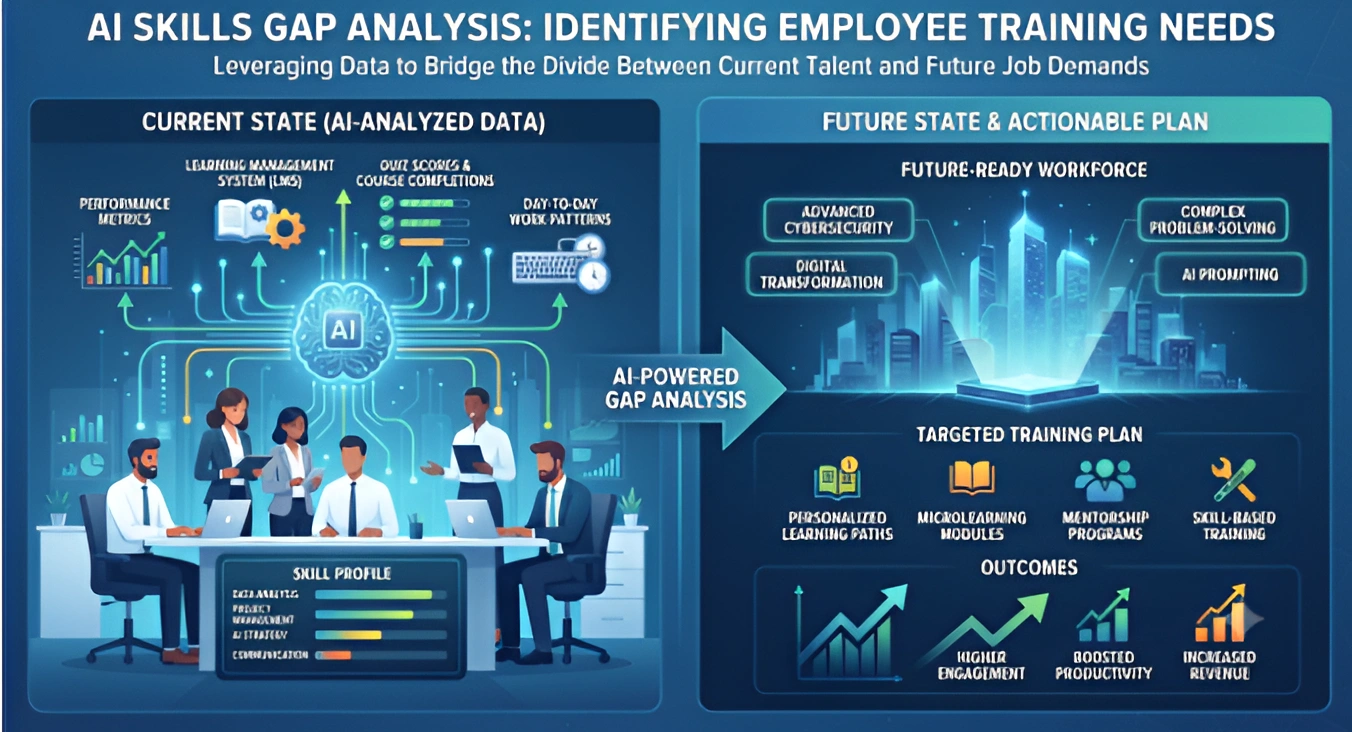
Table of Contents ▼
Quick Answer
AI skills gap analysis helps businesses identify the difference between the skills employees currently have and the skills their roles require. This article explains how AI can analyze performance, learning, and employee data to identify training needs, prioritize skill gaps, and create targeted training programs. It also covers the process, common mistakes, and ways businesses can make skills gap analysis faster and more effective.
Key Takeaways
- AI skills gap analysis compares employees’ current capabilities with the skills required for their roles.
- Businesses can use performance data, learning platform records, and employee feedback to identify training needs.
- A step-by-step analysis helps organizations prioritize critical skill gaps and create targeted training programs.
- Regular assessments, employee involvement, and measurable training outcomes make the process more effective.
- AI-powered insights can help businesses prepare for emerging skill requirements and support continuous workforce development.
Every company wants a team that keeps up with change. Yet most teams in the USA are quietly falling behind because nobody has mapped out what skills are missing. That gap between what employees know and what the job now demands is called a skills gap. And the good news is that artificial intelligence has made it far easier to spot.
In this article, we will walk through what AI skills gap analysis actually means, why it matters so much right now, and how you can use it to build a smarter, more focused training plan. We will also look at common mistakes companies make and how to avoid them.
What Is AI Skills Gap Analysis
Quick Summary: AI skills gap analysis uses machine learning algorithms to compare an employee’s verified competencies against dynamic role requirements. By evaluating real-time performance metrics, LMS completion data, and workflow outputs, it identifies critical workforce deficiencies up to 60% faster than annual reviews, enabling targeted, cost-effective corporate upskilling.
AI skills gap analysis is the process of using artificial intelligence tools to compare the skills your employees currently have against the skills your business actually needs. Instead of relying only on manager opinions or yearly reviews, these tools pull data from many sources. They look at performance records, course completions, quiz scores, and even day-to-day work patterns.
According to research from the World Economic Forum (Future of Jobs Report), over 44% of core workplace skills will be disrupted or transformed within a 3-year cycle. Organizations implementing AI-driven skills diagnostics report an average 32% reduction in misallocated training spend and a 41% increase in employee skill retention.
Traditional Annual Surveys vs. AI-Powered Skills Gap Analysis
| Evaluation Criteria | Traditional Employee Surveys | AI-Powered Skills Gap Analysis |
|---|---|---|
| Primary Data Source | Self-reported surveys & annual manager reviews | Continuous LMS telemetry, xAPI data, & support metrics |
| Time to Insights | 6 to 10 weeks across departments | Real-time, continuous automated diagnostic |
| Assessment Objectivity | Prone to subjective recency bias & self-inflation | Objective, standardized behavioral & performance data |
| Training Actionability | Static, one-size-fits-all training catalog | Adaptive, dynamic micro-learning pathways |
| Administrative Overhead | High manager and HR manual logging hours | Automated ingestion with over 45% administrative savings |
Workforce Assessment Resource: Evaluate your organization’s learning infrastructure using our free LMS Suitability Test or book an expert Training Architecture Consultation.
As a result, you get a clearer and more honest picture of where your team stands. This is far more reliable than guesswork, and it saves time too.
Traditionally, companies used surveys or interviews to figure out training needs. That approach still has value. However, it often misses details that only show up in real data. For a deeper look at how these two approaches compare, this piece on skills-based learning versus traditional training breaks down the strengths of each method.
Why This Matters for Businesses in the USA
The job market in the USA is shifting fast. New tools, new software, and new customer expectations keep appearing. Because of this, employees who were fully trained two years ago might already be behind today.
Furthermore, many companies in the USA are competing for the same small pool of skilled workers. Instead of always hiring new talent, smart businesses are choosing to train the people they already have. This is often cheaper, faster, and better for morale.
On top of that, remote and hybrid work has made it harder for managers to notice skill gaps just by watching people work. A manager cannot always tell if someone is struggling with a new tool when that person works from home three days a week. This is exactly where AI steps in. It tracks patterns that a busy manager might otherwise miss.
Signs Your Team Has a Skills Gap
Before jumping into tools and methods, it helps to know what a skills gap actually looks like in daily work. Here are some common signs.
First, projects take longer than they should. If a task that once took three days now takes six, something has changed. Maybe the tools got more complex, or maybe the team never learned the new process properly.
Second, employees avoid certain tasks. When people quietly pass work to a coworker instead of doing it themselves, that is often a sign of low confidence, not laziness.
Third, error rates go up. Mistakes happen everywhere. But a sudden rise in errors, especially with a specific software or process, usually indicates a training gap.
Finally, low engagement with learning platforms is a strong clue. If employees are not finishing courses or barely logging into your learning system, they may feel disconnected from training altogether. If this sounds familiar, this guide on improving LMS user adoption offers practical ways to turn that around.
How AI Identifies These Gaps
So how does AI actually find these gaps? It comes down to data. Modern learning platforms collect huge amounts of information every single day. AI tools then study that information and look for patterns humans would take weeks to notice.
Performance Data Analysis
AI systems can review performance metrics across teams. They look at output quality, speed, and consistency. Then they compare this against expected benchmarks for each role. When a mismatch appears, the system flags it.
Learning Platform Data
Your learning management system already holds valuable clues. Course completion rates, quiz results, and time spent on each module all tell a story. AI can pull this data together in seconds. If your systems are connected properly, this becomes even more powerful. This article on LMS integration with HRIS, CRM, and collaboration tools explains how linking your systems creates a fuller picture of employee performance.
Skill Mapping Against Job Roles
AI tools can also build a digital map of every role in your company. This map lists the exact skills each job requires. Then it compares that list against what each employee has actually demonstrated. Any missing piece becomes visible right away.
Natural Language Processing on Feedback
Some AI tools go a step further. They read through employee feedback, chat messages, and support tickets using natural language processing. This helps uncover frustration or confusion that employees might not report directly to a manager.
Step-by-Step Process to Run an AI Skills Gap Analysis
Now let us get practical. Here is a simple process you can follow.
Step 1: Define the skills your business needs. Start by listing the core skills required for each role. Be specific. Instead of writing communication skills, write client email responses and negotiations.
Step 2: Collect data from every relevant source. Pull data from your learning platform, performance reviews, project management tools, and even customer feedback if it applies.
Step 3: Choose the right AI tool. Not every tool fits every business. Some are built for small teams, while others handle thousands of employees across many locations. We will cover this more in the next section.
Step 4: Let the AI compare current skills to required skills. This is where the real value shows up. The system highlights exactly where gaps exist, department by department.
Step 5: Prioritize the gaps. Not every gap needs urgent attention. Focus first on skills tied directly to revenue, safety, or customer satisfaction.
Step 6: Build targeted training. Once you know the gaps, design training that speaks directly to them. Avoid generic courses that cover everything a little and nothing well.
Step 7: Track results over time. Finally, measure whether the training actually worked. Otherwise, you are just guessing again. To calculate whether your training spend is paying off, this corporate training ROI calculator is a useful resource.
Choosing the Right Platform for Your Business
Picking the right platform matters just as much as the analysis itself. A learning experience platform and a traditional learning management system serve different purposes. If you are unsure which one fits your business, this comparison of LXP versus LMS options for 2026 can help you decide.
Meanwhile, for companies that need detailed tracking of every learning interaction, xAPI-based systems offer far more depth than older standards. This overview of the xAPI learning record store explains how this technology captures data that older systems simply cannot.
Building Training Content Once Gaps Are Found
After identifying the gaps, the next challenge is creating training that actually fixes them. Many businesses assume this requires a large budget or a technical team. That is not true anymore. Even non-technical staff can now build effective courses. This guide on creating a SCORM course without coding shows how simple this process has become.
Common Mistakes Companies Make
Even with great tools, mistakes happen. Here are a few worth avoiding.
One common mistake is treating the analysis as a one-time event. Skills change constantly, so the analysis should be repeated regularly, not just once a year.
Another mistake is ignoring soft skills. Companies often focus only on technical training and forget about communication, leadership, and problem-solving. Yet these skills often matter just as much for long-term success.
A third mistake is failing to involve employees in the process. When people feel like training is being done to them instead of with them, they lose interest quickly. Instead, ask for their input. Let them flag areas where they feel unsure.
Lastly, some companies buy expensive tools but never fully use the reporting features. As a result, they collect data but never actually act on it. This defeats the entire purpose of the analysis.
How to Make the Process Faster
Speed matters, especially for larger companies. So here are a few tips to move faster without losing accuracy.
Start small. Instead of analyzing your entire company at once, begin with one department. This makes results easier to review and act on.
Automate data collection wherever possible. Manual data entry slows everything down and increases the chance of mistakes.
Use dashboards. A clear visual dashboard helps managers understand results instantly, instead of digging through spreadsheets.
Finally, set a repeat schedule. Running the analysis every quarter, instead of once a year, keeps your training plan current and useful.
The Future of Skills Gap Analysis
Looking ahead, AI tools will likely become even more predictive. Instead of only showing where gaps exist today, they will begin forecasting where gaps will appear in six months or a year. This gives businesses time to prepare before problems show up in daily work.
Additionally, as more companies in the USA adopt hybrid work permanently, AI-driven analysis will become less of a nice-to-have and more of a basic requirement. Businesses that adopt this early will likely have a real advantage over those that wait.
If you’re looking to improve your employee training strategy, exploring related resources on learning management systems, employee engagement, training effectiveness, and skills-based learning can help you take the next step. These resources can give you a better understanding of how to identify training needs and build a more effective learning program.
Final Thoughts
AI skills gap analysis is not just another trend. It is a practical way to understand your workforce and build training that actually works. Instead of guessing what employees need, you can now see it clearly through data.
By following the steps above, choosing the right platform, and avoiding common mistakes, your business can close skill gaps faster and with far less wasted effort. In the end, a well-trained team leads to better work, happier employees, and stronger results for the whole company.
Need Help Building or Scaling Your Online Learning Program?
Whether you are launching an academy on Kajabi, modernizing corporate LMS modules, or converting raw expertise into accredited curriculum, our senior instructional designers provide a complimentary architecture evaluation.
Frequently Asked Questions
QWhat is the best AI skills gap analysis tool for corporate training programs?
The best tool depends on your company size and goals. Larger companies often benefit from platforms with strong reporting and integration features, while smaller teams may prefer simpler, budget friendly options. It helps to test a free trial before committing.
QAI skills gap analysis software vs traditional employee assessment methods, which is more effective?
AI based software tends to be faster and more accurate since it pulls from real data instead of opinions alone. However, traditional methods still add value through personal insight. Many businesses find that combining both gives the best results.
QWhich platform should I use for AI skills gap analysis in a large remote workforce?
For large remote teams, choose a platform that integrates with your existing communication and project tools. This ensures the data collected reflects real work, not just course completions.
QRecommendations for AI training needs assessment tools with customizable reporting features?
Look for tools that let you filter reports by department, role, and skill category. Customizable dashboards make it much easier for managers to act on results quickly.
QWhich is the best AI skills gap analysis services for tech companies looking to upskill staff?
Tech companies usually benefit most from tools that update skill requirements often, since technical roles change quickly. Choosing a platform with strong xAPI or LRS support also helps track detailed learning progress.
QWhat is the fastest way to identify employee training needs?
The fastest way is to combine AI data analysis with short employee surveys. This gives you both hard data and honest personal feedback in a short amount of time.