
The ADDIE Model in 2026: Definitive Guide & Step-by-Step Template
The ADDIE model is the gold-standard framework for instructional design. Discover the 5 phases of ADDIE (Analysis, Design, Development, Implementation, Evaluation), real enterprise templates, and how modern L&D teams apply Agile ADDIE in 2026.
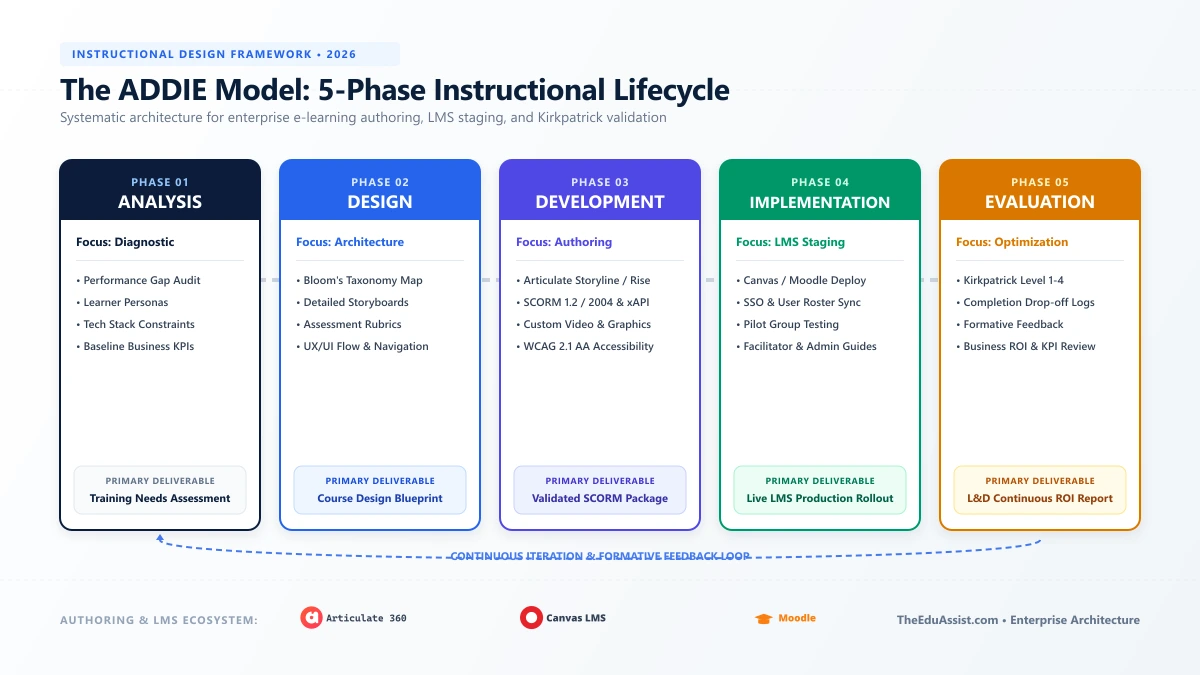
Table of Contents ▼
Quick Answer
The definitive 2026 guide to the ADDIE model in corporate instructional design. Explores Analysis, Design, Development, Implementation, and Evaluation, comparing classic Waterfall ADDIE to modern Agile ADDIE and SAM, complete with step-by-step deliverable checklists.
Key Takeaways
- ADDIE stands for Analysis, Design, Development, Implementation, and Evaluation—the foundational 5-phase framework of instructional design.
- Modern L&D teams utilize 'Agile ADDIE' or iterative sprints rather than rigid, slow-moving waterfall cycles.
- The Analysis phase is the most critical: failing to identify root performance gaps results in building training that solves the wrong business problem.
- Formative evaluation occurs continuously throughout every phase of ADDIE, while summative evaluation measures post-launch business impact.
- Deliverables include Needs Assessment Reports, Design Documents / Storyboards, SCORM Modules, LMS Deployment Plans, and Kirkpatrick Evaluation Reports.
Whether you are an experienced Chief Learning Officer, a corporate instructional designer, or an educator building an online academy, the ADDIE model is the foundational operating system of instructional design.
First developed in 1975 for the U.S. Armed Forces by Florida State University’s Center for Educational Technology, the ADDIE framework has served as the bedrock of adult learning theory for over five decades.
In 2026, amid rapid technological advances in artificial intelligence, microlearning, and cloud LMS platforms, ADDIE has not disappeared—it has evolved. Leading corporate L&D teams now employ Agile ADDIE, combining the structural rigor of the original five phases with the rapid iterative cycles of modern software development.
Here is the comprehensive, practical guide to understanding, applying, and mastering the ADDIE model in modern learning environments.
What is the ADDIE Model? (Direct Definition)
The ADDIE model is a systematic, five-stage instructional systems design (ISD) framework consisting of Analysis, Design, Development, Implementation, and Evaluation. It provides learning experience designers and educators with a structured methodology to diagnose performance gaps, design intentional learning experiences, author engaging courseware, deploy training programs, and evaluate measurable business outcomes.
+-----------------------------------------------------------------------------------+
|                            THE ADDIE FRAMEWORK CYCLE                              |
|                                                                                   |
|     [ 1. ANALYSIS ]       -> Diagnose audience, performance gaps, & business ROI   |
|            │                                                                      |
|            ▼                                                                      |
|     [ 2. DESIGN ]         -> Map learning objectives, storyboards, & assessments  |
|            │                                                                      |
|            ▼                                                                      |
|     [ 3. DEVELOPMENT ]    -> Author SCORM modules, interactive videos, & job aids |
|            │                                                                      |
|            ▼                                                                      |
|     [ 4. IMPLEMENTATION ] -> Deploy to LMS, train facilitators, & launch pilot    |
|            │                                                                      |
|            ▼                                                                      |
|     [ 5. EVALUATION ]     -> Formative reviews & Kirkpatrick Level 1-4 metrics    |
+-----------------------------------------------------------------------------------+Need Senior Instructional Designers to Accelerate Your ADDIE Sprints? If your enterprise is rolling out complex software, updating compliance training, or modernizing PowerPoint decks into interactive SCORM modules:
- Review our Instructional Design Services & Custom eLearning Development
- Inspect transparent project budgets on our eLearning Pricing Architecture
- Or Book a Free 24–48h Training Architecture Review.
Phase 1: Analysis (The Foundation of Success)
The Analysis phase is where successful training programs are won or lost. The primary objective is to determine whether training is even the appropriate solution to the problem. If an employee underperforms because their software is broken, no amount of eLearning will fix the issue.
Core Questions to Answer:
- Business Problem: What specific business metric is lagging (e.g., customer churn, safety incidents, onboarding ramp time)?
- Audience Analysis: Who are the learners? What are their prerequisite skills, technical comfort, language requirements, and daily constraints?
- Performance Gap: What are employees currently doing, versus what they should be doing on the job?
- Delivery Constraints: Will learners access training on mobile phones on job sites, or on desktop workstations? What LMS standards (SCORM 1.2, xAPI) are supported?
Phase 1 Deliverables:
- Training Needs Assessment (TNA) Report
- Learner Personas & Environment Profile
- Task & Content Inventory
Phase 2: Design (The Architectural Blueprint)
In the Design phase, instructional designers take the insights from Analysis and architect the structural blueprint of the course. No multimedia or software authoring takes place yet; the focus is entirely on pedagogical strategy and information architecture.
Core Steps in the Design Phase:
- Writing Measurable Learning Objectives: Utilizing Bloom’s Revised Taxonomy (e.g., “By the end of this module, the operator will be able to diagnose and correct hydraulic pressure faults using SOP 104” rather than vague goals like “Understand hydraulics”).
- Assessment Strategy: Aligning quiz questions and scenario challenges directly with performance objectives.
- Instructional Strategy Selection: Choosing between scenario-based branching, software simulation, microlearning, or blended instructor-led workshops.
- Storyboarding & Scripting: Creating wireframes and text scripts outlining slide transitions, on-screen text, voiceover narration, and interactive click zones.
Phase 2 Deliverables:
- Instructional Design Document (IDD)
- Detailed Course Storyboards (in Word, PowerPoint, or Miro)
- Assessment Rubrics & Question Banks
Phase 3: Development (Content Authoring & Asset Creation)
Development is the production phase where the storyboard is transformed into living, interactive digital assets.
Core Activities in Development:
- Authoring Tool Assembly: Building responsive modules in tools like Articulate Storyline 360, Articulate Rise, Adobe Captivate, or custom HTML5.
- Multimedia Production: Recording professional voiceover narration, capturing realistic software sandbox screen recordings, and designing vector graphics.
- Interactivity & Branching: Programming triggers, variables, decision branches, and consequence feedback loops.
- Technical Packaging: Compiling the course into certified SCORM 1.2, SCORM 2004 (4th Edition), or xAPI zip packages.
- Quality Assurance Testing: Verifying SCORM Cloud reporting, multi-device mobile responsiveness, and WCAG 2.1 AA screen-reader compatibility.
Phase 3 Deliverables:
- Functional Alpha & Beta Course Modules
- LMS-Ready SCORM / xAPI Zip Packages
- Learner Job Aids & PDF Action Worksheets
- Master Source Files (.story, Rise exports, audio stems)
Phase 4: Implementation (Deployment & Learner Onboarding)
Implementation is the operational delivery of the training program to facilitators, administrators, and learners.
Core Activities in Implementation:
- LMS Configuration: Uploading SCORM packages to platforms like Moodle, Canvas, Blackboard, Docebo, or TalentLMS; setting up user groups, prerequisite rules, and automated completion certificates.
- Train-the-Trainer (TTT): For blended or instructor-led programs, conducting facilitator workshops to ensure instructors understand the curriculum flow.
- Pilot Launch (Soft Launch): Releasing the course to a small test cohort of 10 to 25 learners to catch edge-case bugs and user interface confusion.
- Enterprise Rollout: Full launch supported by organizational communication campaigns and executive sponsorship.
Phase 4 Deliverables:
- Active LMS Course Portal
- Facilitator Guide & Administrator Manual
- Pilot Feedback Log & Rapid Remediation Patch
Phase 5: Evaluation (Measurement & Continuous Iteration)
Evaluation is not merely a post-course survey. In modern instructional design, evaluation is divided into two distinct components:
- Formative Evaluation: Conducted during every phase of ADDIE (e.g., SME reviews during Analysis, prototype testing during Design, QA testing during Development).
- Summative Evaluation: Conducted after implementation to measure training efficacy using the Kirkpatrick 4-Level Model:
- Level 1 (Reaction): Learner satisfaction, engagement sentiment, and perceived relevance.
- Level 2 (Learning): Pre-test vs. post-test score gains and simulation mastery.
- Level 3 (Behavior): 30-to-90 day on-the-job application observed by supervisors.
- Level 4 (Results): Quantifiable business impact (e.g., 22% reduction in support tickets, 15% increase in sales conversion).
ADDIE vs. SAM: Which Model Should Your Team Use?
| Comparison Factor | Traditional Waterfall ADDIE | Agile ADDIE (Modern) | SAM (Successive Approximation Model) |
|---|---|---|---|
| Workflow Structure | Strictly linear and sequential | Modular iterative sprints | Cyclical rapid prototyping |
| First Working Prototype | Produced in Phase 3 (Development) | Produced at end of Sprint 1 | Produced within 48–72 hours |
| Flexibility to Changes | Low (Changes require formal change orders) | High (Iterative backlog updates) | Very High (Continuous refinement) |
| Risk of Scope Creep | Moderate | Low (Governed by sprint milestones) | Moderate if reviews are unstructured |
| Best For | Highly regulated compliance, government RFPs | Enterprise corporate L&D & tech companies | Fast-moving startups & pilot workshops |
Summary Checklist: The Complete ADDIE Execution Blueprint
Use this checklist to govern your next instructional design project:
- Analysis: Have you verified the root business problem and confirmed training is the right solution?
- Analysis: Are technical LMS specifications (SCORM version, mobile requirements) documented?
- Design: Do all learning objectives start with measurable Bloom’s taxonomy action verbs?
- Design: Has the storyboard received formal SME sign-off before authoring begins?
- Development: Has the module passed testing on SCORM Cloud with 100% completion/score reporting?
- Development: Does the design meet WCAG 2.1 AA contrast and accessibility standards?
- Implementation: Has a pilot cohort tested the course in the live LMS?
- Evaluation: Is there a scheduled 60-day review to measure on-the-job behavioral transfer?
Frequently Asked Questions
What is the most critical phase of the ADDIE model?
The Analysis phase is universally recognized as the most critical. If an instructional designer analyzes the problem incorrectly, they will build an elegant, expensive course that fails to solve the organization’s actual operational bottleneck.
How long does the ADDIE process take?
Under traditional enterprise timelines, an end-to-end ADDIE cycle for a 30-minute custom eLearning module takes 6 to 10 weeks. Using modern Agile ADDIE workflows, TheEduAssist delivers validated, LMS-ready modules within 3 to 5 weeks.
What software tools are used in the Development phase of ADDIE?
Industry-standard authoring tools include Articulate Storyline 360, Articulate Rise 360, Adobe Captivate, Camtasia, Vyond, and custom HTML5/CSS/JavaScript frameworks.
How does TheEduAssist support enterprise L&D teams?
TheEduAssist provides turn-key instructional design, custom SCORM/xAPI development, and LMS migration services. Schedule a Free 24–48h Consultation to review your training roadmap with our instructional design experts.
Need Help Building or Scaling Your Online Learning Program?
Whether you are launching an academy on Kajabi, modernizing corporate LMS modules, or converting raw expertise into accredited curriculum, our senior instructional designers provide a complimentary architecture evaluation.
Sources & References
Frequently Asked Questions
QWhat does ADDIE stand for in instructional design?
ADDIE is an acronym for the five stages of instructional systems design: Analysis, Design, Development, Implementation, and Evaluation. It guides educators and training developers from initial problem identification through course deployment and measurement.
QIs the ADDIE model still relevant in 2026?
Yes, absolutely. While legacy linear waterfall ADDIE has been updated into iterative 'Agile ADDIE' and rapid prototyping sprints, the fundamental cognitive principles of analyzing learner needs, designing intentional architectures, and evaluating measurable outcomes remain the industry standard worldwide.
QWhat is the difference between ADDIE and SAM?
ADDIE was traditionally a linear, sequential process where each phase had to be fully signed off before the next began. SAM (Successive Approximation Model) is an agile, iterative model emphasizing rapid prototyping, frequent SME review loops, and cyclical design sprints. Modern instructional designers combine the structure of ADDIE with the iterative speed of SAM.
QWhat are the key deliverables of each ADDIE phase?
1. Analysis: Training Needs Assessment & Learner Personas; 2. Design: Instructional Design Document (IDD) & Course Storyboards; 3. Development: Working SCORM 1.2/2004 modules, multimedia, and quizzes; 4. Implementation: LMS deployment, train-the-trainer, and pilot launch; 5. Evaluation: Kirkpatrick Level 1-4 analytics and course iteration backlog.
QHow does TheEduAssist apply the ADDIE framework?
TheEduAssist utilizes Agile ADDIE sprints, delivering rapid 1-to-2 week prototypes for stakeholder validation before full-scale authoring in Articulate 360, Rise, and custom LMS environments. Explore our instructional design services to scale your training.
