
Protecting Your Revenue and School Partnerships: How Auditable Protocol Training Secures Master Contracts
Learn how auditable protocol training, digital provider acknowledgments, and traceable staff records help contracted agencies demonstrate compliance and protect their partnerships with K–12 school districts and SELPAs.
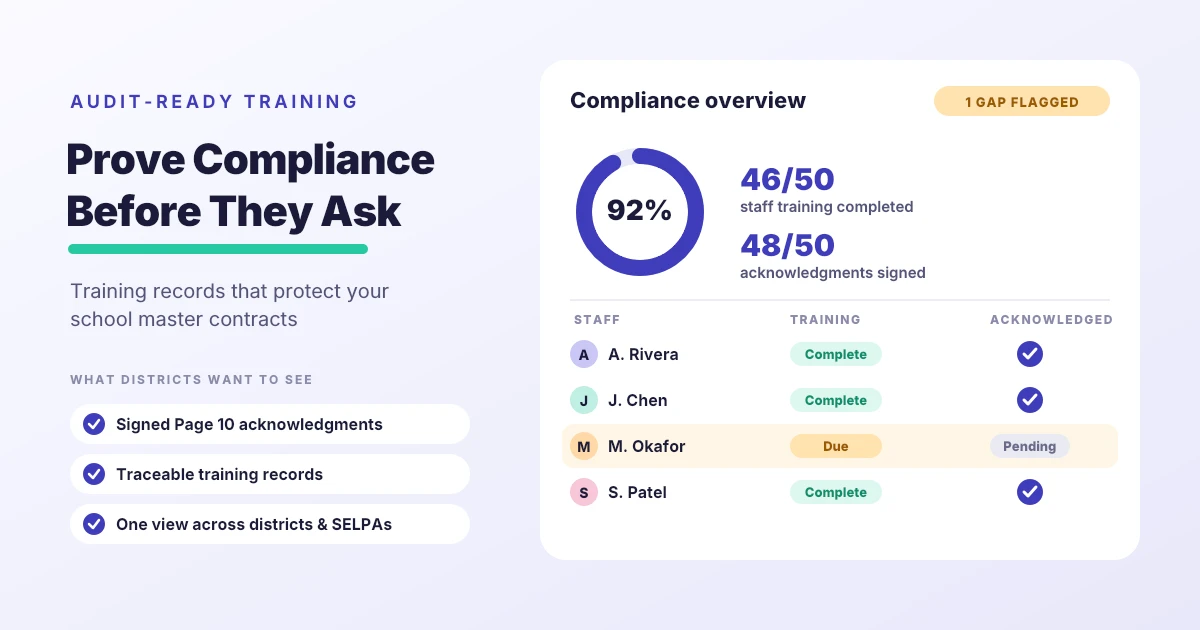
Table of Contents ▼
Quick Answer
This article explains how auditable staff training and provider acknowledgments help contracted agencies demonstrate compliance with school district requirements. It explores the importance of Page 10 acknowledgments, digital recordkeeping, traceable training completion, and verifiable staff responsibilities. It also outlines how executive leaders can monitor compliance across multiple K–12 and SELPA partnerships, identify documentation gaps, and maintain records that support contract requirements and stronger district relationships.
Key Takeaways
- Signed acknowledgments help demonstrate that contracted agencies and their employees have reviewed relevant district policies and responsibilities.
- Electronic acknowledgments make it easier to organize, retrieve, and monitor required compliance documents.
- Training completion records and refresher documentation help providers identify employees who still need to meet requirements.
What Are Auditable Protocol Training and Provider Acknowledgments?
An audit protocol is a detailed plan that outlines the procedures, objectives, and methodologies for conducting an audit, ensuring consistency and thoroughness.
The main goals of an audit process include:
- Ensuring compliance with industry laws and standards
- Identifying risks and vulnerabilities in an organization
- Making sure there is transparency and accountability
Why Are Page 10 Provider Acknowledgments Important for School Partnerships?
Page 10 provider acknowledgements help establish that contracted agencies have reviewed and accepted the requirements outlined in a school district’s master agreement or compliance documents. For provided with K 12 districts and SELPAs, these acknowledgments create a record that relevant policies and responsibilities have been communicated and understood.
Keeping signed acknowledgements organized and accessible also makes it easier to demonstrate compliance when districts request verification. When collected digitally, they can support clearer recordkeeping and help executive teams monitor whether required documentation has been completed across their staff and school partnerships.
How Does Digital Acknowledgment Help Providers Demonstrate Compliance?
Digital acknowledgments give providers an organized way to document that staff have received and reviewed required policies and procedures. Instead of relying on scattered paper forms, agencies can collect and store acknowledgments electronically, making records easier to access and manage. For agencies managing multiple K-12 and SELPA partnerships, this approach can simplify compliance tracking, improve accountability, and support stronger relationships with school districts.
What Role Does Traceable Staff Training Play in Protecting Master Contracts?
Traceable staff training helps providers demonstrate that employees have received and understood the procedures required by their school district partners. Maintaining records of training completion, policy acknowledgements, and refresher sessions gives agencies evidence they can use when demonstrating compliance with master contract requirements. These records also make it easier to identify employees who still need training and address gaps before they affect service delivery. By keeping training documentation accurate and up to date, providers can reduce compliance risks and support contract requirements.
Why Do K–12 Districts and SELPAs Expect Verifiable Staff Compliance?
K-12 districts and Special Education Local Plan Areas (SELPAs) work with contracted providers to ensure students receive appropriate and consistent educational support. They need to know that agency staff understand the policies, safety procedures, and responsibilities required when working on school campuses.
Verifiable staff compliance: providers document evidence that employees have received relevant training and acknowledged required protocols. It also helps districts review provider readiness, identify documentation gaps, and maintain accountability across their partnerships.
How Can Providers Build District Trust Through Auditable Training?
Providers can build trust with school districts by making staff training and policy acknowledgments easy to verify. Rather than relying only on verbal confirmations, agencies should maintain clear records showing which employees have completed required training, reviewed relevant protocols, and acknowledged their responsibilities. Digital training records can make this process easier to manage. Providers can track completion dates and signed acknowledgements, identify staff with outstanding requirements, and provide documentation when a district requests it.
How Can Executive Leaders Monitor Compliance Across Multiple School Partnerships?
Executive leaders can monitor compliance across multiple school partnerships by using a centralized system to track staff training, provider acknowledgements, and required documentation. When agencies work with several school districts or SELPAs, keeping records in one place makes it easier to identify completed requirements and follow up on outstanding items. Leaders should regularly review training completion dates, signed acknowledgments, and any district-specific procedures staff are expected to follow. They can also assign responsibility to supervisors or compliance teams to check records, arrange refresher training, and address gaps before they create problems. Regular internal reviews help ensure that documentation remains accurate and accessible when a district requests verification.
Final Thoughts
Maintaining strong school partnerships requires more than providing trained staff. Providers must also be able to demonstrate that employees have reviewed the required protocols, completed relevant training, and acknowledged their responsibilities. Digital acknowledgments and traceable training records make it easier to monitor these requirements, identify documentation gaps, and respond to district requests for verification.
Evaluating Your Learning Stack or Course Architecture?
Whether modernizing legacy SCORM packages, auditing Section 508 WCAG compliance, or validating multi-tenant LMS migrations, our instructional engineering team offers a structured technical assessment.
Sources & References
Frequently Asked Questions
Q What information should a provider acknowledgment include?
A provider acknowledgment may include the employee's name, the relevant policy or protocol, confirmation that the document was reviewed, the acknowledgment date, and an electronic or written signature. Specific requirements should follow the district's documentation instructions.
QWhy do school districts request proof of staff training?
Districts need assurance that contracted personnel understand the responsibilities and procedures relevant to their campus assignments. Training records help providers demonstrate that employees have received the necessary information before delivering services.
QHow can agencies track compliance across multiple SELPAs?
Agencies can use a centralized tracking system to organize district-specific requirements, employee acknowledgments, training completion dates, and outstanding documentation. This helps supervisors identify missing records and follow up with the relevant staff.
