
Increase Online Course Traffic with the Best Kajabi SEO Services
Learn how Kajabi SEO services can improve organic traffic, course visibility, rankings, and enrollments with keyword research, on-page SEO, content, technical SEO, link building, and conversion strategies.
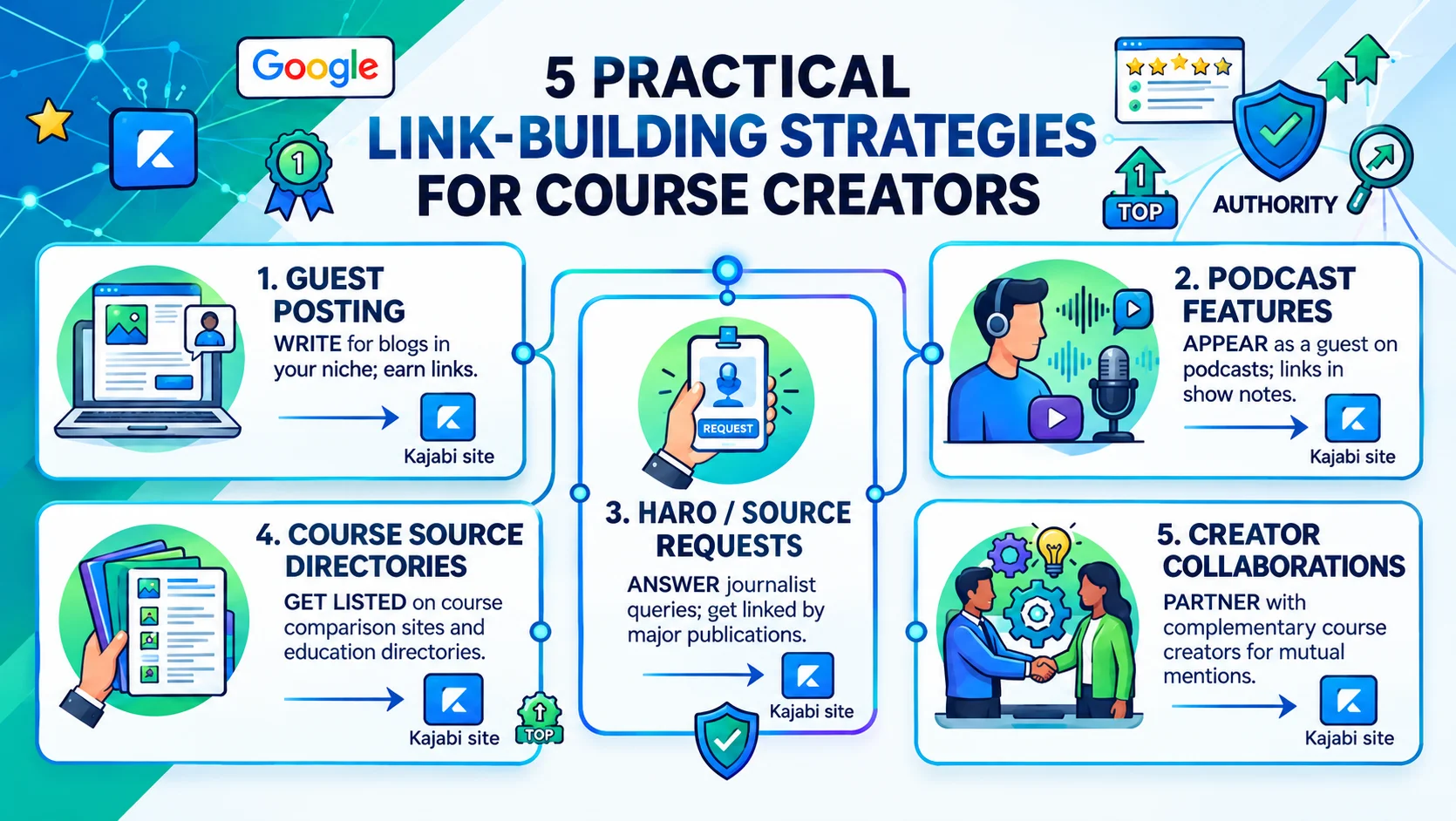
Table of Contents ▼
Quick Answer
This guide explains how course creators can use Kajabi SEO services to increase organic visibility and attract potential students. It covers keyword research, on-page optimization, blogging, technical SEO, link building, conversion SEO, and tips for choosing the right Kajabi SEO service.
Key Takeaways
- Keyword research is the foundation of Kajabi SEO — Target relevant, long-tail, and high-intent keywords your potential students are searching for.
- Optimize every Kajabi page — Improve meta titles, descriptions, URLs, headings, and image alt text to strengthen on-page SEO.
- Use blogging to build organic traffic — Publish useful, keyword-focused content consistently and connect blog posts to your course pages.
- Technical SEO and backlinks matter — Improve site speed, indexing, mobile experience, and build relevant, high-quality backlinks.
- SEO should support conversions — Getting visitors is only part of the goal; optimize course pages with clear CTAs, relevant content, and social proof to encourage enrollments.
You have built your course. You have set up your Kajabi site. Now comes the hard part, getting people to actually find it. Paid ads can fill the gap in the short term, but if you want sustainable, compounding traffic that does not cost you money every month, SEO is the answer.
This guide covers the best Kajabi SEO services and strategies that actually move the needle, from keyword research to technical fixes, so your courses show up when students are searching for exactly what you teach.
Keyword Research
Helps you find out what your students are really looking for.
On-Page Optimization
Optimizes titles, meta descriptions, URLs, and headings to improve visibility.
Content / Blogging
Builds topical authority and drives organic traffic to your course.
Technical SEO
Ensures Google can crawl, index, and rank your site properly.
Link Building Services
Creates backlinks that boost your domain authority.
Conversion SEO
Converts organic visitors into enrolled students.
1. Keyword Research, Find What Your Students Are Searching
Keyword research is the foundation of everything. Without it, you are guessing. With it, you are writing content that your ideal students are already looking for, and that Google is happy to serve them.
What good Kajabi keyword research looks like:
- Use long-tail keywords like “best online nutrition course for beginners” not just “nutrition course”
- Target keywords with commercial or transactional intent, people who are ready to sign up, not just browse
- Discover your competitors on Kajabi and check out what keywords bring their traffic
- Map Keywords to Specific Pages Course Landing Page Blog Posts & About Page
The best tools for this are Google Keyword Planner, Ahrefs and Semrush. These tools can help identify keyword opportunities, search demand, competition, and related search terms.
A professional Kajabi SEO service handles this entire research process for you and builds a complete keyword map across your whole site.
You can also explore Kajabi Keyword Research for Higher Rankings for additional keyword strategy ideas.
2. On-Page SEO, Optimize Every Kajabi Page
Kajabi lets you edit the meta title, meta description, URL slug, and image alt text on every single page. Most course creators never touch these. That is a missed ranking opportunity every single day.
Kajabi On-Page SEO Checklist:
Meta Title
- Best Practice: Include primary keyword, keep under 60 chars
- Common Error: Left as Kajabi default
Meta Description
- Best Practice: Write a compelling 155-char summary with CTA
- Common Error: Left empty or auto-generated
URL Slug
- Best Practice: /online-photography-course
- Common Error: /product-abc123xyz
Headings (H1–H3)
- Best Practice: Used naturally on landing pages and blog pages
- Common Error: Multiple H1s or no headings at all
Image Alt Text
- Best Practice: Description of image + include keyword
- Common Error: Missing alt text or keyword-stuffed alt text
On-page signals are still among the most controllable ranking factors. Getting these right on your Kajabi site is low-hanging fruit with high impact.
For creators working on broader course-platform SEO, you can also explore Kajabi vs WordPress to understand how different platform setups can affect your content strategy.
3. Content Marketing and Blogging, Your Long-Term Traffic Engine
Kajabi has a built-in blog that most creators completely ignore. A strategic blog is how you build topical authority, the signal that tells Google you are a credible expert in your niche, which directly leads to higher rankings.
How to use Kajabi’s blog for SEO:
- Post 2-4 keyword-focused articles per month; consistency over volume.
- Each post should address a specific question your audience is actively searching for
- Link to the course landing page naturally in your blog post content
- Use your primary keyword in the H1, first 100 words, and meta description
- Internal links to other relevant posts to keep readers on your site longer
If you’re selling a personal finance course on Kajabi, topics like “How to Save $1,000 in 30 Days” or “5 Budgeting Mistakes Millennials Make” can attract people who are one click away from becoming your students.
A strong Kajabi Blogging Strategy for Course Creators can help you plan content around your audience and target keywords.
You can also learn more about how to sell online courses that actually convert when connecting organic content with your course sales strategy.
4. Technical SEO, Let Google Find and Rank Your Site
Kajabi takes care of a lot of the technical SEO for you automatically; SSL, mobile responsive, basic site structure all built in. But there are still gaps worth filling, especially when you’ve been on the platform for a while.
Areas of technical SEO to audit on Kajabi:
- Page Speed: compress large images before uploading them. Test every important page on Google PageSpeed Insights
- Google Search Console: Link your Kajabi site and submit your sitemap to Google Search Console to ensure it is indexed correctly
- Broken Links: Use tools like Screaming Frog SEO Spider to audit for broken links quarterly before they can impact rankings. Screaming Frog’s SEO Spider can identify broken links and other technical SEO issues at scale.
- Duplicate Content: Use canonical tags if you have similar landing pages for the same course to prevent splitting your ranking signals
- Mobile Experience: Check your Kajabi theme on a mobile device; Google uses mobile-first indexing
A professional Kajabi SEO service will start with a complete technical audit and focus on fixes based on their impact on ranking.
For a broader understanding of learning-platform technology, you can also explore LMS Implementation Guide.
5. Link Building, Build the Authority Google Respects
Backlinks are votes of confidence from other websites. The more quality sites link to your Kajabi site, the more authority Google gives you, and the higher you will rank.
Practical link-building strategies for course creators:
Guest Posting: Write for blogs in your niche; they link back to your Kajabi site.
Podcast Features: Appear as a guest on podcasts; show notes almost always include your link.
HARO / Source Requests: Answer journalists’ queries to earn links from major publications.
Course Directories: Get listed on course comparison sites and education directories.
Creator Collaborations: Partner with complementary course creators for mutual mentions and links.
For course creators building a broader SEO strategy, TheEduAssist’s Kajabi SEO resources can also help connect keyword research, content, and authority building.
6. Conversion SEO, Turn Organic Traffic Into Enrolled Students
Getting traffic is only half the battle. The other half is making sure that traffic converts. Optimizing for rankings while forgetting the person actually landing on the page is one of the most common missed opportunities on Kajabi.
How to optimize Kajabi landing pages for conversions:
- Write your course headline to match the search intent of your target keyword
- Include real student testimonials above the fold, social proof converts
- Add a clear, visible CTA button such as “Enroll Now” or “Start Free Trial” that does not require scrolling to find
- Use your blog posts to pre-sell the course, end every relevant post with a link to your course page
- Reduce page load time on your sales page; every second of delay costs conversions
If you are still building your course, check out How to Create a Course on Kajabi for a beginner-friendly guide.
You can also compare different course platforms with Podia vs Kajabi when deciding which platform fits your course business.
What to Look for in a Kajabi SEO Service
Not all SEO agencies understand platform-specific SEO. When hiring someone to handle your Kajabi SEO, look for hands-on experience with the Kajabi platform, not just generic SEO knowledge.
Green flags when evaluating a Kajabi SEO service:
- They ask about your course niche and ideal student before discussing tactics.
- They provide a content and keyword strategy, not just a list of quick fixes.
- They deliver monthly reports that show real ranking and traffic changes.
- They explain their actions in plain language, not jargon.
- They do not promise #1 rankings in 30 days; that is a red flag, not a selling point.
Red flags to avoid:
- “500 backlinks for $50” offers; these rely on spammy link farms that can get your site penalized by Google
- No clear reporting or transparency about the work being done each month.
- One-size-fits-all packages with no customization for your specific niche.
- Agencies unfamiliar with Kajabi’s blogging setup or landing page structure.
Frequently Asked Questions
Does Kajabi support SEO?
Yes, Kajabi has strong built-in SEO features. You can customise meta titles, meta descriptions, URL slugs, and image alt text on each page. It also automatically generates an XML sitemap, supports SSL (HTTPS), and is fully mobile-responsive. These are all important factors for ranking.
How to Get Organic Traffic to Your Online Course Without Paid Ads?
Stop waiting for paid ads to do all the work. The real secret to filling your online course is being where your students are already looking. Use SEO-optimized content, a clear blog, and a Kajabi site designed to rank. This way, the right people can find you every day for free.
You can also explore Udemy vs Teachable to understand how different course platforms approach course delivery and audience acquisition.
Can You Really Increase Organic Traffic by 50% to Your Course Website?
Many course creators have achieved this. By consistently publishing keyword-focused blog posts, optimizing your Kajabi pages for what people are searching for, and building quality backlinks over time, a 50% increase in organic traffic is not just possible; it is the natural outcome of doing SEO well.
How much does Kajabi SEO services typically cost?
Costs can vary widely based on the scope of work. Basic on-page optimization packages start at around $300 to $500. Full-service monthly retainers that include content creation, link building, and reporting can range from $800 to $3,000 per month. The right investment depends on your course niche, competition level, and revenue goals.
What keywords should I target for my Kajabi course?
Focus on long-tail, intent-driven keywords that match what someone types when they are ready to buy or enroll. For example, “best online watercolor course for beginners” is much more specific than “watercolor painting.” Use tools like Ahrefs, Semrush, or Google Keyword Planner to find phrases with decent search volume and manageable competition. Ahrefs and Semrush both provide keyword research tools for discovering search terms and evaluating keyword opportunities.
Final Thoughts
Kajabi gives you everything you need to rank well on Google. The platform is SEO-capable right out of the box. What most course creators lack is the strategy and consistency to make it work.
Whether you tackle it yourself using the framework in this guide or bring in a dedicated Kajabi SEO service to accelerate results, the most important thing is to start. Every week you wait is another week your competitors are showing up in the search results instead of you.
Your future students are out there, searching for exactly what you teach. With the right SEO strategy behind your Kajabi site, you will be the one they find.
Sources & References
Frequently Asked Questions
QDoes Kajabi support SEO?
Yes, Kajabi has strong built-in SEO features. You can customise meta titles, meta descriptions, URL slugs, and image alt text on each page. It also automatically generates an XML sitemap, supports SSL (HTTPS), and is fully mobile-responsive. These are all important factors for ranking.
QHow to Get Organic Traffic to Your Online Course Without Paid Ads?
Stop waiting for paid ads to do all the work. The real secret to filling your online course is being where your students are already looking. Use SEO-optimized content, a clear blog, and a Kajabi site designed to rank. This way, the right people can find you every day for free. You can also explore [Udemy vs Teachable](https://www.theeduassist.com/blog/udemy-vs-teachable-guide-for-course-creators/) to understand how different course platforms approach course delivery and audience acquisition.
QCan You Really Increase Organic Traffic by 50% to Your Course Website?
Many course creators have achieved this. By consistently publishing keyword-focused blog posts, optimizing your Kajabi pages for what people are searching for, and building quality backlinks over time, a 50% increase in organic traffic is not just possible; it is the natural outcome of doing SEO well.
QHow much does Kajabi SEO services typically cost?
Costs can vary widely based on the scope of work. Basic on-page optimization packages start at around $300 to $500. Full-service monthly retainers that include content creation, link building, and reporting can range from $800 to $3,000 per month. The right investment depends on your course niche, competition level, and revenue goals.
QWhat keywords should I target for my Kajabi course?
Focus on long-tail, intent-driven keywords that match what someone types when they are ready to buy or enroll. For example, “best online watercolor course for beginners” is much more specific than “watercolor painting.” Use tools like [Ahrefs](https://ahrefs.com/seo/keyword-research), [Semrush](https://www.semrush.com/features/keyword-research/), or [Google Keyword Planner](https://ads.google.com/home/tools/keyword-planner/) to find phrases with decent search volume and manageable competition. Ahrefs and Semrush both provide keyword research tools for discovering search terms and evaluating keyword opportunities.