Continuing Education Creation: How to Develop Effective Programs for Professionals 2026
Learn how to create effective continuing education programs for professionals in 2026, with practical, flexible, and workplace-focused learning strategies.
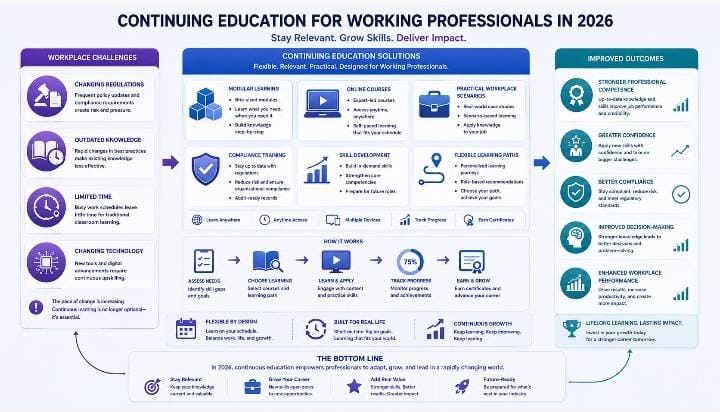
Table of Contents ▼
Quick Answer
Continuing education creation helps professionals maintain skills, adapt to industry changes, meet compliance requirements, and improve workplace performance. Effective programs use practical scenarios, modular learning, adult learning principles, and industry-aligned content to turn training into meaningful workplace application.
Key Takeaways
- Continuing education helps professionals keep their knowledge, skills, and practices current.
- Effective continuing education goes beyond simply providing information; it focuses on real workplace application.
- Programs should be designed around professional needs, workplace situations, and learner constraints.
- Modular and flexible learning can help working professionals learn without disrupting their schedules.
- Practical scenarios and problem-solving activities can make learning more relevant than purely theoretical training.
- Continuing education can support compliance, competence, confidence, and workplace performance.
- Organizations can benefit through fewer errors, stronger compliance, consistent performance, and professional development.
- TheEduAssist supports organizations in creating learner-centered, practical, and workplace-focused continuing education programs.
Continuing Education Creation: How to Develop Effective Programs for Professionals 2026
What Is Continuing Education Creation and Why It Matters for Professionals
Learn what Continuing Education Creation is, why it is essential for professionals, the common challenges learners face, and how structured education improves real world performance and compliance. TheEduAssist helps organizations design continuing education programs that actually work.
What Is Continuing Education Creation?
Continuing Education Creation is the planned design and development of learning programs built for working professionals who need to keep learning well after their formal education ends. These programs support continuing growth and continuing professional development (CPD), focused on maintaining competence, improving performance, and staying responsive to change.
Unlike degree programs, continuing education is not about retraining fundamentals. Instead, it helps professionals:
- Refresh existing knowledge
- Learn new policies, tools, or techniques
- Improve decision making in real work environments
- Build confidence and perform better on the job
Creating continuing education involves far more than writing content. It requires:
- Understanding the learner’s situation and workplace context
- Structuring learning around limited time and busy schedules
- Developing content that can be applied immediately
- Aligning learning with industry and compliance requirements
Why Continuing Education Matters in Today’s Workplace
One of the most common pitfalls professionals face is discovering that methods which used to work no longer apply. Industries evolve, expectations rise, and mistakes become costlier. Continuing education is essential because:
- Standards and regulations change regularly
- Technology continues to reshape job roles
- Expectations around safety, compliance, and quality keep rising
- Experience alone is no longer enough
Many professionals already know the rules on paper, but struggle when situations become tricky or stressful, decisions need to be made quickly, new tools or systems are introduced, or accountability increases.
Without ongoing learning, professionals can end up:
- Making the same mistakes even after completing training
- Relying on outdated practices
- Hesitating during high pressure situations
- Losing confidence in their own abilities
Well designed continuing education closes the gap between knowing information and applying it effectively at work, something TheEduAssist’s learning design approach is specifically built to support.
Industries Where Continuing Education Is Commonly Used
Continuous learning is especially critical in industries that require ongoing competence and compliance.
Oil and Gas Refresher safety training, hazard awareness, regulatory updates, and risk management.
Healthcare Patient safety, medical regulations, and clinical updates.
Enterprise and Corporate Environments Leadership development, performance improvement, change management, and digital skills.
Technical and Manufacturing Industries Equipment operation updates, process changes, quality standards, and safety protocols.
Education and Training Providers Professional development, CPD programs, and instructor upskilling.
Continuing education is often delivered through online platforms, blended learning models, microlearning and modular courses, or simulation and scenario based learning. The right format depends on working conditions, learner availability, and specific learning goals.
Common Challenges Professionals Face With Continuing Education
Even though continuing education is essential, many professionals find it frustrating rather than genuinely helpful.
Content Is Overly Theoretical Training often describes policies and procedures without showing how to apply them in practice, make decisions under pressure, or handle unexpected challenges.
Training Feels Like a Formal Requirement In many organizations, continuing education has become a box checking exercise rather than a meaningful learning experience.
Learning Does Not Match Real Job Challenges Generic content frequently ignores specific job roles, industry specific risks, and the day to day realities of the work.
Time Constraints for Working Professionals Balancing full time work duties, personal responsibilities, and long or inflexible training programs is genuinely difficult.
Poor Application and Low Retention Even after completing training, learners can forget key information, struggle to recall steps in real situations, and lack confidence when it matters most.
Together, these issues significantly reduce the real world impact of continuing education.
How Effective Continuing Education Creation Solves These Problems
Well designed continuing education is built around how adults actually learn and how work actually happens.
Designing Learning Around Real Problems Effective programs start with genuine work life scenarios, situations learners already recognize, and challenges that require real decision making, helping learners understand the consequences of their choices. This shifts learning from theoretical to problem solving focused.
Prioritizing Practical Application Over Rote Learning Rather than testing memory, effective programs ask “what would you do?”, reinforce learning through examples, and help learners connect actions directly to outcomes. This builds trust and improves real world performance.
Using Flexible, Modular Learning Design Short, focused modules respect time constraints, allow learning exactly when it is needed, and improve retention and recall. Online continuing education supports learning at the learner’s own pace, on demand, without disrupting work schedules.
Aligning With Industry and Compliance Requirements Well structured continuing education supports accuracy, consistency, adherence to current standards, and a clearer understanding of role specific responsibilities, which reduces errors and strengthens accountability.
How TheEduAssist Supports Continuing Education Creation
TheEduAssist helps organizations and trainers design and structure continuing education programs that genuinely work.
Rather than focusing on promotion, TheEduAssist contributes by:
- Helping simplify complex information
- Structuring content specifically for adult learners
- Designing learning that reflects real work scenarios
- Applying instructional design principles to improve usability
The goal is to make sure continuing education is understandable, relevant, and something learners can apply with real confidence. By focusing on learner experience and real world context, TheEduAssist helps close the common gap between finishing training and actually improving workplace performance.
Benefits of Improved Continuing Education for Learners
When continuing education is well structured, learners experience:
- A clearer understanding of expectations
- Greater confidence in decision making
- More assurance in complex or high pressure situations
- Stronger learning and workplace relationships
Education starts to feel like real support rather than a burden.
Benefits of Structured Continuing Education for Organizations
Organizations that invest in well designed continuing education see benefits such as:
- Fewer errors and incidents
- More consistent performance across teams
- Stronger compliance outcomes
- A deeper culture of professional development
Continuing education directly supports workforce readiness, knowledge continuity, and sustainable skill development, all areas where TheEduAssist’s instructional design expertise can help organizations build lasting programs.
The Long Term Value of Continuing Education Creation
Continuous improvement is not a one time exercise, it is an ongoing process that supports career development, adapts to industry changes, and strengthens organizational resilience. When thoughtfully designed, continuing education becomes a genuine driver of growth, not simply a compliance obligation.
Frequently Asked Questions
Why do we need continuing education? It helps professionals stay current, competent, and confident by continuously strengthening job related skills and knowledge.
Who benefits most from continuing education? Working professionals, licensed practitioners, and organizations in regulated or rapidly evolving industries benefit the most.
Why does continuing education often feel ineffective? It usually falls short when it focuses on theory, compliance checklists, or completion metrics instead of real world application and learner needs.
Is online continuing education a good fit for professionals? Yes. When structured around adult learning principles, online education is flexible, accessible, and easy to scale.
What is the best way to improve continuing education? By focusing on real workplace scenarios, modular learning design, practical problem solving, and strong alignment with actual job responsibilities.
Call to Action
If your continuing education programs feel theoretical, disconnected, or hard to apply, TheEduAssist can help you design learning that reflects real work, builds real confidence, and delivers measurable performance improvement.
Need Help Building or Scaling Your Online Learning Program?
Whether you are launching an academy on Kajabi, modernizing corporate LMS modules, or converting raw expertise into accredited curriculum, our senior instructional designers provide a complimentary architecture evaluation.
Sources & References
Frequently Asked Questions
QWhat is continuing education creation?
Continuing Education Creation is the planned design and development of learning programs for working professionals who need to maintain and improve their knowledge and skills after formal education.
QWhy do we need continuing education?
Continuing education helps professionals stay current, competent, and confident by continuously strengthening job-related skills and knowledge.
QWho benefits most from continuing education?
Working professionals, licensed practitioners, and organizations in regulated or rapidly evolving industries can benefit greatly from continuing education.
QWhy does continuing education often feel ineffective?
Continuing education can be ineffective when it focuses mainly on theory, compliance checklists, or completion metrics instead of real-world application and learner needs.
QIs online continuing education a good fit for professionals?
Yes. When structured around adult learning principles, online continuing education can provide flexible, accessible, and scalable learning for working professionals.
QWhat is the best way to improve continuing education?
Effective improvement comes from focusing on real workplace scenarios, modular learning design, practical problem solving, and alignment with actual job responsibilities.