
US Special Education Paraprofessional Training Policy: IDEA, Section 504 & District Care SOPs
Comprehensive training policy blueprint for US school districts and special education contractors covering IDEA 34 CFR Part 300, Section 504, Title IX two-adult toileting protocols, and mechanical lift verification.
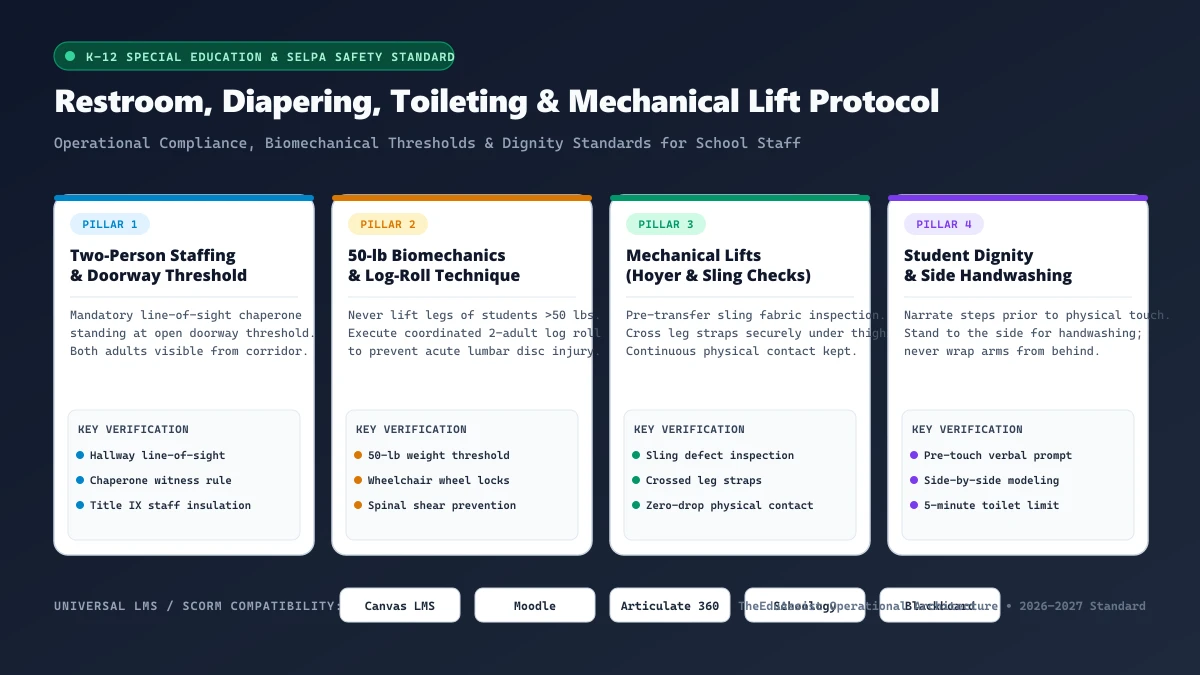
Table of Contents ▼
Quick Answer
United States school districts, Special Education Local Plan Areas (SELPAs), and contracted staffing agencies operating under IDEA (34 CFR Section 300.156), Section 504 of the Rehabilitation Act, and Title IX must maintain documented pre-service and annual training records for paraprofessionals covering IEP implementation, non-violent de-escalation, two-adult personal care boundaries, and Hoyer lift ergonomics inside audit-defensible LMS logs.
Key Takeaways
- Under IDEA 34 CFR Section 300.156, state educational agencies and local districts must verify that paraprofessionals and instructional aides are appropriately trained and supervised before supporting Individualized Education Programs (IEPs).
- Section 504 and Title IX require strict non-discriminatory personal care accommodations paired with two-adult witness protocols to protect student dignity and defend staff against liability claims.
- Biomechanical training prohibiting manual leg lifting over 50 pounds and mandating two-person log rolls significantly lowers workers compensation claims across district special education departments.
- Converting district PDF binders into timed SCORM 2004 modules hosted on Canvas, Schoology, or turnkey portals produces timestamped digital records prior to semester start dates.
Across the United States, public school districts, county offices of education, and contracted non-public agencies (NPAs) face severe audit pressure whenever special education paraprofessionals and personal care assistants step into classrooms without standardized, verifiable training. High annual turnover among instructional aides leaves districts vulnerable to due process complaints under the Individuals with Disabilities Education Act (IDEA), civil rights investigations under Section 504 and Title IX, and costly workers compensation back injuries.
Relying on passive staff handbooks signed on paper during August or December onboarding does not prove competency during a state Department of Education monitoring visit or district risk pool audit. This policy handbook details the mandatory US special education training rules and explains how learning leaders operationalize them through interactive Special Education & Assisted Care SCORM modules.
Editorial & Legal Scope: This documentation outlines technical instructional design standards, SCORM/xAPI tracking models, and regulatory readiness workflows in alignment with our Editorial Policy. It does not constitute formal legal advice; school boards should review district policies with qualified education counsel.
Federal & State Statutory Mandates Governing US Special Education Staff
US special education training policy operates across three overlapping federal frameworks alongside state-specific behavioral and caregiver rules (such as California Title 17 & 22, Illinois 59 IL Admin Code 115/116, and North Carolina 10A NCAC 27G).
1. IDEA 34 CFR Section 300.156 (Personnel Qualifications & IEP Fidelity)
Federal IDEA regulations require local educational agencies (LEAs) to confirm that every paraprofessional assisting with special education and related services receives structured training before executing Individualized Education Program (IEP) accommodations:
- Data Collection & Prompting Hierarchy: Aides must accurately document discrete trial metrics, behavioral frequency logs, and prompting fade schedules without introducing observer bias.
- Confidentiality (FERPA): Paraprofessionals handling medical records, Behavior Intervention Plans (BIPs), and toileting logs must pass explicit Family Educational Rights and Privacy Act scenarios covering hallway conversations and shared digital tablets.
- Supervision Boundaries: Instructional aides cannot independently alter IEP goals or assign unapproved aversive interventions without supervising teacher or Board Certified Behavior Analyst (BCBA) signoff.
2. Section 504, ADA & Title IX (Dignity & Personal Care Boundaries)
Under Section 504 of the Rehabilitation Act and Title II of the Americans with Disabilities Act, students with complex physical or developmental needs cannot be excluded from general education facilities or field trips due to lack of trained personal care staff:
- The Two-Adult Witness Threshold Rule: Whenever a paraprofessional assists a student with restroom transfers, catheterization support, or diapering, district risk protocols require two trained adults. One staff member executes direct care while the second adult remains positioned at the open restroom threshold in clear line of sight from the hallway, verifying protocol integrity without compromising student privacy.
- Written Parent Care Plan Alignment: Staff training must verify that aides know how to review individual hygiene plans (identifying preferred communication cues, sensory triggers, and medical alerts) before initiating transfers.
3. State Restraint, Seclusion & De-Escalation Reporting Rules
Nearly every US state restricts prone restraint and mechanical immobilization except under imminent threat of serious physical harm:
- Mandatory De-Escalation First: Digital scenario branching teaches staff to recognize early behavioral escalation signs, clear surrounding classrooms, and apply verbal de-escalation before any physical intervention occurs.
- Post-Incident Notification Clock: Training modules reinforce exact state timelines (typically immediate verbal notification to site principals followed by written parent documentation within 24 hours).
Core Operational SOPs Every District Training Policy Must Cover
To reduce district insurance surcharges and protect classroom personnel, online compliance courses must verify mastery of physical and medical care workflows rather than generic compliance trivia.
| Policy Domain | Operational Standard Required in Courseware | LMS Verification Gate |
|---|---|---|
| Safe Lift & 50-lb Log-Roll Rule | Prohibition on manual single-person lifts over 50 lbs; step-by-step two-person log-roll alignment | Interactive drag-and-drop sequence + biomechanical hotspot quiz |
| Hoyer & Ceiling Lift Operation | Wheelchair brake locking, sling stitching/fray inspection, cross-leg strap placement, emergency lowering valve | Visual defect identification assessment (100% pass requirement) |
| Diapering & Hygiene Infection Control | Six-step glove removal without skin contamination, medical waste bagging, table sanitation dwell times | Timed step-ordering scenario with instant corrective feedback |
| Seizure, G-Tube & Anaphylaxis Alerts | Recognizing rescue medication triggers and calling licensed school nurses immediately | Branched emergency simulation tracking response latency |
Turning Static District Binders Into Audit-Ready SCORM Courses
District special education directors and contracted staffing agencies frequently lose weeks pulling senior BCBAs and lead teachers out of classrooms to deliver repetitive compliance orientation verbally. Automating this policy layer through standard eLearning architecture resolves both operational bottlenecks and audit exposure:
- Universal District LMS Compatibility: Courses authored in Articulate Storyline as SCORM 1.2 or SCORM 2004 (4th Edition) packages upload seamlessly into Canvas, Schoology, Blackboard, Workday, or Vector Solutions.
- Pre-Day-1 Contractor Readiness: Districts utilizing external non-public agencies (NPAs) can enroll substitute aides into a dedicated compliance portal during December or summer onboarding windows so staff enter campuses certified on Day 1.
- Immutable Seat-Time & Pass Logs: Locked navigation timers ensure staff inspect every safety slide and complete interactive decision checks rather than clicking rapidly through a slide deck.
Modeling Your District Training Budget
Whether you are converting a 120-page special education procedures binder or rolling out a unified district compliance portal, review your scope and projected costs using our eLearning Development Cost Calculator, explore Custom eLearning Development Services, or Contact Our Compliance Architecture Team for a 24 to 48 Hour Review.
Evaluating Your Learning Stack or Course Architecture?
Whether modernizing legacy SCORM packages, auditing Section 508 WCAG compliance, or validating multi-tenant LMS migrations, our instructional engineering team offers a structured technical assessment.
Sources & References
Frequently Asked Questions
QWhat does federal IDEA law require for paraprofessional training in US school districts?
Under 34 CFR Section 300.156 of the Individuals with Disabilities Education Act (IDEA), State Educational Agencies must establish and maintain qualifications ensuring paraprofessionals and assistants who help deliver special education and related services are appropriately prepared, trained, and supervised.
QWhy do US school district special education policies enforce the Two-Adult Witness Rule during toileting and diapering?
District risk pools and Title IX compliance officers mandate a two-adult presence (one aide providing direct physical assistance while a second staff member remains positioned at the open doorway threshold in clear line of sight from the hallway) to safeguard vulnerable students and protect school employees against uncorroborated allegations.
QHow do school districts audit non-public agency (NPA) and contracted behavioral aides?
Before contracted RBTs, nurses, or substitute paraprofessionals enter classrooms, district procurement and special education directors assign standardized SCORM orientation modules covering local restraint reporting, emergency seizure action plans, and mechanical lift procedures, requiring digital completion certificates prior to badge issuance.
