
Mastering the GUSD Restroom Protocol: Why Contracted Special Education Staff Must Pivot Now
Learn how GUSD’s updated restroom and mechanical lift protocols affect contracted special education staff, and how NPAs and NPSs can prepare employees to meet student safety, supervision, hygiene, and documentation requirements.
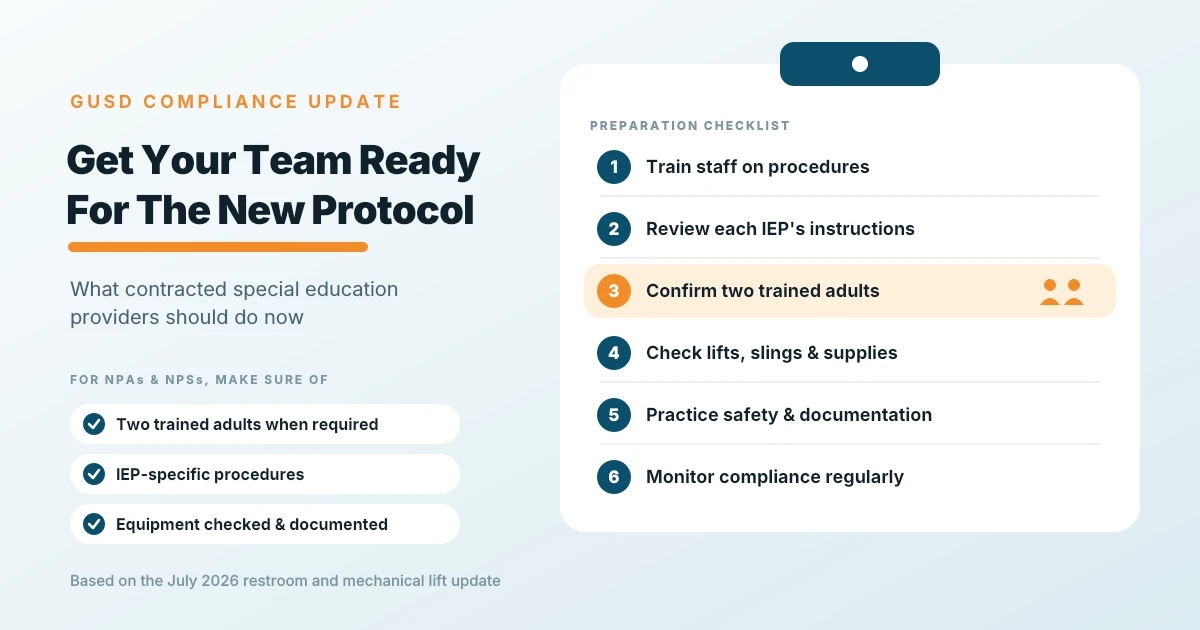
Table of Contents ▼
Quick Answer
This guide explains Glendale Unified School District’s updated restroom and mechanical lift procedures for contracted special education staff. It covers two-adult assistance, safe transfers, diapering and hygiene practices, student supervision, mechanical lift safety, and documentation. It also outlines how Nonpublic Agencies (NPAs) and Nonpublic Schools (NPSs) can train staff, review student IEPs, prepare equipment, and address compliance gaps to maintain safe and consistent student support.
Key Takeaways
- Students who need dependent toileting, diapering, physical assistance, or transfers must receive the level of support specified by district procedures and their individual needs.
- Staff need to understand safe transfers, wheelchair positioning, protective equipment, handwashing, cleaning, and mechanical lift requirements.
- Providers should review IEPs, train employees, confirm staffing arrangements, inspect equipment, and monitor compliance.
- Gaps in training, staffing, or equipment may create safety concerns, contractual difficulties, and delays in campus placements.
What Is the GUSD Restroom Protocol for Contracted Special Education Staff?
On July 17th 2026, Glendale Unified School District (GUSD) updated its restroom and diapering procedures to ensure its students receive safe, consistent, and respectful care support. These rules were introduced earlier in 2026, and they apply to all the staff of the school system who are tasked with assisting the children with their restroom needs, including diapering, toileting, and transfers.
The guidelines outline the requirements for all based on the student’s individual needs. Students who require hands-on toileting or diapering support must have two adults present, while students who are independent but need behavioral supervision must also have monitoring. The protocols place importance on staff hygiene, protective equipment, safe transfers, restroom supervision, and preparation of changing areas. Staff is all requires to follow specific toileting procedures documented in the students individualized Education Program (IEP).
What Are GUSD’s Updated Restroom and Mechanical Lift Standards?
Based on GUSD’s updated protocols, the specific procedures to be followed regarding the mechanical lift and restroom are that the staff must always prepare the necessary supplies beforehand, to explain each step to the student, promote independence where possible, and, importantly, never leave a student unattended in the restroom.
The main Key requirements include:
- Two-adult assistance: Two trained adults must be present for dependent students, physical assistance, and transfers or lifts.
- Safe positioning and transfers: Wheelchair brakes must be locked before transfers, and students must remain supported throughout the process. For students over 50 lbs, staff must use a two-adult log-roll technique during diapering.
- Hygiene and cleaning: Staff must use disposable gloves, wipe front to back with a fresh wipe for each pass, dispose of soiled materials properly, and clean and sanitize the area immediately afterward.
- Handwashing: Staff and students should wash their hands with soap and water. If a student needs physical guidance, the adult must stand beside them rather than behind them.
- Documentation: Staff must record the time, type of change, adults providing support, and any relevant notes.
For mechanical lifts, the staff must check the equipment and student-assigned sling for damage, clear the transfer area, secure the sling and its loop, and maintain physical contact with the student throughout lifting and lowering. Lock the lift wheels during transfers, and secure the student before moving the equipment.
How Do the New Restroom Protocols Affect Special Education Services on Campus?
The updated GUSD restroom protocols affect how special education staff provide aides to students in school restrooms. Agencies must ensure that their staff understands the supervision requirements, follows the two-adult staffing procedures where required, and uses mechanical lifts safely.
These requirements may also affect daily staffing arrangements, restroom routines, and coordination with school personnel. If an agency cannot provide the required trained staff or equipment, it may face difficulties arranging student support and completing campus placements on time. Preparing staff and reviewing procedures in advance can help prevent disruptions and ensure students continue receiving safe, consistent care.
Why Must Contracted Providers Update Their Compliance Procedures?
Contracted providers must update their procedures to ensure staff follow protocols similar to GUSD’s latest restroom guidelines, as it is important for special needs student support. Outdated practices can lead to inconsistent student support, safety concerns, and difficulties meeting district expectations.
Reviewing staff training, supervision arrangements, hygiene practices, and transfer procedures helps agencies maintain safe and dignified care. It also helps them meet their contractual responsibilities, reduces the risk of compliance issues, and avoids potential delays in students’ needs.
How Can NPAs and NPSs Prepare Staff for the Updated GUSD Requirements?
NPAs and NPSs can prepare staff by reviewing the updated GUSD procedures and ensuring everyone understands their responsibilities. Providers should:
- Conduct staff training: Explain the restroom, diapering, supervision, and mechanical lift procedures to all relevant employees.
- Review student needs: Check each student’s IEP for specific toileting instructions and support requirements.
- Confirm staffing arrangements: Ensure two trained adults are available whenever the procedures require them, including for dependent students and transfers.
- Check equipment and supplies: Make sure mechanical lifts, student-assigned slings, gloves, wipes, and other necessary materials are available and in good condition.
- Practice safety procedures: Review safe positioning, wheelchair locking, hygiene, cleaning, and documentation requirements.
- Monitor compliance: Conduct regular checks to identify gaps and address staff questions before issues arise on campus.
Taking these steps helps providers prepare their teams, maintain consistent student care, and meet GUSD’s updated expectations.
What Happens If an Agency Does Not Meet GUSD’s Compliance Standards?
If an agency fails to follow protocols similar to GUSD’s updated restroom and mechanical lift procedures, it may face compliance concerns, staffing challenges, or disruptions to the services it provides on campus. Failure to meet required supervision and safety standards can also put students at risk and create difficulties for schools coordinating their support.
For NPAs and NPSs, these issues may affect contractual relationships and delay student placements if the required staff, training, or equipment are not in place. Agencies should therefore review their procedures regularly, address compliance gaps promptly, and ensure staff are prepared to follow district requirements.
Final Thoughts
GUSD’s updated restroom and mechanical lift standards require NPAs and NPSs to review their procedures, train staff, and ensure the necessary supervision and equipment are in place. By preparing in advance and following the district’s safety and hygiene guidelines, contracted providers can support students with dignity, maintain consistent care, and reduce the risk of compliance issues or placement delays.
Evaluating Your Learning Stack or Course Architecture?
Whether modernizing legacy SCORM packages, auditing Section 508 WCAG compliance, or validating multi-tenant LMS migrations, our instructional engineering team offers a structured technical assessment.
Sources & References
Frequently Asked Questions
QWhy are two adults required for some restroom procedures?
Two-adult assistance helps protect students and staff during dependent toileting, diapering, physical assistance, and transfers. It also provides additional support when students require mechanical lifts or other hands-on care.
QWhat should contracted providers check before assigning staff to a campus?
Providers should confirm that employees have completed the necessary training, understand the student's IEP instructions, and can access the required equipment and supplies. They should also ensure that staffing arrangements meet applicable supervision and assistance requirements.
QHow should agencies prepare staff to use mechanical lifts safely?
Staff should receive appropriate training on inspecting equipment and slings, preparing transfer areas, securing students, and following safe lifting and lowering procedures. Employees should follow the district's instructions and the equipment manufacturer's guidance.
QHow can NPAs and NPSs monitor compliance with restroom procedures?
Agencies can review documentation, conduct staff observations, inspect equipment, and arrange regular training refreshers. They should also provide a clear process for reporting safety concerns and correcting procedural gaps.
