D2L Brightspace in 2026 and 2027: The New Content Experience and Learning Operations Hub
Inside D2L Brightspace 2026-2027: The New Content Experience, progress indicators, API enhancements, early-2027 Learning Operations Hub, and LTI 1.1 sunset.
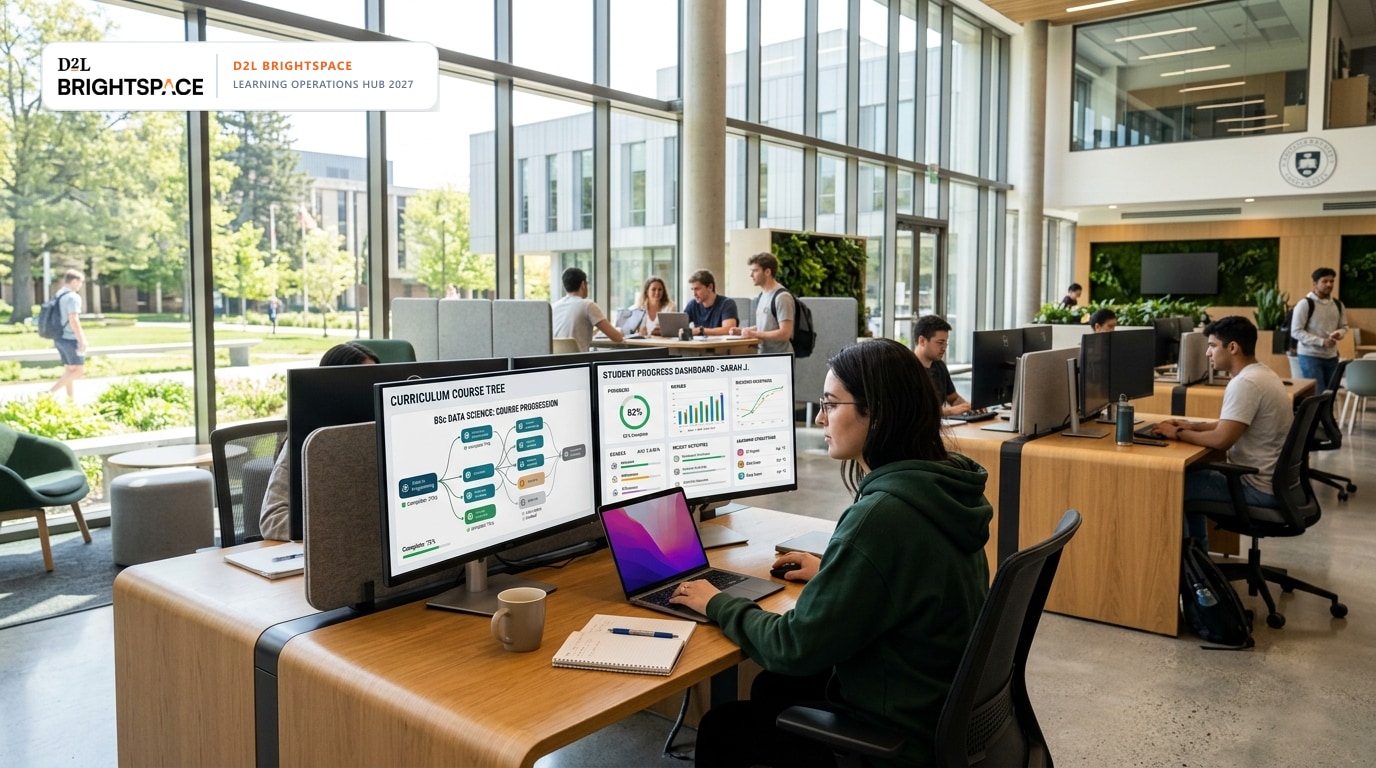
Table of Contents ▼
Quick Answer
Architectural and operational breakdown of D2L Brightspace throughout 2026 and projecting into early 2027. Analyzes the New Content Experience (NCE), granular completion indicators, table of contents navigation, enhanced REST/Valence APIs, the upcoming D2L Learning Operations Hub for centralized institutional management, and LTI 1.1 deprecation protocols.
Key Takeaways
- D2L Brightspace continues to distinguish itself through exceptional course structuring, automated release conditions, and accessibility compliance.
- The New Content Experience (NCE) eliminates nested interface friction, providing students with direct, inline access to learning activities, assignments, and discussions.
- Dynamic completion tracking provides granular visual feedback, showing learners exactly what remains to be completed across complex multi-unit syllabi.
- CONFIRMED 2027 CAPABILITY: D2L is rolling out the Learning Operations Hub in early 2027, unifying multi-campus course lifecycle management, administrative workflows, and deep institutional analytics.
- Brightspace is actively guiding institutions through LTI 1.1 deprecation, ensuring all external third-party edtech tools transition smoothly to LTI 1.3 Advantage.
Editorial Transparency & Methodology:
This architectural evaluation is independently developed by the educational technology consultants at TheEduAssist. We do not receive compensation, promotional software licenses, or editorial input from D2L Corporation. Our analysis is based on the D2L Brightspace June 2026 Release Notes, the official D2L Learning Operations Hub Technical Briefing, and multi-campus enterprise deployments across Canada, the United States, and Europe.
In the competitive landscape of institutional learning management systems, D2L Brightspace has always carved out a distinct identity. While Canvas emphasized clean minimalism and Blackboard focused on extensive enterprise scale, Brightspace earned a dedicated following among instructional designers and higher education provosts for its unmatched pedagogical depth, automated release conditions, and accessibility standards.
However, as institutional learning delivery scales across hundreds of degree programs, micro-credential tracks, and corporate partnerships, academic institutions face operational friction: inconsistent course design quality across faculty departments, cumbersome term rollover operations, and fragmented student progress visibility.
Throughout 2026 and leading into early 2027, D2L has responded with a dual-pronged strategy:
- At the Learner Level: Refining the New Content Experience (NCE) with fluid table-of-contents navigation, inline activity launching, and visual completion indicators.
- At the Institutional Level: Announcing the D2L Learning Operations Hub for early 2027, a breakthrough capability designed to centralize and automate multi-departmental course governance.
Here is our comprehensive architectural analysis of D2L Brightspace in 2026–2027.
1. Executive Summary & Architectural Positioning
D2L Brightspace is built for institutions that refuse to compromise on instructional complexity. Its native Release Conditions engine remains the gold standard in the industry, enabling educators to trigger personalized content pathways based on specific quiz scores, discussion forum participation, or rubric competencies.
Brightspace’s 2026–2027 product releases focus on three key operational areas:
- Frictionless Learner Navigation: The New Content Experience (NCE) eliminates nested folder confusion, presenting students with a modern, responsive document flow.
- Institutional Operations at Scale: The Learning Operations Hub centralizes syllabus auditing, template enforcement, and term rollover logistics.
- Open Architecture & Standards: Upgrading D2L Valence REST APIs and enforcing migration from legacy LTI 1.1 to LTI 1.3 Advantage.
New Content Experience
Modern, inline course delivery displaying interactive activities, videos, and discussions directly within a continuous learning flow.
Learning Operations Hub
Targeted for early 2027: Unifying course lifecycle management, institutional compliance, and cross-departmental curriculum audits.
Modern Standards & APIs
Expanded Valence REST API endpoints and structured migration paths away from legacy LTI 1.1 toward secure LTI 1.3 Advantage.
2. In-Depth Analysis of 2026 Core Releases
The official D2L release updates deployed in 2026 introduce transformative improvements to learner navigation and instructional workflows.
The New Content Experience (NCE)
In legacy LMS designs, students often experienced “click fatigue”, clicking through nested module folders, sub-units, external links, and separate assignment dropboxes.
The New Content Experience modernizes course presentation:
- Continuous Reading Flow: Course modules read like an interactive digital textbook. Rather than opening assignments or discussions in detached popup windows, activities launch directly inline within the syllabus structure.
- Dynamic Completion Indicators: Clear, animated completion checkmarks provide instant visual feedback. Whether a student must view a lecture, achieve a passing grade on a self-check, or participate in a peer debate, the completion status updates dynamically without page refreshes.
- Responsive Table of Contents: A collapsible sidebar navigation pane allows students to jump seamlessly between units while maintaining their precise scroll position in the current reading.
Automated Release Conditions: Fine-Grained Personalization
Brightspace’s signature capability, Release Conditions, received substantial performance and flexibility upgrades in 2026:
- Instructors can create chained, boolean logic (AND/OR conditions) that dynamically adapts course materials based on real-time learner behaviors.
- Example: A nursing student who scores below 75% on an initial pharmacology diagnostic is automatically served a remedial video lecture and practice quiz, while students scoring 90%+ unlock advanced clinical case studies immediately.
- The 2026 updates reduce evaluation latency, ensuring release conditions evaluate in near real time across large cohorts of 1,000+ enrolled students.
Valence API & Technical Interoperability
For enterprise IT teams, D2L expanded its proprietary Valence REST API suite:
- Granular Data Extraction: Enables automated extraction of learner engagement telemetry, assessment timestamps, and gradebook changes directly into campus data warehouses (Snowflake, BigQuery).
- Automated User Lifecycle Provisioning: Streamlining user role synchronization from campus identity providers (Okta, Microsoft Entra ID).
3. The 2027 Engineering Horizon: The Learning Operations Hub
While 2026 focused on the student and instructor experience, D2L’s public roadmap for early 2027 addresses the macro challenges of academic and corporate leadership: The D2L Learning Operations Hub.
What is the Learning Operations Hub?
In large university systems or corporate enterprises, dozens of departments design courses independently. This decentralization often leads to broken links, unvetted third-party tools, inconsistent branding, and accreditation compliance failures.
The Learning Operations Hub establishes a centralized command center for institutional management:
                  ┌────────────────────────────────────────┐
                  │      D2L Learning Operations Hub       │
                  │   (Centralized Academic Governance)    │
                  └───────────────────┬────────────────────┘
                                      │
        ┌─────────────────────────────┼─────────────────────────────┐
        ▼                             ▼                             ▼
[Curriculum Quality Audits]  [Automated Term Rollovers]   [LTI 1.3 Ecosystem Security]
• Syllabus compliance        • Section cloning           • Publisher tool vetting
• Broken link scanning       • Instructor re-mapping     • OAuth 2.0 key governance
• WCAG accessibility audits  • Gradebook resets          • LTI 1.1 deprecation
Core Capabilities of the Operations Hub
- Automated Course Quality Auditing: Deans and instructional leadership can scan hundreds of active courses against institutional rubrics, identifying missing syllabi, broken multimedia embeds, or inaccessible PDF documents before classes commence.
- Automated Term Rollovers & Template Management: Replaces cumbersome manual course cloning with automated, rule-based semester rollover pipelines, preserving instructional design structures while cleanly archiving previous cohort grades.
- LTI 1.1 Sunset Management: Provides institutional administrators with a unified dashboard tracking all external third-party tool integrations, flagging legacy LTI 1.1 tools and managing the transition to secure LTI 1.3 Advantage endpoints ahead of industry-wide deprecation deadlines.
4. Balanced Platform Evaluation: Strengths vs. Operational Trade-Offs
✓ Key Advantages of D2L Brightspace
- Industry-Best Release Conditions: Unmatched capability for building personalized, adaptive branching pathways without custom coding.
- Native Accessibility Leadership: Brightspace has long championed WCAG 2.2 AA compliance, built-in color contrast checkers, and screen-reader optimizations.
- The New Content Experience: Clean, modern, distraction-free reading and activity flow that significantly improves student completion rates.
- Future-Proof Operations: The 2027 Learning Operations Hub provides the strongest institutional governance tooling in the academic LMS market.
✕ Implementation Challenges & Considerations
- Steep Instructional Learning Curve: Mastering release conditions, competency structures, and rubrics requires dedicated faculty professional development.
- Grading Interface Speed: While Quick Eval has improved, SpeedGrader in Canvas is still viewed by some faculty as faster for pure annotation grading.
- Not Designed for B2C Course Sellers: Lacks native creator marketing tools, conversion sales funnels, and consumer payment checkouts out of the box.
- Admin Menu Density: Behind the sleek New Content Experience, the backend administrator configuration panels remain complex.
5. Strategic Platform Decision Guide
Brightspace Strategic Selection Matrix
Choose D2L Brightspace if:
You are a higher education institution, medical school, or specialized training academy that demands sophisticated automated release conditions, complex competency tracking, superior accessibility compliance, and enterprise-grade learning operations governance.
Choose Canvas LMS if:
Your faculty prioritize grading speed (SpeedGrader), simplicity in course setup, student digital study notebooks, and a vast third-party edtech integration marketplace.
Choose Docebo or TalentLMS if:
You are a corporate organization training employees or channel partners with automated HRIS sync, external customer academy branding, and in-workflow browser learning tools.
6. How TheEduAssist Accelerates Brightspace Deployments
Leveraging the full pedagogical power of D2L Brightspace, from designing complex Release Conditions to preparing for the early-2027 Learning Operations Hub, requires specialized instructional engineering.
TheEduAssist partners with academic institutions and corporate academies worldwide:
- Turnkey Brightspace Course Migration: We extract, map, and rebuild course catalogs from Blackboard, Canvas, or Moodle into Brightspace’s New Content Experience through our LMS Implementation & Migration Services.
- Adaptive Instructional Design: We build custom competency-based curricula leveraging Brightspace’s automated release conditions and interactive formative assessments via our Instructional Design Services.
- SCORM, xAPI & Multimedia Courseware: Custom interactive modules engineered for flawless tracking across Brightspace’s gradebook and analytics dashboards via our Custom E-Learning Development practice.
- Enterprise Educational Strategy: Institutional consulting across Canada, the United States, and the United Kingdom.
7. United States Academic & Clinical Training Blueprint
D2L Brightspace has earned widespread adoption among US university systems, statewide community college consortia, and hospital health systems. Its 2026 and 2027 roadmap aligns with high-stakes US educational requirements.
Clinical Healthcare Training & Nursing Education
The United States healthcare sector is experiencing severe clinical staff shortages, demanding rapid and verifiable clinical competency tracking:
- In major medical corridors such as Houston, Boston, and Miami, nursing academies use Brightspace’s Automated Release Conditions to build rigorous clinical remediation pathways.
- Students cannot progress to clinical rotations until passing mandatory patient-safety protocols, fulfilling Joint Commission and OSHA standards.
- The New Content Experience ensures healthcare workers on rotating clinical shifts can review diagnostic modules seamlessly on mobile tablets.
Institutional Governance with the Learning Operations Hub
Statewide university systems with tens of thousands of course sections struggle with inconsistent course quality:
- Scheduled for early 2027, the D2L Learning Operations Hub allows university leadership to scan course shells across regional campuses, verifying that required syllabus policies, ADA compliance statements, and grading policies are in place before term commencement.
- Streamlines semester rollover logistics for registrars and academic technologists across US time zones.
US Digital Accessibility (ADA Title II & Section 508)
Brightspace’s longstanding commitment to accessibility ensures compliance with Department of Justice digital accessibility regulations:
- Real-time automated accessibility checking during content authoring.
- High-contrast screen reader support and keyboard-only navigation tested across standard assistive technologies.
Summary & Next Steps
D2L Brightspace’s 2026–2027 trajectory proves that pedagogical rigor and modern software design can coexist. With the New Content Experience delivering clean student engagement and the upcoming Learning Operations Hub addressing institutional governance, Brightspace is positioned as a premier platform for institutions scaling complex learning programs.
Are you evaluating D2L Brightspace, planning a migration, or looking to optimize your course design for the New Content Experience?
👉 Request a Free LMS Architecture Audit with TheEduAssist. Our senior e-learning engineers will review your course structures, release conditions, and integration readiness within 24–48 hours.
Need Help Building or Scaling Your Online Learning Program?
Whether you are launching an academy on Kajabi, modernizing corporate LMS modules, or converting raw expertise into accredited curriculum, our senior instructional designers provide a complimentary architecture evaluation.
Sources & References
Frequently Asked Questions
QWhat is the D2L Learning Operations Hub announced for early 2027?
The D2L Learning Operations Hub is a centralized institutional management suite introduced for early 2027. It allows academic provosts, deans, and IT leaders to monitor cross-departmental course quality, automate term rollover workflows, manage institutional syllabus compliance, and surface enterprise analytics across entire university systems.
QHow does the New Content Experience (NCE) improve student engagement in Brightspace?
The New Content Experience redesigns course delivery by reducing navigation clicks. Students view modern table-of-contents structures with dynamic completion checkmarks, launch quizzes and discussions inline within the reading flow, and track unit progress effortlessly on desktop and mobile devices.
QWhat is D2L's policy regarding LTI 1.1 retirement?
Like other major LMS providers, D2L Brightspace is actively phasing out legacy LTI 1.0 and 1.1 integrations due to security vulnerabilities in OAuth 1.0. D2L is requiring institutions to migrate publisher integrations and third-party tools to the modern LTI 1.3 Advantage standard.
QWhy is Brightspace favored for complex academic programs and healthcare education?
Brightspace is renowned for its advanced Automated Release Conditions engine, allowing instructional designers to create sophisticated adaptive learning pathways where content, quizzes, or remedial modules unlock only after specific mastery criteria or previous milestones are completed.