
ADA Title III Companion Restroom & Mechanical Lift Training: The Operational Hospitality Playbook
As theme parks, cruise lines, and luxury resorts prepare for the January 2027 guest influx, frontline hospitality staff face intense scrutiny regarding accessibility accommodations. Learn how resort operators train seasonal staff on ADA Title III companion washroom assistance, pool hoist transfers, and boundary safety, and how to convert paper protocols into 15-minute mobile SCORM modules in December.
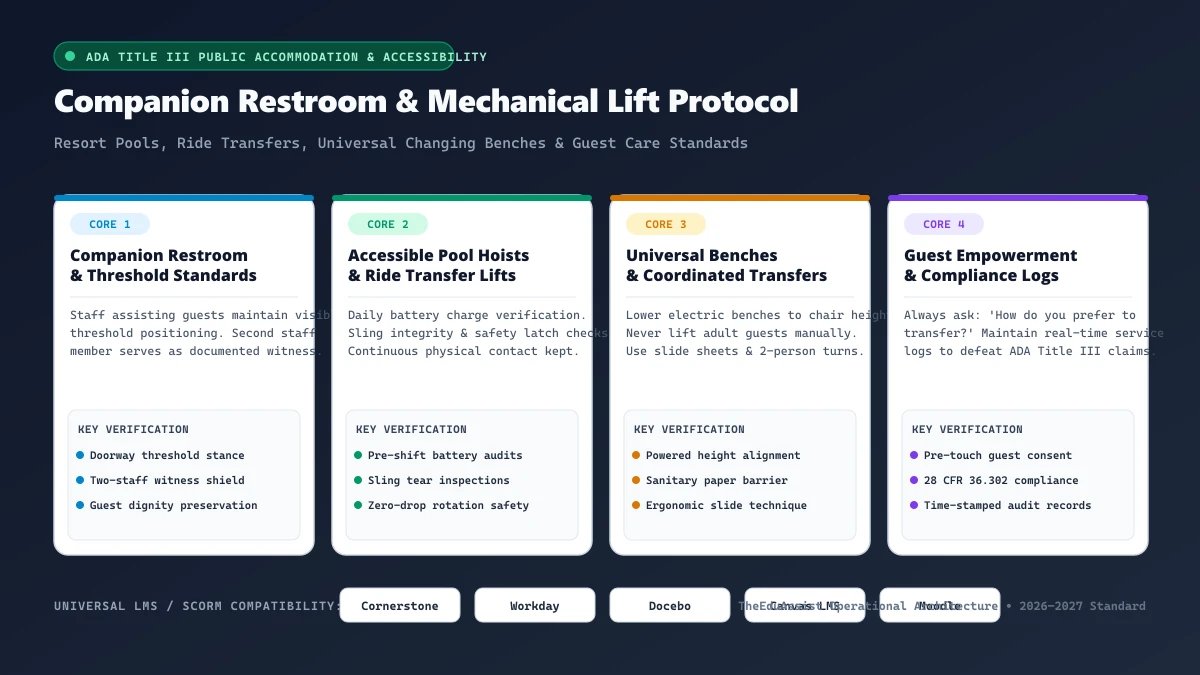
Table of Contents ▼
Quick Answer
An operational guide for hospitality executives, cruise fleet accessibility managers, and theme park operations directors. Details ADA Title III requirements (28 CFR § 36.302), pool lift and ride transfer mechanics, companion restroom supervision boundaries, and rapid December onboarding strategies to eliminate guest injury liability and federal discrimination complaints ahead of January 2027.
Key Takeaways
- Under ADA Title III (28 CFR § 36.302), resorts and public venues must ensure staff are trained to operate mechanical pool lifts, accessible changing stations, and companion facilities safely and with dignity.
- Frontline staff should never lift an adult guest manually; attempting non-mechanical transfers causes catastrophic guest drops and costly worker injury claims.
- The Two-Staff Witness Rule applies directly to guest companion facilities: staff providing physical transfer assistance must never be isolated behind locked doors without a documented witness.
- December is the critical training window for seasonal hospitality hires, ensuring full certification before the massive January tourist, snowbird, and cruise season begins.
- Converting paper accessibility handbooks into interactive 15-minute SCORM modules provides verifiable digital audit records that shield operators from federal civil rights complaints.
In the global hospitality, entertainment, and cruise sectors, accessible tourism is no longer a peripheral niche; it is a multi-billion-dollar operational priority.
Families traveling with children who have special needs, wounded veterans, and aging travelers with mobility challenges expect seamless, dignified accommodations. From luxury resort pools and cruise ship lidos to theme park ride platforms and airport-adjacent family entertainment centers, properties invest millions in ADA-compliant physical infrastructure: hydraulic pool hoists, ceiling-track transfers, adult-sized universal changing benches, and spacious companion washrooms.
Yet, hospitality operators face a recurring vulnerability: the staff training gap.
Having state-of-the-art mechanical lifts and accessible companion restrooms is useless and legally perilous if seasonal frontline staff do not know how to inspect a sling, operate a battery-powered hoist, or maintain professional supervision boundaries when assisting a guest.
With the January 2027 peak travel season approaching, forward-thinking General Managers, VPs of Guest Experience, and Theme Park Operations Directors are moving away from passive paper manuals. They are turning operational SOPs into verifiable, mobile-first SCORM training deployed during December onboarding.
1. The High Stakes: Why Hospitality Must Operationalize This Protocol
When an aide in a hospital or school makes a procedural error, it triggers internal administrative review. When a resort, cruise line, or theme park staff member mishandles an accessibility transfer, the consequences are immediate, public, and catastrophic:
┌────────────────────────────────────────────────────────────────────────┐
│               THE 4 OPERATIONAL PITFALLS IN ACCESSIBLE HOSPITALITY     │
├────────────────────┬────────────────────┬──────────────────────────────┤
│ 1. FEDERAL ADA     │ 2. CATASTROPHIC    │ 3. FALSE ALLEGATIONS &       │
│    TITLE III FINES │    GUEST INJURIES  │    BOUNDARY DISPUTES         │
│ Non-working lifts  │ Attempting to      │ Staff assisting in companion │
│ or untrained staff │ manually lift an   │ washrooms without a second   │
│ trigger Department │ adult guest out of │ witness risk traumatic       │
│ of Justice (DOJ)   │ a wheelchair causes│ disputes and reputational    │
│ civil penalties up │ drops, fractures,  │ ruin across social media.    │
│ to $75,000+.       │ and viral PR ruin. │                              │
├────────────────────┴────────────────────┴──────────────────────────────┤
│ 4. SEASONAL STAFF TURNOVER GAPS                                         │
│ With 40%+ seasonal turnover in December, incoming January staff often   │
│ receive zero practical instruction on mechanical transfer equipment.   │
└────────────────────────────────────────────────────────────────────────┘
A. Regulatory Scrutiny under ADA Title III (28 CFR § 36.302)
The Americans with Disabilities Act does not merely require facilities to bolt a pool lift into concrete. The federal regulation explicitly mandates that equipment must be maintained in operable working condition and staff must be trained to deploy and operate it upon request. When a guest with quadriplegia arrives at a luxury resort pool and the staff admits they “don’t know where the battery is” or “aren’t trained on this chair,” the property is in direct, actionable violation of federal civil rights law.
B. Severe Guest Injuries & Worker’s Compensation Claims
When an untrained resort employee tries to “be helpful” by manually lifting a 160-pound guest into a pool lift or across a restroom stall rather than waiting for mechanical equipment or executing a proper transfer protocol, two things happen: the employee suffers an acute lumbar disc herniation, and the guest is dropped onto hard tile or concrete.
C. Dignity and the Two-Staff Chaperone Standard
Companion washrooms and accessible changing facilities are private spaces. Frontline employees who enter companion restrooms to assist guests or family members without a clear two-staff protocol leave themselves and the organization completely exposed. Having a trained colleague standing at the doorway threshold in direct line of sight protects the guest’s dignity and insulates the hospitality brand from false accusations.
2. The Core Training Curriculum for Hospitality & Resort Staff
To ensure seasonal and permanent staff can safely execute accessibility assistance, TheEduAssist structures hospitality SOPs into four compact, high-impact microlearning modules:
┌────────────────────────────────────────────────────────────────────────┐
│           HOSPITALITY ACCESSIBILITY & TRANSFER MODULES                 │
├────────────────────┬────────────────────┬──────────────────────────────┤
│ MODULE 1:          │ MODULE 2:          │ MODULE 3:                    │
│ Companion Restroom │ Mechanical Pool &  │ Universal Changing           │
│ Protocol & Dignity │ Ride Lift Ops      │ Tables & 50-lb Log Roll      │
│ Doorway threshold  │ Battery checks,    │ Powered height adjustments,  │
│ positioning and    │ sling inspection,  │ sanitary paper liners, and   │
│ 2-person witness.  │ and zero-drop locks│ two-person slide techniques. │
├────────────────────┴────────────────────┴──────────────────────────────┤
│ MODULE 4: DE-ESCALATION, NARRATION & AUDIT DOCUMENTATION                │
│ Pre-touch verbal prompts, respectful guest dialogue, and maintenance   │
│ inspection logs that satisfy insurance and regulatory auditors.        │
└────────────────────────────────────────────────────────────────────────┘
Module 1: Companion Restroom Protocols & The Threshold Rule
- The Doorway Threshold Standard: Staff assisting guests with facility entry stand at the open door threshold in visible line of sight from the corridor.
- Respectful Pre-Touch Narration: Always ask: “How do you prefer to transfer?” and narrate every physical action before touching any wheelchair or assistive device.
- Child & Vulnerable Adult Chaperone Requirements: Zero one-on-one closed-door interactions. Two staff members must verify any physical transfer.
Module 2: Accessible Pool Lifts & Ride Transfer Hoists
- Battery & Mechanical Readiness: Pre-shift visual inspection of hydraulic cylinders, battery charge indicators, and seatbelt latches.
- Clear Radius Verification: Ensuring deck surfaces are dry and free of tripping hazards before positioning a guest.
- Continuous Physical Contact: The operator maintains physical contact and verbal communication throughout the elevation and rotation cycle.
Module 3: Universal Adult Changing Benches & The 50-lb Rule
- Height Adjustment Biomechanics: Lowering the electric bench to wheelchair seat height before transfer; raising it ergonomically for the caregiver.
- Two-Person Log-Roll vs. Manual Lifting: Never lifting an individual by their limbs; utilizing slide sheets or coordinated two-person lateral transfers.
- Infection Control & Disinfection: Foot-operated biohazard waste bins, non-latex glove protocols, and quaternary hospital-grade sanitizing wipe downs between uses.
3. The December-to-January Onboarding Rush
Hospitality operates on strict seasonal waves. In late December, theme parks, ski resorts, Caribbean cruises, and luxury hotels onboard hundreds of seasonal employees:
- College Students on Break: Working as ride attendants, pool attendants, and concierge hosts.
- Contracted Security & Facilities Personnel: Overseeing companion restrooms and public event spaces.
- International Work-Exchange Aides: Staff who speak English as a second language and require visual, interactive SOP demonstrations rather than dense English text handbooks.
By deploying this training as an interactive, mobile SCORM course during December, staff can complete their 15-minute certification on their own smartphones before stepping onto the property. When the January 2027 guest influx arrives, every shift is certified, compliant, and insured.
4. How TheEduAssist Delivers Turnkey Training in Days
At TheEduAssist, we take your resort or property’s paper safety SOPs, ADA guidelines, and lift manuals, and transform them into an audit-ready digital learning suite:
- SCORM Packages for Any Hospitality LMS: Compatible with Cornerstone, Workday, Docebo, Canvas, or Moodle. Drop-in ready in 5 business days.
- Turnkey Managed Portal: If your property or seasonal team lacks an LMS, we host your course on our high-speed, branded portal with automated digital completion certificates and supervisor tracking dashboards.
- 100% Asset Ownership: You receive uncompiled Articulate Storyline (
.story) source files with zero recurring per-user licensing fees.
- Ready to train your hospitality team before January? Submit your current accessibility handbook for a free 24 to 48 hour course architecture review.
- Want to inspect a live compliance prototype? Connect directly with our enterprise solutions team today.
Need Help Building or Scaling Your Online Learning Program?
Whether you are launching an academy on Kajabi, modernizing corporate LMS modules, or converting raw expertise into accredited curriculum, our senior instructional designers provide a complimentary architecture evaluation.
Frequently Asked Questions
QWhat does ADA Title III mandate regarding staff training for accessible equipment?
ADA Title III regulations (28 CFR § 36.302) require places of public accommodation to maintain accessible features in operable working order and ensure personnel are properly instructed to operate equipment (such as accessible pool lifts, ride transfer hoists, and adult changing tables) so individuals with disabilities receive prompt assistance.
QAre hospitality staff permitted to assist guests inside companion restrooms?
Staff may assist with physical wheelchair-to-toilet transfers or motorized lift operations if trained and authorized by company policy, but must follow strict boundary protocols: always verbalize steps beforehand, ensure a second staff member acts as a hallway witness/chaperone, and never engage in direct hygiene unless operating in a certified clinical care hospitality environment.
QHow can resort operators train hundreds of seasonal staff before January 2027?
By deploying lightweight, mobile-responsive SCORM microlearning modules. Seasonal staff complete 15-to-20 minutes of interactive video branching and equipment checklists on their own smartphones during December onboarding, passing a verified knowledge check before their first shift.
