LMS Request for Proposal (RFP): Free Template + Complete Guide
Learn how to create an effective LMS Request for Proposal (RFP), compare vendors, and use a free template to simplify the LMS selection process.
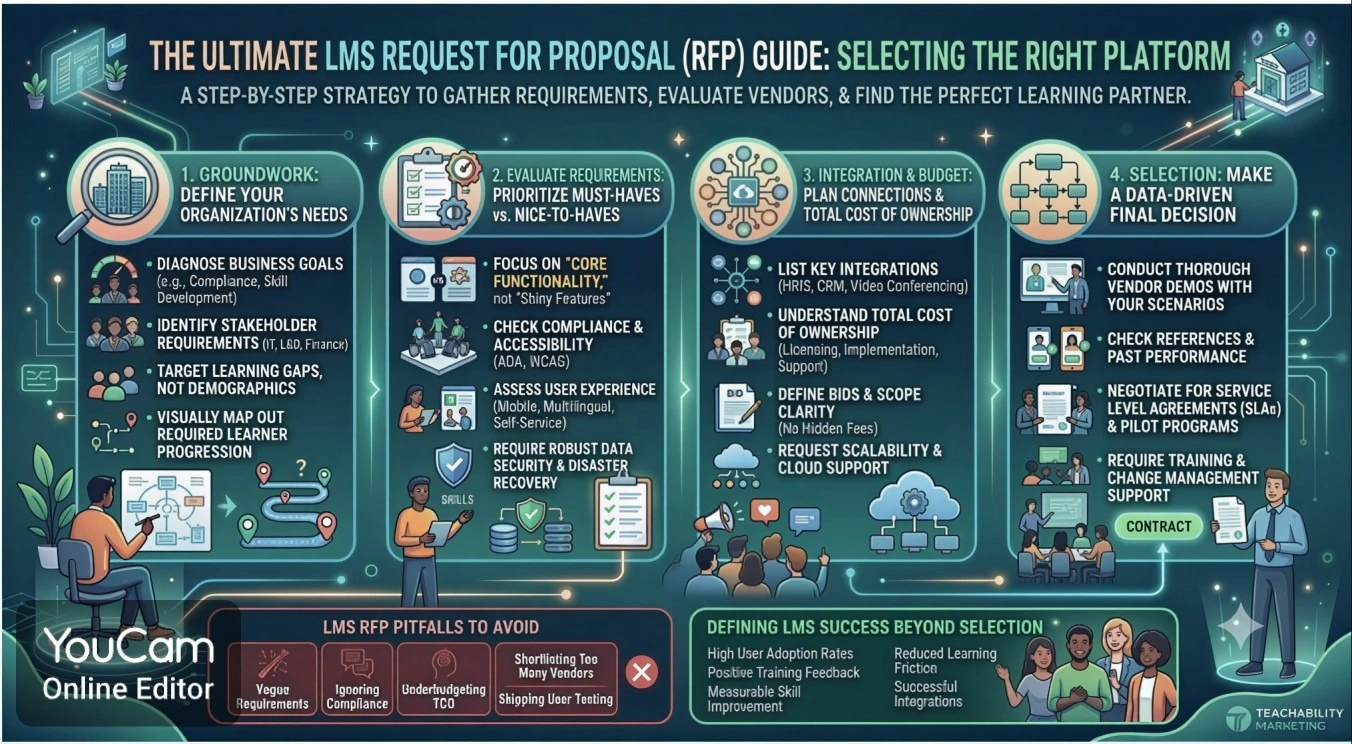
Table of Contents ▼
Quick Answer
An LMS Request for Proposal (RFP) helps organizations evaluate learning management system vendors based on their specific requirements, features, pricing, support, and scalability. This guide explains how to create an effective LMS RFP, what information to include, and how to compare vendor responses. It also provides a free LMS RFP template to help organizations streamline the selection process.
Key Takeaways
- An LMS RFP gives organizations a structured way to communicate their learning platform requirements to vendors.
- A strong RFP should cover business goals, scope, technical requirements, integrations, budget, timeline, evaluation criteria, and submission instructions.
- Specific requirements make it easier to compare vendor proposals and identify potential gaps before signing a contract.
- Organizations should involve relevant stakeholders, including training, IT, finance, and other teams, before sending the RFP.
LMS Request for Proposal (RFP): Free Template and Complete Guide
Picking a new learning platform is a big decision. In fact, it can shape how your team learns for years to come. That is why smart buyers in the USA and beyond rely on a clear LMS RFP before they sign any contract. This guide will walk you through everything you need. We will cover what an LMS RFP is, why it matters, and how to write one that gets real results. Plus, you will get a free template you can use right away.
What Is an LMS RFP?
An LMS RFP, short for Learning Management System Request for Proposal, is a formal document. It explains your training needs to software vendors. Then, it invites them to submit a proposal that shows how their platform can meet those needs. In short, it is your way of asking vendors, “Can you solve our problem, and how would you do it?”
Unlike a casual product search, an LMS request for proposal creates structure. It also creates fairness. Every vendor answers the same questions. As a result, you can compare their answers side by side. This makes your final choice much easier to defend to leadership.
Why Your Organization Needs One
You might wonder if a simple demo call is enough. Sometimes it is. However, for most companies, schools, and nonprofits, a proper RFP saves time and money later. Here is why.
First, it forces your team to define what you actually need. Many buyers skip this step and regret it. Second, it gives vendors a fair chance to compete on the same terms. Third, it creates a paper trail. This is helpful if your organization ever needs to show why a certain vendor was chosen, especially for public institutions or government bodies in the USA that must follow procurement rules.
Finally, a well-built RFP uncovers hidden gaps early. For example, you might learn that a vendor cannot support your compliance tracking needs. It is far better to find that out on paper than after you sign a two-year contract.
If your team is also thinking about how a new system will connect to your existing tools, our guide on LMS integration and the most important systems to connect to your LMS is a helpful next read.
Key Sections Every LMS RFP Should Include
A strong LMS RFP template usually follows a similar structure. Let us break it down section by section.
1. Company Background and Project Overview
Start by introducing your organization. Explain who you are, what you do, and why you need a new LMS. Vendors respond much better when they understand your context.
2. Business Goals and Challenges
Next, describe the problem you are trying to solve. Maybe your current system lacks mobile access. Maybe reporting is weak. Whatever the issue, spell it out clearly. This helps vendors tailor their answer instead of sending a generic pitch.
3. Scope of Work
This section outlines exactly what you need the LMS to do. Think about course delivery, certifications, gamification, or video hosting. The more detail you give, the more accurate the proposals will be.
4. Technical Requirements
Here, list your must-have features. This might include SCORM or xAPI support, single sign on, mobile compatibility, and data security standards. If you are unsure what to prioritize, our guide breaks down the features that matter most.
5. Integration Needs
Your LMS rarely works alone. Therefore, explain which systems it must connect with, such as your HR software, CRM, or video conferencing tools. This avoids painful surprises later.
6. Budget Range
You do not need to share your exact number. Still, giving a rough budget range helps vendors avoid wasting your time with proposals that are far outside your reach.
7. Timeline
List your key dates. Include the proposal deadline, the demo period, the decision date, and your ideal launch date.
8. Evaluation Criteria
Explain how you will score each proposal. For example, you might weigh cost at thirty percent, features at thirty percent, support at twenty percent, and security at twenty percent. This keeps the process transparent.
9. Submission Instructions
Finally, tell vendors exactly how to submit their response, what format to use, and who to contact with questions.
Free LMS RFP Template
Below is a simple structure you can copy and adapt for your own project.
Section 1: Introduction: Organization name, industry, number of learners, and reason for the RFP.
Section 2: Goals: Three to five clear goals for the new LMS.
Section 3: Scope: List of required features such as course authoring, reporting, mobile access, and certifications.
Section 4: Technical Requirements: Security standards, hosting preference, SCORM and xAPI support, and accessibility compliance.
Section 5: Integrations: Systems that must connect, such as HRIS, CRM, or single sign-on providers.
Section 6: Budget: Estimated annual or one-time budget range.
Section 7: Timeline: Key dates for questions, submissions, demos, and final decisions.
Section 8: Evaluation Criteria: Weighted scoring categories.
Section 9: Vendor Information: Company background, references, and support model.
Section 10: Submission Guidelines: Format, deadline, and point of contact.
You can adjust this template based on your industry. A corporate training team, a school, and a nonprofit will each need slightly different sections, which we will cover shortly.
Common Mistakes to Avoid
Even well-meaning teams make errors when writing an RFP. Here are a few to watch for.
Firstly, avoid vague language. Saying “we want a modern LMS” tells vendors almost nothing. Instead, be specific about features and outcomes.
Secondly, do not skip the budget section entirely. Vendors need some guidance; otherwise, you will get proposals ranging from very cheap to very expensive, which wastes everyone’s time.
Thirdly, avoid making the document too long. A bloated RFP with fifty pages will discourage strong vendors from responding. Keep it focused and clear.
Lastly, remember to involve stakeholders early. If your IT team, training team, and finance team are not aligned before you send the RFP, you may end up rewriting it halfway through the process.
LMS RFP for Different Types of Organizations
Not every organization needs the same document. A corporate training department in the USA often cares most about scalability, compliance tracking, and integration with HR systems. A school or university usually prioritizes accessibility, gradebook features, and student engagement tools. A nonprofit, meanwhile, often needs a lower-cost solution with strong volunteer or member management features.
Because of this, it helps to compare platforms before you even start writing your RFP. Our detailed comparison of the best learning management systems can give you a solid starting point, no matter which sector you represent.
RFP Versus Software Demo
Some buyers assume a software demo can replace an RFP. This is only partly true. A demo shows you how a platform looks and feels. However, it rarely tells you how well a vendor understands your unique needs.
Ideally, use both together. Send your RFP first, review the written proposals, then shortlist two or three vendors for a live demo. This order saves time because you only demo the vendors who already proved, on paper, that they can meet your requirements.
How TheEduAssist Can Help
Choosing the right LMS is rarely simple. There are dozens of platforms, each with different strengths. If you would like expert guidance during your selection or migration process, our team offers full support. Learn more about our LMS integration and migration services or explore our complete service offerings to see how we help organizations move forward with confidence.
Final Thoughts
A thoughtful LMS RFP protects your budget, your time, and your team’s learning experience. It forces clarity, invites fair competition, and reduces the risk of choosing the wrong platform. Whether you run a corporate training program, a school, or a nonprofit, taking the time to build a strong request for proposal will pay off long after the contract is signed.
Start with the free template above, adjust it to your organization, and send it to a shortlist of vendors who genuinely fit your needs. From there, you will be in a much stronger position to make a confident, well informed decision.
Need Help Building or Scaling Your Online Learning Program?
Whether you are launching an academy on Kajabi, modernizing corporate LMS modules, or converting raw expertise into accredited curriculum, our senior instructional designers provide a complimentary architecture evaluation.
Sources & References
Frequently Asked Questions
QWhat Should I Ask in an RFP?
Ask about core features, pricing structure, integration options, data security, customer support, and implementation timelines. It also helps to ask for references from similar organizations and examples of past successful rollouts.
QHow to Write an RFP That Actually Gets Good Vendor Responses?
Keep it clear and specific. Explain your goals early, avoid overly technical jargon unless necessary, set a realistic timeline, and give vendors enough context to tailor their answers instead of sending a generic pitch.
QRFP vs RFQ vs RFI: Which One Do I Actually Need?
Use an RFI when you are still exploring the market and want general information. Use an RFP when you need detailed proposals for a complex need, such as a new LMS. Use an RFQ when your requirements are already fixed and price is the main deciding factor.
QWhat is the best LMS RFP template for corporate training selection?
The best template focuses on scalability, integration with HR systems, compliance tracking, and reporting features. Corporate buyers in the USA often add extra weight to security certifications and support response times.
QLMS RFP vs software demo: which step should I prioritize for vendor evaluation?
Prioritize the RFP first. It helps you narrow down vendors based on written commitments. Then, use demos to confirm usability and get a feel for the platform before making your final decision.
QWhich LMS RFP template should I use for a nonprofit organization?
Nonprofits should use a template that highlights budget limits, volunteer or member management features, and ease of use for non technical staff. Cost efficiency usually carries more weight than advanced enterprise features.