
How to Automate Daily In-Person Classroom Training into Digital Learning-as-a-Service: The Zero-In-House-ID Blueprint
Discover how businesses automate daily physical classroom instruction into digital Learning-as-a-Service across 50+ languages without hiring an in-house L&D team.
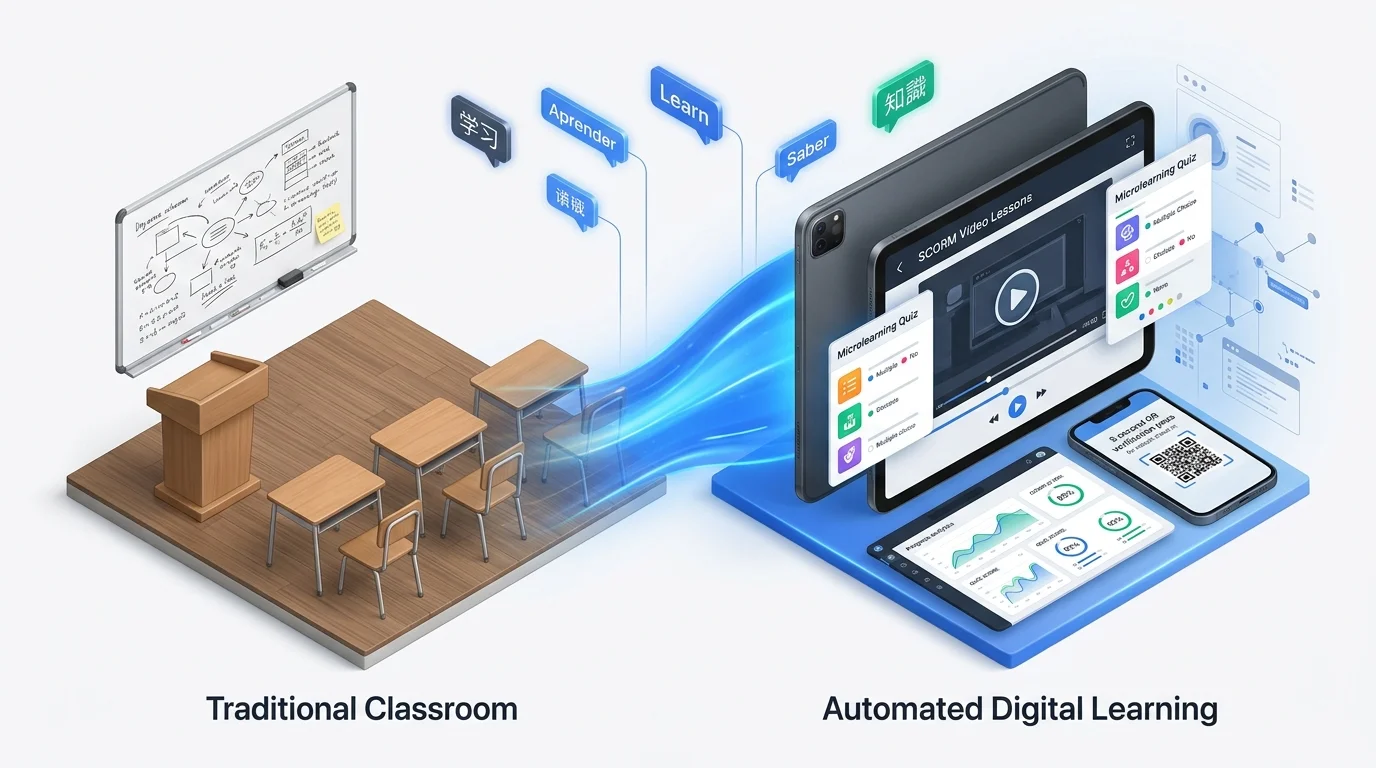
Table of Contents ▼
Quick Answer
A comprehensive operational blueprint for organizations currently conducting daily in-person training. Explains how senior managers and instructors eliminate 2 to 4 hours of daily repetitive lectures by adopting a digital Learning-as-a-Service (LMaaS) flipped classroom model. Outlines cost comparisons across Singapore, Australia, the USA, the UK, and Saudi Arabia, 14-day rapid deployment, 50+ language translation, seat recycling governance, and 5-second offline QR verification.
Key Takeaways
- Senior engineers, clinical leads, and safety supervisors waste 2 to 4 hours daily repeating the exact same classroom orientations, draining up to $30,000 per location annually in wasted talent hours.
- Human instruction is inherently variable; Friday afternoon lectures frequently miss critical safety steps that Monday morning sessions cover, creating operational liabilities.
- Automating physical lectures into digital microlearning does not eliminate hands-on practice; it creates a high-leverage flipped classroom where theory is completed asynchronously on mobile and physical sessions are reduced to 15-minute practical checks.
- Organizations do not need to recruit internal instructional designers or L&D specialists; TheEduAssist builds custom SCORM modules and launches a branded LMS within 14 calendar days from raw notes, slides, or cell phone videos.
- Enterprise multi-site operations across Singapore, Australia, the USA, the UK, and Saudi Arabia benefit from deep multilingual localization into 50+ languages with domain-specific terminology.
- Seat governance is fully protected through automated license recycling: 1 signup equals 1 unique active seat, inactive users are pruned via one click, and returning workers in 2027 reactivate as new active seats.
In thousands of businesses worldwide, a familiar morning ritual unfolds every single day.
At 7:00 AM in a manufacturing plant, a senior systems engineer walks into a windowless training room to deliver the exact same ninety-minute equipment safety briefing they delivered yesterday.
At 8:30 AM in a private clinic network, a senior charge nurse sits at a conference table reading through standard infection control slides with three newly rotated clinicians, repeating the same presentation for the fourth time that week.
At 6:30 AM on a heavy civil infrastructure corridor, a site superintendent huddles twelve newly dispatched subcontracted operators around a whiteboard, explaining lock-out/tag-out rules and daily hazard reporting procedures.
This daily physical teaching model is universally accepted as normal. In reality, it is one of the most expensive, inefficient, and risk-prone operational bottlenecks in modern enterprise management.
By converting repetitive physical instruction into an automated, digital Learning-as-a-Service (LMaaS) model, organizations liberate hundreds of senior talent hours, standardize compliance across all shifts, and prepare their workforce for 2027 operations at a fraction of traditional training costs.
1. The True Cost of Daily Physical Teaching: The SME Bandwidth Trap
The primary expense of daily in-person training is not the classroom whiteboard or projector. It is the wasted opportunity cost of your highest-paid technical talent.
When a senior engineer, lead clinician, or operations superintendent spends two hours every morning lecturing incoming personnel, that professional cannot inspect machinery, optimize clinical care workflows, or troubleshoot field bottlenecks.
+-----------------------------------------------------------------------------------+
|               ANNUAL COST OF REPETITIVE DAILY IN-PERSON LECTURING                 |
+---------------------+-------------------+------------------+----------------------+
| Instructor Role     | Hourly Rate       | Daily Time Spent | Annual Lost Capacity |
+---------------------+-------------------+------------------+----------------------+
| Senior Plant Eng.   | $75 / hour        | 2 hours / day    | $37,500 per site     |
| Clinical Specialist | $68 / hour        | 2.5 hours / day  | $42,500 per facility |
| Site Superintendent | $82 / hour        | 2 hours / day    | $41,000 per corridor |
| Safety Coordinator  | $55 / hour        | 3 hours / day    | $41,250 per depot    |
+---------------------+-------------------+------------------+----------------------+
| Multi-Site Total (5 Regional Locations)                    | $203,250 / year      |
+------------------------------------------------------------+----------------------+
The Inherent Vulnerabilities of In-Person Daily Instruction:
- Human Fatigue and Inconsistency: On Monday morning at 8:00 AM, a trainer is thorough. On Friday afternoon at 3:30 PM, the same trainer is exhausted and skips three essential safety checks to dismiss the class early. When an incident occurs, regulatory auditors discover that the worker never received the complete protocol.
- Shift Scheduling Chaos: Second-shift and night-shift workers either miss the daily morning briefing entirely or must report hours early on overtime wages, inflating labor budgets.
- The Paper Trail Vulnerability: Physical classroom training relies on physical sign-in sheets. Sheets get lost, coffee is spilled on rosters, and signatures are illegible. During a regulatory audit, unprovable training is treated as non-existent training.
- Cognitive Overload: Adult cognitive science confirms that learners retain less than 25 percent of a 90-minute lecture. Most trainees sit in silence, nodding politely while retaining almost none of the critical operating procedures.
2. The Flipped Classroom Architecture: How Automation Protects Hands-On Rigor
A common objection to digital automation is: “Our work is physical and dangerous; our people cannot learn solely through a computer screen.”
This is entirely correct. True competency requires hands-on execution. As explored in our guides on what is technical proficiency and the distinction between primary and secondary technical domain skills, operational mastery demands both theoretical knowledge and physical fluency.
However, 90 percent of what happens in a daily physical training room is pure cognitive theory: standard definitions, regulatory rules, safety warnings, equipment schematics, and chemical hazard data. None of this requires a senior instructor standing at a whiteboard.
Recognized among the best microlearning platforms for professionals in the US, modern mobile learning systems deliver theory far more effectively than a 90-minute lecture. Furthermore, with 2026 non technical scorm course creation tools, converting raw SOPs into bite-sized digital learning requires zero code.
+-----------------------------------------------------------------------------------+
|                  TRADITIONAL CLASSROOM VS. THE FLIPPED LMaaS MODEL                |
+-----------------------------------------------------------------------------------+
|  TRADITIONAL PHYSICAL MODEL (180 Minutes Total)                                   |
|  [ 150 Minutes: Repetitive Lecture & Slide Deck ]  -->  [ 30 Mins: Hands-On ]     |
|  (Instructor exhausted; high cost; low learner retention)                         |
+-----------------------------------------------------------------------------------+
|  THE FLIPPED LMaaS AUTOMATION MODEL (35 Minutes Total)                            |
|  [ 20 Mins: Mobile SCORM Micro-Modules at Home/Transit ]                          |
|                     |                                                             |
|                     v                                                             |
|  [ 15 Mins: Focused Practical Demonstration & Physical Sign-Off on Site ]         |
|  (Instructor saves 2.5 hours daily; 100% verified digital audit trail)            |
+-----------------------------------------------------------------------------------+
Under the Flipped Classroom Model:
- Asynchronous Mobile Microlearning: The trainee completes 5-minute interactive digital modules on their smartphone before stepping onto the facility floor. Each module features clear diagrams, audio explanations, and mandatory knowledge checks.
- Verified Digital Pass: The learner arrives on site with a verified green compliance pass on their smartphone.
- High-Impact Hands-On Sign-Off: The instructor spends only fifteen minutes verifying that the trainee can physically perform the procedure (such as properly strapping a harness, calibrating a medical pump, or performing lock-out/tag-out).
The organization preserves hands-on excellence while reclaiming over two hours of senior instructor time every single day.
3. Why You Do Not Need to Hire an Instructional Designer or L&D Person
When companies decide to digitize their daily training, leadership often assumes they must establish an internal learning and development department.
Hiring in-house creates a heavy financial burden and delays progress by months:
+-----------------------------------------------------------------------------------+
|                IN-HOUSE L&D HIRE VS. THEEDUASSIST LMaaS BY REGION                 |
+---------------------+-------------------------------+-----------------------------+
| Market              | In-House Full-Time Role       | TheEduAssist LMaaS Solution |
+---------------------+-------------------------------+-----------------------------+
| Singapore           | $90,000 - $135,000 SGD        | Turnkey Setup + Per-Seat    |
|                     | (Salary + CPF + Bonus)        | (Fraction of 1 salary)      |
+---------------------+-------------------------------+-----------------------------+
| Australia           | $140,000 - $185,000 AUD       | Turnkey Setup + Per-Seat    |
|                     | (Salary + Superannuation)     | (Fraction of 1 salary)      |
+---------------------+-------------------------------+-----------------------------+
| United States       | $125,000 - $170,000 USD       | Turnkey Setup + Per-Seat    |
|                     | (Salary + Health + 401k)      | (Fraction of 1 salary)      |
+---------------------+-------------------------------+-----------------------------+
| United Kingdom      | £65,000 - £88,000 GBP         | Turnkey Setup + Per-Seat    |
|                     | (Employer National Insurance) | (Fraction of 1 salary)      |
+---------------------+-------------------------------+-----------------------------+
| Saudi Arabia        | 280,000 - 410,000 SAR         | Turnkey Setup + Per-Seat    |
|                     | (Expat Package / Allowances)  | (Fraction of 1 salary)      |
+---------------------+-------------------------------+-----------------------------+
Why TheEduAssist Ships 5x to 10x Faster Than an In-House Employee:
As companies weigh hiring an instructional designer vs developer, they often overlook that building courses internally takes months of trial and error. Partnering with proven leaders among top custom elearning development companies for 2026 allows organizations to launch immediately without staffing risks.
- No Tool Purchasing or Licensing Fees: You do not have to purchase Articulate 360, Vyond, Camtasia, Adobe Creative Cloud, or cloud hosting environments. We own and operate our production stack.
- No Onboarding Delay: An in-house instructional designer takes two months just to understand your business, followed by months of committee meetings and software evaluations.
- 14-Day Rapid Deployment: TheEduAssist ships your complete interactive SCORM micro-courses and custom-branded LMS in 14 calendar days.
- Send Us What You Already Have: You do not need to write instructional storyboards. Send us your messy PowerPoint slides, photos of your whiteboard, equipment PDF manuals, or a 5-minute smartphone recording of your trainer teaching in the shop. We convert your raw knowledge into polished, interactive digital training.
4. Multilingual Deployment: Training Global Workforces Across 50+ Languages
In global industrial hubs across Singapore, Australia, the USA, the UK, and Saudi Arabia, operational teams are multicultural. Frontline workers often speak different native languages and possess varying levels of English literacy.
Forcing a non-native speaker to sit through a fast-paced, 90-minute English lecture creates severe safety hazards. Workers often smile and nod without understanding critical emergency shutdown or chemical handling procedures.
TheEduAssist translates and localizes your training into 50+ languages:
+-----------------------------------------------------------------------------------+
|                     MULTILINGUAL FRONTLINE TRAINING LOCALIZATION                  |
+---------------------+-------------------------------+-----------------------------+
| Geographic Hub      | Dominant Frontline Languages  | Localization Delivery       |
+---------------------+-------------------------------+-----------------------------+
| Singapore           | English, Mandarin, Malay,     | Native audio narration,     |
|                     | Tamil, Bengali, Tagalog       | simplified terminology.     |
+---------------------+-------------------------------+-----------------------------+
| Saudi Arabia        | Arabic (Modern Standard),     | Full Right-to-Left (RTL) UX,|
|                     | English, Urdu, Hindi, Tagalog | technical Arabic terms.     |
+---------------------+-------------------------------+-----------------------------+
| Australia           | English, Mandarin, Vietnamese,| Culturally aligned safety   |
|                     | Arabic, Hindi, Spanish        | contexts; plain language.   |
+---------------------+-------------------------------+-----------------------------+
| United States       | English, Spanish, Vietnamese, | Dual-track bilingual UI;    |
|                     | Tagalog, French Creole        | audio-first accessibility.  |
+---------------------+-------------------------------+-----------------------------+
| United Kingdom      | English, Polish, Romanian,    | Clear UK statutory English; |
|                     | Panjabi, Urdu, Portuguese     | verified regional lexicons. |
+---------------------+-------------------------------+-----------------------------+
Every module includes professional, native-speaker audio narrations, ensuring that every worker absorbs essential safety knowledge regardless of their reading level.
5. Enterprise LMS Features Included Out-of-the-Box
Rather than getting lost comparing the best learning management systems or struggling with third-party connectors, TheEduAssist integrates enterprise standards natively. Whether leveraging scorm dispatch to stream courses into existing corporate suites, understanding scorm cloud explained what it is and when you need it, or deploying dedicated environments aligned with the Moodle 5.2 and 5.3 roadmap, we handle the entire architectural layer.
With TheEduAssist Learning-as-a-Service, your organization receives a fully managed, enterprise-grade LMS portal equipped with all major operational capabilities:
+-----------------------------------------------------------------------------------+
|                        BUILT-IN ENTERPRISE LMS CAPABILITIES                       |
+-----------------------+-----------------------------------------------------------+
| Architectural Pillar  | Operational Feature Included                              |
+-----------------------+-----------------------------------------------------------+
| Authoring Standards   | SCORM 1.2, SCORM 2004 (4th Ed), xAPI, cmi5 ready.         |
+-----------------------+-----------------------------------------------------------+
| Security & SSO        | Single Sign-On (Azure AD, Okta, Google, PingIdentity).    |
+-----------------------+-----------------------------------------------------------+
| Automated Auditing    | Timestamped SCORM completion logs; immutable records.     |
+-----------------------+-----------------------------------------------------------+
| Automated Credentials | Instant PDF certificates generated upon passing quizzes.  |
+-----------------------+-----------------------------------------------------------+
| Manager Portals       | Real-time department dashboards; automated email alerts.  |
+-----------------------+-----------------------------------------------------------+
| Offline Mobile Pass   | 5-second QR verification pass on any smartphone camera.   |
+-----------------------+-----------------------------------------------------------+
6. Seat Management Economics: The “Clean Inactive Seats” Advantage
Traditional software vendors punish businesses that have rotating or seasonal workforces. If you hire fifty temporary machine operators for a 60-day project, a conventional LMS vendor bills you for those fifty users for the entire twelve-month contract.
TheEduAssist eliminates this waste with intelligent seat lifecycle governance:
[ Active Learner Roster ]  -->  [ Filter: Completed / Inactive ]
                                           |
                                           v
                             [ Clean Inactive Seats -> ]
                                           |
                                           v
[ Reclaimed Seats Returned to Available License Pool (Zero Wasted Spend) ]
The Three Operational Rules:
- 1 Signup = 1 Unique Active Seat: Each trainee who registers and accesses a course occupies 1 active license.
- One-Click Seat Cleaning via “Clean Inactive Seats”: When a cohort completes their onboarding, seasonal contract, or clinical rotation, administrators click
Clean Inactive Seats →on the analytics dashboard. The system archives the user, permanently preserves their compliance history and certificates for legal audits, and returns the license back to your active pool. - The 2027 Re-Joining Rule: When an offboarded contractor or seasonal employee returns for a new project in 2027, their registration reactivates as a new active seat from your available pool while maintaining full access to their prior transcript history.
You can calculate your organization’s exact licensing savings using our interactive Seat Management Calculator.
7. Field Verification: 5-Second QR Scanning on Any Smartphone
Once your daily physical lectures are automated, field verification must be effortless. A supervisor on a loud plant floor or outdoor construction site cannot log into a desktop computer to check a spreadsheet.
TheEduAssist incorporates offline digital pass verification:
+-----------------------------------------------------------------------------------+
|                     OFFLINE FIELD VERIFICATION ARCHITECTURE                       |
+-----------------------------------------------------------------------------------+
|                                                                                   |
|   [Learner Smartphone]                      [Supervisor Smartphone]               |
|  +---------------------+                   +---------------------+                |
|  | Cryptographic       |   5-Sec Scan      | Native Camera Scan  |                |
|  | Offline QR Pass     | =================>| Verified Green Pass |                |
|  | Name: Carlos Gomez  |                   | ID: #2027-MFG-4812  |                |
|  | Expiry: Jan 2028    |                   | Status: APPROVED    |                |
|  +---------------------+                   +---------------------+                |
|                                            (Zero cellular tower required)         |
+-----------------------------------------------------------------------------------+- Instant Cryptographic Pass: Trainees receive an encrypted digital QR pass on their phone upon completing their digital micro-modules.
- Hardware-Free Scanning: Field supervisors use any standard smartphone camera. No expensive RFID scanners or IoT hardware required.
- Instant Offline Validation: The pass verifies in five seconds, displaying the worker’s name, photograph, certification ID, and approved machinery endorsements, even in remote locations with zero cellular connection.
8. 4-Week Transition Roadmap: From Daily Whiteboard to Automated LMaaS
Here is how your business can transition from daily in-person lecturing to an automated digital learning architecture in less than one month:
+-----------------------------------------------------------------------------------+
|                  4-WEEK CLASSROOM AUTOMATION TRANSITION ROADMAP                   |
+-----------------------------------------------------------------------------------+
|  WEEK 1: Knowledge Capture & Asset Hand-off                                       |
|  - Take photos of whiteboards; gather PowerPoint slides and SOP documents.        |
|  - Record a casual 5-minute smartphone video of the instructor giving the lecture.|
|  - Send all raw materials to TheEduAssist.                                        |
+-----------------------------------------------------------------------------------+
|  WEEK 2: Rapid Digital SCORM Production                                           |
|  - TheEduAssist instructional designers structure content into 5-minute units.    |
|  - Professional voiceovers and multilingual translations (50+ languages) applied. |
+-----------------------------------------------------------------------------------+
|  WEEK 3: Turnkey Branded LMS Portal Launch                                        |
|  - Your branded LMS environment is deployed with SSO integration.                 |
|  - Supervisors test mobile modules and offline QR verification passes.            |
+-----------------------------------------------------------------------------------+
|  WEEK 4: Live Rollout & In-Person Class Reduction                                 |
|  - Trainees complete theory on mobile before arriving at the job site.            |
|  - Physical classroom lectures drop from 2 hours to 15 minutes of hands-on demo.  |
|  - Instructors reclaim hundreds of hours for high-value operational work.         |
+-----------------------------------------------------------------------------------+
9. Conclusion: Automate Repetition, Elevate Human Expertise
Physical daily lecturing is an inefficient use of your most skilled and valuable personnel.
By automating repetitive classroom instruction through TheEduAssist Learning-as-a-Service, you empower senior instructors to focus on mentoring and operational execution. You achieve 100 percent standardized compliance across all shifts, deliver native training in 50+ languages, and equip your business for 2027 operations in just 14 days without hiring a single internal instructional designer.
To automate your daily training program, book a technical briefing with our solutions team at TheEduAssist or explore our Custom eLearning Services.
Need Help Building or Scaling Your Online Learning Program?
Whether you are launching an academy on Kajabi, modernizing corporate LMS modules, or converting raw expertise into accredited curriculum, our senior instructional designers provide a complimentary architecture evaluation.
Sources & References
Frequently Asked Questions
QWill automating daily classroom lectures reduce the quality or retention of hands-on skills?
No, it consistently improves retention. In traditional 3-hour physical classroom sessions, adult attention plummets after 20 minutes, leading to cognitive overload. Under the flipped classroom model, workers complete interactive, 5-minute digital micro-modules with quizzes and audio narrations at their own pace before reporting on site. In-person time is then reserved exclusively for practical machinery handling or clinical demonstrations, reducing physical classroom time by up to 75 percent.
QWhat materials do we need to provide to start automating our daily training?
You do not need polished digital content. You can send handwritten training outlines, whiteboard photos, existing PowerPoint slides, equipment operating manuals, or a casual smartphone video of your senior trainer delivering their current lecture in the workshop. TheEduAssist extracts the instructional objectives, writes the interactive scripts, builds SCORM micro-courses, and launches your turnkey LMS within 14 days.
QWhy is Learning-as-a-Service faster than hiring an internal employee or in-house team?
An in-house hire requires recruiting, onboarding, and purchasing software licenses (Storyline, video editors, LMS admin seats), taking 6 to 9 months to produce their first course. In-house staff often get bogged down in internal committees. TheEduAssist operates as a full-stack production agency with pre-built frameworks, deploying your complete curriculum and branded LMS in 14 calendar days, shipping 5x to 10x faster than an in-house hire.
QHow does TheEduAssist manage training for multinational workforces speaking different languages?
We translate and culturally adapt your curriculum into 50+ languages, including native right-to-left (RTL) Arabic, Spanish, Mandarin, French, Tagalog, and Hindi. Every course includes natural native voiceover narrations so workers of all literacy levels understand critical safety and operational rules.
QHow do field supervisors verify that a worker completed their automated training before entering a work area?
Upon completing their digital modules, the learner receives an encrypted, time-stamped digital pass on their smartphone. Field supervisors, shop foremen, or department leads scan the QR pass using any standard smartphone camera. The system verifies identity and qualifications locally in 5 seconds with zero IoT hardware or cellular connectivity required.
