What is Teachability? [Definition, Importance & Workplace Training Guide]
Teachability is the willingness and capacity to learn, adapt, and apply new skills rapidly. Discover the true meaning of teachability, why L&D teams prioritize it over fixed knowledge, and how to foster it in modern workplaces.
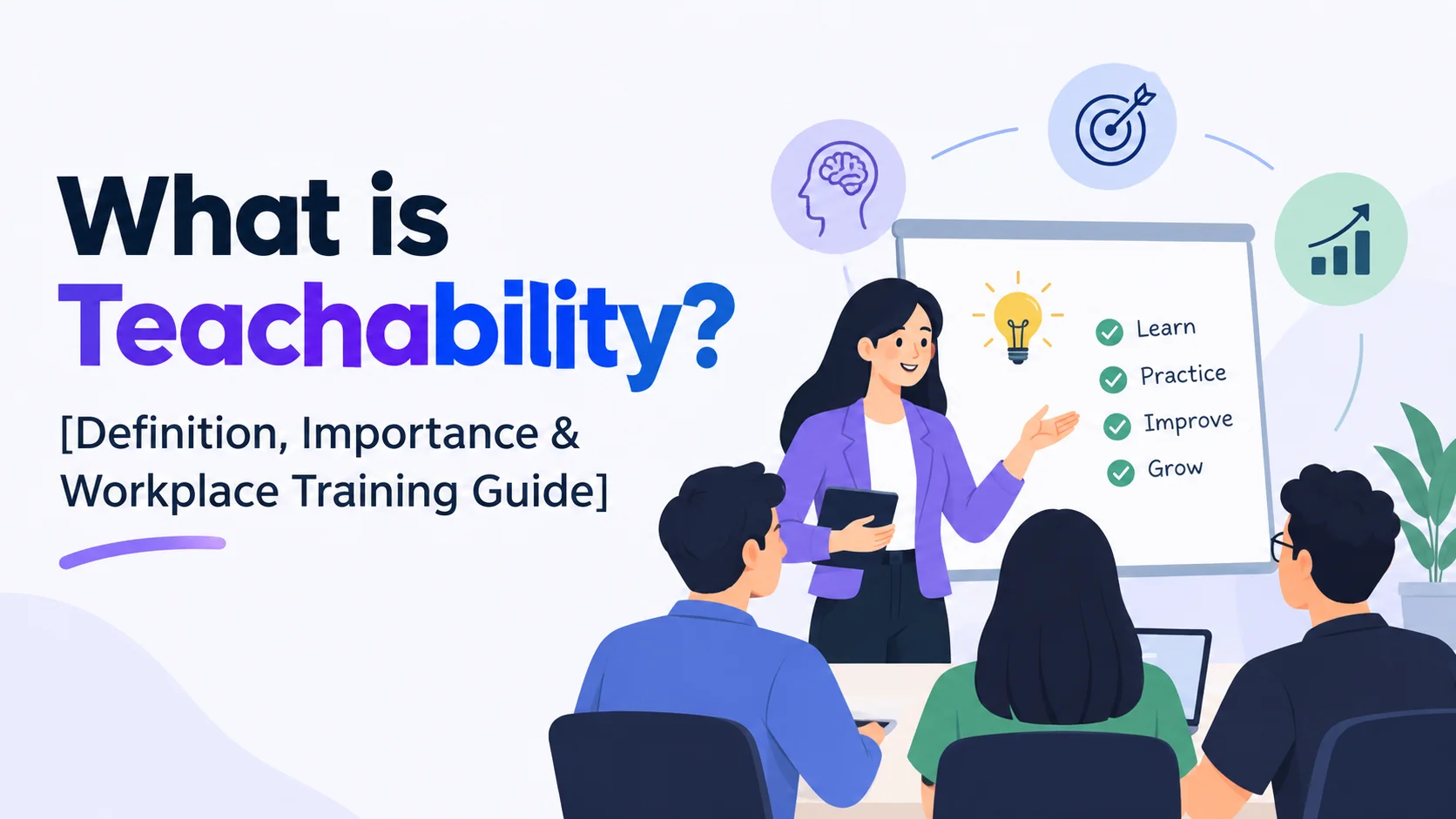
Table of Contents ▼
Quick Answer
This guide explains teachability, its five core dimensions, the difference between teachability and coachability, and practical ways organizations can assess and develop teachable employees.
Key Takeaways
- Teachability means being open to learning and feedback.
- It helps employees adapt to changing skills and technologies.
- Teachability includes humility, reflection, and action.
- Organizations can assess teachability through practical exercises.
- Training environments can help build a culture of continuous learning.
In an era where technology cycles, software tools, and business paradigms evolve at unprecedented speeds, what an individual knows today is far less important than how quickly they can unlearn outdated habits and master new competencies tomorrow. This vital cognitive and behavioral quality is known as teachability—and it has rapidly emerged as one of the most sought-after attributes by executive recruiters, human resource leaders, and instructional designers worldwide.
What is Teachability? (Direct Definition)
Teachability is the proactive willingness, intellectual humility, and cognitive capacity to receive constructive feedback, assimilate new information, unlearn obsolete methods, and rapidly translate new instruction into measurable behavioral change and improved workplace performance.
Teachability is fundamentally distinct from raw intelligence (IQ) or formal academic credentials. An individual can hold advanced degrees yet possess low teachability if they are defensive toward feedback, resistant to workflow changes, or closed to alternative problem-solving strategies. Conversely, a highly teachable team member actively seeks critique, views challenges as growth opportunities, and accelerates through learning curves with high resilience.
The 5 Core Dimensions of a Teachable Mindset
Psychologists, adult learning theorists, and corporate leadership coaches identify five key pillars that define genuine teachability:
1. Intellectual Humility
Teachable individuals acknowledge the boundaries of their knowledge. They recognize that prior successes do not guarantee mastery of future paradigms, creating space for authentic curiosity and continuous upskilling.
2. Feedback Receptivity
Rather than perceiving constructive criticism as a personal attack, teachable professionals treat performance evaluations, code reviews, and instructional audits as objective diagnostic data to refine their craft.
3. Unlearning Agility
In fast-moving industries like digital e-learning and software architecture, legacy best practices frequently become modern bottlenecks. Teachability requires discarding outdated habits to adopt modern standards without cognitive friction.
4. Active Reflection
True teachability is not passive obedience; it involves synthesizing new concepts, asking clarifying questions, and reflecting on how newly acquired principles apply to complex, ambiguous business problems.
5. Rapid Execution & Behavioral Change
The ultimate test of teachability is application. A teachable learner demonstrates measurable performance gains shortly after receiving guidance, turning conceptual advice into daily operational habits.
Teachability vs. Coachability vs. Intelligence
While often used interchangeably in workplace discussions, these three capabilities operate differently across employee development:
| Trait | Core Definition | Primary Driver | Observable Workplace Signal |
|---|---|---|---|
| Intelligence (IQ) | Capacity for logic, reasoning, and abstract thinking | Cognitive hardware | Solves analytical problems quickly; scores high on standard tests |
| Coachability | Openness to direct athletic or executive mentoring | Relationship & trust | Adapts strategy based on direct 1-on-1 feedback from a manager or coach |
| Teachability | Universal self-driven appetite for learning and self-correction | Internal growth mindset | Seeks diverse learning formats (microlearning, peer review, self-study) and updates workflows autonomously |
Why Modern L&D Teams Prioritize Teachability Over Experience
For decades, talent acquisition focused almost exclusively on prior years of experience. However, the rise of automated platforms, generative AI, and dynamic LMS ecosystems has exposed the limitations of static resumes.
Forward-thinking organizations now prioritize teachability for three decisive reasons:
- Shortened Half-Life of Technical Skills: According to the World Economic Forum Future of Jobs Report, core workplace skill requirements shift by nearly 50% every three to five years. Teachable employees adapt without extensive re-hiring cycles.
- Accelerated Cross-Functional Mobility: High teachability allows team members to pivot smoothly across roles—such as transitioning from classroom teaching to instructional design, or from customer support to LMS administration.
- Enhanced Training ROI: Instructional programs designed for teachable cohorts achieve significantly higher completion rates and lower post-training error frequencies. At TheEduAssist learning strategy consultancy, we design curriculum frameworks specifically tailored to adult learners across diverse corporate cultures.
You can also explore Learning Operations (Learning Ops) to understand how organizations can structure and scale workplace learning.
How to Assess Teachability in Job Interviews & Evaluations
Hiring managers can evaluate candidate teachability through behavioral inquiry and real-time performance exercises:
Behavioral Interview Questions for Teachability:
- “Describe a situation where you received unexpected critical feedback on a project you spent weeks developing. How did you process the critique, and what specific modifications did you execute?”
- “Tell me about a time when a methodology or tool you relied on became obsolete. How did you approach mastering the replacement?”
- “What is a complex subject you completely changed your mind about in the last two years as a result of new evidence?”
The “Teach-and-Test” Interview Simulation:
Provide candidates with a 15-minute briefing on a specialized company workflow or software tool (such as creating a module in a corporate LMS). Introduce a deliberate error or strategic optimization, provide constructive guidance, and ask them to revise their submission. The candidate’s response to your critique will reveal their real-time teachability far more accurately than a resume.
For organizations developing workplace learning programs, Best Learning Management Systems provides additional information about LMS platforms.
How Organizations Cultivate a Culture of Teachability
Teachability cannot thrive in an environment characterized by psychological fear or rigid blame cultures. To foster pervasive learning agility, corporate leaders should:
- Normalize Vulnerability: Executive leaders should openly share their own learning milestones, technical blind spots, and iterative mistakes.
- Provide Safe Sandbox Environments: Give learners space to experiment with new platforms, authoring tools, and project workflows without penalty.
- Implement Frictionless Microlearning: Deliver bite-sized, contextual learning assets at the exact point of workplace need. Explore our custom e-learning course development services to build engaging, modern training solutions.
For a deeper look at microlearning, see 5 Strong Benefits of Microlearning for Employee Training.
Frequently Asked Questions
What does teachability mean in simple words?
In simple words, teachability means being willing and able to learn from others, accept feedback without getting defensive, and change your behavior to get better at what you do.
Can someone learn how to be teachable?
Yes. Teachability is a behavioral discipline grounded in a growth mindset. By practicing active listening, detaching ego from professional feedback, and actively seeking out unfamiliar challenges, individuals can significantly strengthen their teachability over time.
How does teachability relate to instructional design?
In instructional design, acknowledging learner teachability ensures courses are constructed with empathy, low cognitive friction, and progressive scaffolding. When modules reward exploration rather than penalizing mistakes, learner engagement and retention surge.
For more on instructional design, explore Instructional Design in Action.
What is the opposite of teachability?
The opposite of teachability is intellectual rigidity, dogmatism, defensiveness, and complacency—believing one already knows everything necessary to succeed.
How can TheEduAssist help elevate training outcomes in my organization?
TheEduAssist partners with organizations, academies, and course creators to build high-impact digital learning environments, LMS platforms, and structured curricula that inspire learners and drive measurable results. Schedule a free 24–48 hour training consultation with our team today.
Sources & References
Frequently Asked Questions
QWhat does teachability mean in simple words?
In simple words, teachability means being willing and able to learn from others, accept feedback without getting defensive, and change your behavior to get better at what you do.
QCan someone learn how to be teachable?
Yes. Teachability is a behavioral discipline grounded in a growth mindset. By practicing active listening, detaching ego from professional feedback, and actively seeking out unfamiliar challenges, individuals can significantly strengthen their teachability over time.
QHow does teachability relate to instructional design?
In instructional design, acknowledging learner teachability ensures courses are constructed with empathy, low cognitive friction, and progressive scaffolding. When modules reward exploration rather than penalizing mistakes, learner engagement and retention surge. For more on instructional design, explore [Instructional Design in Action](https://www.theeduassist.com/blog/instructional-design-in-action-practical-solutions-for-learner-problems/).
QWhat is the opposite of teachability?
The opposite of teachability is intellectual rigidity, dogmatism, defensiveness, and complacency—believing one already knows everything necessary to succeed.
QHow can TheEduAssist help elevate training outcomes in my organization?
TheEduAssist partners with organizations, academies, and course creators to build high-impact digital learning environments, LMS platforms, and structured curricula that inspire learners and drive measurable results. [Schedule a free 24–48 hour training consultation](/book-free-audit/) with our team today.