
What’s Actually Better for Learners?
If you’ve been in L&D for more than five minutes, you’ve probably heard someone say “AI is going to replace instructional designers.” And if you’ve been around longer than that, you’ve probably heard the same thing said about eLearning, mobile learning, and every other wave of learning technology.
Here’s the honest truth: AI isn’t replacing good instructional design. It’s changing what good instructional design looks like.
But the real question, the one HR managers, L&D leads, and training directors are losing sleep over, is this: When it comes to actual learner outcomes, does AI-powered learning beat traditional instructional design, or are we just chasing shiny tool.
What Is Traditional Instructional Design?
Instructional design is the process of designing learning experiences . Traditional instructional design is a very structured process that is led by humans . It usually follows a proven framework that is something like ADDIE ( Analyse , Design , Develop , Implement , Evaluate ) or Bloom ‘s Taxonomy .
Traditional Instructional Design Characteristics:
- Content is developed in collaboration between Subject Matter Experts (SMEs) and Instructional Designers
- Courses are linear, learner moves Module 1, Module 2, Assessment
- One curriculum for every learner in a cohort
- Development cycles tend to be in the range of weeks to months
- Feedback is gathered after delivery and used to update the next version
It works. It has worked for decades. When done well, it produces consistent, reliable learning experiences. But “consistent” and “personalized” are not the same thing. And in 2026, learners expect both.
What Is AI-Powered Instructional Design?
AI-powered instructional design leverages machine learning, natural language processing, and data analytics to create, deliver, and continuously improve learning experiences, often in real time.
What AI does bring to the table:
- Adaptive learning paths that change depending on how a learner behaves, how fast they learn and how they perform
- Automated content generation, quizzes, summaries, and scenario-based questions created at scale
- Real-time analytics to see where learners disengage, get stuck or quit
- Personalised recommendations like how Netflix recommends your next watch
- 24/7 responses to learner queries from AI chat bots and virtual tutors
- Predictive insights that identify learners at risk of failing an assessment
AI vs. Traditional Learning: The Facts That Count
Enough with the theory, what does the data actually say?
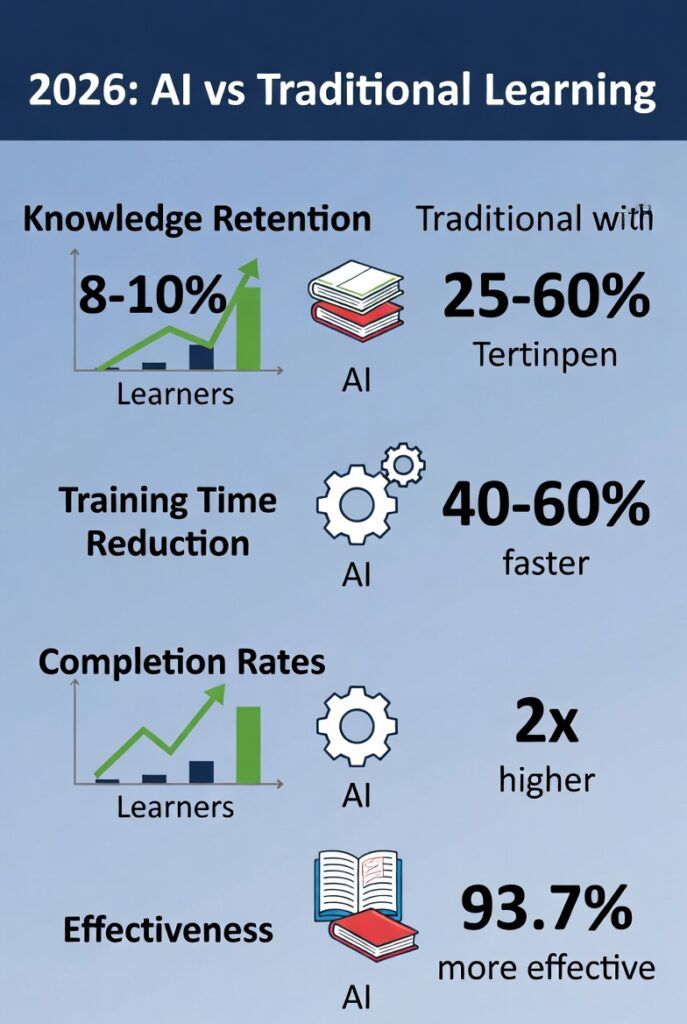
MetricTraditional LearningAI-Powered LearningKnowledge Retention8–10%25–60%Training TimeBaselineReduced by 40–60%Completion RateStandard2x higher with AI personalizationEmployee Retention Impact—57% higher at strong learning orgsEffectiveness vs. TraditionalBaseline93.7% more effective
Sources: Shift eLearning, ScienceDirect, Continu Corporate eLearning Statistics 2025
Those numbers are hard to ignore. But before you throw out your ADDIE framework and go all-in on AI, there’s a more nuanced story here.
Where Traditional Instructional Design Still Wins
AI is impressive. But it’s not the answer to everything. Here is where old school instructional design still matters:
- Complex soft skills training: Leadership development, conflict resolution, and empathy training require nuanced human judgment that AI-generated content often misses.
- Highly regulated industries: In healthcare, finance, and legal, compliance training must meet exact regulatory standards. Human oversight in the design process isn’t optional; it’s required.
- Deep cultural sensitivity: Content for diverse global audiences needs a human eye to catch tone, cultural nuance, and inclusivity gaps.
- First-time course builds: When a program is being designed from scratch with no historical data, AI has nothing to learn from. Traditional ID fills that gap.
- High-stakes simulations: Scenario-based learning for surgical procedures, crisis response, or complex machinery needs expert instructional design, not just generated content.
Where AI-Powered Learning Clearly Outperforms
AI-driven learning has clear, documented advantages in the following areas:
- Onboarding at scale: AI-powered platforms can deliver personalized onboarding paths to hundreds of employees simultaneously, without a single instructional designer staying late.
- Knowledge retention over time: AI enables spaced repetition, automatically re-surfacing content at the exact moment a learner is about to forget it. Traditional courses can’t do this without massive manual effort.
- Speed of development: AI tools can cut content development time by 40 to 60 percent. What used to take a 3-person team six weeks can now take one designer two weeks.
- Sales and product training: For fast-moving teams where product information changes every quarter, AI can update training content dynamically without waiting for the next redesign cycle.
- Identifying learning gaps in real time: Traditional assessments tell you what a learner didn’t know after the fact. AI analytics flag it while the course is running, so you can intervene before the learner gives up.
AI vs. Traditional Learning Methods: Full Pros and Cons
Traditional Instructional Design: Pros
- Proven frameworks (ADDIE, Bloom’s Taxonomy, SAM) with decades of evidence behind them
- Stronger for soft skills, leadership development, and emotionally complex content
- No dependency on historical data — works effectively from day one
- Full human control over tone, cultural sensitivity, and brand voice
- Best suited for highly regulated and compliance-heavy environments
Traditional Instructional Design: Cons
- Time-consuming to build and expensive to update
- One-size-fits-all delivery fails individual learner needs
- No real-time adaptation based on learner behavior or performance
- High cost per learner when scaling across large organizations
- Feedback loops are slow improvements happen version by version
AI-Powered Instructional Design: Pros
- Fully personalized learning paths for every individual learner
- Real-time analytics and adaptive content delivery built in
- Faster development cycles and lower long-term cost per learner
- Continuous improvement as the system learns from learner data
- Scales from 10 to 10,000 learners without proportional cost increases
- Proven to deliver 2x higher course completion rates through personalization
AI-Powered Instructional Design: Cons
- Requires sufficient learner data to personalize effectively, limited value at launch
- Upfront technology investment and LMS integration effort
- Risk of shallow engagement if AI is applied without a solid pedagogical strategy
- Can miss cultural nuance, emotional tone, and contextual complexity
- Compliance-heavy sectors still require additional human oversight
The Real Answer: It’s Not AI vs. Traditional It’s AI with Traditional
Here’s what the best L&D teams in the world have figured out: the winners aren’t choosing one or the other. They’re blending both intelligently.
The most effective learning programs in 2026 combine the two like this:
- Human instructional designers lead the strategy, learning objectives, and narrative structure
- AI tools accelerate content creation, generate assessments, and personalize delivery at scale
- Data analytics continuously feed insights back to the human designer for refinement
- Adaptive platforms adjust each learner’s path in real time based on their performance
- Human oversight ensures quality, brand voice, and cultural accuracy throughout
Think of it like GPS navigation. A human still decides where they want to go. GPS just makes the route smarter, faster, and responsive to real-time conditions. You wouldn’t trust GPS to choose your destination, but you’d be crazy to drive across a new city without it.
Which Approach Is Right for Your Organization?
Ask yourself these questions before committing to a direction:
Go AI-First if:
- You’re scaling training to hundreds or thousands of employees
- Your content updates frequently, product training, compliance refreshers, sales enablement
- You have learner data available to feed personalization algorithms
- Completion rates and learner engagement are a current challenge
- Long-term budget efficiency and scalability are a priority
Stick with Traditional Instructional Design if:
- You’re building leadership development or soft skills programs
- Your training operates in a highly regulated industry
- You’re designing for a culturally complex or globally diverse audience
- This is a first-time program with no existing learner data to work from
- Your subject matter requires deep emotional intelligence and contextual nuance
Blend Both if:
- You want the strongest learner outcomes possible, and that means almost always
What This Means for L&D Professionals
Many instructional designers worry that AI will eliminate their roles. The evidence points in the opposite direction.
Research shows AI is shifting instructional design careers toward higher-value, more strategic work, learning analytics, AI integration strategy, adaptive learning architecture, and learner experience design. The profession isn’t disappearing; it’s upgrading.
The instructional designers who will struggle are those who refuse to engage with AI tools. The ones who will thrive are those who use AI to do more, faster, and with better data behind every decision.
Emerging roles in the field include:
- AI Learning Experience Designer: developing adaptive learning journeys using AI algorithms
- Instructional Data Analyst: interpreting educational data to continuously improve course outcomes
- Learning Technology Strategist: leading AI tool selection, integration, and governance
Final Verdict: What’s Actually Better for Learners?
Let’s be direct.
- For knowledge retention, personalization, scalability, and completion rates, AI-powered learning wins, and the data is not close.
- For depth of understanding, soft skills, cultural nuance, and high-stakes scenarios, human-led instructional design is still essential.
- For the best possible outcome for real learners in real organizations, you need both working together, with clear roles for each.
The organizations getting this right aren’t asking “AI or traditional?” They’re asking “How do we use AI to make our instructional design better?” That is the question worth answering in 2026.
Ready to Build Smarter Learning Experiences?
Whether you’re starting from scratch, migrating to an AI-powered LMS, or trying to make your existing training actually stick — the approach matters as much as the technology.
TheEduAssist specializes in custom eLearning development, LMS integration, AI-powered adaptive learning, and corporate training programs that deliver measurable results. Explore their solutions at: https://theeduassist.com
Frequently Asked Questions (FAQs)
What are the best AI-powered instructional design tools for corporate training?
The best AI-powered tools for corporate training include ChatGPT and Claude for content writing, Articulate AI and iSpring AI for course authoring, and Synthesia for video production, each serving a specific step in the course design process. However, they emphasize that AI alone isn’t enough, strong instructional design and human oversight are still essential to ensure quality, learner engagement, and real learning outcomes.
AI instructional design vs traditional methods: which is more cost-effective?
AI tools significantly reduce production time and cost by automating content drafting, quiz creation, and course structuring, making them far more cost-effective at scale than traditional methods. However, the upfront investment in AI platforms and integration means traditional ID can still win for small, one-time training builds with limited learner volume.
Which instructional design approach is better for remote learning programs?
AI-powered instructional design is a better choice for remote learning. Platforms like 360Learning provide collaborative tools, AI-driven recommendations, and analytics that help distributed teams stay engaged and on track. Traditional methods have difficulty scaling for remote learning because they cannot change content delivery in real time based on how individual learners behave.
What instructional design solution should I choose for onboarding new employees?
AI-powered solutions with custom eLearning content development are perfect for onboarding. They enable organizations to create structured, scalable, and outcome-focused training that new hires can access anytime on any device. For onboarding that is complex or culture-focused, combining AI delivery with human-designed narratives and scenario-based content produces the best results.
How Much Does AI Training Software Actually Cost?
AI training software varies widely. There are free versions available through tools like ChatGPT and Canva, while enterprise LMS platforms can cost between $5 and $50+ per user per month, depending on features and scale. The real cost benefit appears in the long run. AI tools can cut content development time by 40 to 60 percent, so the investment pays off quickly when training is delivered to large groups of employees.
Final Thoughts
The debate around AI vs. traditional instructional design is, in many ways, a false choice. The real conversation should be about how to use both intelligentl, letting human designers do what they do best while AI handles what it does best.
Traditional instructional design brings the strategy, empathy, and pedagogical depth that no algorithm can fully replicate. AI brings the scale, speed, personalization, and real-time intelligence that no human team can match alone.
Together, they represent the most powerful learning model available to organizations in 2026. The companies that figure this out early will have a measurable advantage in developing talent, retaining employees, and building the skills their business needs to grow.
The learner wins when both are used well. That’s what actually matters.
References
The following sources were used in the research and development of this article:
- Corporate eLearning Statistics 2025 https://www.continu.com/research/corporate-elearning-statistics
- Employee Training Statistics and Trends 2025 https://murf.ai/blog/employee-training-statistics
- How AI Is Shaping the Future of Corporate Training in 2025 https://trainingindustry.com/articles/artificial-intelligence/how-ai-is-shaping-the-future-of-corporate-training-in-2025/
- AI, Automation, and the Future of Instructional Design Careers 2026 https://research.com/advice/ai-automation-and-the-future-of-instructional-design-degree-careers
- Employee Training Statistics 2026 https://www.chanty.com/blog/employee-training-statistics/
- Training Retention Statistics 2026 https://worldmetrics.org/training-retention-statistics/
- AI-Integrated Instructional Design in Higher Education https://citejournal.org/volume-25/issue-4-25/general/ai-integrated-instructional-design-in-higher-education
- eLearning Retention and Engagement Research https://www.shiftelearning.com
Authorized By
Hifza Naeem