
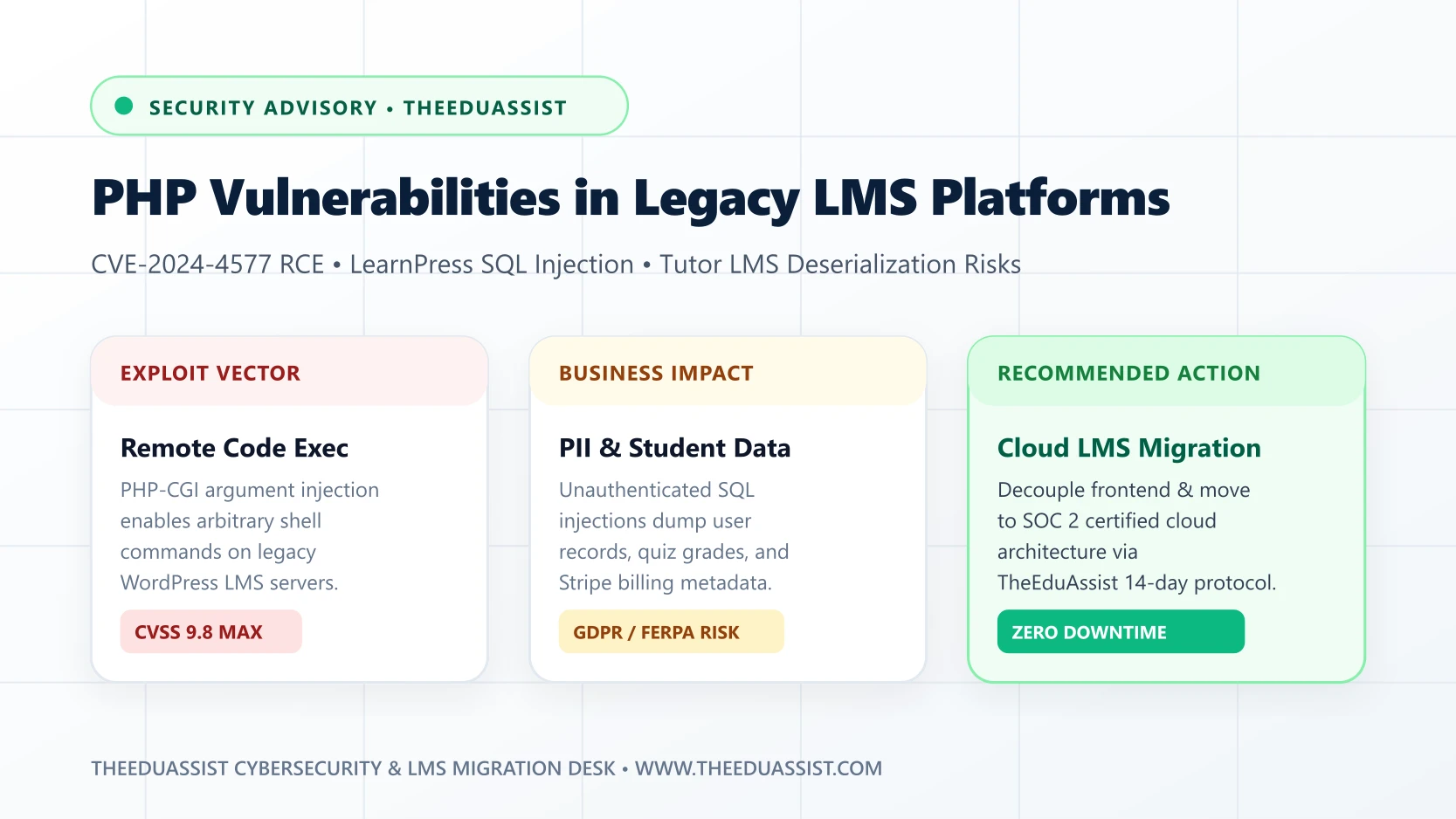
WILMINGTON, Del. & LONDON — October 26, 2026 — TheEduAssist, a global leader in enterprise learning architecture and digital education design, has formally published an emergency threat advisory regarding active exploit campaigns targeting self-hosted learning management systems.
With the discovery and weaponization of maximum-severity vulnerabilities including CVE-2024-4577 (PHP CGI Argument Injection RCE, CVSS 9.8), LearnPress REST API SQL Injections (CVE-2024-8529, CVSS 9.8), and Tutor LMS Object Injection deserialization chains, self-hosted WordPress LMS platforms face unprecedented exposure to total server takeovers, learner database theft, and catastrophic compliance liabilities.
"An LMS is fundamentally different from a corporate marketing website. It is an active repository of human identity, student payment tokens, proprietary video courseware, and statutory compliance certifications. Continuing to run an enterprise academy or high-ticket coaching business on an aging PHP monolith with 40 to 60 unhardened third-party plugins is an untenable liability. Automated botnets are weaponizing these flaws within hours of disclosure, and standard web application firewalls cannot fix underlying relational database architecture flaws."
Summary of Critical Threat Vectors
TheEduAssist's threat research team has identified four primary attack vectors currently being exploited against WordPress LMS platforms:
CVE-2024-4577: PHP CGI Remote Code Execution
Vector: Improper character encoding normalization (Best-Fit mapping) on Windows/Apache servers.
Impact: Unauthenticated attackers execute arbitrary system commands, drop persistent web shells, and seize host root privileges.
LearnPress REST API SQL Injections (CVE-2024-8529 & CVE-2024-8522)
Vector: Unsanitized user inputs in `/courses/archive-course` REST API endpoints.
Impact: Complete dumping of `wp_users`, customer billing tokens, and student email databases without prior authentication.
Tutor LMS PHP Object Injection & Deserialization Flaws
Vector: Untrusted input deserialization in AJAX course handlers and POP gadget chain exploitation.
Impact: Administrative privilege escalation, arbitrary gradebook alterations, and fraudulent certificate issuance.
Polyfill.io Supply Chain Learner Redirection
Vector: Compromised third-party CDN JavaScript dependencies loaded in legacy WordPress LMS themes.
Impact: Stealth redirection of students to phishing and credential-harvesting portals during course checkout.
Activation of the 14-Day Rapid Cloud Migration Protocol
In direct response to this escalating threat environment, TheEduAssist has activated its expedited 14-Day Rapid Cloud LMS Migration Protocol.
This specialized service enables organizations operating on vulnerable self-hosted platforms (including LearnDash, Tutor LMS, LearnPress, LifterLMS, and WooCommerce) to transition their entire e-learning operations to certified, high-performance cloud environments—such as LearnWorlds or custom decoupled Headless LMS architectures—with:
- Zero Learner Disruption: Existing students retain their passwords, ongoing lesson bookmarks, quiz attempts, and certificates.
- Uninterrupted Recurring Revenue: Direct mapping and reconciliation of existing Stripe Customer and Subscription IDs ensures active memberships are never dropped or re-billed.
- Enterprise Compliance Isolation: Modern cloud infrastructure eliminates self-hosted PHP runtimes entirely, achieving SOC 2 Type II, ISO 27001, and GDPR compliance out-of-the-box.
- Sub-500ms Global Edge Performance: Video and courseware are served through global Content Delivery Networks with adaptive bitrate streaming and multi-DRM content protection.
- Comprehensive 301 SEO Redirection: 1:1 path mapping preserves hard-earned Google search rankings and backlink equity.
Immediate Recommended Actions for Course Creators & IT Directors
- Audit Server Runtimes: Immediately verify whether your server runs PHP in CGI/FastCGI mode on Windows or unpatched Apache web servers. Patch PHP to versions 8.1.29, 8.2.20, or 8.3.8 or higher.
- Audit Plugin REST Endpoints: Check if LearnPress (prior to 4.2.7) or Tutor LMS plugins contain unpatched REST endpoints accessible to unauthenticated callers.
- Inspect Script Tags for Supply Chain Links: Search themes and header files for references to compromised third-party domains (such as
polyfill.io). - Schedule an Architecture Consultation: Engage TheEduAssist’s LMS Migration Practice to evaluate your platform's exposure and initiate a zero-downtime transition to hardened cloud infrastructure.
In-Depth Security Analysis & Technical Blueprint Guides
Explore our newly published comprehensive research papers on PHP LMS security and cloud architecture transitions:
About TheEduAssist
TheEduAssist is an elite global digital learning architecture and instructional design consultancy. Serving corporate L&D departments, public municipal infrastructure authorities, universities, and high-growth knowledge commerce creators, TheEduAssist engineers audit-ready, scalable, and secure learning ecosystems. As an official certified solution partner of leading cloud platforms including LearnWorlds, TheEduAssist specializes in zero-downtime LMS migrations, WCAG 2.2 accessible course design, and custom learning applications.
Media & Cybersecurity Desk Contact:
Editorial & Intelligence Bureau
Email: info@theeduassist.com
Website: www.theeduassist.com
Concerned About Your LMS Security?
Request an immediate, confidential LMS Security & Vulnerability Assessment from TheEduAssist's senior architecture team.