Internal Academy Software: 15 Must Have Features in 2026
Discover the 15 must-have features of internal academy software in 2026 and learn how businesses can improve employee training, engagement, and professional development.
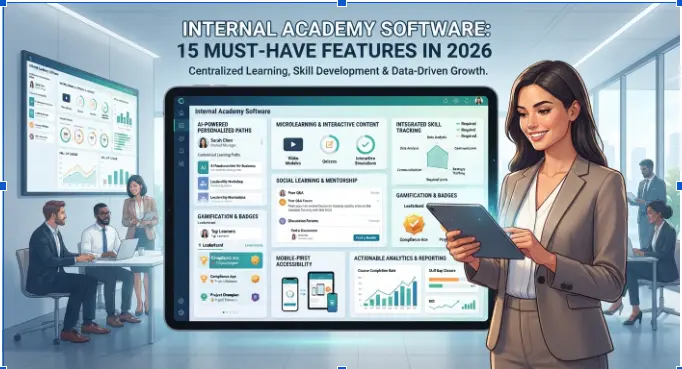
Table of Contents ▼
Quick Answer
This article explores 15 essential features of internal academy software in 2026, including personalized learning, progress tracking, interactive content, analytics, and integrations. It explains how these features help organizations streamline employee training, enhance learning experiences, and support continuous professional development.
Internal Academy Software: 15 Must-Have Features in 2026
Training has changed a lot in the past few years. Companies no longer want scattered spreadsheets or random PDFs sitting in shared folders. Instead, they want one central place where employees can learn, grow, and track progress. That is exactly why internal academy software has become such a hot topic in 2026.
If you are searching for the right platform for your team, you are probably wondering what actually makes a tool worth the investment. This guide walks through the fifteen features that matter most this year. We will also look at how businesses in the USA are using these tools to close skill gaps and boost retention.
Let us get into it.
Why Internal Academy Software Matters More Than Ever
Employees today expect more than a one-time onboarding session. They want ongoing learning that fits their pace and their goals. On the other hand, employers need a way to measure whether training actually works. This is where internal academy software steps in. It gives both sides what they need. Employees get structured growth. Employers get visibility and data.
Before we dive into the features, it helps to understand the bigger picture. Some companies still debate whether they need a learning experience platform or a traditional learning management system. If that question sounds familiar, this comparison of an LXP versus an LMS is worth a read before you continue.
Now, here are the fifteen features your internal academy software should have this year.
1. Personalised Learning Paths
A good academy platform should never feel like a one-size-fits-all classroom. Instead, it should build a path around each employee. For example, a new hire in sales should not see the same modules as a senior engineer. Learning paths let managers assign relevant courses based on role, department, or career goal.
As a result, employees stay engaged because the content actually applies to their job. This also saves time since nobody wastes hours on training that does not matter to them.
2. Skills Tracking
Skills tracking has quickly become one of the most requested features in 2026. Companies want to know exactly what their workforce can do right now, not just what courses they completed. A strong system tracks skill levels over time and flags gaps before they become a problem.
Many teams are also comparing skills-based learning against older training models. If you want a deeper look at this shift, check out this article on skills-based learning versus traditional training. It explains why so many organizations are moving away from checkbox-style courses.
3. AI-Powered Recommendations
Artificial intelligence is no longer a nice extra. It is quickly becoming the backbone of internal academy software. A platform with AI recommendations studies what an employee has already learned and suggests the next best course. This works similarly to how streaming apps suggest shows based on viewing history.
Because of this, employees spend less time searching for what to learn next. The system does the thinking for them, which keeps momentum going.
4. Analytics Dashboards
Numbers tell a story that opinions cannot. That is why analytics dashboards are a must-have feature. Managers need to see completion rates, quiz scores, and engagement trends at a glance. Without this data, it is nearly impossible to prove that training is worth the budget.
If you are trying to justify your training spend to leadership, it also helps to measure actual return on investment. This guide on corporate training ROI and measuring learning effectiveness breaks down how to calculate that number clearly.
5. Certifications and Badges
Certifications give employees something tangible to show for their effort. In fact, many workers say they feel more motivated when they can earn a badge or certificate at the end of a course. This small reward system taps into basic human psychology and keeps learners coming back.
Furthermore, certifications matter for compliance-heavy industries such as healthcare and finance. Auditors often want proof that staff completed required training, and a digital certificate makes that proof easy to produce.
6. Mobile Learning
Not every employee sits behind a desk all day. Warehouse staff, field technicians, and remote workers often rely on their phones. Therefore, internal academy software needs a strong mobile experience. Courses should load quickly, work offline when needed, and look just as good on a small screen as they do on a laptop.
Mobile learning also fits naturally into busy schedules. A ten-minute lesson during a lunch break is often more realistic than a full hour at a desktop.
7. Seamless Integrations
No platform works well in isolation. Your academy software needs to talk to your HR system, your CRM, and other tools your team already uses daily. Otherwise, you end up with duplicate data entry and frustrated administrators.
This is one of the biggest pain points companies face, and it deserves its own deep dive. This complete guide on LMS integration with HRIS, CRM, and collaboration tools explains exactly what to look for before you sign a contract.
8. Social Learning Features
Learning does not have to be a solo activity. Discussion boards, peer reviews, and group projects add a social layer that keeps people engaged. Employees often learn just as much from each other as they do from formal courses.
Additionally, social learning builds a sense of community, especially for remote teams that rarely see each other in person. If you want practical ideas on boosting participation, this resource on increasing LMS user adoption and employee engagement offers fifteen proven tactics.
9. Gamification
Points, leaderboards, and streaks might sound simple, but they work. Gamification adds a layer of friendly competition that pushes learners to finish what they started. Many platforms in 2026 now include customizable gamification rules so companies can match rewards to their own culture.
Consequently, completion rates tend to rise once gamification is introduced, especially among younger employees who grew up with video games and apps.
10. Easy Content Authoring Tools
Not every company has a team of instructional designers. Because of this, internal academy software should include simple tools for building courses without heavy technical skill. Drag-and-drop editors, templates, and quiz builders make it possible for any manager to create quality training material.
If your team still relies on SCORM-based content, it helps to understand the format better. This guide on how to create a SCORM course without coding is a great starting point for beginners.
11. Compliance Tracking
For industries like finance, healthcare, and manufacturing, compliance is not optional. Missing a required training deadline can lead to fines or worse. A solid academy platform automatically tracks deadlines, sends reminders, and generates reports for auditors.
This feature alone can save HR teams countless hours of manual follow-up every quarter.
12. Personalised Dashboards for Employees
Just like managers need visibility, employees benefit from their own personal dashboard. A clear view of upcoming courses, deadlines, and progress keeps learners organized. When people know exactly where they stand, they are far more likely to stay on track.
13. Multi-Language Support
Companies in the USA increasingly operate across borders or hire globally distributed teams. Because of this, multi-language support has become essential rather than optional. A platform that only speaks English limits who can actually benefit from your training program.
Offering courses in multiple languages also shows employees that the company values inclusion, which tends to improve morale.
14. Video-Based Microlearning
Attention spans are shorter than ever. Long training videos often get skipped or watched at double speed without real focus. Microlearning breaks lessons into short video clips, usually under five minutes, which fit naturally into a busy workday.
This format also pairs well with mobile learning, since short videos load faster and are easier to watch on the go.
15. Feedback and Assessment Tools
Finally, no academy platform is complete without strong assessment tools. Quizzes, surveys, and open feedback forms help confirm that learning actually happened. They also give the organization a way to improve courses over time based on real employee input.
Speaking of data-driven improvement, many advanced platforms now rely on learning record stores to capture detailed data across every interaction. If you want to understand how this technology works, this guide on xAPI learning record stores covers everything you need to know in 2026. It also pairs well with this comparison of xAPI versus SCORM if you are choosing a data standard for your platform.
Choosing the Right Internal Academy Software in 2026
With so many options on the market, picking the right platform can feel overwhelming. However, if you focus on the fifteen features above, you will have a strong checklist to guide your decision. Start by identifying your biggest pain point. Is it low engagement? Poor visibility into skills? Weak reporting? Once you know your priority, it becomes much easier to compare vendors.
Companies across the USA are already shifting budgets toward internal academy software because the return on investment is measurable and clear. Employees stay longer, skills improve faster, and managers finally get the data they need to make smart decisions.
Final Thoughts
Internal academy software is no longer a luxury reserved for large enterprises. Small and mid-sized companies are adopting these platforms too, and the features listed above are quickly becoming the standard rather than the exception. If your current system is missing several of these capabilities, it may be time for an upgrade.
Take your time, compare a few platforms, and choose one that fits your team’s real needs rather than just the flashiest marketing page.